Organic
 Call Kai
 Learn
Learn Practice Test
 Spaced Repetition
 Match
Match Flashcards
 Knowt Play
1/105

There's no tags or description
Looks like no tags are added yet.
Name | Mastery | Learn | Test | Matching | Spaced | Call with Kai | Chat |
|---|
No analytics yet
Send a link to your students to track their progress
106 Terms
C:H about 1:1
at least 6 C atoms
Benzene ring
Rotate plane of polarised light, Optical Isomer
Chiral carbon
No plane of symmetry
cis-trans isomer
C=C
at least 2 diff grps attached to each C
React with hot acid (H2SO4)
to form 2 organic products
Contains ester or amide
react with HNO3 via ES
phenol
react w hot acid
oxygen gone
OH → C=C
React with acid to form a salt (rtp)
Neutralisation
Amine of Amino acid
soluble in acid
basic group
acidified with dilute acid
COO-, CN,
forms COOH
reacts with NaOH in ethanol
contains RX
product becomes C=C
reacts with hot NaOH
RX
product becomes alc
reacts with hot NaOH to form 2 organic products
ester or amide
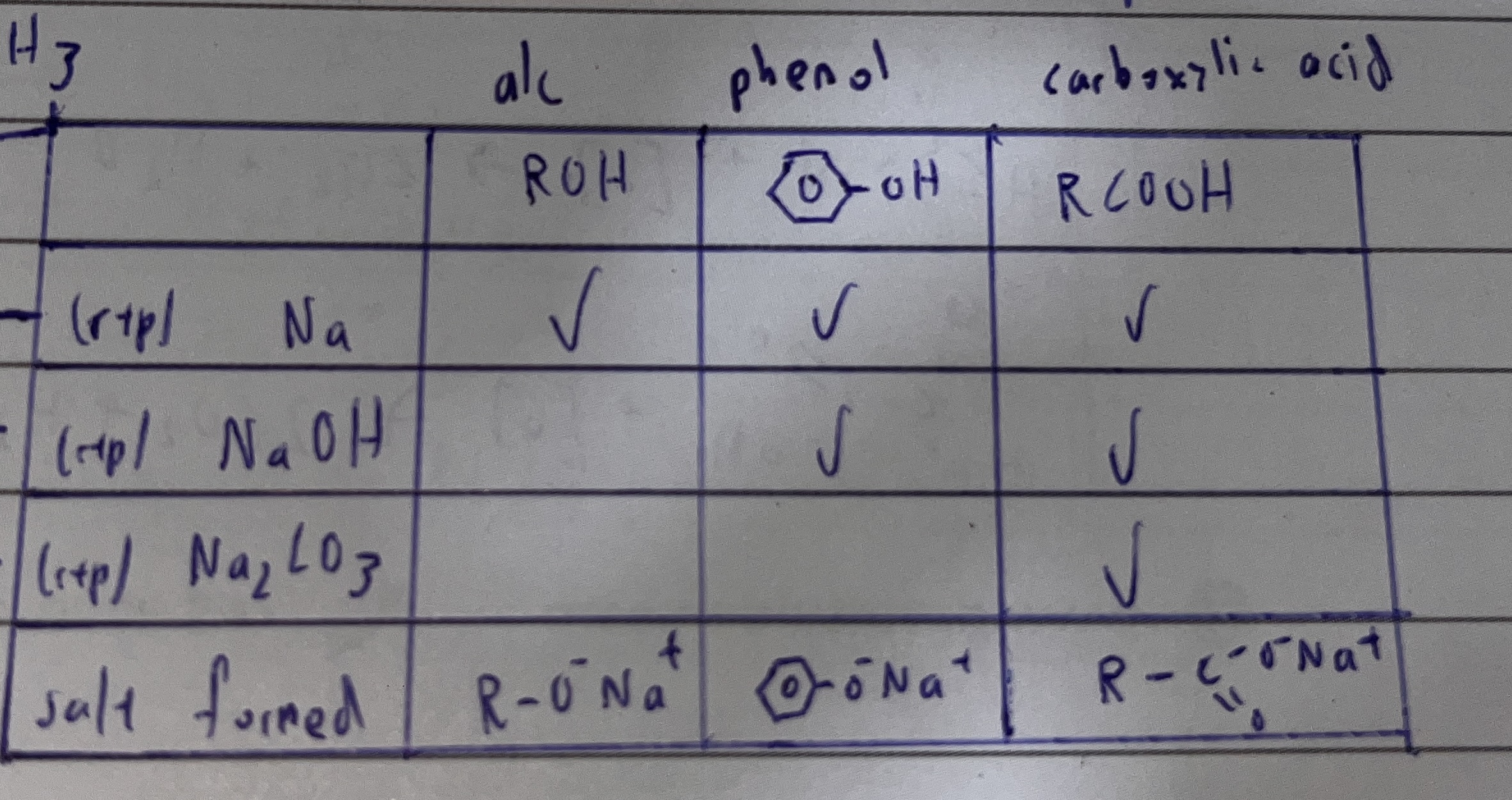
COOH > PHENOL > OH
reactions w Na, NaOH, Na2Co3
React with NaOH, I2, warm
OXIDATION
2• alc (1R grp, 1CH3)
ketone containing CH3
COOH oxidised⁉
HCOOH OR (COOH)2
form CO2
reacted w 2,4-dinitrophenylhydrazine
carbonyl
react with PCL5, PBr3, PI3
OH or COOH
hydrolysis of amide vs ester
amide→basic (acidic forms nh4)
ester→acidic (basic forms coo-)
react w tollens, forming silver mirror
aldehyde
react w fehlings, forming reddish-brown ppt
aliphatic aldehyde
decolourises hot, acidified KMnO4
C=C, 1/2• alc grp, aldehyde
decolourises cold, alkaline KMnO4
C=C
decolourises X2 in UV light
FRS
decolourises X2 in CCl4
C=C
decolourises X2 with FeX3
benzene ring
react with alcoholic NH3
RX or amine
react with H2O to form an acid and white fumes
acyl Cl
undergo reduction w LiAlH4 in dry ether
COOH, aldehyde, ketone, CN
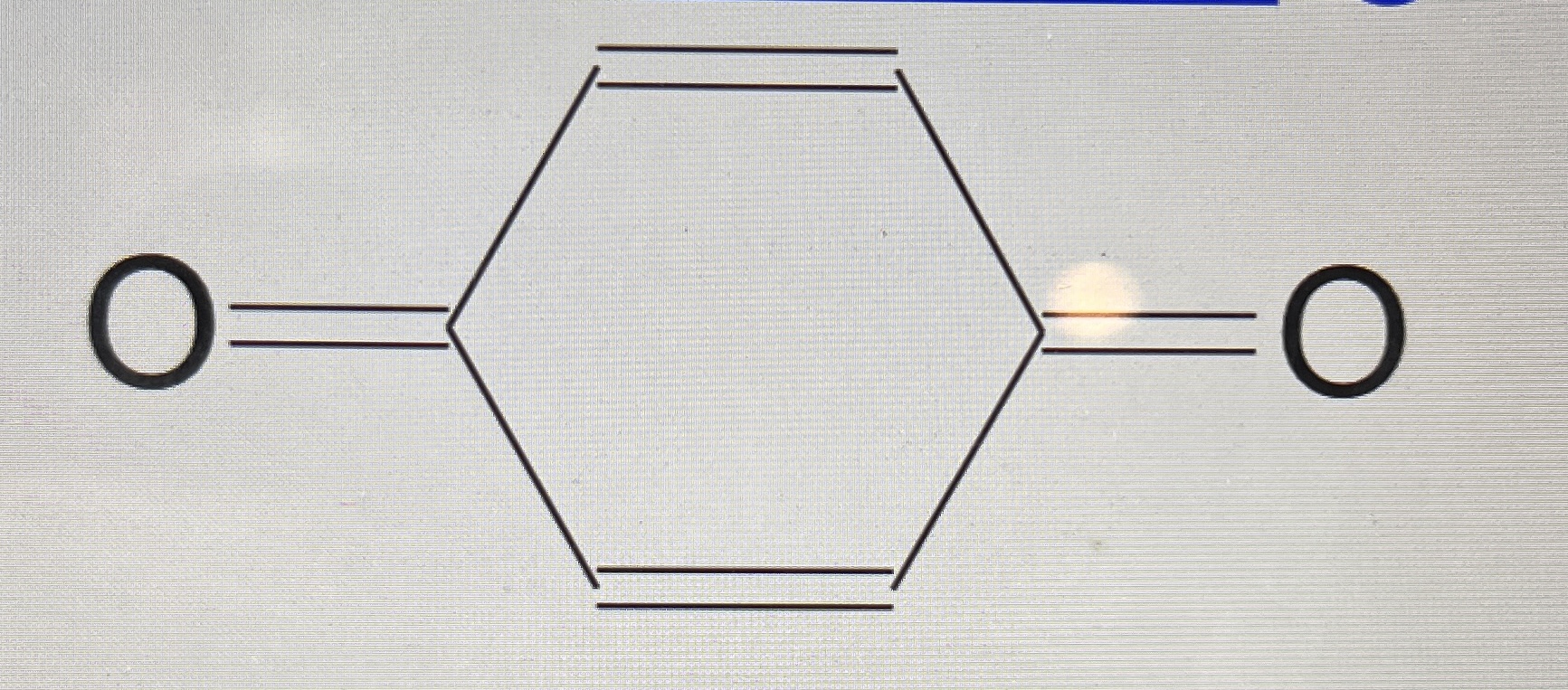
only 1,2 and 1,4 phenol can oxidise
become this
COOH + PCL5
BECOME ACYL CL
nitrogen cmpnd + Sn + HCL
REDUCTION
NO2 → NH2
benzene can react w X2 alone
got ED grp attached
long chain R on benzene + hot acidified KMnO4
R grp becomes COOH
long chain R grp (OH at tip) on benzene
+ acidfied hot K2Cr2O7
only the tip become COOH
R-X to R-CN
KCN in ethanol, heat
R-CN to R-COOH/R-COO- + NH3/NH4+
Acidic Hydrolysis (H2SO4), heat
OR
Basic Hydrolysis (NaOH), heat
RCN to RCH2NH2
Reduction
LiAlH4 in dry ether
R-X to R-OH
NaOH, heat under reflux
RX to C=C
NaOH in ethanol, heat
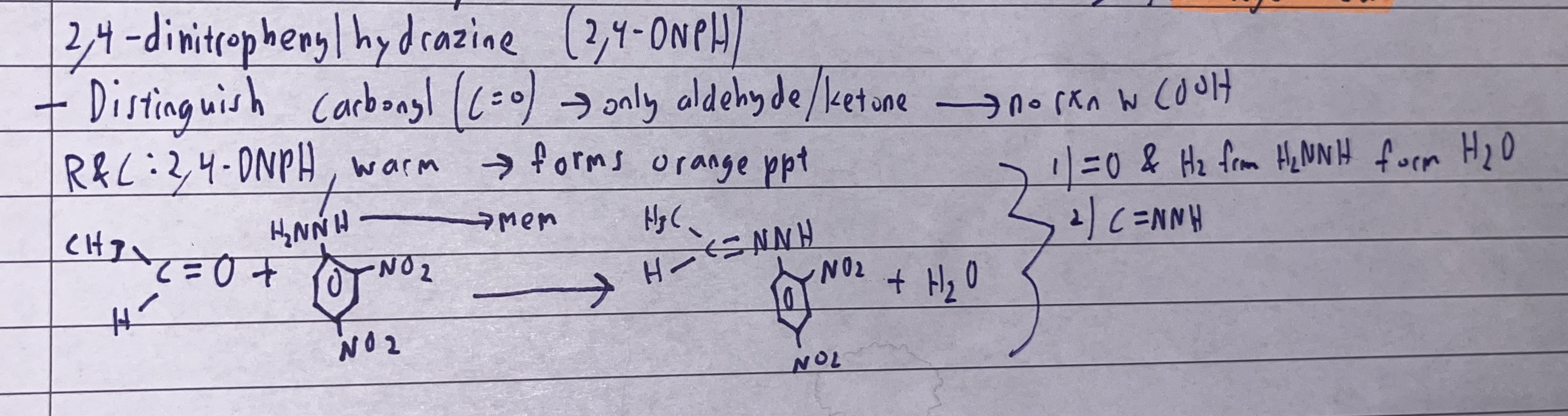
How to test for carbonyl (C=O)
2,4-dinitrophenylhydrazine, warm
forms orange ppt
add CN to carbonyl
Nucleophilic Addition
HCN, in presence of NaCN
Test for CH3 on ketone or 2• alc
I2, NaOH, warm
forms yellow ppt CHI3
Replace CH3 with O- Na+
Fehling
Test for aliphatic aldehyde
Reddish-brown ppt formed
Tollen
Test for any aldehyde
Silver mirror formed
Reduction of OH
Na rtp
OH bcm O- Na+
Esterification
COOH → H2SO4 catalyst, heat
Acyl Cl → rtp
1• alc oxidation
OH → K2Cr2O7, H2SO4, heat with immediate distillation → Aldehyde (1R grp)
OH → KMnO4, H2SO4, heat under reflux → COOH
2• alc
OH → any OA → ketone
OH to C=C
Elimination
Excess conc H2SO4, heat under reflux
Major product of OH to C=C
Most R grps
C=C is e- rich, more ED grps → better resonance → more stable
OH → Cl
PCl5, heat
OH to Br
PBr3, heat
OH to I
PI3, heat under reflux
Benzene → 1NO2
conc HNO3, conc H2SO4
if got R grp (ED) → rtp (eg Phenol)
Phenol → 3NO2
conc HNO3 at rtp
Benzene to 1X
X2 + AlX3
Phenol → 3Br
Br2
Benzene to 1R grp
RX + AlX3
Electrophilic Substituition
Generate Electrophile
Electrophilic attack of Benzene Ring
Form carbocation intermediate (X thing)
Loss of H
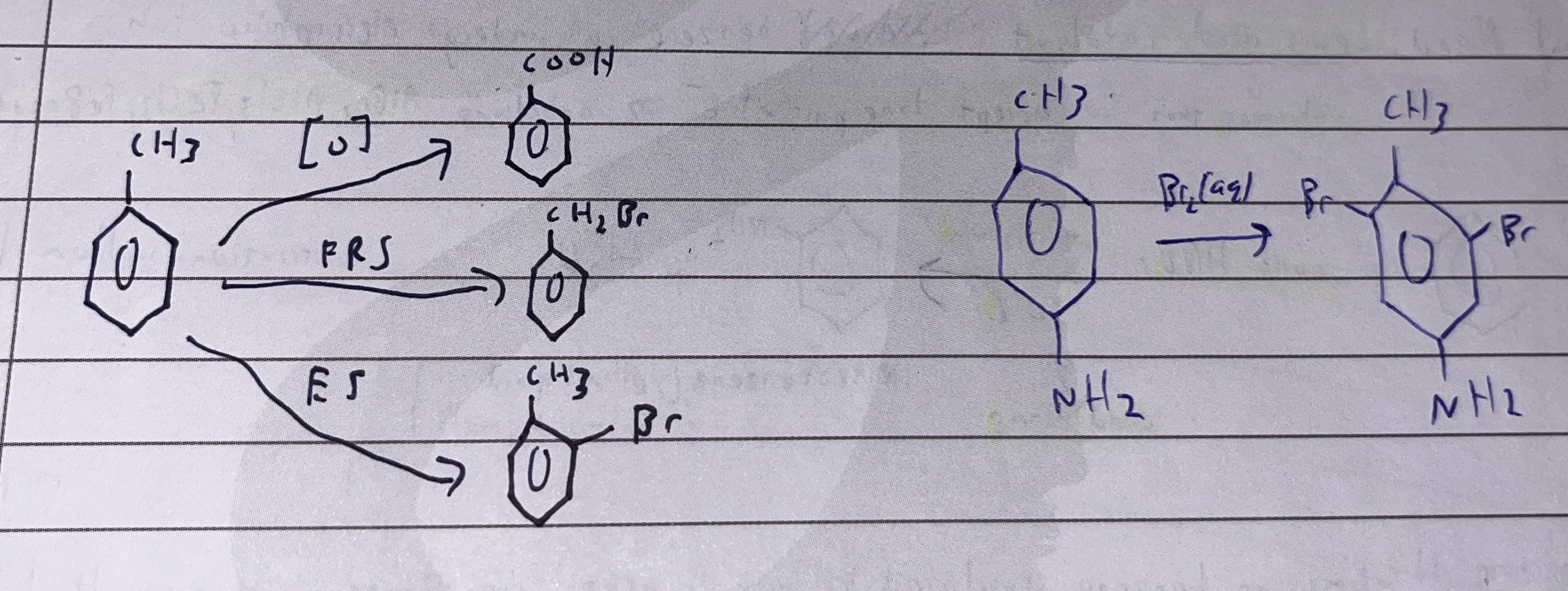
Methyl Benzene (any alkane/alkene attached)
OXIDATION
Form COOH on Benzene
+ H2O + xCO2(for long chain of alkane/alkene)
Reactions of Methyl Benzene
Alkane undergo what
FRS
X2, UV light
Ratio of Halogenoalkane formed
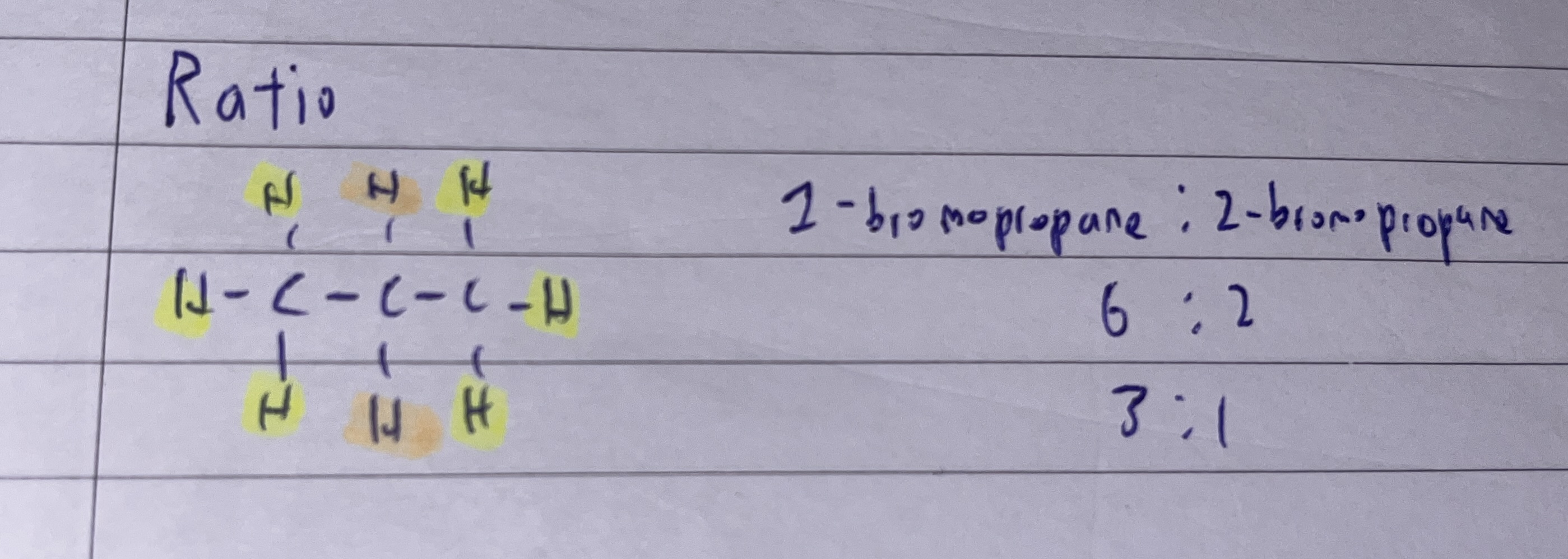
C=C mild oxidation become C-C
KMnO4, NaOH/H2SO4, cold
add 1OH to each C
Strong Oxidation C=C → C=O
Oxidative Cleavage
KMnO4, NaOH/H2SO4, heat
H attached to C become OH
H2C=O become CO2/CO3²- + H2O
Alkene → Alkane
H2, Ni
C=C → 2X
X2 in CCl4, in the dark
X added to each C
C=C → OH
steam(H2O(g)), conc H2SO4
OH on one C, H on other C
C=C → 1X
HX
X added to 1 C, H added to other C
Form highest degree carbocation
Higher degree → Most R grps (ED)
MEANS Higher dispersion of +ve charge
MEANS More stable
Test for Alkenes
Br2 in CCl4
Strong/Cold Oxidation
Test Phenol
neutral FeCl3
Br2
Distinguish Between RX
add AgNO3
fastest{ AgI, AgBr, AgCl }slowest
explain using (orbital overlap)
Added 1C to RX
KCN in ethanol
Added 1C to a carbonyl
HCN in KCN
CN to COOH
dilute H2SO4 heat
CN to amine
LiAlH4 in dry ether to CN
increase >1C
CONDENSATION
Acyl Cl + Phenol
Phenolic Ester
COOH + OH
ester
acyl Cl + amine
amide
Decrease in C
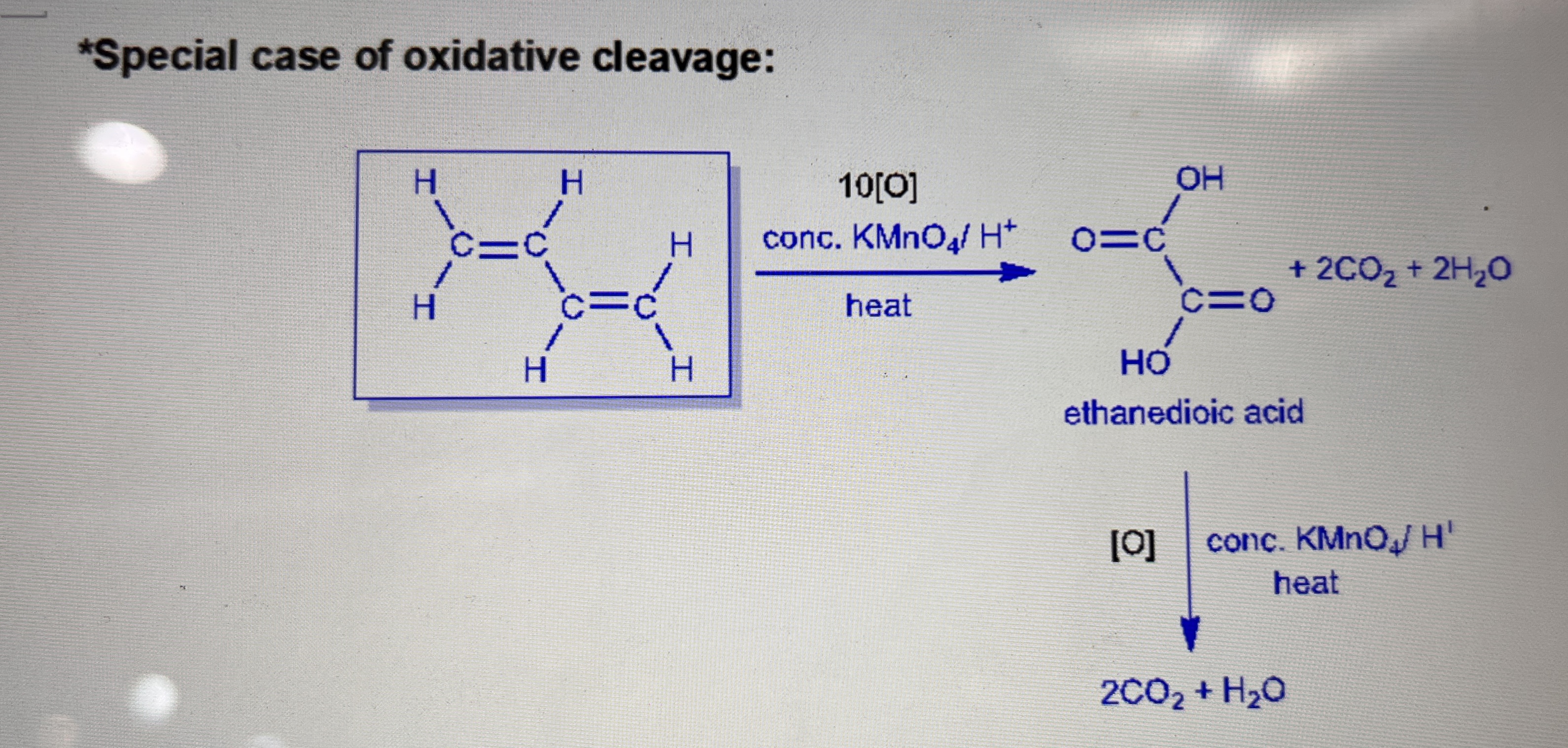
Strong Oxidation of C=C
Special Case
Oxidative Cleavage
RBr to RCl
Become Alc first
RBr + NaOH → ROH
ROH + PCl5 → RCl
RX to RNH2
NH3 in ethanol
Change in position of X
R-X to C=C first
NaOH in ethanol
Acyl Cl + H2, Pd, BaSO4
Aldehyde
Partial Reduction
Acyl Cl → Aldehyde
H2, Pd, BaSO4
Acyl Cl → 1• Alc
LiAlH4 in dry ether
What is H2, Pd/Pt/Ni
Reducing Agent
OH → C=C
conc H2SO4, heat
Alkene → COOH
Strong Oxidation
OH is ED or EW
ED
NH2 is ED or EW
ED
R grp is ED or EW
ED
COOH is ED or EW
EW
carbonyl ED or EW
EW
NO2 ED or EW
EW
C=C to Br&OH
Br2 and H2O
EA and ES reaction mechanism have
slow step
no fast step