BIO 4226 Immunology Part 2
 Call Kai
 Learn
Learn Practice Test
 Spaced Repetition
 Match
Match Flashcards
 Knowt Play
1/119

There's no tags or description
Looks like no tags are added yet.
Name | Mastery | Learn | Test | Matching | Spaced | Call with Kai | Chat |
|---|
No analytics yet
Send a link to your students to track their progress
120 Terms
5 components of the innate immune system?
anatomical barrier (skin), antimicrobial peptides, phagocytic imune cells, natural killer (nk) cells, complement.
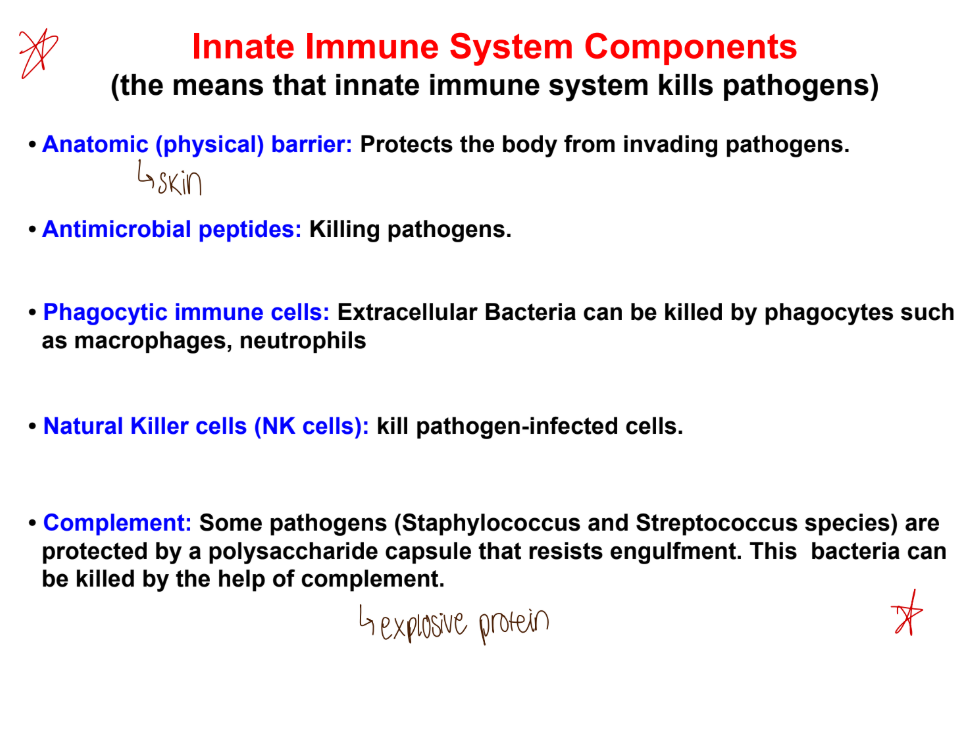
The complement system is composed of what three pathways? Explain each.
Lectin: activated by lectin-type proteins that recognize and bind to carbohydrates on pathogen surfaces
Classical (antibody-triggered): works together with antibodies
Alternative: activated by the presence of the pathogen alone

Why is inflammation a double-edged sword?
It destroys all tissues along with pathogens
Innate vs adaptive differences
innate: 1st. immediate and general (minutes to hours)
adaptive: 2nd. slow (days) and specific. recruits B and T cells
to detect pathogens, innate immunity requires what?
cell-associated receptors (e.g. pattern recognition receptors)
to destroy pathogens, innate immunity needs what?
secreted proteins such as antimicrobial enzymes (lysozyme), antimicrobial peptides, and complement system.
AIDS is due to HIV-1 and HIV-2 infection and leads to what?
destruction of T cells, DCs, and macrophages bearing CD4
infections by bacteria and other pathogens which normally can be controlled by such cells
Hepatitis D virus (HDV) requires what virus for its replication?
Hepatitis B
What is HDV superinfection? what does it lead to?
chronic co-infection of HDV and HBV when a person is already chronically infected with HBV. most severe, rapid progression to liver-related mortality and hepatocellular carcinoma (HCC)
What is pegylated interferon? What is the role of pegylated interferon alfa?
It lasts long in the body (half-life is extended) and is used to treat hepatitis C and B. Can reduce liver inflammation and fibrosis and increase survival (~30% of patients).

1 in ____ eggs are contaminated with Salmonella.
20,000
How are eggs contaminated?
bacteria within the hen’s ovary or oviduct before the shell forms around the yolk and white.
Salmonella (does/doesn’t) make the hen sick.
doesn’t
Salmonella infections in humans leads to what disease
acute gastroenteritis
Acute gastroenteritis clinical symptoms
abdominal pains, nausea, diarrhea, vomiting, fever
Salmonella attaches to plants more strongly than E coli, plants such as:
cantaloupe, honeydew melon, and watermelon. Fruits that grow and mature on the ground
Transmission of Salmonella from what to humans is now a rising issue?
raw fruit and vegetables

In healthy people, Salmonella Typhimurium infection can be cleared within how many days, and how?
14 days; it is self-limiting and does not require antibiotic treatment.
Typhoid fever and paratyphoid fever are life-threatening illnesses caused by what bacterias?
Salmonella Typhi and Salmonella Paratyphi, respectively
What are endotoxins?
non-secreted constituents of bacterial structure that trigger phagocytes to release cytokines
What are exotoxins? what’s one example?
Secreted toxins from pathogenic bacteria which cause disease.
example: clostridium difficile toxin A and B causing colitis.
What is an example of an endotoxin?
LPS
What are some examples of Gram-negative bacteria?
E coli, salmonella
LPS is a constituent of the outer cell membrane of what bacteria?
Gram-negative bacteria

What is a molecular pattern in gram-negative bacteria?
lipopolysaccharide (LPS)

Name 3 good gut bacteria and 3 bad gut bacteria:
Good/Commensal: Bifidobacteria, Escherichia Coli (E coli), and Lactobacilli
Bad: Campylobacter, Enterococcus Faecalis, and Clostridium Difficile (C. diff)

What does Clostridium difficile cause?
Causes colitis (inflammation in the colon/large intestine) by toxin A and B.

Patients in hospitals who are on antibiotics are more susceptible to what?
clostridium difficile infection (diarrhea and bloody stool). using antibiotics → kills good bacteria, allowing bad bacteria to grow → c. diff grows → aggressive acute colitis → treatment: more potent antibiotics
Deadly infections transfer from animal reservoirs to humans known as what?
Zoonotic infection / Zoonosis
zoo- = animal
SARS stands for
severe acute respiratory syndrome
What makes a great layer of protection against mosquitoes?
body hair
The first barrier against infection is due to what?
Epithelial surfaces, tight junctions, and mucus

What prevents microorganisms from adhering to the epithelium?
Mucus, mucins (glycoproteins)
What is cystic fibrosis?
Mucus becomes abnormally thick and dehydrated due to CFTR gene defects which encodes a chloride channel in the epithelium. Increases susceptibility to infection in lung and digestive system.
Microbiota can make what?
antimicrobial substances (lactic acid, antimicrobial peptides, bacteriocins: nature’s antibiotics)
antibiotics kill what?
all bacteria (good AND bad)
Salmonella typhi causes what? How is it spread? treatment?
typhoid fever; spread through fecal contaminated food and water
treatment: IV fluid & antibiotics
Vivrio cholera causes what? How is it spread? Treatment?
cholera; spread through fecal contaminated food and water
treatment: IV fluid & antibiotics
What is water chlorination?
Adding chlorine (Cl2) to water to kill bacteria → germ-free water. Can prevent spread of waterborne diseases like cholera, typhoid, and dysentery
What does clostridium tetani (tetanus bacterium) do?
it secretes a neurotoxin → serious illness in neuronal tissues: tetanus

Symptoms of tetanus
severe, painful spasms; rigidity of voluntary muscles; difficulty swallowing; death due to inability to breathe
Epithelial cells and phagocytes produce several kinds of what?
antimicrobial proteins
What digests the cell wall of bacteria?
Lysozymes

What are amphipathic peptides that disrupt the cell membrane of microbes?
Defensins

What 3 proteins are activated by proteolysis?
Defensins, Calthelicidins, and RegIII

RegIII is one of several antimicrobial peptides produced by what kind of cell?
Paneth cells
Why does RegIII specifically target Gram-positive bacteria and not Gram-negative bacteria?
RegIII binds to the surface peptidoglycan layer of Gram-positive bacteria, It is pore forming. Lipopolysaccharide from Gram-negative bacteria blocks the pore forming activity.
What is the series of immune stages when an infectious microorganism enters through a wound in the skin?
Pathogens adhere to epithelium → local infection, penetration → local infection of tissues → adaptive immunity

The complement system goes together (complements) with what?
bactericidal activity of antibodies (but, still able to kill pathogen without antibodies)
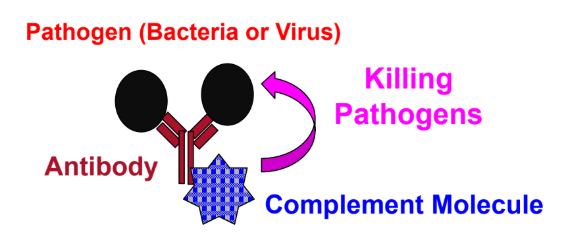
What is the Complement?
a collection of more than 30 soluble proteins present in the blood and other body fluids
Complement proteins are mainly produced where? What happens in absence of infection?
Liver; they circulate in an inactive form in the absence of infection.
Some complement proteins are inherently proteases and produced as inactive pro-enzymes (zymogens), which will be active only after what?
proteolytic cleavage by another complement protein.
What are step one and two of the complement activation?
1: interaction of a complement protein with pathogen surface
2: activating C3 convertase
Describe the Lectin pathway
Mannose-binding lectin (MBL) and Ficolins bind to particular carbohydrate structures on microbial surfaces. MBL-associated serine proteases (MASPs) trigger cleavage of complement proteins and activation of the pathway.
Describe the Classical pathway
C1q (recognition protein) associated with proteases (C1r and C1s) either recognize a microbial surface directly or binds to antibodies already bound to a pathogen.
Describe the Alternative pathway
Spontaneous hydrolysis of the complement C3, binds directly to the microbial surface
For all three pathways, complement binding with pathogen activates what?
C3 convertase
C3 convertase is cleaved into what? Give their relative sizes, and what they do:
C3 convertase → C3a + C3b
C3a: small, induces inflammation
C3b: large, does opsonization and enables phagocytosis
C3b can also bind to _______ to form ________.
C3 convertases; C5 convertase
C5 convertase is cleaved into what? What is their function? What is the outcome of this?
C5a: inflammation
C5b: enhances Membrane Attacking Complex (MAC)
Outcome: creates a pore in the membrane leading to cell lysis.
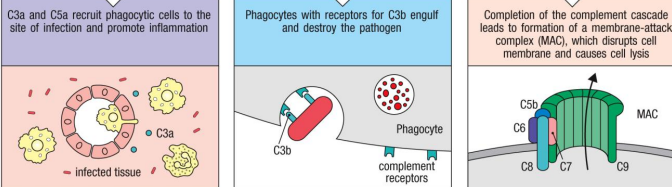
The complement system recognizes microbial surfaces and
destroys them by coating the pathogens with what?
C3b
C3b has the ability to interact with microbial surface through a highly reactive ______ bond which is hidden inside the intact C3 protein.
thioester
How does C3b work?
It exposes thioester bond, and interacts with microbial surface through binding to thioester bond, then reacts with hydroxyl or amino group on molecules
Without binding to the surface, thioester is rapidly hydrolyzed, rendering C3b inactive.
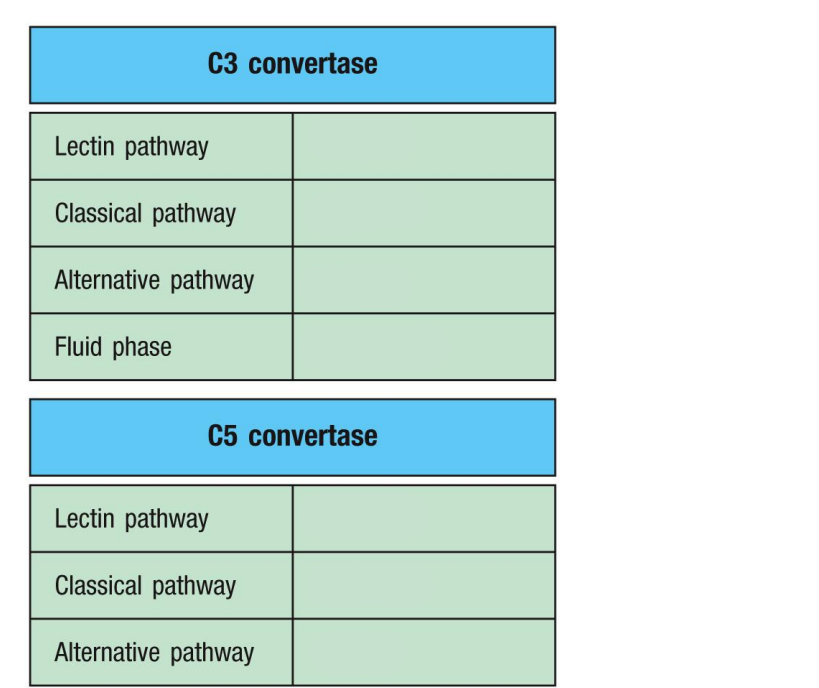
Fill in the blanks and name what two parts combine to form it.

Which pathway uses soluble receptors that recognize microbial
surfaces to activate the complement cascade
Lectin pathway
List molecular patterns found in Gram-positive, Gram-negative, and Yeast
Gram-positive bacteria: lipoteichoic acids
Gram-negative bacteria: lipopolysaccharide (LPS)
Yeast: glycan
What is glycan
A large number of monosaccharides linked glycosidically
The glycan of yeast and vertebrate cells terminate in separate residues, what are they?
glycan of yeast terminates in mannose residues
glycan of vertebrate cells terminate in sialic acid residues
Lectin pathway uses __________ to interact with the microbial surface, which is the specific way to distinguish microorganisms from vertebrate host’s cells.
mannose-glycan
Lectin pathway uses ______ receptors that recognize microbial surfaces
to activate the complement cascade
soluble
Which are more abundant in plasma between ficolin and MBL (mannose-binding lectin)
ficolin
Patients experience substantially more respiratory infection by common extracellular bacteria during early childhood without what two proteins?
MBL or MASP-2
Importance of innate immunity during early childhood.
What are pattern recognition receptors participating in the lectin pathway?
Mannose-binding lectin (MBL) and Ficolins
Where is mannose-binding lectin (MBL) synthesized?
Liver
What is the structure of a MBL? What are the terminals called?
An oligomeric protein; N-terminal collagen-like domain, C-terminal C-type lectin domain (carbohydrate recognition domain)
What are collectins?
Mix of collagen-like domain and lectin domain

MBL further assembles into _____ through the formation of a triple helix by their collagen-like domains, which then assemble into _____ by disulfide bonding between the collagen domain. then _____ domain of MBL interacts with mannose-glycan.
trimers; oligomers; carbohydrate-recognition
______ MBL has low affinity for mannose, while ______ MBL has high total binding strength.
A single carbohydrate recognition domain; multimeric
What is the term for “every binding affinity”?
AVIDITY
Why does MBL have different binding strengths for different cells?
It interacts strongly with microbial surfaces, like Gram-positive/negative bacteria, mycobacteria, yeasts, some viruses and parasites, while not interacting with host cells.
Describe the domain of Ficolins
A collagen-like and fibrogen-like domain.

Fibrinogen-like domain interacts with what? What does it not bind?
Fibrinogen-like domain interacts with oligosaccharides containing acetylated sugars, doesn’t bind mannose-
carbohydrates.
How did MBL and Ficolins work?
By making complexes with serine proteases and recognize particular carbohydrate on microbial surfaces
Give the pathway of how MBL works
MBL forms complexes with inactive MASPS (MASP-1, MASP-2, MASP-3)
upon pathogen surface binding, MASP-1 activates MASP-2
MASP-2 cleaves C4 and C2 into C4b and C2
Makes C4b2a (C3 convertase)
C4b2a cleaves C3 into C3a and C3b
What is another term for C3 convertase?
C4b2a
How do Ficolins works?
Ficolins make a complex with MASP-1 and MASP-2
Pathogen surface binding activates MASP-2
MASP-2 cleaves C4 into C4a + C4b
C4b binds to C2
C2 is cleaved by MASP-2 to produce C2a
C2a makes a complex with C4b (C4b2a, C3 convertase)
C4b2a cleaves C3 into C3a and C3b
The classical pathway is similar to the lectin pathway, except that it
Uses C1, a pathogen sensor, which interacts directly with pathogens and also binds to antibodies
C1 is comprised of what components?
C1q: pathogen sensor, a hexamer of trimers. Each monomer contains an N-terminal globular (head) domain and a C-terminal Collagen-like domain.
C1r & C1s: serine proteases that form tetramers that fold into C1q
C1q is able to bind to the _____ of antibodies that has bound pathogens via their _____.
constant Fc region; antigen-binding sites
C1q works for what immunity?
innate and adaptive
How does the classical pathway work?
Globular head domains bind to the pathogen surface
C1r becomes active and activates C1s
Active C1s cleaves C4 into C4b
C4b binds to the pathogen surface
C4b interacts with C2 and makes C4b2a (C3 convertase)
C4b2a cleaves C3 into C3a and C3b
C4b2a (C3 Convertase) works for which pathways?
Lectin and classical pathways
What is C4b2a often known as?
Classical C3 convertase since it was first discovered as part of the classical pathway
Complement activation is largely confined where when it is initiated?
The surface
The alternative pathway is an implication loop for C3b formation that is accelerated by _____ in the presence of pathogens
properdin
How does the alternative pathway work?
It uses C3 Convertase (C3bBb)
C3b binds Bb, a cleavage fragment of factor B → C3bBb (C3 Convertase)
C3bBb cleaves C3 into C3a and C3b
What two ways can C3b in the alternative pathway be activated?
C3b generated by either lectin or classical pathways
C3b binds to pathogen surface
C3b interacts with Factor B (C3bB)
Factor D cleaves Factor B into Ba + Bb
Ba is dissociated. Bb remains to form C3bBb (C3 convertase)
A steady, low-level production of C3 (H2O) by hydrolysis (aka tickover)
C3(H2O) binds Factor B
Factor D cleaves Factor B into Ba + Bb
Ba is dissociated. Bb remains to form C3(H2O)Bb (C3 convertase)
C3(H2O)Bb is stabilized by binding properdin (Factor P)
What is made by neutrophils and released when they’re activated by pathogens?
Properdin aka factor P
“Properdin” (factor P)-deficient patients are susceptible to infections with ______, the main agent of bacterial meningitis.
Neisseria meningitides
“C3”-deficient patients are susceptible to infections by a wide range of extracellular bacteria, including ______
Streptococcus pneumoniae