Income Statement
 Studied by 0 people
 Call Kai
 Learn
Learn Practice Test
 Spaced Repetition
 Match
Match Flashcards
 Knowt Play
1/24

There's no tags or description
Looks like no tags are added yet.
Name | Mastery | Learn | Test | Matching | Spaced |
|---|
No study sessions yet.
25 Terms
Period Cost:
Period Cost is the cost that is expensed immediately.
These include: Selling cost, general cost, administrative cost, research cost.
Unexpired Cost
Is capitalized as an asset for future
Appears on balance sheet
Is expensed in future periods according to the matching principle
Nonoperating items on Income Statement
The unusual and/or infrequent revenues and expenses that are not part of the core business; they come from nonoperating business such as:
Sale of something other than inventory
Write-downs
Write-offs
Sale of PP&E
Sale of an investment in another company
Unusual operating expense
Income from Continuing Operations
Calculation of Income from Continuing Operations
Income from Continuing Operations =. Operating income (Revenues and Expenses) + Nonoperating income (Gains and Losses)
The nature of the item and the financial statement effects should be disclosed on the face of the income statement or in the footnotes.
Calculation of Net Result of the Transaction
For nonoperating items, only the net result of the transaction, the gain or the loss, is reported, not the gross amount.
Net gain or loss = Selling price (SP)/Net realizable value (NRV) - Book/carrying value
Income from Discontinued Operations
Includes selling off a product line, a separate division, or a segment of a company's operations.
The income from discontinued operations:
Reported separately on the income statement
Comes after the income from continuing operations in the income statement
Reported as net of tax
Components of the Income Statement
Single-Step Income Statement
All revenues and gains
All expenses and losses
Pretax income
Income tax expense
Net income
Multiple-Step Income Statement
Benefits of the multi-step income statement are that it:
Enhances user information
Separates operating business from nonoperating
Provides readily available information for ratio analysis
Multiple-Step Income Statement Snapshot
See picture
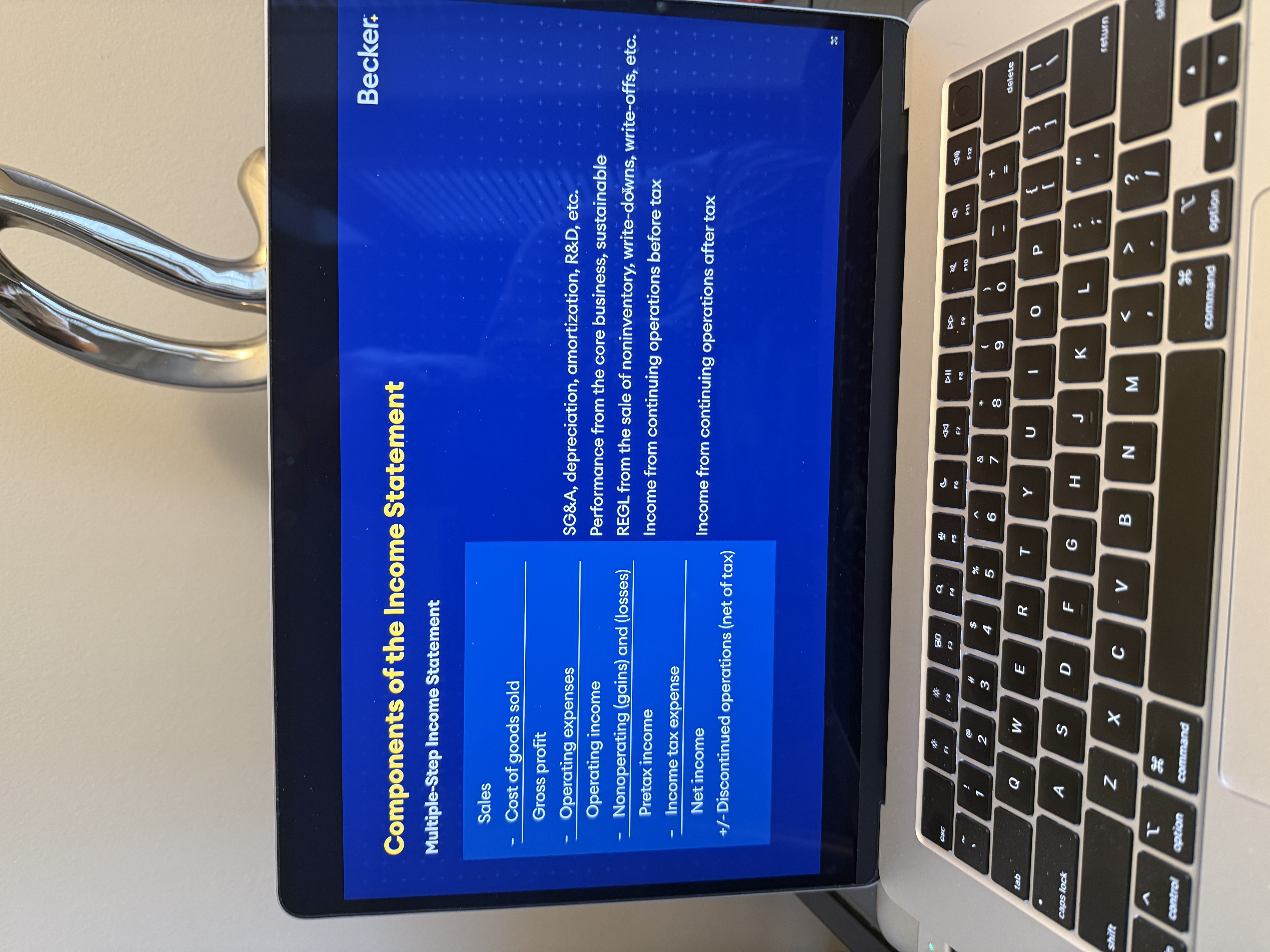
Gross Profit
Sales - Cost of Goods Sold
Operating Income
Gross Profit - Operating Expenses
Pre-tax income
Operating income minus non-operating (gains) and (losses)
Net income
Pre-tax income minus income tax expense
+/- discontinued operations (net of tax)
NOTE: Discontinued operations are reported “Net of Tax”.
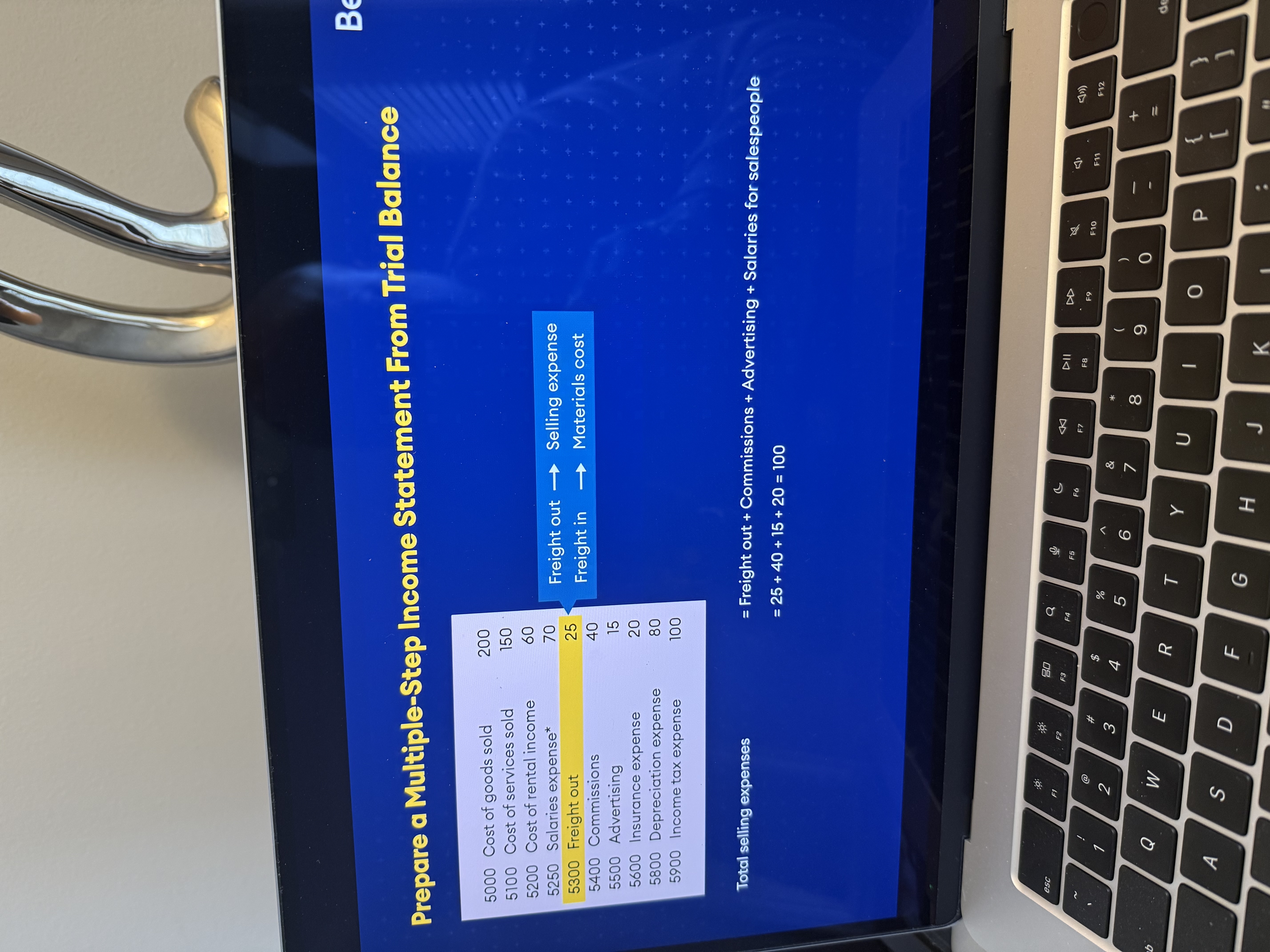
Total selling expenses
Total selling expenses are the indirect costs of promoting, selling, and delivering products/services, comprising marketing (ads, social media), sales staff costs (salaries, commissions, travel), and distribution (shipping, warehousing, handling), all aimed at generating revenue but separate from production costs (COGS) and General and Administrative Expenses.
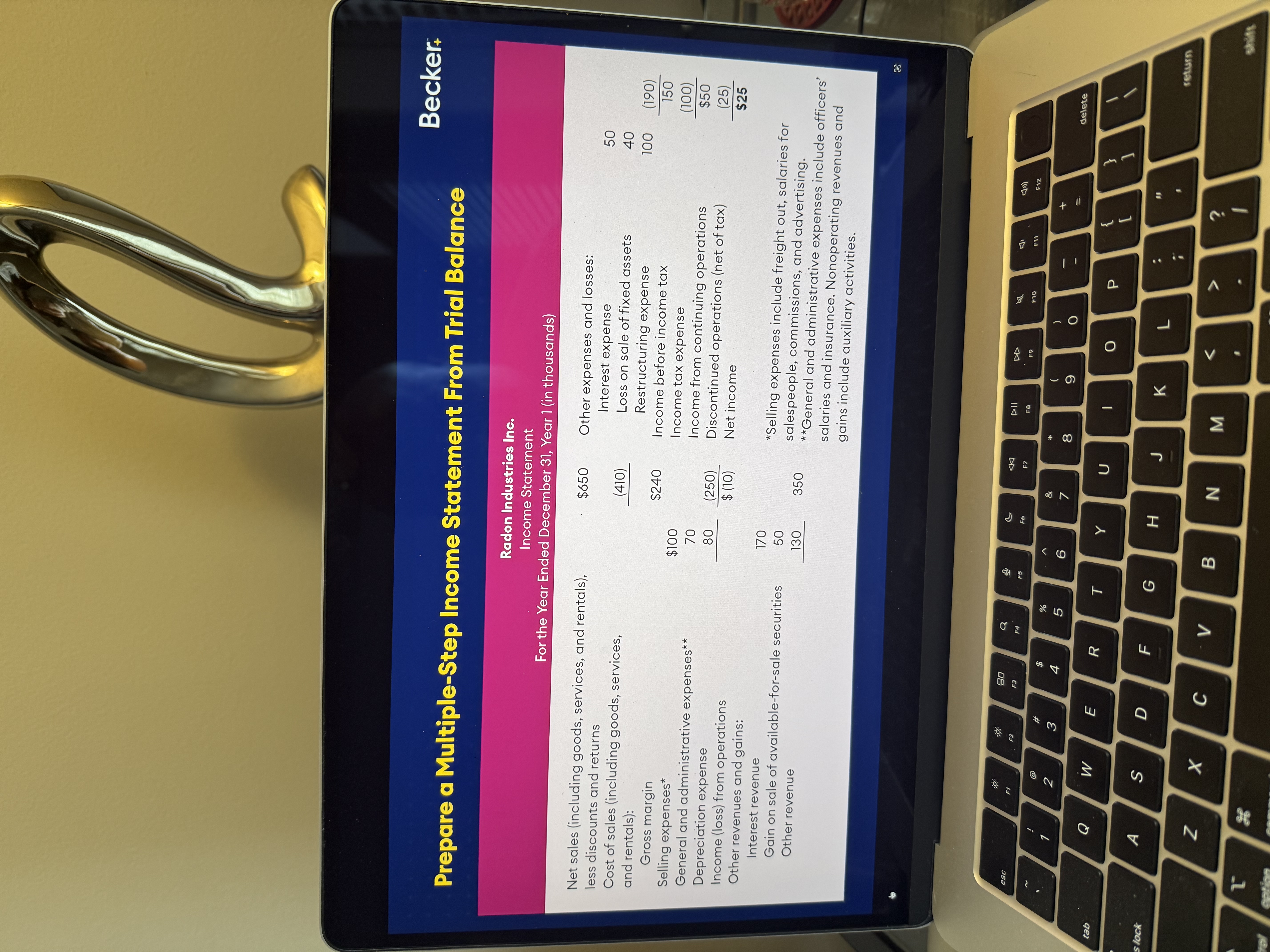
Continuing operations
= operating income + non-operating income
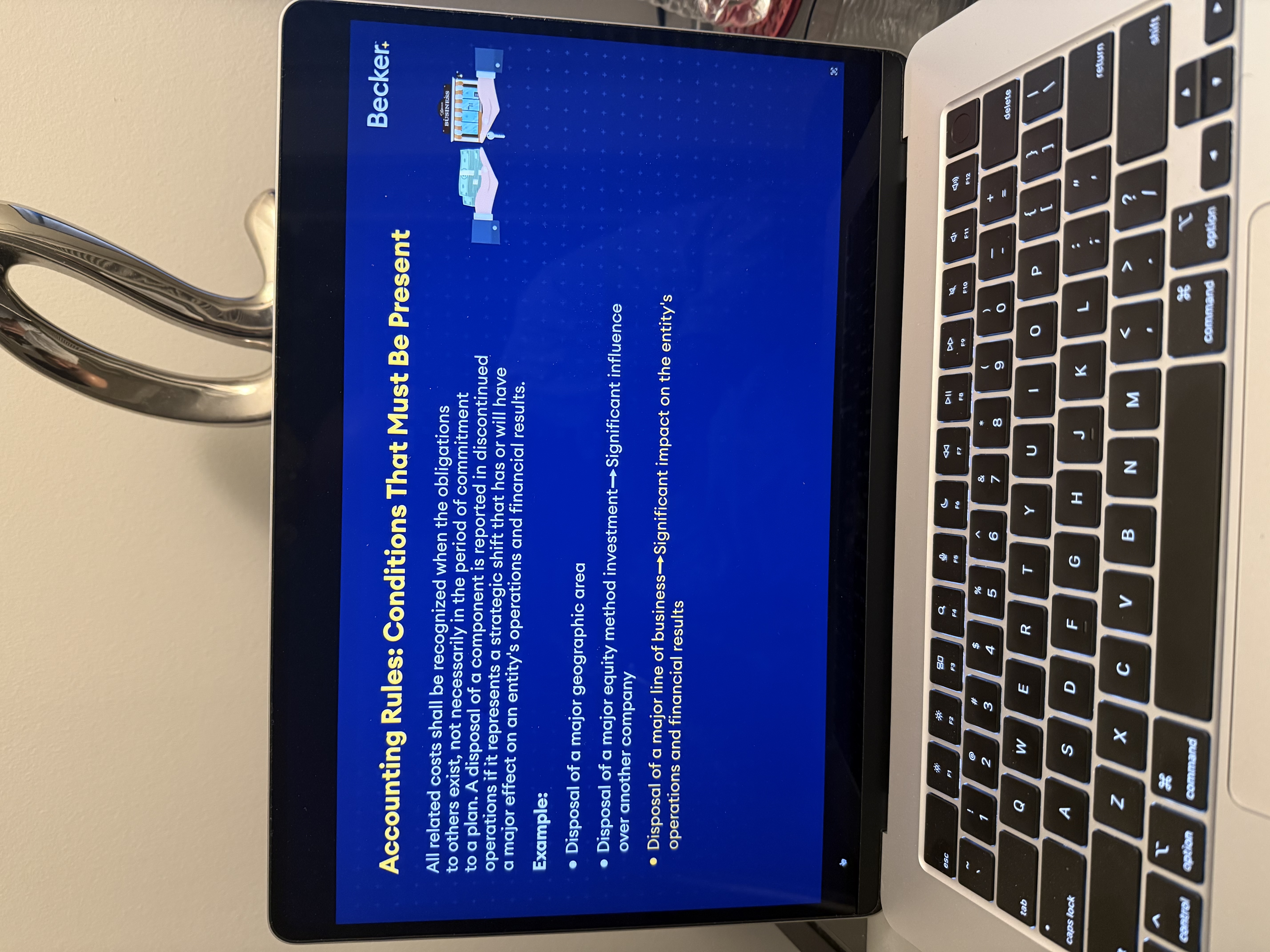
Discontinued operations
Example: the results from operations are reported for 2022 under discontinued operations if it:
Has been disposed of during 2022 regardless of the selling date.
Is classified as held for sale during 2022, even if a buyer is not found yet.
Held for sale criteria:
For business activity to be classified as held for sale what are the six criteria that must be met?
If any of the six criteria are no longer met, the activity should be re-classified as held and used. The held and use classification is the default for property, plant and equipment, and simply means that a company uses the assets and they are not actively for sale.
Management commits to a plan to sell the activity.
The activity is available for immediate sale and its present condition.
An active program to locate a buyer has been initiated.
The sale of the activity is probable, and completion of the sale is expected to occur within a year.
The activity is being actively marketed at a reasonable sale price relative to its current fair value.
Significant changes in a plan to sell are not expect


Impairment loss of the component
Calculate the net realizable value (NRV) example: NRV = $1,000
calculate the impairment loss
a. Book value = $2000.
b. Impairment loss = NRV - book value. = $1,000 - $2,000 =$-1,000
c. This loss will go under the heading “discontinued operation.”
Example 2:
Book value = $10
Calculate the NRV = $8
a. Fair value = $9
b. Cost to sell = $1
c. NRV=Fair value - Cost to sell = $9 - $1 = $8
Calculate the impairment loss
a. Impairment loss = NRV - book value = $8 - $10 = -$2
The book value should be written down from $10 to $8.
Note: if in the next year, there is an increase in the fair market value from $9 to $12,
Should the book value of $8 be written up to NRV of $11?
No. Although the mathematical gain is $3, the impairment loss cannot be reversed more than the amount originally written down (i.e. $2).
Impairment loss continued
Depreciation and amortization
Once management decides to dispose of the component, assets within the component are no longer depreciated or amortized.
Measurement and evaluation
How is the segment classified as held for sale reported on the balance sheet? It is measured at the lower of its NRV or its book value.
Foreign Currency Terminology
Exchange Rate: exchange rate is the price of one unit of a currency expressed in units of another currency; the rate at which two currencies will be exchanged at equal value.
The exchange rate may be expressed as:
Direct method: the direct method is the domestic price of one unit of another currency. For example, one euro cost $1.47.
Indirect method: the indirect method is the foreign price of one unit of the domestic currency. For example, 0.68 euro buys $1.00.
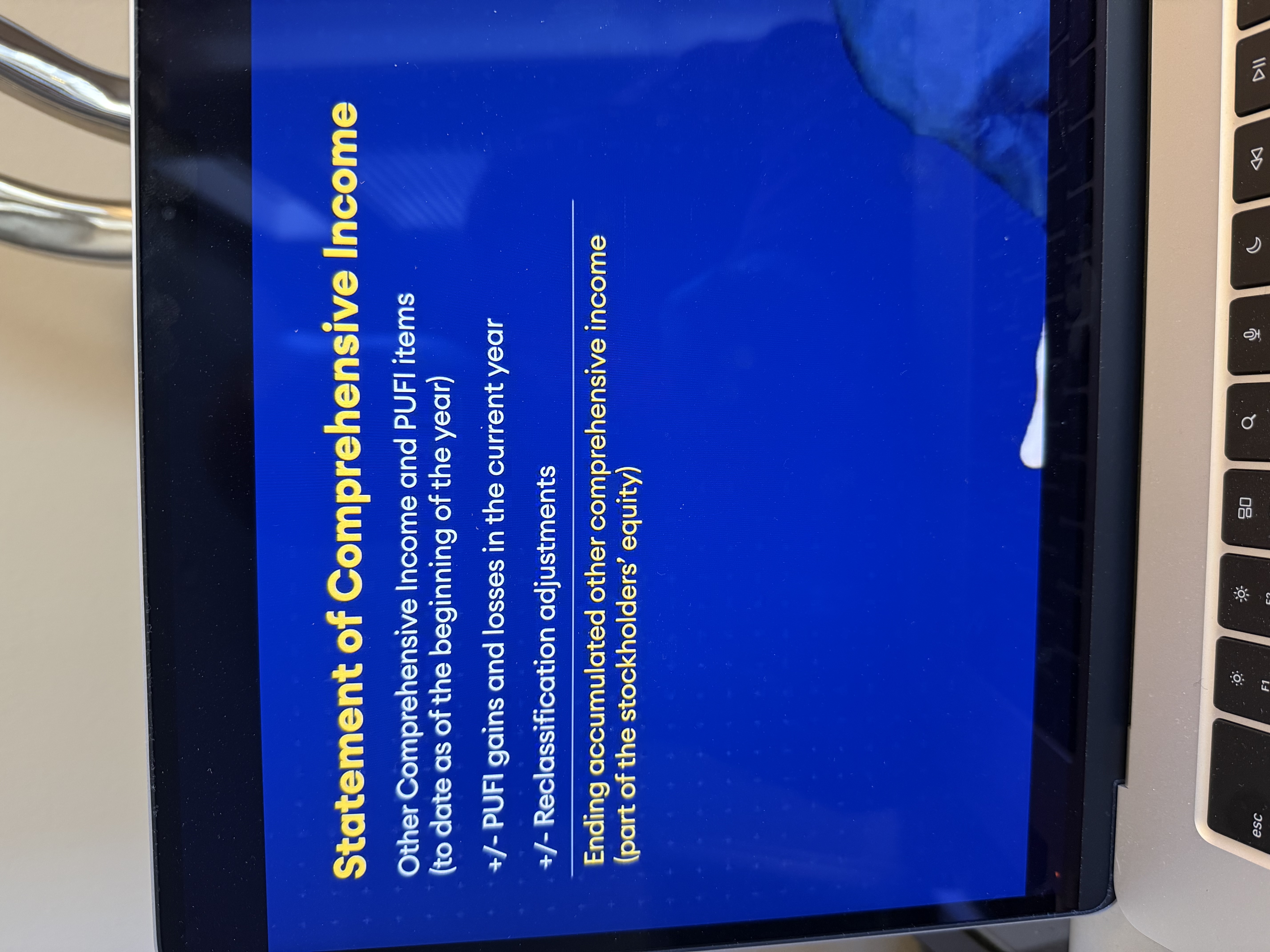
Statement of comprehensive income
Comprehensive income = net income + other comprehensive income (OCI)
OCI items are revenues, expenses, gains, and losses that are included in comprehensive income, but excluded from net income under US GAAP.
Items not on income statement: goes directly to equity.
PUFI:
pension adjustment
unrealized, gains, and losses (available for sale debt securities and hedges)
foreign currency items
instrument specific credit risk.
Note: comprehensive income is not the same as other comprehensive income
Statement of comprehensive income cont’d
Shall be presented in a financial statement in the same prominence as other financial statements.
Does not apply to not for profit entities or to any company that does not have comprehensive income.
Should not be reported on a per share basis.
Statement of comprehensive income cont’d 2
Under US GAAP, how can comprehensive income be presented?
See picture
Note: you’ll know if it’s a single statement approach if your starting point is revenues
The multi-step approach starting point is net income.
Interim Reporting:
Yes - must be reported.
income tax, expense or benefit
Calculate income tax expenses, if you have gains or benefits.
Allocate losses to each of the PUFI components.
Disclose allocation of tax expense or benefit either:
A. On the face of the financial statement.
B. Or in the notes

Required disclosures
The tax effects of each component of comprehensive income.
The tax effects must be allocated to each component.
A. On the face of the statement of comprehensive income.
B. Or notes
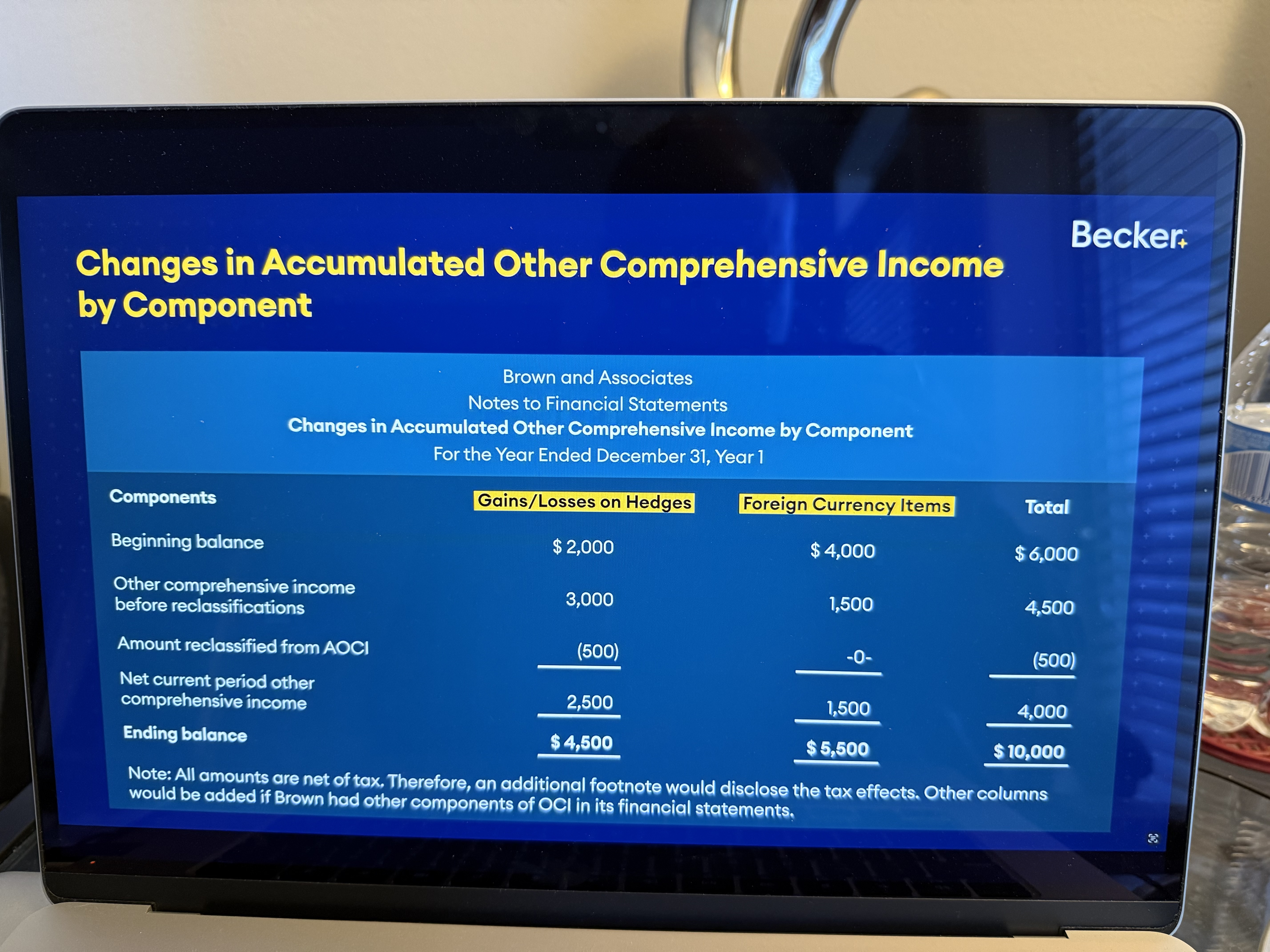
All formats must disclose changes and accumulated balances for each of the components of other comprehensive income.
Can also have a change due to a re-classification adjustment, even if there were not any current year adjustments.
The change in the accumulate balances by component can be shown two ways: face of the financial statement or separately disclosed in the notes.
Total accumulated other comprehensive income in the balance sheet as an item of equity
Equity comprises:
A. Paid in capital minus treasury stock.
B. Earned capital (retained earnings);
C. Ending accumulated other comprehensive income.
The reclassification adjustment
The classification adjustments are made to avoid double counting.
Re-classification adjustments, move other comprehensive income items from accumulated other comprehensive income to the income statement.
Need to reverse any gain or loss at previously went direct to equity.

Accumulated other comprehensive income
The gains and losses that go direct to equity accumulate in an account called, accumulated other comprehensive income.
Accumulated other comprehensive income is a component of equity that includes the other comprehensive income for the current period as well as previous periods.
Any gains and losses that go on the income statement, eventually become part of net income, and then they get closed out to retained earnings.
AOCI is a component of equity on a company's balance sheet that captures certain unrealized gains and losses not recognized in net income, accumulating over time, similar to how retained earnings accumulate profits
Closing Entry Year End: Net Income and OCI
Example: Net income = &95k and OCI gain = $20k.
Net income $95k
Retained Earnings $95k
OCI gain $20k
AOCI $20k (stockholders equity)