Strabismus Terms & Definitions for Medical Students
 Call Kai
 Learn
Learn Practice Test
 Spaced Repetition
 Match
Match Flashcards
 Knowt Play
1/117

There's no tags or description
Looks like no tags are added yet.
Name | Mastery | Learn | Test | Matching | Spaced | Call with Kai | Chat |
|---|
No analytics yet
Send a link to your students to track their progress
118 Terms
intermittent
In terms of frequency of strabismus, _____ frequency has a better prognosis
Exo>Eso>Vertical
order from best to worst prognosis of strabismus depending on the deviation type
smaller, microstrabismus
In terms of magnitude of strabismus, a strabismus having a ____ magnitude generally has better prognosis except in the case of ____
unilateral, amblyopia
In terms of laterality, a strabismus that is ____ has a poorer prognosis because it is associated with ____
non-comitant
In terms of comitancy, a strabismus that is _____ has a poorer prognosis
Phoria
the ability to fuse 100% of the time with no manifest deviation
Intermittent tropia
the ability to fuse, but not 100% of the time
Constant tropia
the inability to fuse with a manifest deviation 100% of the time
Eyelid position/ptosis
Interpupillary distance
Pseudoesotropia
Orbital placement
4 Factors That May be Misinterpreted as Strabismus
magnitude and direction
Von graefe and maddox rod give the ____ (2) of a phoria
Laterality
Frequency
Direction
3 aspects of a strabismus that are evaluated with Unilateral Cover Test
Magnitude
Direction
2 aspects of a strabismus that are evaluated with alternating cover test
constant, 30 second
an intermittent exotropia control score of 5 is a ____ exotropia during a _____ period of observation
>50
an intermittent exotropia control score of 4 is an exotropia ____% of 30 seconds of observation without dissociation
<50
an intermittent exotropia control score of 3 is an exotropia ____% of 30 seconds of observation without dissociation
>5
an intermittent exotropia control score of 2 is no exotropia unless dissociated and recovers in _____ seconds
1-5
an intermittent exotropia control score of 1 is no exotropia unless dissociated and recovers in _____ seconds
<1
an intermittent exotropia control score of 0 is no exotropia unless dissociated and recovers in _____ seconds
version, inconsistent
A fixation loss during cover test will present as a ____ eye movement and is ____ on repetition
vergence, version, consistent
An actual eye movement during cover test will present as a ___ eye movement if phoric and a ____ eye movement if tropic and is ____ on repetition
normal binocular vision
no manifest deviation on cover test with fusion indicates _____. quality of fusion and the binocular system should still be assessed
strabismus surgery, monofixation syndrome
no manifest deviation on cover test without fusion usually occurs secondary to ____. The Eyes are aligned in the absence of fusion and these patients are more likely to develop _____
torsional deviation, monocular diplopia
no manifest deviation on cover test with diplopia suggests a ____, but _____ needs to be ruled out as well
with
manifest deviation on cover test having diplopia (with or without) the potential to fuse usually occurs with a large ocular deviation with not enough fusion range. Patient still has normal sensory response with normal correspondence
without
manifest deviation on cover test having diplopia (with or without) the potential to fuse usually occurs when deep suppression is disrupted (Fixation switch diplopia)
longstanding strabismus with deep suppression
manifest deviation on cover test without diplopia usually occurs in...
monofixation syndrome with anomalous correspondence
manifest deviation on cover test without diplopia and with peripheral fusion occurs in...
Fixation Switch Diplopia
diplopia secondary to a disruption of previously developed sensory adaptation. The dominant now has worse acuity than the non-dominant eye and the non-dominant eye is forced to fixate. Treatment is optical correction that switches fixation to the dominant eye.
I.e.) patient having cataracts in both eyes with amblyopia OS. If cataract sx is performed OS first this will force the previously non-dominant eye to be the seeing eye if it now performing better than OD visually
Sensory strabismus
strabismus induced by a reduced visual acuity in one eye leading to a breakdown of the fusion mechanism (untreated anisometropia, corneal opacities, macular lesions, etc). Usually presents as constant unilateral eso or exotropia of moderate magnitude sometimes with a vertical component.
<5
If vision loss has an onset ____ yo sensory strabismus of eso or exotropia are equally likely
>5, exotropia
If vision loss has an onset ____ yo sensory strabismus of _____ is almost always the case
cosmetic surgery, pthisis bulbi
The management of sensory strabismus is ____ or to otherwise monitor for ____
Monofixation Syndrome (Microtropia)
a constant unilateral strabismus <10 PD/<5 degrees. Presents as amblyopia in the strabismic eye while the eyes appear cosmetically aligned. Occurs naturally, but is also a favorable outcome of strabismus surgery.
global, local
Monofixation syndrome will show no ____ stereopsis and reduced ____ stereopsis
positive
Presence of peripheral fusion in monofixation syndrome will result in ____ worth 4 dot testing at near
negative
Absence of central fusion in monofixation syndrome will result in _____ 4 BO testing
habitual correction, patching
The management of monofixation syndrome involves ____and ____ for residual amblyopia
7
Monofixation syndrome decompensates about ____% per year indicating possible need for strabismus surgery or prism over time
Simultaneous Prism Cover Test
cover test involving placing a prism over one eye and an occluder over the other eye simultaneously. The prism value that results in no eye movement upon application of the prism and occluder indicates the ocular deviation providing the manifested angle size of anomalous correspondence.
Fully accommodative esotropia
esotropia where plus lens correction eliminates the tropia resulting in a phoria.
I.e.) 25 eso tropia sc, 5 eso phoria cc
Partially accommodative esotropia
esotropia having residual tropia even with plus lens correction. Prism or strabismus surgery can be employed.
I.e.) 25 eso tropia sc, 15 eso tropia cc
cyclopentolate 1%, atropine 1%
perform Cycloplegic refraction in the management of accommodative esotropia with _____ (one of these two drops)
+3
Trial up to ____ D at near repeating cover test until tropia is resolved in the management of accommodative esotropia
relieving prism
Consider _____ in the management of partially accommodative esotropia
Infantile esotropia
large magnitude esotropia with early onset resulting in lack of fusion and poor fusion potential. Perform a cycloplegic refraction to rule out accommodative esotropia and Rx a significant prescription. Refer for strabismus surgery when detected on 2 exams 2-4 weeks apart in children as earlier ocular alignment has better sensory outcomes.
Sagging eye syndrome (age related distance esotropia)
a bilateral divergence insufficiency esotropia greater at distance (12 PD) than near (5 PD) typically in patients >70 yo due to degeneration of connective tissue and sagging of the lateral rectus. A small vertical deviation and bilateral blepharoptosis are also common.
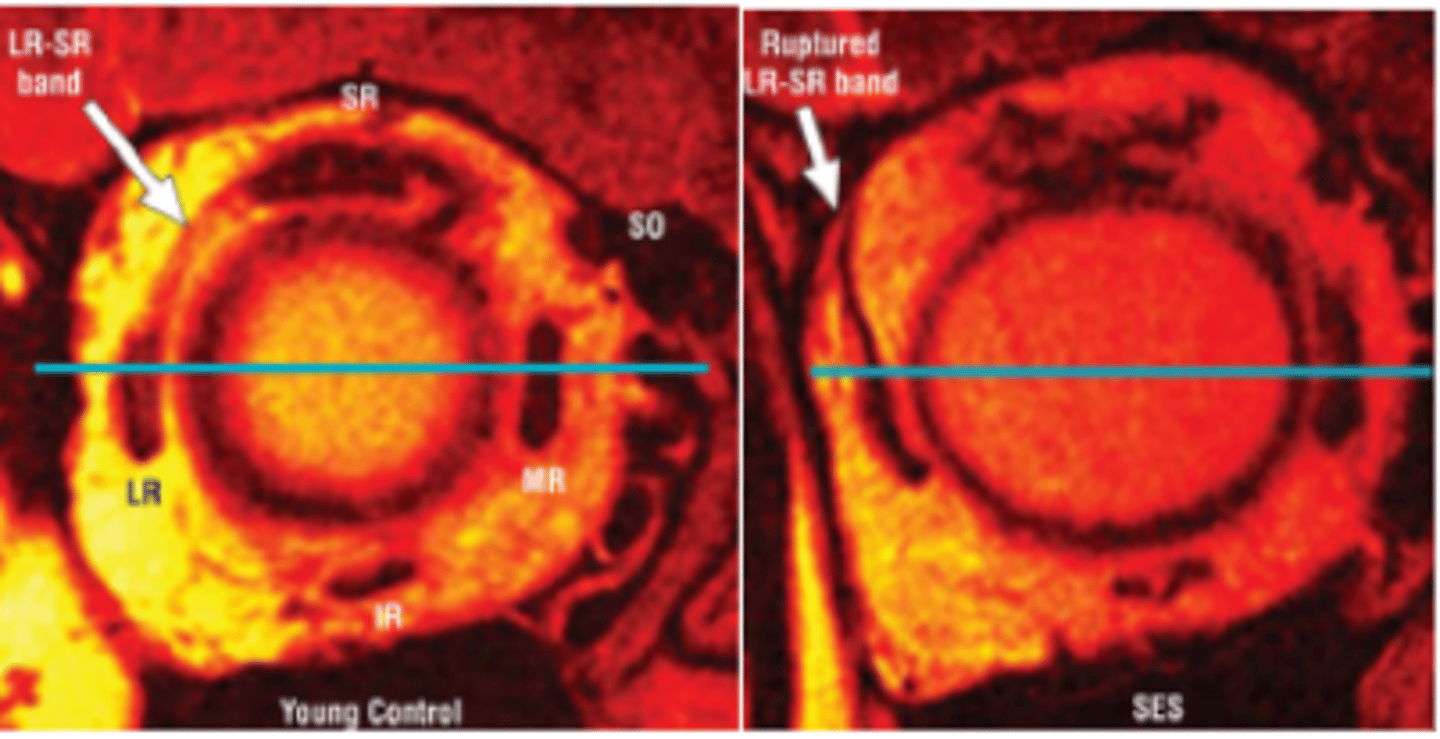
CN 6 palsy
It is important to differentiate sagging eye syndrome from a...
prism, surgery, vision therapy
Treatment of sagging eye syndrome is ____ if the magnitude is small and ____ if the magnitude of large. ____ alone is insufficient
Heavy eye syndrome (myopic strabismus fixus)
a divergence insufficiency esotropia that presents similar to sagging eye syndrome but occurs in young adults. Occurs due to an elongated axial length (high myopia) causing superotemporal globe shift.
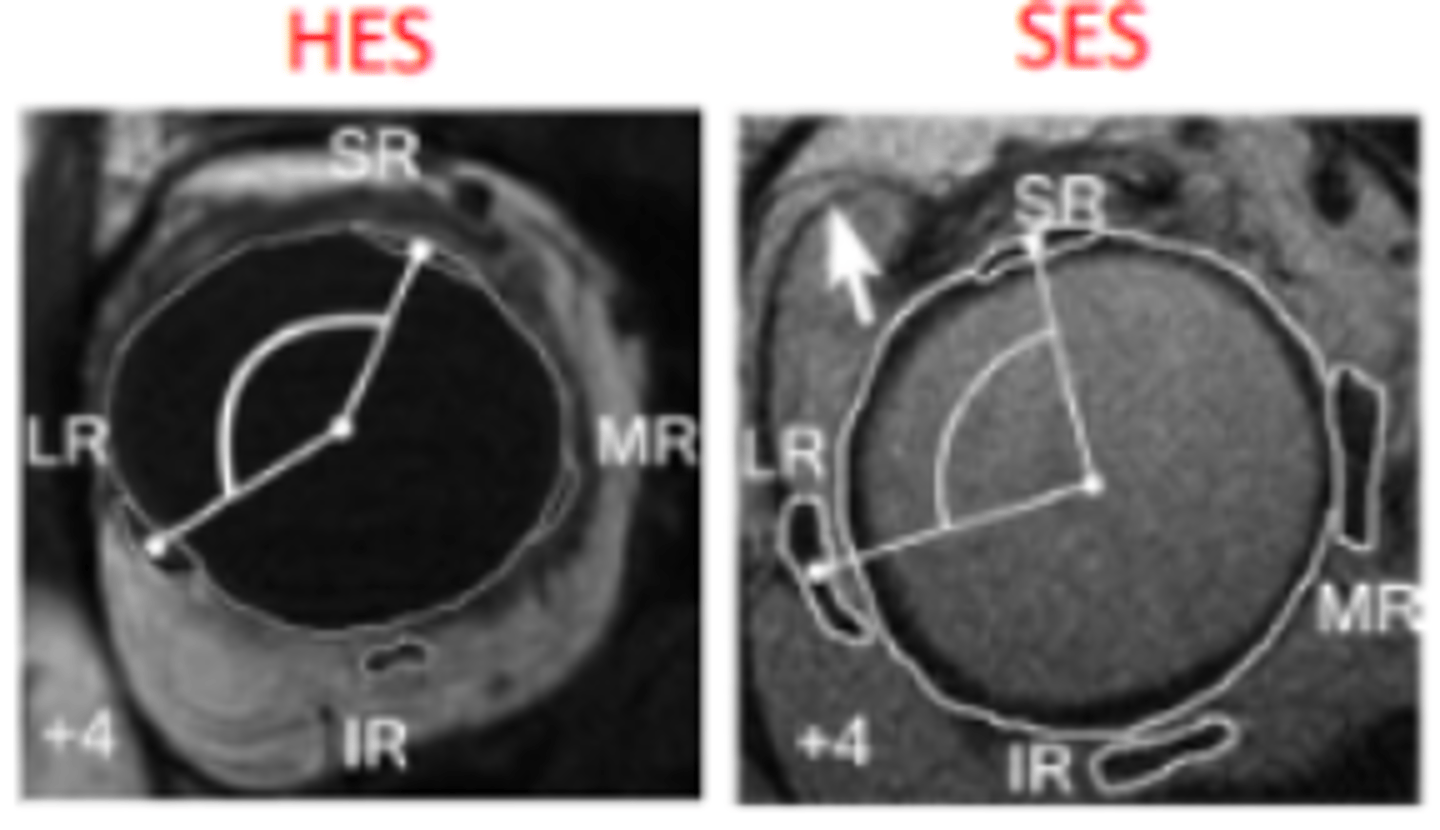
Prism, surgery, patching
three treatment options for heavy eye syndrome
Pseudoesotropia
the appearance of an esotropia due to the presence of a wide epicanthal fold. No treatment is required, just patient education.
Interimittent exotropia
the most common form of childhood exotropia.
Divergence excess
exo deviation having a greater exo at distance than at near with a high ACA. May have a high frequecy tropia at distance and a low frequency tropia or phoria at near.
Simulated divergence excess
intermittent exotropia that has ocular posture similar to divergence excess (exo greater at distance) with a normal to low ACA and therefore does respond well to overminusing. Is more common than true divergence excess.
Basic exo
intermittent exotropia that is equal in deviation magnitude at distance and near with a normal ACA ratio. If the control score is high, consider surgery. If the control score is low, consider lenses, prisms, patching, and vision therapy.
surgery
If the intermittent exotropia control score is high in a basic type exotropia consider...
lenses, prisms, patching, and VT
If the intermittent exotropia control score is low in a basic type exotropia consider... (4)
Convergence insufficiency
intermittent exotropia having greater exo at near with a low ACA ratio. Is often accompanied by other accommodative dysfunctions.
Consecutive strabismus
strabismus that is secondary to strabismus surgery or botox injection. Prism correction may help if there is complaint of diplopia.
intractable diplopia
Patients having consecutive strabismus are not good candidates for vision therapy due to risk of...
version
EOM testing tests the ability of ____ eye movements
positive
(positive or negative) forced duction testing is when resistance occurs indicating restrictive etiology
negative
(positive or negative) forced duction testing is when there is no resistance indicating paralytic etiology
Duane's retraction syndrome
abnormal synergistic innervation between the lateral rectus to muscles innervated by the oculomotor nerve (usually the medial rectus). Is associated with limitation of abduction, variable limitation of adduction, globe retraction, and a vertical deviation in adduction. Address with prism if decompensating, patient education, monitoring, or surgery in significant cases.
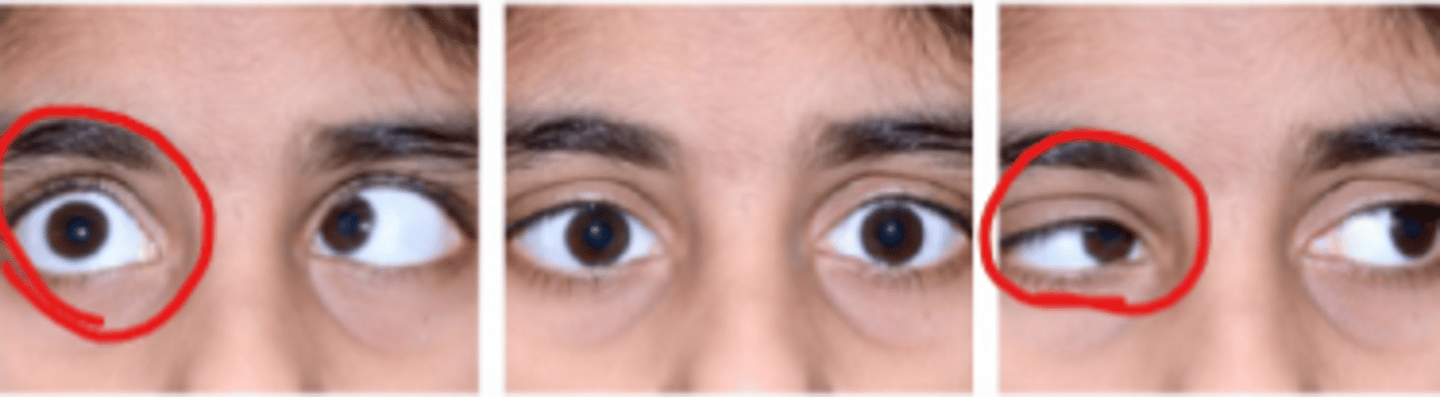
Type I (esotropic DRS)
form of Duane's retraction syndrome making up 78% of cases. Has a lack of abduction with a basic type eso posture and globe retraction on adduction.
Type II (exotropic DRS)
form of Duane's retraction syndrome making up 7% of cases. Has a lack of adduction with a basic exo posture and globe retraction on adduction.
Type III
form of Duane's retraction syndrome making up 15% of cases. Has a lack of abduction and adduction with globe retraction on adduction
Large deviation in primary gaze
Significant head posture
Significant over or undershoot
Significant globe retraction
4 indications When to Treat Duane's Retraction Syndrome
Brown's syndrome
mechanical restriction of the superior oblique tendon resulting in the appearance of an inferior oblique palsy. Is confirmed with positive forced duction testing. Educate patient and monitor for normal binocular vision in primary gaze. Consider surgery for significant cases.
spread of comitancy
It may be difficult to diagnosis a longstanding palsy due to...
Suppression
Anomalous correspondence
Expanded vergence ranges (especially vertical)
Spread of comitancy
4 Signs of Longstanding Paralytic Strabismus
down and out, ptosis
A complete CN 3 palsy will result in a _____ eye position and a complete ____
microvascular ischemia
A pupil sparing CN 3 palsy suggests...
compressive lesion (I.e. aneurysm)
A pupil involving CN 3 palsy suggests a...
neuroimaging
Always refer CN 3 palsy for...
CN 4 Palsy
The most common type of paralytic strabismus
21
CN 4 palsy is bilateral in ____% of traumatic cause
3 months
CN 6 palsy is usually self-resolving within ____ unless there is another underlying condition. Treat with Fresnel prism or patching until there is resolution.
Younger 50 yo
Other cranial nerve involvement
History of cancer
Absence of microvascular risk factors
Refer CN 6 Palsy for MRI if... (4)
Female
sex more often affected by thyroid eye disease
90%
percentage of thyroid eye disease cases associated with hyperthyroidism
10%
percentage of thyroid eye disease cases associated with hypo or euthyroidism
Dalrymple's sign
widening of the palpebral fissure seen in thyroid eye disease
Von Graefe's sign
lag of the upper lid on downgaze seen in thyroid eye disease
inferior
medial
superior
lateral
obliques
Order of EOM involvement in thyroid eye disease
compressive optic neuropathy
Visual field loss is an ocular emergency in thyroid eye disease due to risk of...
Myasthenia gravis
autoimmune disease resulting in muscle fatigue. Ocular manifestations include ptosis and ophthalmoplegia. Refer to PCP for blood work, neuroophthalmological, and CT scan to rule out thymoma.
pupil sparing
Ophthalmoplegia associated with myasthenia gravis is always...
autoimmune, difficulty swallowing and aspiration pneumonia
Childhood myasthenia gravis present similar to adult onset, but it is not ____. Systemic concerns include ____ (2). Refer to pediatrician
Internuclear ophthalmoplegia and skew deviation
two ocular dysfunctions seen in multiple sclerosis
15-20 PD
magnitude of deviation for strabismus surgery in eso deviations
>25 PD
magnitude of deviation for strabismus surgery in exo deviations
>10 PD
magnitude of deviation for strabismus surgery in hyper deviations
Eliminate diplopia
Maintain or restore binocular vision
Improve cosmesis
3 Goals of Strabismus Surgery
Tenon's capsule
facial sheath of the eye that serves as a barrier to orbital fat. Damage to this structure during strabismus surgery may lead to fat adhesion.
Recession
extraction of an EOM from its previous location of insertion and reinsertion more posteriorly to weaken its influence on ocular position.
I.e.) bilateral recession of the MR in an esotropic patient
Resection
removal of a portion of an EOM in order to strength its influence on ocular position.
I.e.) bilateral lateral rectus resection in an esotropic patient
Muscle transposition
strabismus surgery that may be performed when there is a muscle paralysis, a completely non-functional muscle
adjustable suture
An ____ may be applied in order to allow for small changes in ocular alignment after strabismus surgery has be completed
Tenon's capsule prolapse
Dellen
Pyogenic granuloma
Epithelial inclusion cyst
Chronic red eye
Chemosis
6 mild Complications of Strabismus Surgery