Chemistry
 Call Kai
 Learn
Learn Practice Test
 Spaced Repetition
 Match
Match Flashcards
 Knowt Play
1/91

There's no tags or description
Looks like no tags are added yet.
Name | Mastery | Learn | Test | Matching | Spaced | Call with Kai | Chat |
|---|
No analytics yet
Send a link to your students to track their progress
92 Terms
atomic notation
atomic number (Z)- number of protons, determines element
mass number (A)- number of protons and neutrons, determines isotope
charge (C)- number of protons minus electrons
Bohr model
electrons orbit at fixed distances, different between orbits decreases the larger they get
principal quantum number (n) describes the energy level
excitation- electrons are allowed to absorb specific photon energies to jump energy levels, each atom has specific absorption spectrum
emission/relaxation- electrons in excited state can return to lower energy state by emitting a photon, each atom has specific emission spectrum
emission energy is less than excitation energy because there is loss of vibrational energy in electron
Rutherford experiment
gold foil experiment with alpha particles
most of volume of atoms is empty space
nucleus must be positively charged to deflect alpha particle
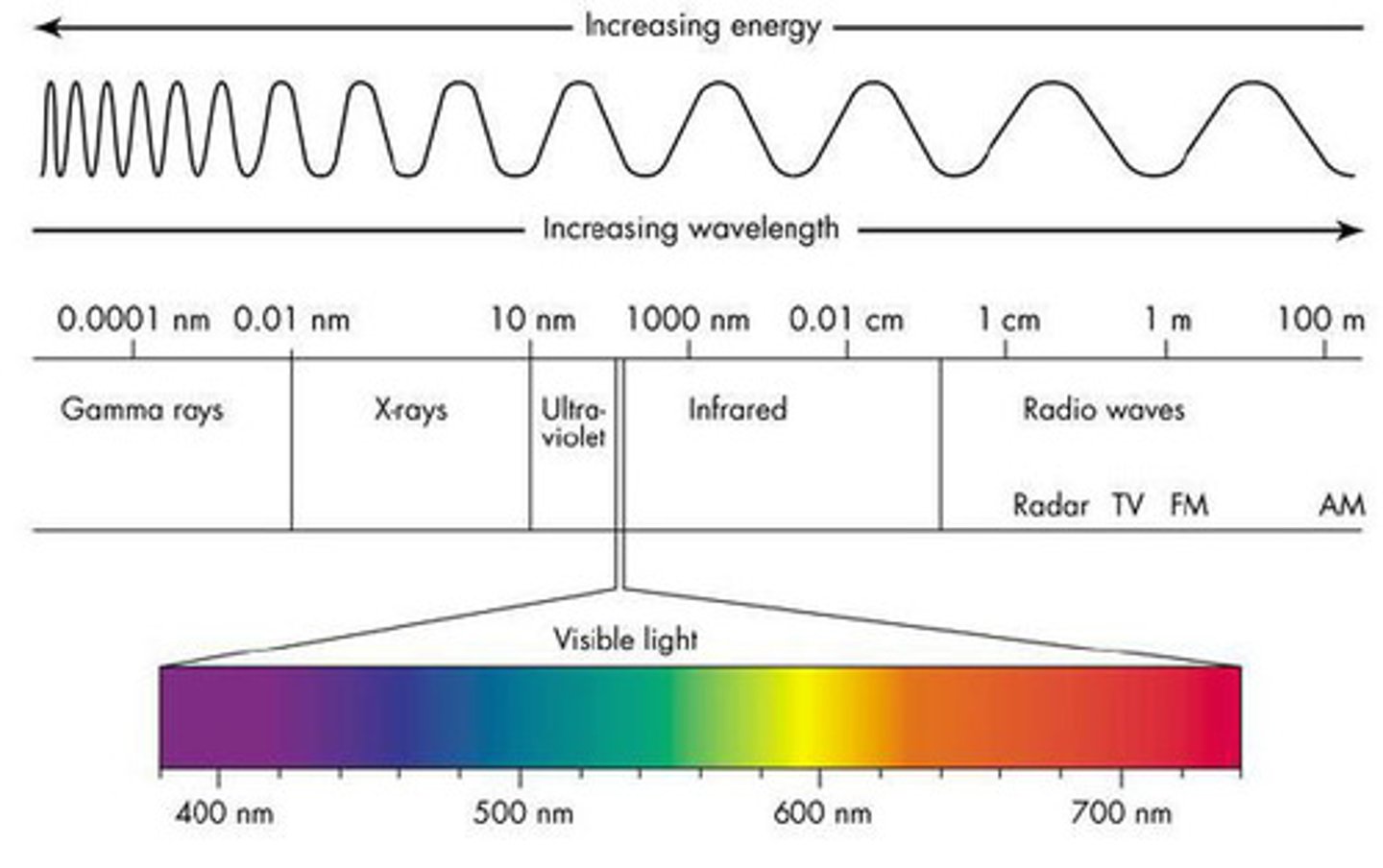
electromagnetic spectrum
energy = planks*frequency, frequency = c/wavelength
increasing wavelength:
1. gamma rays
2. X-rays
3. UV
4. violet (300 nm)
5. red (700 nm)
6. IR
7. microwaves
8. radiowaves
gay X-men using viagra in my room
quantum numbers
principal quantum number (n)- energy level, n = 1, 2, 3, etc.
azimuthal, orbital angular momentum (l)- shape of orbital, l = 0 is s, l = 1 is p, etc.
magnetic (ml)- orientation of orbital, ml ranges from -l to +l
electron spin (ms)- direction of electron spin, ms = 1/2, -1/2
rules for filling orbitals
Pauli exclusion principle- no two electrons in the same atom can have the same quantum numbers, same spin
aufbau principle- electrons fill in lowest energy orbitals first, two exceptions where s electrons are promoted: copper (and silver, gold) (d9 becomes s1d10) and chromium (and molybdenum) (d4 becomes s1d5)
hund's rule- electrons fill each orbital in a subshell before doubling up
when removing electrons, 4s electrons are removed before 3d to create ions
Fe = 4s2 3d6
Fe2+ = 3d6
isoelectronic
two atoms have same number of electrons
magnetism
paramagnetic- at least one unpaired electron, attracted to an external magnetic field
diamagnetic- all electrons are paired, repelled from an external magnetic field
shielding
valence electrons have lower effective nuclear charge because they are further away from nucleus and are repelled by core electrons
more protons means greater effective nuclear charge
more orbital rings means lower effective nuclear charge
more electrons (greater negative charge) means lower effective nuclear charge
electrostatic attraction
increases from lower left to upper right
1. down a group, valence electrons are farther away means weaker pull
2. across a period, more protons means stronger pull
3. becoming more negatively charged, more shielding means weaker pull
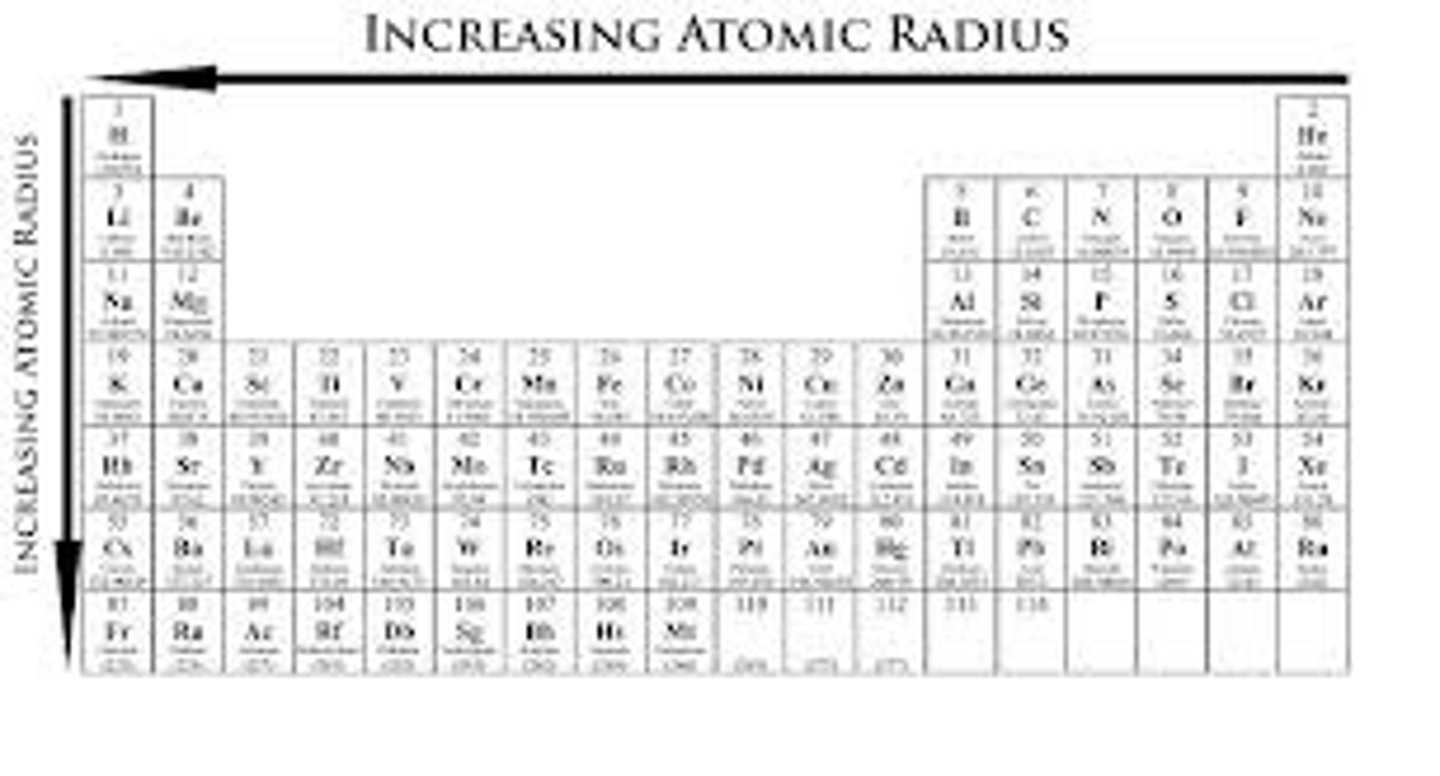
atomic radius
increases from upper right to lower left
1. down a group, more orbital rings means larger atom
2. across a period, more protons means smaller atom
element groups
alkali metals (1), alkaline earth metals (2), halogens (7), nobel gases (8), transition metals (d block), rare earth metals (f block)
alkali metals and alkaline earth metals often get oxidized to become metal cations
H+ often gets reduced to become H2, and leaves solution
halogen anions often get oxidized to become diatomic
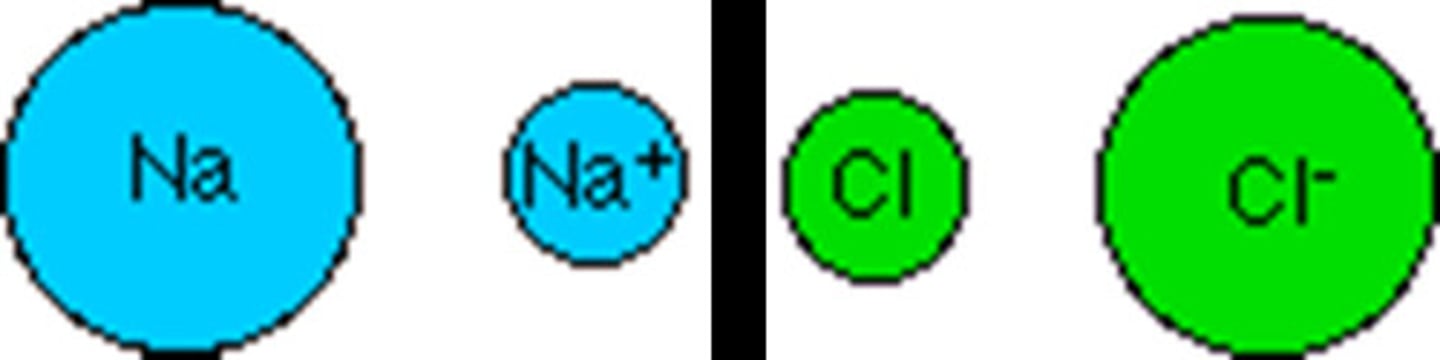
ionic radius
increases with increasing negative charge
anions (-) are larger than neutral, cations (+) are smaller
free radicals
atoms with unpaired valence electrons, can be charged or uncharged, damage DNA to cause cancer
reactive oxygen species (ROS) are free radicals
H2O2 is an ROS
antioxidant enzymes remove ROS
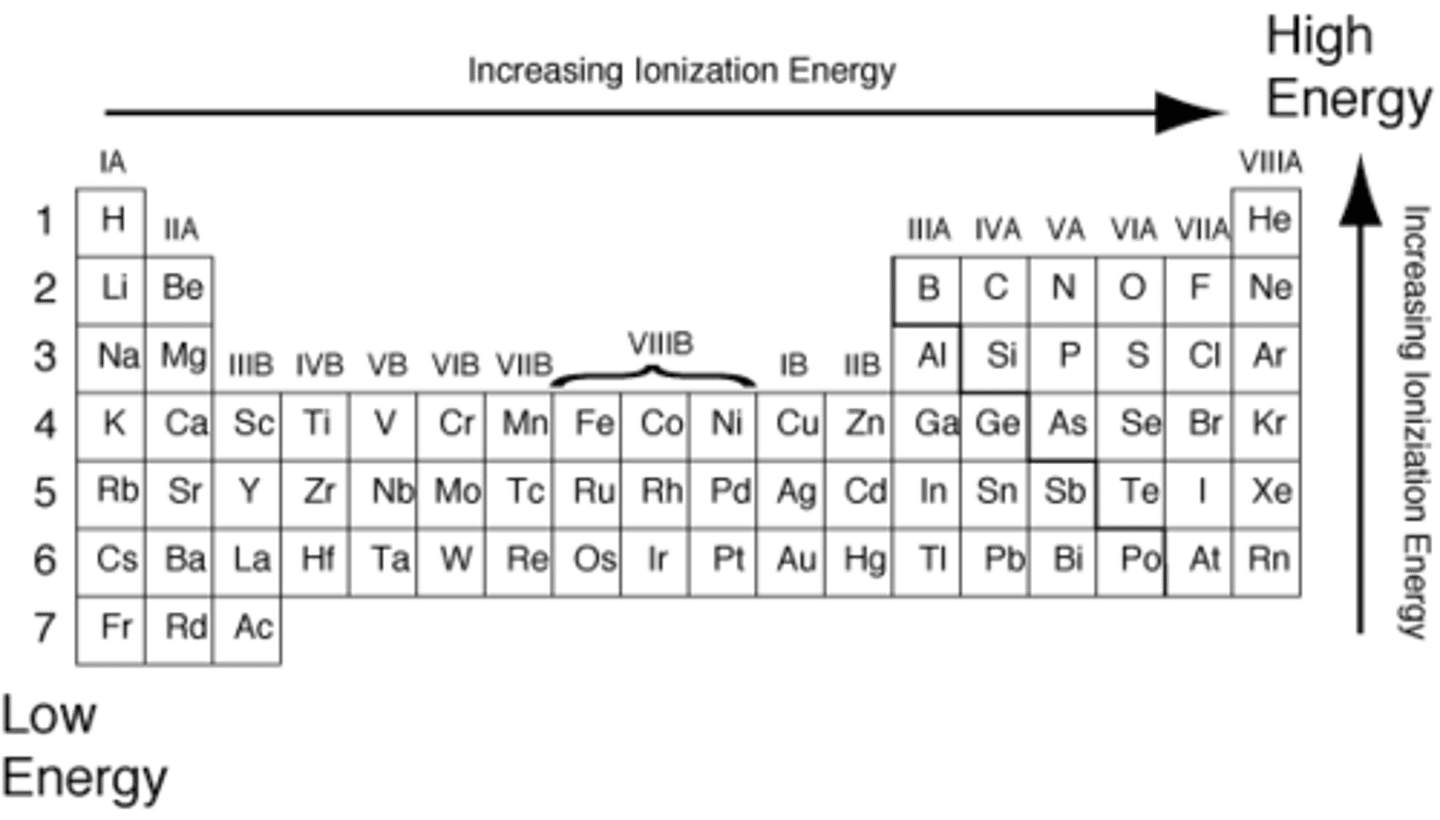
ionization energy
increases from lower left to upper right
1. down a group, more rings means valence electrons are less tightly held
2. across a period, more protons means valence electrons are more tightly held
for neutral atoms, second ionization energy always greater than first
closed-shell requires more energy to remove electron
ionization energy of boron slightly lower than beryllium because electron is in alone in p-orbital
ionization energy of oxygen slightly lower than nitrogen because electron has to occupy a p orbital with an electron already in it, calculate energy difference by comparing oxygen if hypothetically spin pairing didn't occur with when it does occur
electron affinity
increases from lower left to upper right (value becomes more negative, but magnitude increases)
1. down a group, more rings means less energy released
2. across a period, more protons means more energy released
defined as energy change when adding an electron to valence shell in gas state
high electron affinity means high reduction potential
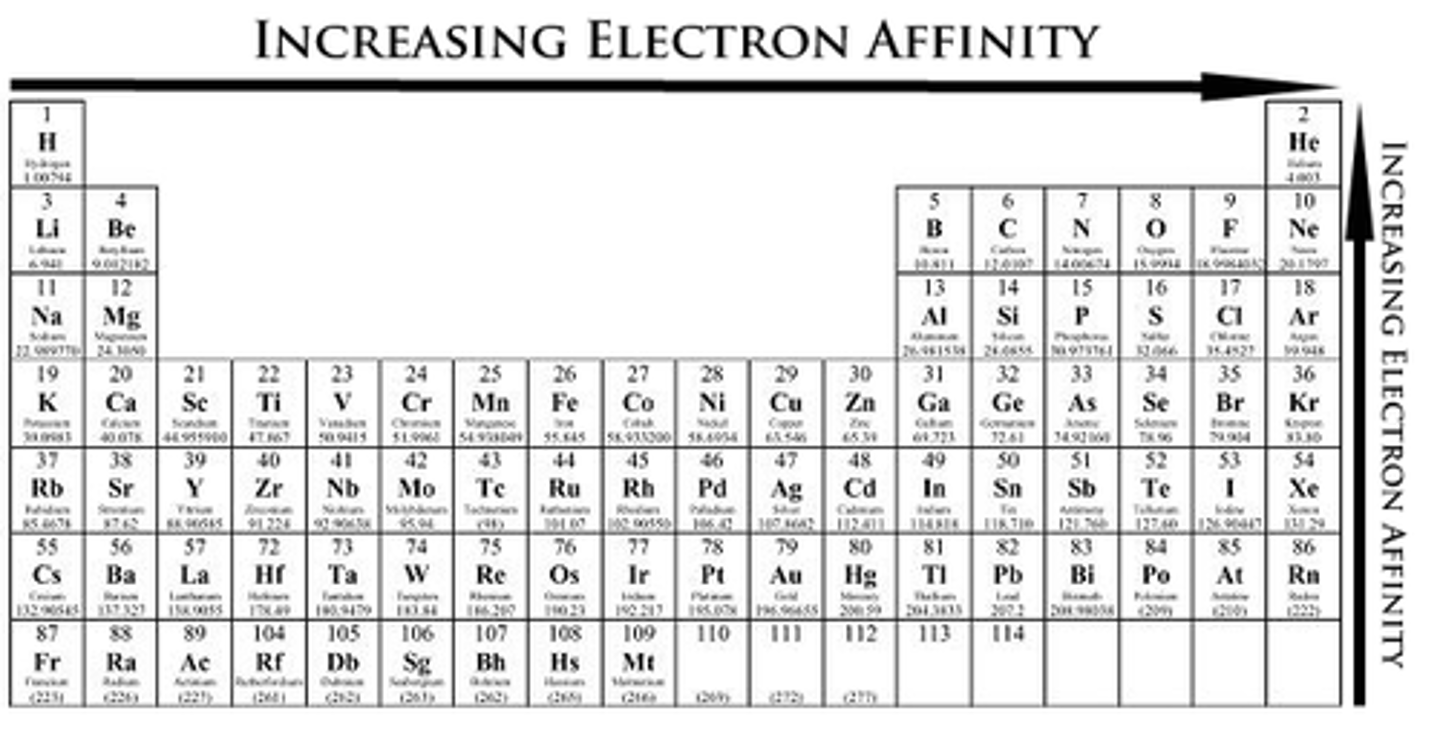
electronegativity
increases from bottom right to upper left
1. down a group, more rings means less pull
2. across a period, more protons means more pull
metals lose electrons in presence of non-metals
F > O > N > Cl > Br > I > S > C = H
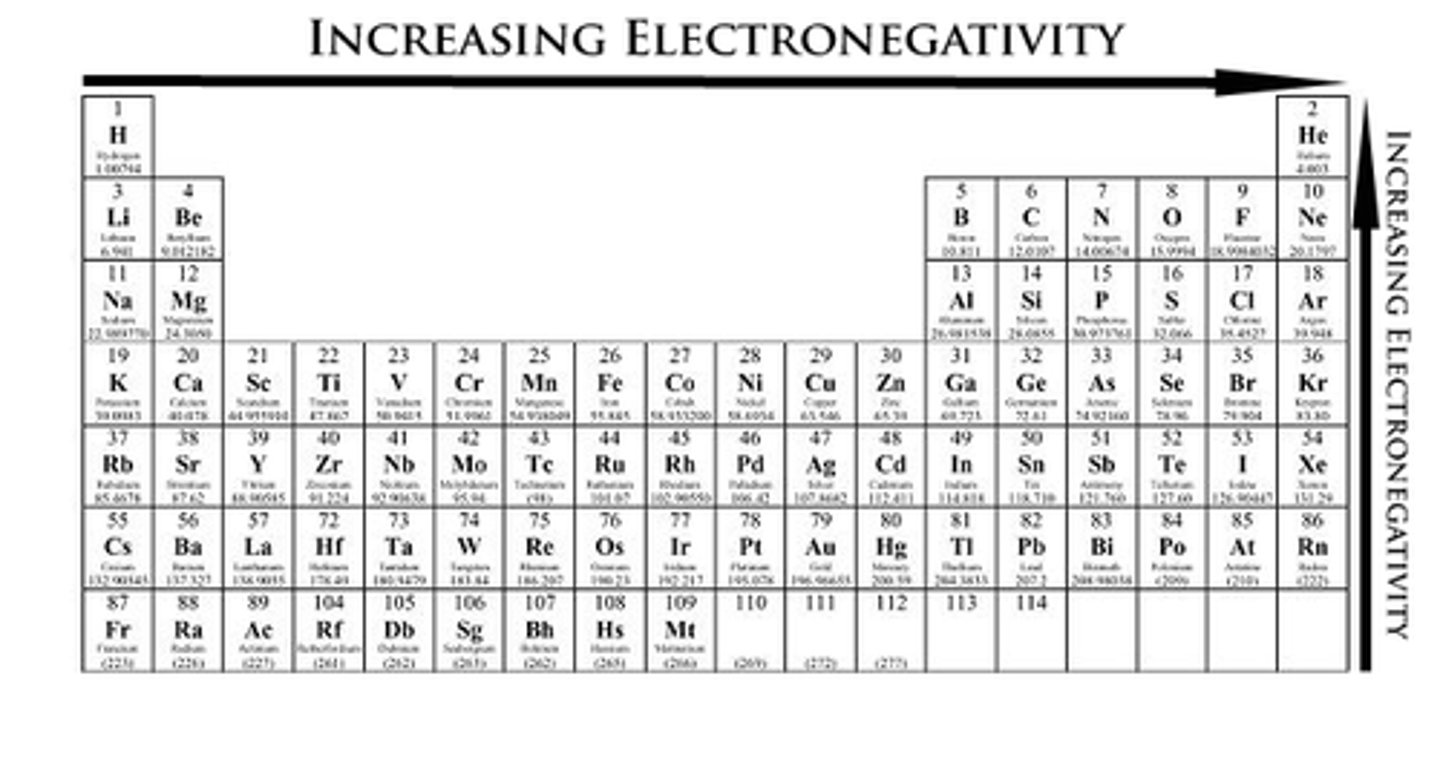
acidity
increases from upper left to lower right (different!)
1. down a group, size explains: larger atom means conjugate base (cation) is more stable
2. across a period, electronegativity explains: more protons means conjugate base (cation) is more stable
Lewis structures and formal charge
1. place least electronegative atom is center, always C
2. start with all single bonds, deduct 2 electrons for each
3. start with most electronegative atoms and make octets
4. any remaining electrons add to central atom
5. form bonds to fill any atoms without octets
6. assign formal charge = valence electrons - sticks - dots
positive formal charge should be on less electronegative atoms
try to reduce set of formal charges
check that formal charges add up to overall charge
hybridization
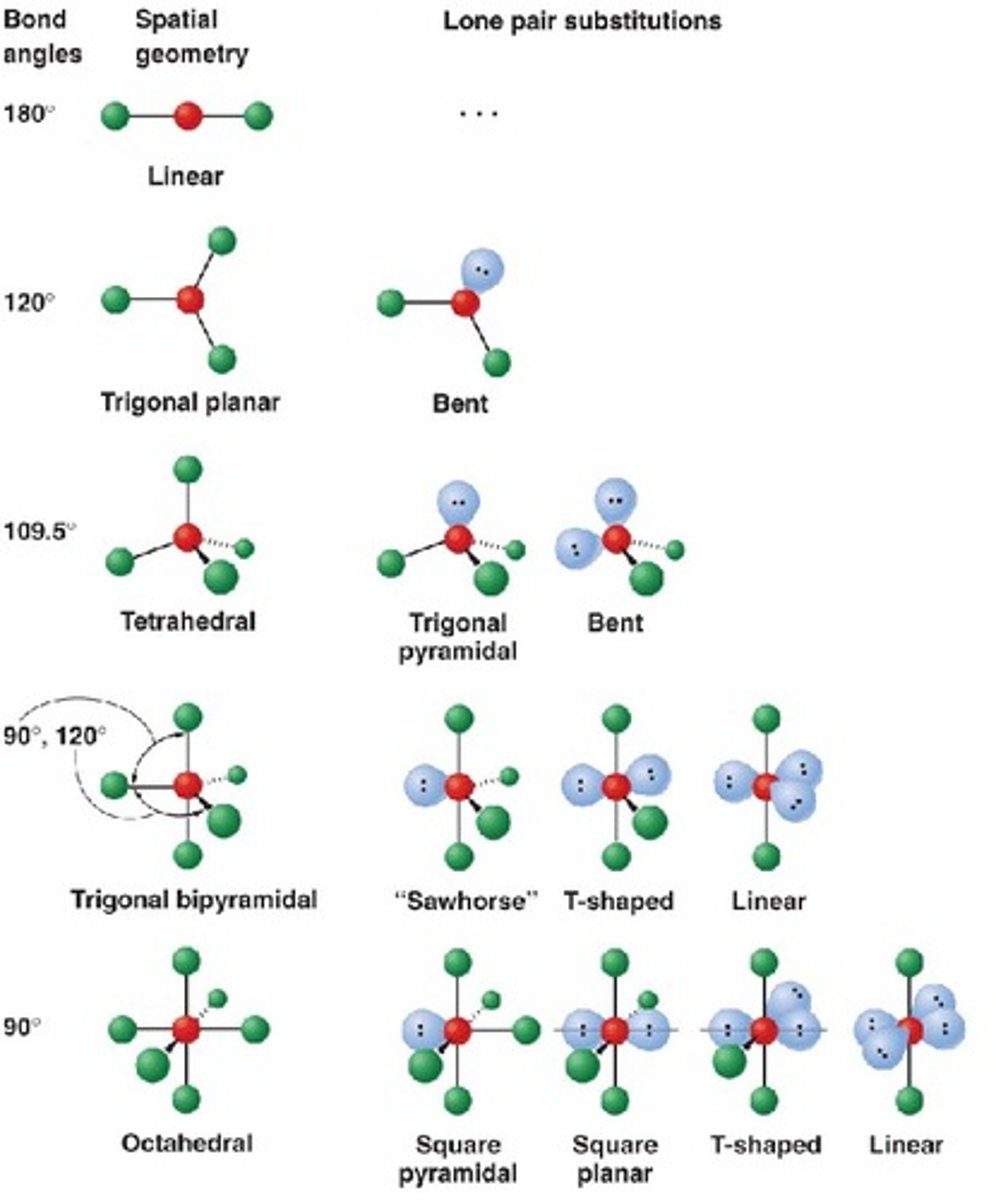
sp for 2 groups, sp2 for 3 groups, sp3 for 4 groups
lone pairs determine molecular geometry: NH3 is trigonal pyramidal (sp3), H2O is bent (sp3), XeF4 is square planar (sp3d2), SF6 is octahedral (sp3d2)
octahedral is 6 bonds, 90 degrees (sp3d2)
sp3 to sp2 conversion to attain planarity and aromaticity (4n+2 electrons resonating in a ring)
amide N can convert from sp3 to sp2 to get resonance stabilized by carbonyl O
orbitals with more s character are more stable
bond length
depends on atomic radius (which increases to lower left)
depends on bond order, more electrons shared is a stronger bond and closer bond
breaking bonds
breaking a bond is endothermic (positive dH) but also exergonic! (negative dG)
ATP ->ADP + H2O requires heat but produces net energy
stronger bonds:
1. have more electrons shared
2. shorter distance between atoms
3. have higher dissociation energy
ATP phosphates
alpha- phosphate closest to sugar
beta- middle one
gamma- phosphate on tip
covalent bonds
metal and nonmetal share electrons
electronegativity differences creates dipoles at each bond
molecular dipole found by adding up all the bond dipoles
metallic bonds
sea of electrons delocalized between metal ions
usually S and D block elements
these compounds are conductors and malleable
coordinate covalent bond
formed between atoms with lone pairs and atoms that are electron deficient
usually between transition metals and organic compounds, where compounds donate electron pairs to coordinate with the metal
coordinate number- number of compounds coordinating with metal ions
Fe2+ can form 6 coordinate covalent bonds (that completely fill up its valence shells)
Fe2+ forms coordinate covalent bonds with hemoglobin
ionic bonds
formed between cations and anions
ions dissociate in aqueous solution, become conductor
as solids, these compounds are insulators and brittle
insulator/conductor
insulator- valence electrons tightly bound to atom
conductor- delocalized electrons, metallic bonds
intermolecular forces
pulling apart atoms is always endothermic!
4 types of IMFs:
1. ion-dipole forces- ions and polar molecule
2. dipole-dipole forces- two polar molecules, align along the molecular dipoles, H-bonding is special case
3. dipole-induced dipole forces- polar, nonpolar molecules
4. london dispersion forces- Van der Waals, temporary
5. Hydrogen bonds- align along the bond dipoles, require a donor and an acceptor, only N, O, and F can do hydrogen bonds
solvation shell
A cagelike network of solvent molecules that forms around a solute in a solution
decrease in entropy
active site
acidic and basic amino acids can undergo H-bonding and ionic interactions with the substrate
ATP has negatively charged phosphates that interact well with H, R, and K
entropy
disorder, always increasing in universe
what increases entropy (S):
1. increasing number of particles
2. increasing volume
3. increasing temperature
formation of a more organized compound or state would decrease entropy
enthalpy
breaking bonds is endothermic (dH > 0)
forming bonds is exothermic (dH < 0)
heat of formation (dHf) of elements in standard state is 0
heat of reaction (dH) = Hf products - Hf reactants
multiply by number of moles
positive dH means endothermic, heat is reactant
negative dH means exothermic, heat is product
Gibbs free energy and spontaneous reactions
dG = dH - TdS
dGo = - RTlnK
dG = dGo + RTlnQ
free energy of formation (dGf) of standard state elements is 0
spontaneous process is exergonic (dG < 0)
nonspontaneous process is endergonic (dG > 0)
examples:
combustion (-dH, +dS) is spontaneous at all temperatures
freezing (-dH, -dS) is spontaneous at low temperatures
ATP -> ADP (+dH, +dS) is spontaneous at high temperatures
bond and IMF strengths
order of bond strengths:
1. covalent
2. ionic
3. metalic
4. coordinate covalent
order of IMF strengths:
1. ion-dipole
2. dipole-dipole (H-bonds)
3. dipole-induced dipole
4. london dispersion forces
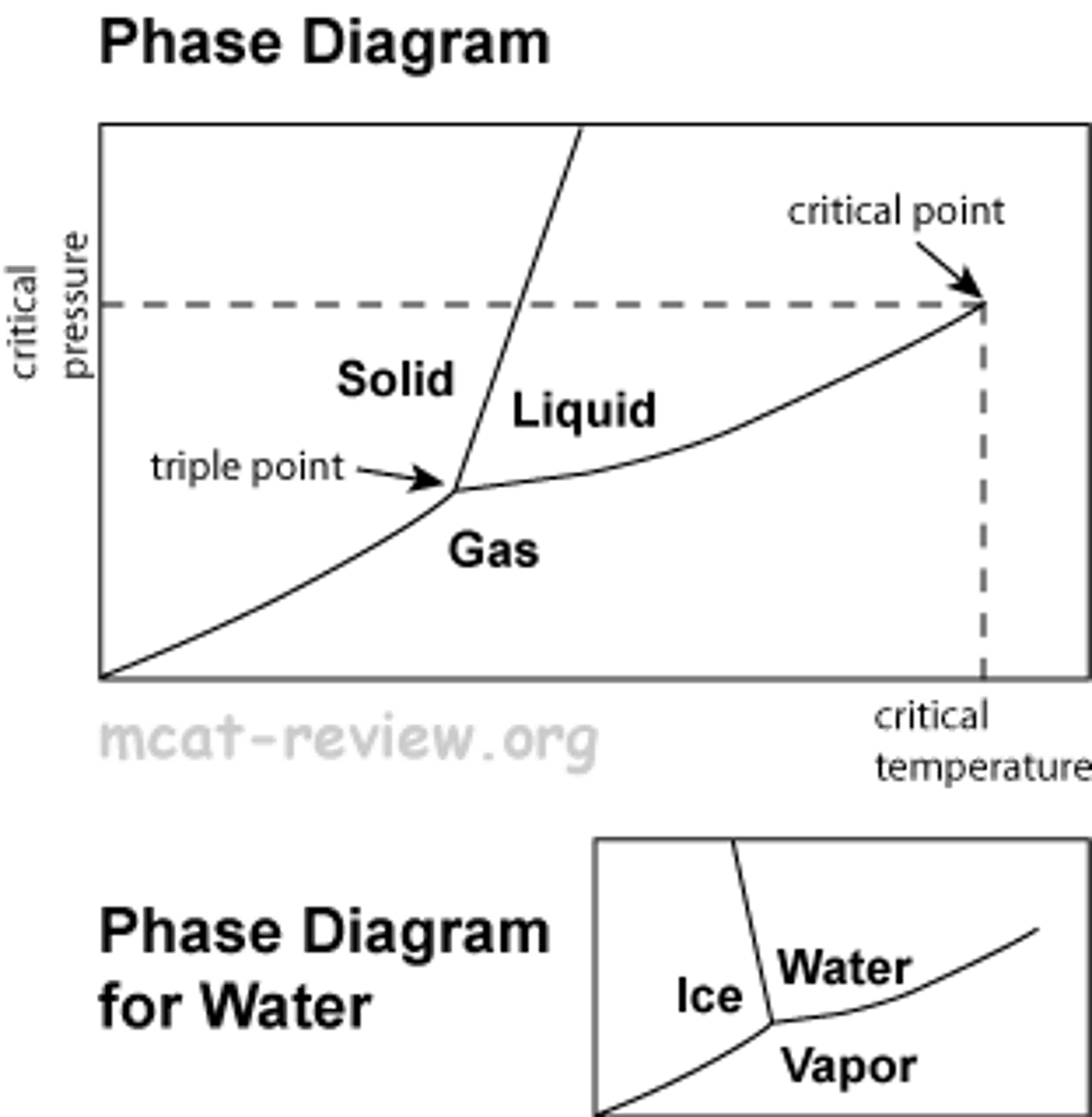
phase diagram
as pressure and temperature increase, phase change from solid to liquid to gas
triple point- all three phases coexist
critical point- above point liquid and gas are no longer distinct, becomes supercritical fluid
sublimation and evaporation line up on the diagonal
melting line is positive sloping, but for water it is negative sloping (MP decreases when pressure increases, since ice has more volume than water)
density is directly proportional to external P, indirectly proportional to external T
calorimetry
measure changes to determine heat transfer
constant pressure calorimeter- coffee cups
bomb calorimeter- volume constant, pressure changes
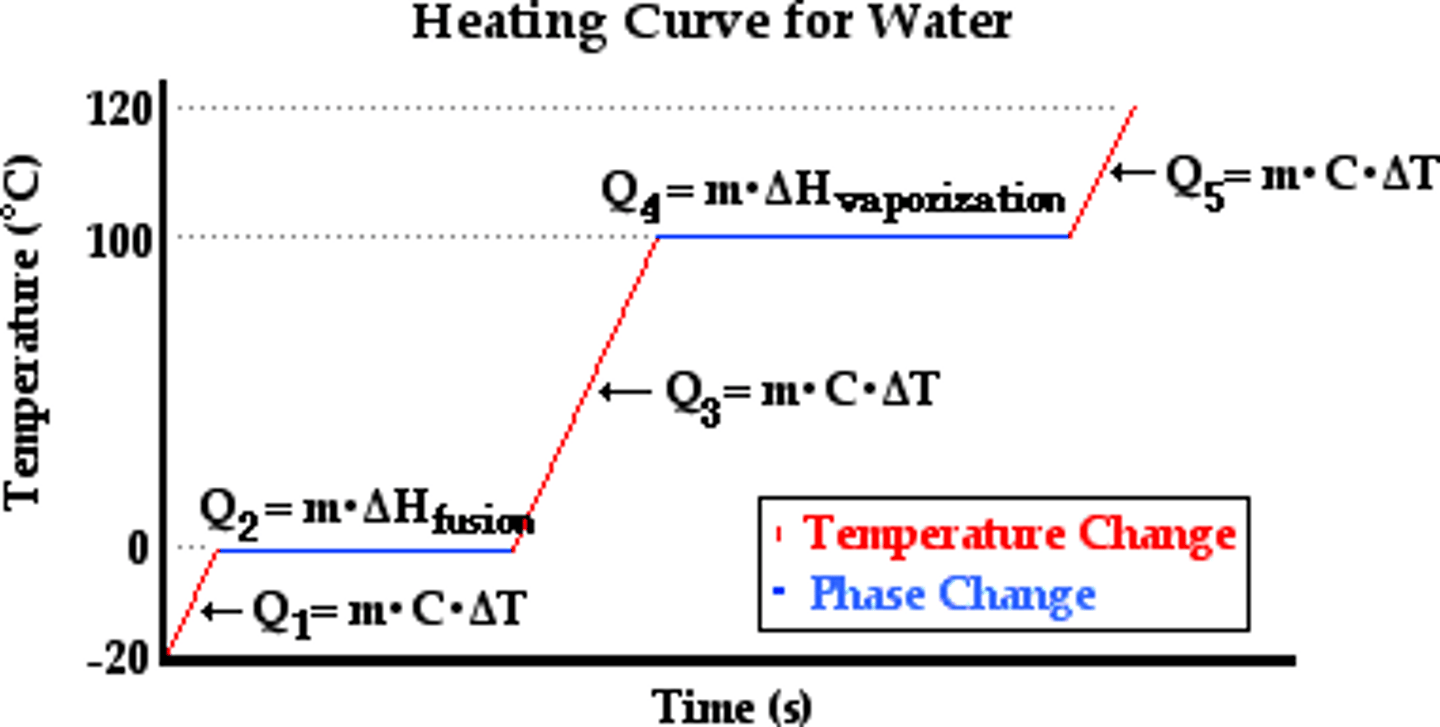
heating curve
heat for phase change
q = ndH
n = moles
dH = molar enthalpy of phase change
as IMFs break, potential energy of substance increases but no temperature changes occurs
heat for temp increase
q = mcdT
c = specific heat (J/kgK)
C = mc = heat capacity (J/K)
vapor pressure explains boiling point
force exerted by gas particles
Patm has no effect, external T is directly proportional
boiling point is when Pvap reaches Patm
boiling point is directly proportional to:
1. IMFs- the weaker the interactions, the higher the Pvap, the higher the boiling point
2. Patm- the lower the atmospheric pressure, the easier it is for Pvap to reach Patm
fp depression/bp elevation
3 factors cause this widening of fp and bp:
1. impurities (during mp determination)
2. ions (colligative property in solvent)
3. cholesterol (in lipid membrane)
surface tension
factors that decrease surface tension:
1. increased temperature
2. increased surface area
barometer
air pressure inside tube is less than atmospheric pressure, so liquid level rises
increased liquid pressure exerts force downward to compensate for decreased air pressure, until equilibrium
air pressure inside does not change!
solution and electrolytes
homogenous mixture, solute in solvent (usually aqueous)
strong electrolyte- complete dissociation, strong acid/base
weak electrolyte- partial dissociation- weak acid/base
non-electrolyte- no dissociation, covalent bonds
van't Hoff factor (i)- number of particles per mol
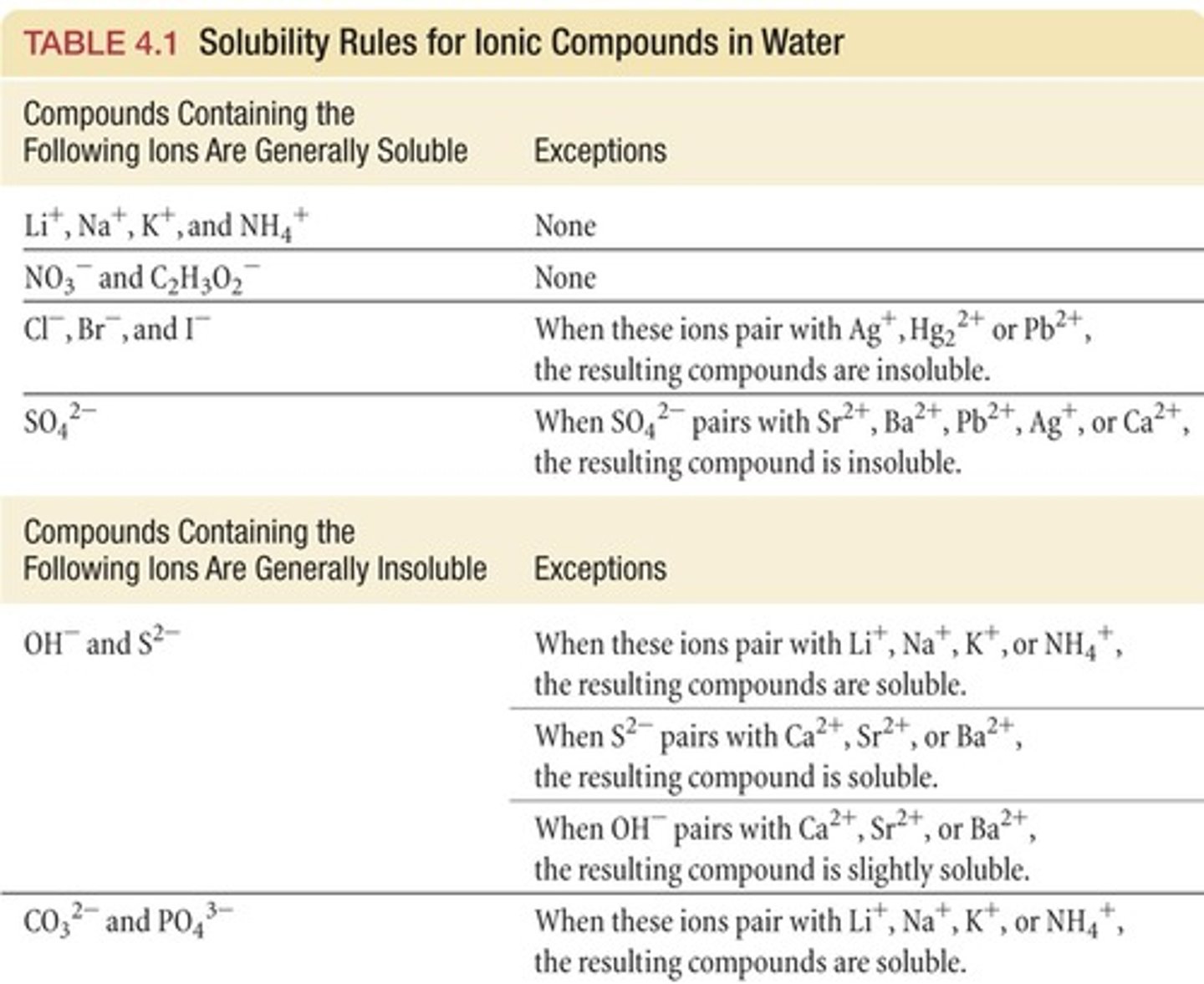
solubility rules
solid/liquid solubility in water:
1. directly proportional to temperature
2. not affected by pressure
gas solubility in water:
1. indirectly proportional to temperature
2. directly proportional to pressure
always soluble:
1. alkali metal ions, H+, NH4+
2. NO3-, CH3COO-, ClO4-
usually insoluble:
1. Ag+, Pb2+, Pb4+, Hg2+
2. CO3(2-), PO4(3-), S2-
kinetic-molecular theory of gases
an ideal gas has:
1. no IMFs
2. particles have no volume
3. temperature is average KE
4. elastic collisions with container
high temperature, low pressure creates an ideal gas since interactions are minimized
basic gas laws
Avogadro's law- n proportional to V, so 1 mol is 22.4 L at STP
Boyle's law- P inverse to V, PV = PV
Charles' law- T proportional to V, V/T = V/T
Gay-Lussac's law- T proportional to P, P/T = P/T
Dalton's law- partial pressure proportional to mole fraction, Ptotal = P1 + P2
PdV curve
x-axis is volume
y-axis is pressure
work = PdV = area under the curve
filling up more volume under constant pressure does more work
units of pressure
1 atm = 100 kPa = 760 torr = 760 mmHg
ideal gas law
PV = nRT
R = .08 Latm/Kmol
but you don't need this, just use 22.4 L/mol at 0 C and 1 atm
real gas law and non-ideality
P_theoretical > P_obs, since particles have IMFs with each other
V_theoretical < V_obs, since particles have size
(P_obs + an^2/V^2)(V_obs - nb) = nRT
1. a increases as IMF increase
2. b increases as particle size increases
non-ideal conditions are high pressures and low temperatures, which maximize IMFs:
1. V_obs is greater than predicted
2. P_obs is smaller than predicted
Graham's law of diffusion/effusion
rate1/rate2 = sqrt(molar mass2/molar mass1)
heavier particles diffuse slower
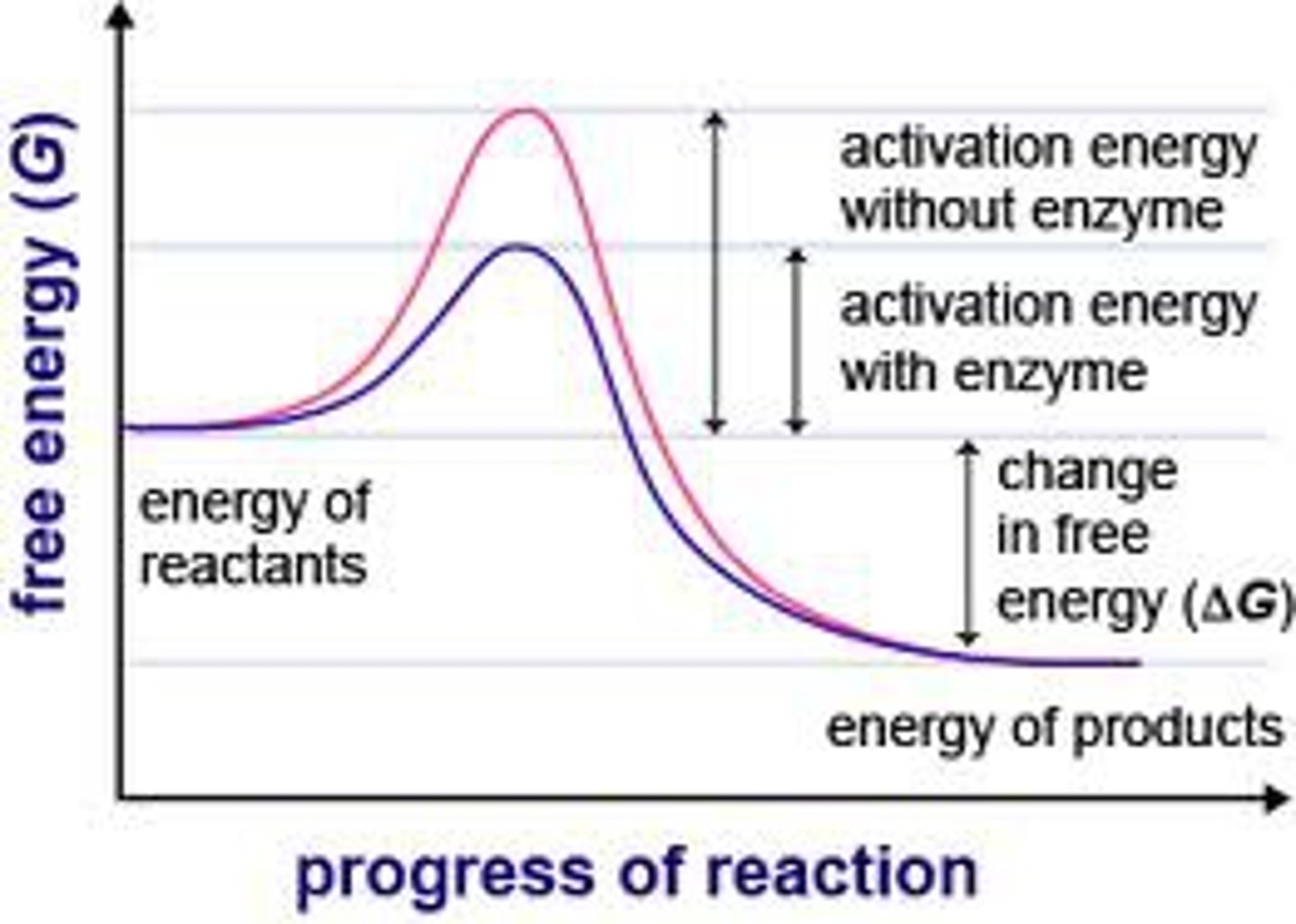
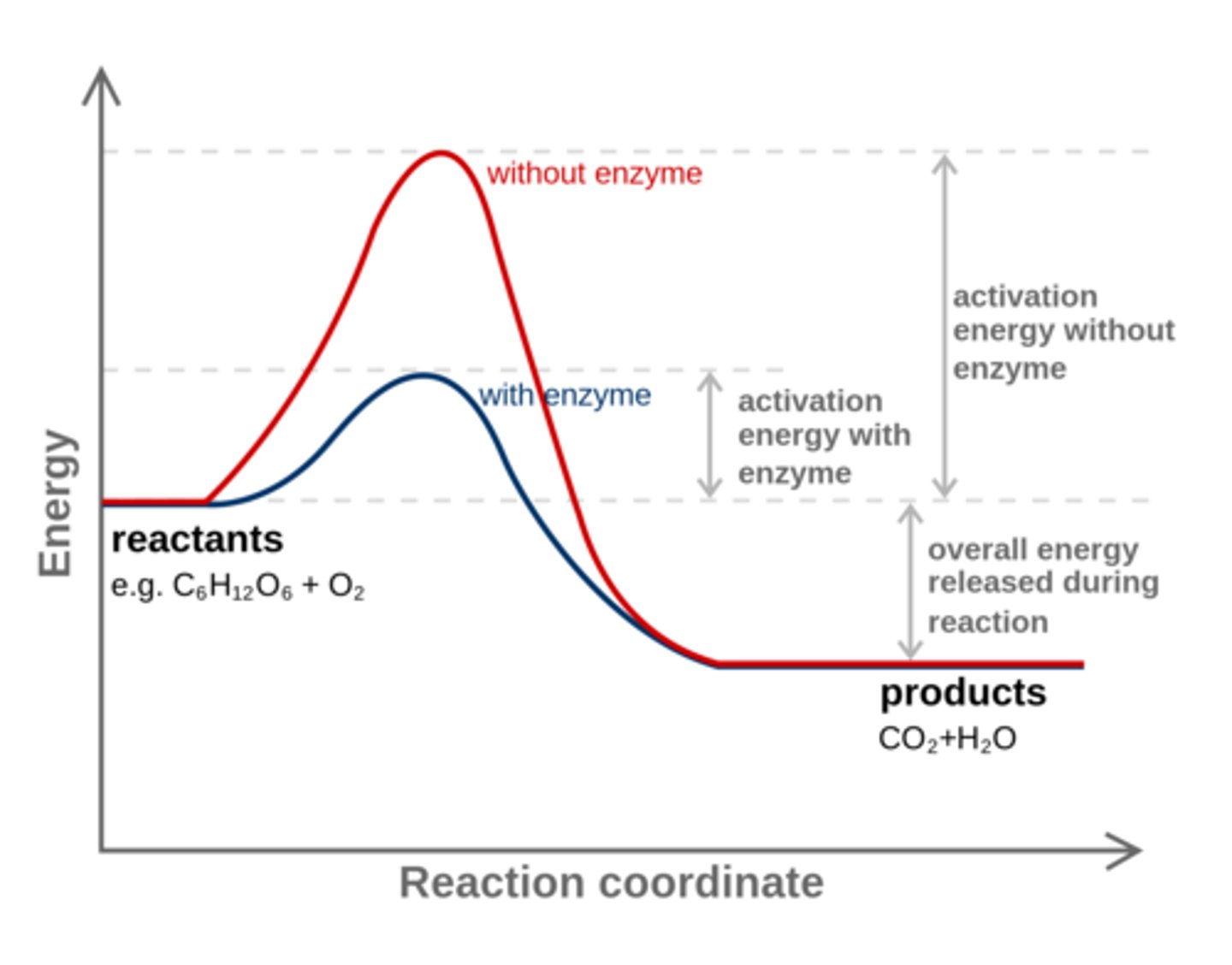
reaction coordinate graph
x-axis is reaction progression
y-axis is free energy
peaks are transition states
valleys are intermediates
the highest peak is the rate limiting step
difference between reactant energy and highest peak is Ea
catalysts lower peaks, does not affect equilibrium
reaction rate
factors that increase it:
1. higher concentration of reactants
2. proper orientation, catalysts help
3. minimum energy to overcome Ea
rate constant
factors that increase it:
1. increased temperature
2. decreased activation energy
3. not affected by concentration of reactants!
rate law
rate = k[A]^x[B]^y
order is sum of exponents
determine rate law:
1. coefficients of reaction become the exponents of rate law
2. solids are not included
3. rate law determined by rate limiting step
determine rate law from data:
1. determine rate constant from any trial
2. 0th order if rate is same between two trials with diff. concentrations of a reactant
3. 1st order is rate increase is same as concentration increase of reactant
4. everything else must be 2nd order
catalytic efficiency
vmax = k_cat*[total enzyme]
catalytic efficiency = k_cat/Km
equilibrium constants
K is conc. of reactants over products, K > 1 favors products
K only changes when temperature changes
Keq > 1 means dG < 0, so spontaneous
Keq < 1 means dG > 0, so non-spontaneous
Q is reaction quotient using present concentrations state:
1. Q > K favors shift to reactants
2. Q = K is in equilibrium
3. Q < K favors shift products
why? because of the equation below:
1. dG = dGo + RTlnQ
2. dGo = -RTlnK
3. dG = 0 at equilibrium
factors that affect equilibrium
Le Chatelier's principle says system in equilibrium shifts to minimize stress:
1. change in concentration/partial pressure
2. change in pressure/volume
3. change in temperature
change in concentration or partial pressure- causes shift to reduce the change, solids do not affect equilibrium!
increase in pressure- causes shift towards side with less moles of gas
decrease in volume- causes shift towards side with less moles of gas
change in temperature- treat heat as a reactant/product
multiple equilibria
when one reaction in a system shifts, all reactions shift in the same direction
H2O + CO2 <-> H2CO3 <-> H+
when a person hyperventilates, CO2 decreases, blood pH increases
combining two equations requires multiplying the K values
reversing an equation requires inversing the K value
solubility equilibrium
Ksp- concentrations of products since the reactant is solid
molar solubility- moles of solid dissolved, you can plug this into Ksp equation
Qsp > Ksp means that oversaturated, precipitate forms (shift towards reactants)
common ion effect- salt solubility decreases when mixed in solution with a common ion (shift towards reactants)
opposite effect is true, salt solubility increases when mixed with solution that reacts with an ion, like an acid/base (shift towards products)
association/dissociation equilibrium
Ka = [AB]/[A][B]
Kd = [A][B]/[AB]
kinetics vs. thermodynamics
kinetics- rate, intermediate, activation energy, catalyst
faster product
thermodynamics- stability, equilibrium, spontaneity, entropy, enthalpy, free energy
more stable product
for example, free energy of ion transport does not tell you about the kinetics of a channel protein
acid/base trends
acids have more electronegative atoms
atoms without H can be acids if electron deficient
increased acidity:
1. more positive charge
2. more electronegative atom (only within a period)
3. larger atom (only within a group)
bases have less electronegative atoms
atoms without lone pairs are not basic
increased basicity:
1. more negative charge
2. less electronegative atom
3. smaller atom
acidity/basicity of salts
salts will completely dissociate in water!
acidic salt contains ion that is a weak acid
cations in group I and II are not acidic (spectators!)
basic salt contains weak base
anions like Cl, Br, or I are not basic (spectators!)
determine pH of solution
1. The acidity of an element increases as one moves to the right or down the periodic table.
2. The conjugate base of a strong acid is a very weak base, forming pH neutral solutions.
3. The conjugate base of a weak acid is a kinda weak base, pH will be higher.
amphoteric
can be both acid or base
examples:
1. amino acids
2. water
3. bicarbonate
strong acids (6) and calculating pH
HCl, HBr, HI, H2SO4, HClO4 (perchloric acid), HNO3
how to calculate pH:
1. write the concentration in scientific notation
2. take the negative of the 10 exponent
3. round down (because you ignored the actual value) and say it's somewhere in between those two values
for diprotic acids, just double the concentration, you can get a negative pH
large Ka, weak conjugate base has small Kb
weak acids and calculating pH
acetic acid, H3PO4 (phosphoric acid), H2CO3 (carbonic acid), NH4, HF
Ka = [H+]^2/[HA] from ICE table
pH = -1/2log(Ka[HA])
use same estimation technique
small Ka, strong conjugate base has large Kb
pH in solution is a bit under 7
weak acids can fully dissociate just like strong acids if another reaction removes protons to shift equilibrium to the right (like bicarbonate buffer)
strong bases (6) and calculating pH
O2-, OH-, OR-, H-, R-, NH2-
how to calculate pOH:
1. write the concentration in scientific notation
2. take the negative of the 10 exponent
3. round down (because you ignored the actual value) and say it's somewhere in between those two values
for diprotic bases, just double the concentration, can get a negative pOH
large Kb, weak conjugate acid has
weak bases and calculating pH
NH3
Kb = [OH-]^2/[B] from ICE table
pOH = -0.5log(Kb[B])
small Kb, strong conjugate acid was large Ka
pH in solution is a bit over 7
differences in pH
pH 4 has 100 times H+ concentration as pH 6
buffers
conjugate acid/base pair, minimize pH change
weak acid or base (acetic acid, phosphoric acid, carbonic acid are weak acids, NH3 is weak base etc.)
both acid and base must be available to push equilibrium to account for changes in conc.
pH = pKa + log([A-]/[HA])
HH equation shows that conc. of acid/base dependent on pH
if pH < pKa, then buffer is more protonated, each difference of 1 in pH is 10-fold increase in concentration
adding water dilutes your buffer, reduces buffering capacity, but does not affect equilibrium
choose a buffer within 1 of the pH you want to maintain!
![<p>conjugate acid/base pair, minimize pH change</p><p>weak acid or base (acetic acid, phosphoric acid, carbonic acid are weak acids, NH3 is weak base etc.)</p><p>both acid and base must be available to push equilibrium to account for changes in conc.</p><p>pH = pKa + log([A-]/[HA])</p><p>HH equation shows that conc. of acid/base dependent on pH</p><p>if pH < pKa, then buffer is more protonated, each difference of 1 in pH is 10-fold increase in concentration</p><p>adding water dilutes your buffer, reduces buffering capacity, but does not affect equilibrium</p><p>choose a buffer within 1 of the pH you want to maintain!</p>](https://knowt-user-attachments.s3.amazonaws.com/1ae060fd-efd7-4189-b812-e8ef1117d8c2.jpg)
henderson-hasselbalch equation
pH = pKa + log [base]/[acid]
conc. of acid/base are dependent on pH
calculate pH of buffer solution given conc.
when [base] = [acid], pH = pKa at half-equivalence point
auto-ionization of water, pH/pOH
at standard conditions:
Kw = KaKb = 1e-14
pKa = -logKa, pKb = -logKb
pKa + pKb = 14 (pH + pOH = 14)
pH = 0 is most acidic, pOH = 0 is most basic, neutral is pH = 7
titration
sigmoidal curve, indicator changes color at equivalence point
used to determine concentration of solution, where moles added equals moles in solution to reach each equivalence point
at equivalence point:
1. compound becomes deprotonated
2. moles of acid = moles of base, meaning everything is neutralized
3. center of vertical segments
at half-equivalence point:
1. pKa = pH
2. [acid] = [base], moles of acid = 1/2 moles of base, meaning half of the acid is neutralized
4. center of horizontal segments
polyprotic titration can be done with amino acids, double the moles added to reach the second equivalence point
for titrating a strong acid, the same volume of strong or weak bases is required to neutralize, the strength will only affect the pH of equivalence point
![<p>sigmoidal curve, indicator changes color at equivalence point</p><p>used to determine concentration of solution, where moles added equals moles in solution to reach each equivalence point</p><p>at equivalence point:</p><p>1. compound becomes deprotonated</p><p>2. moles of acid = moles of base, meaning everything is neutralized</p><p>3. center of vertical segments</p><p>at half-equivalence point:</p><p>1. pKa = pH</p><p>2. [acid] = [base], moles of acid = 1/2 moles of base, meaning half of the acid is neutralized</p><p>4. center of horizontal segments</p><p>polyprotic titration can be done with amino acids, double the moles added to reach the second equivalence point</p><p>for titrating a strong acid, the same volume of strong or weak bases is required to neutralize, the strength will only affect the pH of equivalence point</p>](https://knowt-user-attachments.s3.amazonaws.com/fb0f9686-0675-4994-9511-bef6ca5b4ea8.jpg)
indicators
choose indicator with pKa within 1 of the pH you want to measure!
equivalence point is the pKa of the indicator
redox reactions
OIL RIG
reduction is gain of electrons, decreased charge
reduction potentials are for the reactants of reduction rxn
easily reduced: neutral nonmetals, anything ending with O, halogens
oxidation is loss of electrons, increased charge
oxidation potentials are for the reactants of oxidation rxn
easily oxidized: H2, neutral metals, anything ending with H
redox reactions can be coupled so that a non-spontaneous reaction can occur, check the reduction potentials!
the ETC is a series of reductions, so each step has a higher standard reduction potential, with O2 -> H2O having the highest

oxidation states
Free Elements: Any uncombined element (like O₂, Na, or Cl₂) has an oxidation state of 0.
Monatomic Ions: A single-atom ion (like Cl⁻ or Mg²⁺) has an oxidation state equal to its net charge.
Neutral Compounds: The sum of all oxidation states for a neutral molecule equals 0.
Polyatomic Ions: The sum of all oxidation states in a multi-atom ion equals the overall charge of that ion.
cell potential
Ecell = Ered + Eox
free gibbs energy is inversely proportional with E:
1. dG = -nFEcell
2. Ecell > 0, cell is spontaneous (galvanic)
3. Ecell < 0, cell is nonspontaneous (electrolytic)
Faraday's constant
charge per 1 mol of electrons
F = 100,000 C/mol
Faraday's Law and electroplating
over time, electrons can be used to do work like electroplating
I = Q/t
Q = nF
Faraday's constant is charge per mole
calculate moles of metal plated given current and time:
1. determine charge: Q = It
2. determine moles of electrons: ne = Q/F
3. determine moles of metal: nmetal = ne/ionic charge (electrons per metal)
galvanic cell
cell must have two electrodes, an electrolyte bridge, and a wire with resistance (galvanic) or power source (electrolytic)
spontaneous, positive Ecell
oxidation at the anode (an ox), reduction at the cathode (red cat)
electron travel from anode (-) to cathode (+) through wire, discharging battery
cathode is plated, anode loses metal ions
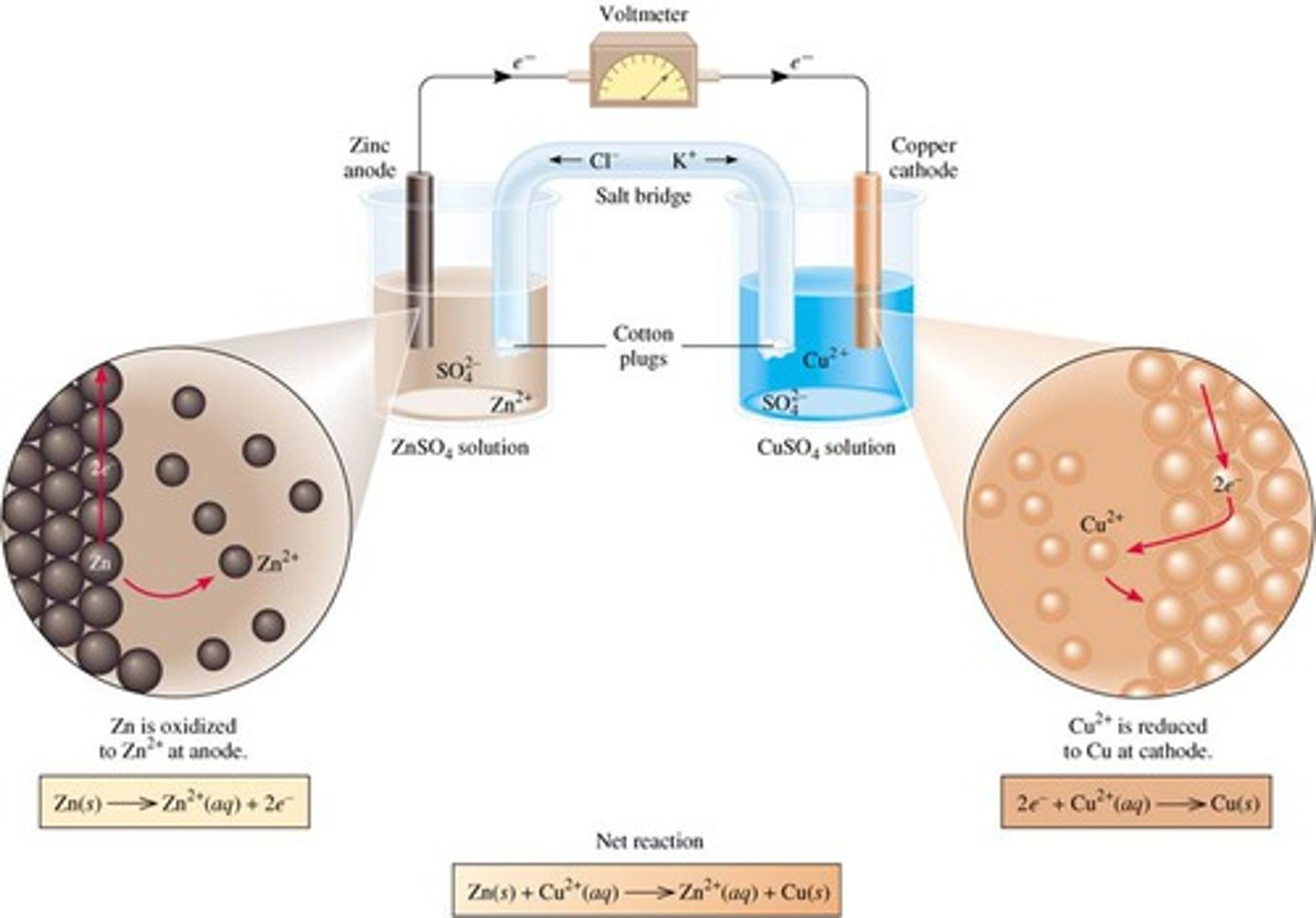
Nerst equation
cell in equilibrium has an actual cell potential of 0 and a standard cell potential of not 0
E = E0 - (RT/nF)lnQ
E0 = (RT/nF)lnK
-as temp increases, Ecell decreases
-as battery approaches equilibrium, Ecell approaches 0
-E0 is constant
salt bridge
anion will always migrate towards anode, cation will always migrate toward cathode
in galvanic cell, salt bridge balances out movement of electrons from anode to cathode
in electrolytic cell, anion just is attracted to positively-charged anode
without a salt bridge, current immediately stops
electrolytic cell
opposite of galvanic cell
recharging battery using external energy source reverses flow of electrons
electrons still going from anode to cathode, but are being forced to cathode is negative and anode is positive
increasing current will increase rate of electroplating
drives nonspontaneous reaction, negative Ecell
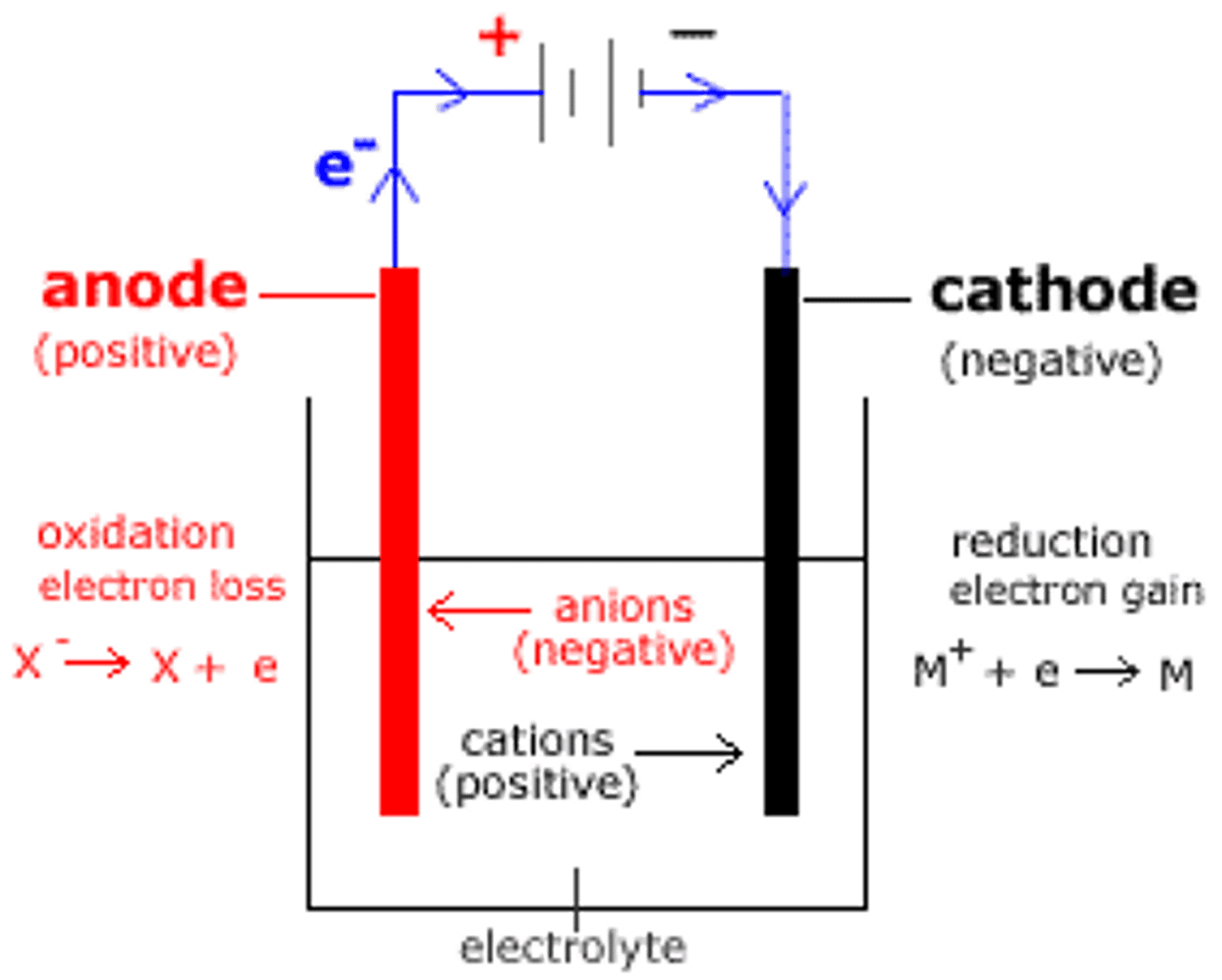
electrolysis
in electrolytic cell with water, hydrolysis will occur creating H2 at the cathode and O2 at the anode
in electrolytic cell with NaCl, hydrolysis will occur creating H2 at cathode and Cl2 at anode
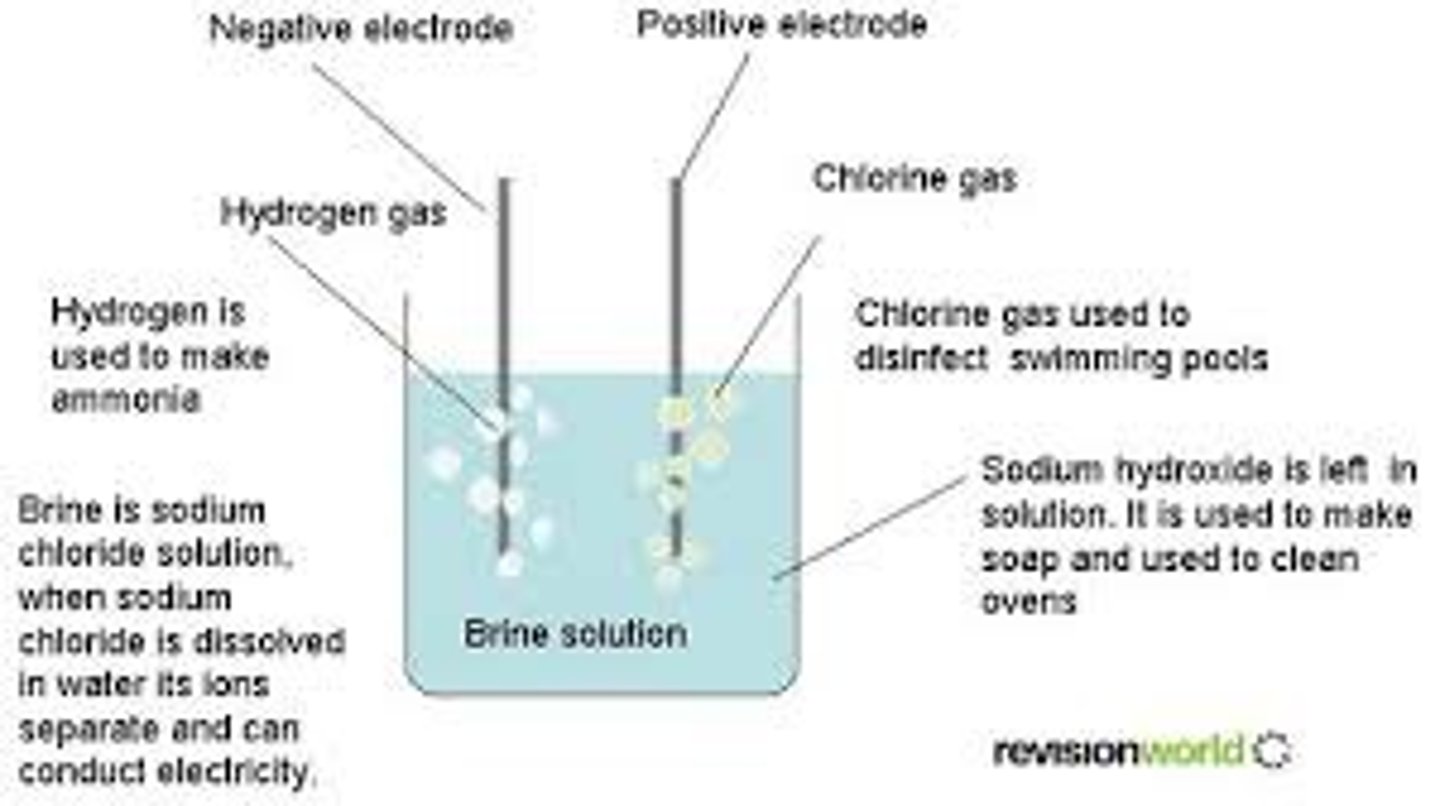
redox titration
cerimetry- Ce4+ + e- => Ce3+
adding Ce4+, observing increase in pH on y-axis
alpha decay
4/2He2+ emitted from nucleus, subtract 2 protons and 2 neutrons
larger nuclei more likely to undergo, less dangerous
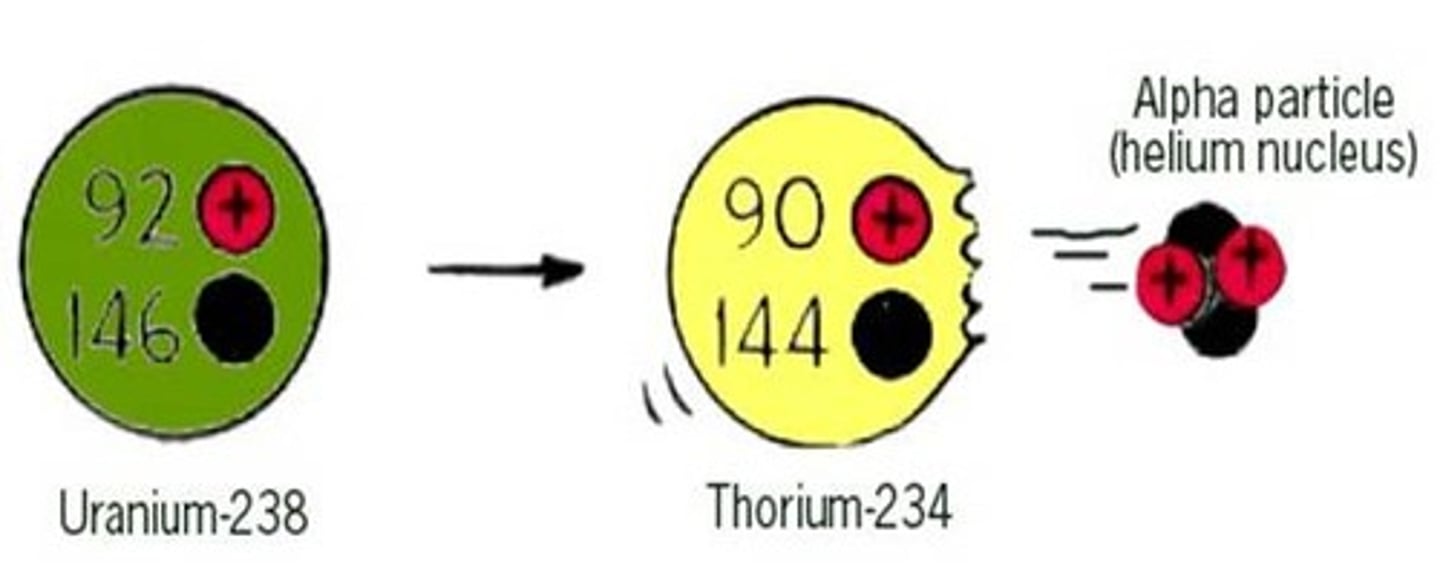
beta decay
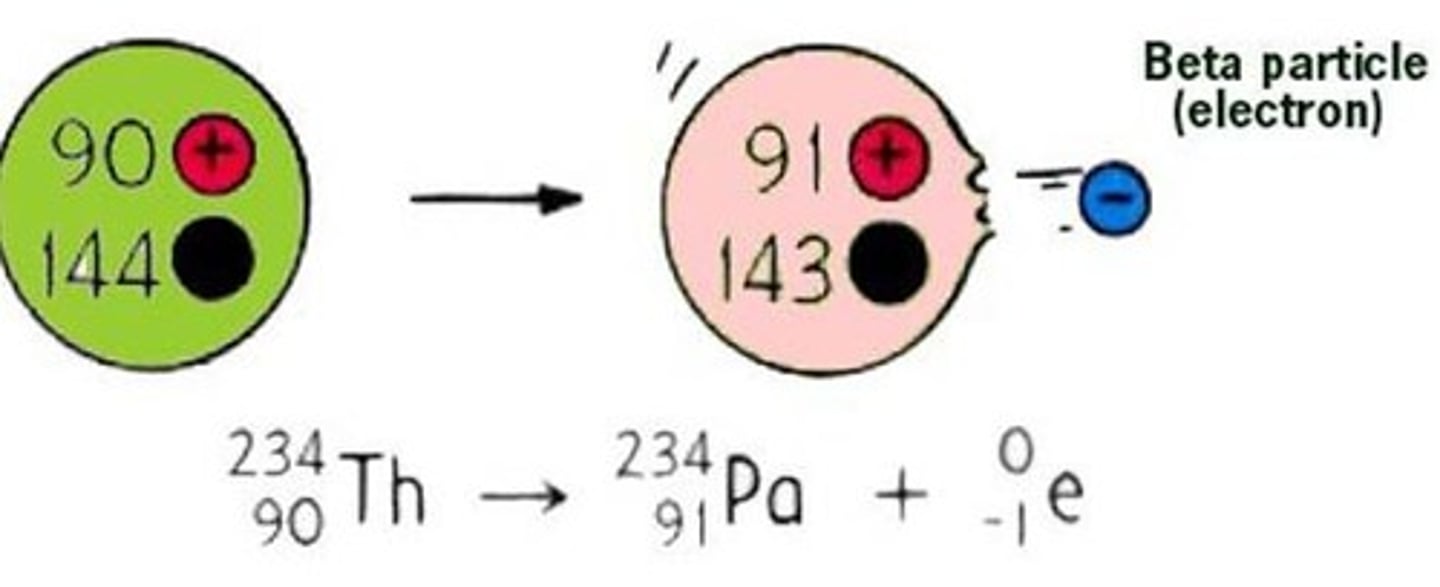
beta decay- electron emitted from nucleus, neutron becomes a proton and electron
positron emission- beta positive decay, positron (positive charged electron) is emitted, proton becomes a neutron and positron
electron capture- another type of beta decay, electron absorbed by nucleus, electron and proton become a neutron
high proton to neutron ratio makes this more likely
gamma decay
photons are emitted
most dangerous type of radiation
half-life
time it takes for a substance to decay to half of its original amount
a radioactive isotope will have a half-life as it decays to a different daughter isotope (which may or may not be radioactive)
atomic mass would be negligibly affected, while atomic number would be affected
nuclear reactions
are always exothermic!
decay, fission, fusion
mass defect- protons and neutrons separately have more mass than when together in nucleus, binding energy between nucleons
binding releases energy, breaking bonds takes energy