biology230 FINAL
 Call Kai
 Learn
Learn Practice Test
 Spaced Repetition
 Match
Match Flashcards
 Knowt Play
1/71

There's no tags or description
Looks like no tags are added yet.
Name | Mastery | Learn | Test | Matching | Spaced | Call with Kai | Chat |
|---|
No analytics yet
Send a link to your students to track their progress
72 Terms
How do biologists measure species diversity?
Biologists measure species diversity by combining two separate components: species richness and relative abundance. Basically, the different species that are present and their proportion to one another. There could be many different species, but one species can be dominating the community itself. By comparing them, they come to a conclusion of species diversity
keystone species (def)!!!!!!
a keystone species is a powerful predatory with a strong impact on its ecosystem. Their impact on their community is much larger than their total mass or abundance indicates. A keystone species occupies an ecological niche that holds the rest of its community in place.
what roles do keystone species have in their community + examples!!!!!!
regulate the populations in an ecosystem —- use example of pisaster ochraceus — when pisaster ochraceus (a species of starfish) was removed from their ecosystems, their main prey (mussels) overpopulated and drove out every other species. When otters were removed from their ecosystem, such as when the orcas had been feeding on them after the whale population decline due to the fur trade, sea urchins overpopulated and prevented the growth of kelp (they were eating all of it)
species diversity
the variety of species that make up the community. has two components: species richness and relative abundance. Species richness refers to the number of different species in the community. relative abundance of the different species refers to the proportional representation of each species in the community (comparing the numbers of each species)
What is the green world hypothesis?
The number of herbivores (referring to trophic cascade) is not only bottom-up, but also top-down. The green world hypothesis aimed to explain how the earth was “green” as in how we had so many producers. Up until this point, everybody believed that the trophic cascade was only bottom-up, which didn’t explain how there were so many producers left. Then, they developed the top-down explanation where predators keep herbivores in check, preventing them from drawing out all of the producers.
top-down green world hypothesis (ecological control)
The amount of herbivores that feed on a plant community is regulated by predators. Basically, the predators would be keeping the number of herbivores in check, which are meant to keep the amount of producers in check. If there are too many herbivores, there will be no more producers. The predators keep herbivores in check so that there are enough producers.
buttom-up green world hypothesis (ecological control)
The amount of producers limits the amount of herbivores which feed on them which limits the amount of predators. Basically, if there were less producers, herbivores would have less food, so there would be less surviving herbivores, in turn, the predators would have less herbivores to feed on
trophic cascade
a trophic cascade is when you have an apex predator which controls the distribution of resources, leading to a cascade of indirect effects.
otter, sea urchin, kept trophic cascade explained + orca!
Sea otters consume sea urchins, which consume kelp. If there are no otters to balance the number of sea urchins, there will be less kelp. At the Aleutian Islands in Alaska, the past fur trade of whales and the near extinction forced orcas to consume other organisms. They resorted to otters, which directly impacted how much sea urchins there were and kelp there were (in this given ecosystem). So, the orcas were eating the otters. Since there were less otters, the number of sea urchins went up which lowered the remaining kelp levels.
Examples of keystone species
Pisaster Ochraceus (a species of starfish) which primarily eat mussels. When removed from their ecosystem, mussels overpopulated and drove out basically every other organism in the same environment.
Why do nutrients cycle while energy flows?
Nutrients are uptaken by different organisms and eventually decompose back into the soil, where it is used by producers to refuel herbivores and so forth. Energy, on the other hand, flows as organic matter while losing much of itself while traveling up the food chain, The biomass is limited for each consumer, only being (approx.) 10% of the actual energy that was consumed.
Caterpillar energy percentages ratio
half of the calories it consumes is excreted as feces, 35% goes toward cellular respiration, and the REMAINING 15% OF THE CALORIES GOES TOWARD BIOMASS
How does climate change impact invertebrates? (quick bullet points)
temperature plays a vital role in breeding success for many organisms (which also impacts water warmth), geographic ranges shrink (habitat) like the example with the Upland Summer Mayfly who rely on cold streams a, reduced snow coverage (more habitat scarcity), altered weather patterns which can impact species in many different ways like how floods can wash out certain species
Ecological succession
the process where a disturbed area’s variety of species are replaced by a succession of other ones (two types);
are ecological disturbances good or bad for communities?
ecological disturbances are usually bad for communities since it results in habitat destruction and possibly spreading disease. Small scale natural disturbances are often positive for a biological community since they sometimes create new habitats and opportunities for life. Example —- natural fires consume dead organic material, creating more opportunities for vegetation to grow and possibly more habitats; !!! also, when a large tree falls in a windstorm, it creates new habitats. more light can reach the forest floor, giving small seedlings opportunity to grow. Even the depression of the trees roots may fill with water and be used by many different animals.
primary succession
when ecological succession begins in a virtually lifeless area with NO SOIL; often, the only life forms present are autotrophic bacteria. lichens and mosses are often first to colonize the area; EXAMPLES: areas of cooled lava flows on a volcanic island, rubble left over by a retreating glacier
secondary succession
when a disturbance has destroyed an existing community, but LEFT SOIL IN TACT
biomass (not rlly relevant js for understanding)
the amount on mass of living organic material in an ecosystem
order of a food web (FROM BOTTOM TO TOP)
producers (often plants), primary consumers (usually herbivores), secondary consumers, tertiary consumers, and quaternary consumers
primary production
the rate at which an ecosystem’s producers convert solar energy to the chemical energy stored in biomass
pyramid of production
illustrates the cumulative loss of energy with each transfer in a food chain where the width of each tier is how much chemical energy of the tier below is incorporated into the organic matter of that trophic level
What challenges and opportunities did life on land present to the first land plants?
On land, the resources that photosynthetic organisms like plants need are in two very different places. Light and carbon dioxide are mainly available in the air, while water and mineral nutrients are in the soil. Also, early plants (bryophytes and ferns) had to house their gametes in gametangia to keep them moist while out of the water. This is because their original embryos were exposed to more water. Also, being on land likely meant less predators to eat the plant so it definitely benefit their survival, but they’d have to adapt to these different conditions.
What features have plants evolved to meet challenges of life on land?
to get the best of both worlds, plants adapted the structures of roots and shoots. Shoots bear leaves, where most of the gas exchange occurs. Roots anchor the plant to the ground and into the soil, where it can absorb nutrients.
Alteration of generations (what is it)
Gametophytes form gametes which unite to form zygotes which develop into sporophytes and sporophytes produce spores which become/give rise to gametocytes; allows for the genetic benefits like variation to evolve from sexual reproduction but also uses the energy efficiency of asexual reproduction
vascular tissue; xylem and phloem
vascular tissue is a system of tube-shaped cells that branch throughout plants. It is composed of two types of cells: xylem and phloem. Xylem cells consist of dead tubular cavities to promote water and mineral transportation from roots to leaves. phloem cells consist of living cells that distribute sugars from leaves to roots (such as buds)
Seed
consists of an embryo packaged along with a store of food within a protective covering. Early on, seeds weren’t in a specialized chamber. Seeds gave rise to now gymnosperms (and later on, with a protective covering, angiosperms)
flower
complex reproductive structure that bears seeds within protective chambers called ovaries
Bryophytes + their innovations
about 475 mya they originated from an algal ancestor. They lack true roots, lignin, and leaves. Since they don’t have lignin, they have weak support. Bryophytes have gametangia, which protects the gametes and embryos.
ferns and other seedless vascular plants + their inner
425 mya plants evolved into ferns. They have vascular tissue and lignin but lacked seeds. This lignin allows them to grow much taller and have stronger support.
gymnosperms + their inner
360 mya; SEEDS!!! seeds further protected the plant’s embryos from drying and other hazards. The seed consists of an embryo packaged along with a store of food within a protective covering.
angiosperms + their inner
140 mya; flower!!! allowed for further protection of the embryo through their flower. The flower bears seeds with ovaries (protective chambers).
bryophyte/moss life cycle explained (alteration of generations) MOSS NEED WATER WHY
mosses need water to reproduce since sperm swim to reach the egg and to keep aerial parts of a plant moist. To manage this while living on land, they have two distinct stages of life/forms. These forms alternate to take turns producing each other; gametocytes form gametes which unite to form zygotes which develop into sporophytes which produce spores which become/give rise to gametophytes.
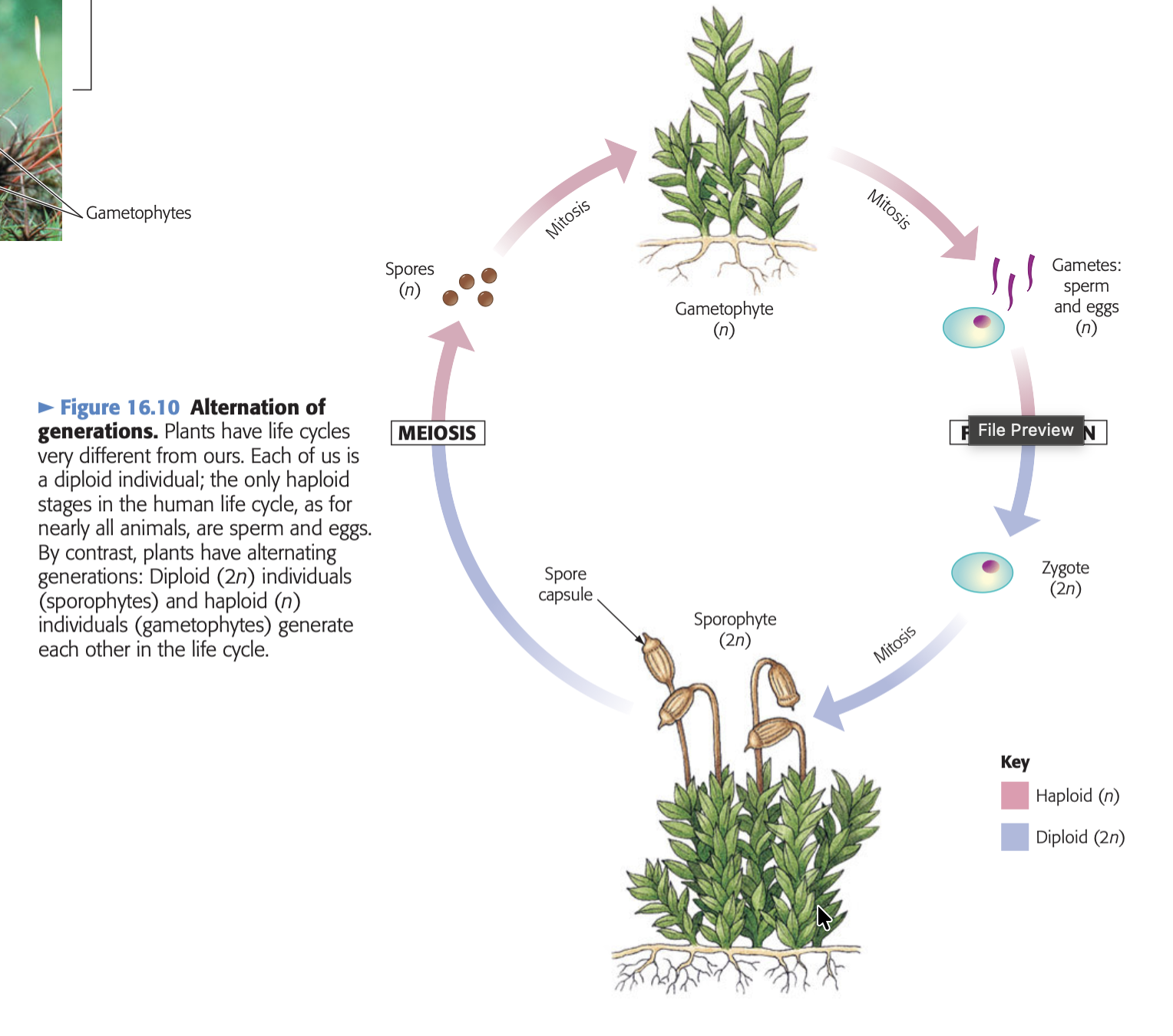
gametophytes vs sporophytes (ALTERNATING GENERATIONS)
gametophytes are haploid, green, and sponge-like. They form gametes; sporophytes are made of diploid cells and grow out of a gametophyte. Sporophytes produce spores
what reproductive adaptations do plants have to meet the challenges of life on land?
gametangia
what structural adaptations do plants have to meet the challenges of life on land? (just a list)
lignin, shoots, roots, cuticle, stomata
roots
subterranean organs which anchor the plant into the soil, where nutrients and water is absorbed. often part of mycorrhizae, a symbiotic relationship with fungi which allow for more mineral absorption
shoots
leaf-bearing organs. leaves are the main photosynthetic organ, so shoots support the plant and bear the leaves which perform gas exchange
cuticle
cuticle is a layer coating the leaves and other aerial parts of most plants and helps the plant body retain water
stomata
microscopic pores which regulate gas exchange (their on the bottom of the leaf since its cooler and can lower the rate of evaporation quicker
lignin
chemical which hardens the cell walls of plants; is more rigid than cellulose
gametangia
protective structures where plants produce their gametes. a gametangium has a jacket of protective cells surrounding a moist chamber where gametes can develop without being dehydrated.
How are seeds (used by which types of plants) even better designed for dispersal than spores?
Seeds are used by gymnosperms and angiosperms. seeds are an embryo packaged with food and protective covering while spores develop into gametophytes which later produce gametes. Seeds have more nutrition and support to develop while spores don’t have this extra nutrients or protection. Seeds on angiosperms have flowers, nectar, and scent to attract pollinators to disperse their seeds. while seeds on gymnosperms don’t have flowers for protection or attraction, they still protect the embryo itself which is to develop. Spores, however, just rely on winds or water transport.
reproductive structures of angiosperms
Angiosperms have gametangia like other plants, but they also have flowers. Flowers are complex reproductive structures that bear seeds within protective chambers called ovaries. Angiosperms also often have brightly colored petals to attract pollinators to deliver their pollen to other plants, which directly impacts their reproductive success. They also have stamen (with an anther), and a pistil (with stigma, style, and ovary).
Examples of pollinators and how they’re attracted
EXAMPLES? Pollinators are often attracted by bright colors (like petals), sweet nectar, and strong scents. Nectar, specifically, was actually an adaptation for flowers to give something in exchange for pollination. Nectar eventually evolved to be hidden for pollinators that were unlikely to deliver the pollen to the proper species.
What does a seed develop from (explained)?
seeds are basically the embryo (which is a fertilized egg) packaged with food and protective covering. The anther on the stamen of a plant will produce pollen through their sacs where meiosis happens for pollen grains to form. This pollen is blown through the wind or picked up by an animal pollinator. When this pollinator delivers the pollen to the same species, the pollen reaches the pistil (female reproductive structure). On the pistil, it first is catched by the stigma, supported by the style which also connects it with the ovary of the plant (where the egg is). Basically, pollen is created by male part and reaches the female reproductive part of another flower and reaches the ovary through the stigma (the style is what connects it to even reach the egg, though) SEEDS DEVELOP FROM THE OVULES INSIDE OF THE OVARY WHEN ITS FERTILIZED BY POLLEN
what does a fruit develop from? (explained)
Flowering plants from their seeds in ovaries. As the seeds develop, the ovaries sometimes develop into fruit. The ovaries develop into bright fruit, which attract animals to eat them and disperse their seeds
stamen
male reproductive structure of a flower; contains a stalk-like filament which ends in an anther
anther
the pollen-producing part on the ends of stamen’s filaments. Anther has pollen sacs in which meiosis occurs and pollen grains form. The filament reaches anther up high so that this pollen is likely to blow in the wind or be picked up by a pollinator
pistil
female reproductive structure of a flower; consists of a stigma, style, and ovary
stigma
part of the pistil and is raised and sticky which catches pollen; supported by the style
style
part of the pistil that supports the stigma (which catches pollen) and also connects the stigma to the ovary so that the eggs inside can be fertilized by pollen
ovary
one of two female reproductive organs that produces eggs and secretes the hormone estrogen; in plants it holds the eggs where pollen is to reach through the stigma
petals
the part of the female reproductive structure and aims to attract pollinators. They’re often brightly colored to be noticed
sepals
part of a flower that helps protect it while it is still developing. The sepal is usually green which camouflages the bud from possible consumers.
pollination in angiosperms (lowkey simplified)
anther’s in stamen undergo meiosis and are raised high to be blown in the wind or picked up by an animal and delivered to a pistil. Flowers often have bright petals, sweet nectar, or strong scents to attract pollinators. After delivered to the pistil, It is caught by the stigma and reaches the egg in the ovary; THIS POLLINATION WITH POLLINATORS AND STIGMA ALLOWS CROSS-POLLINATION WHICH CREATES OFFSPRING WITH NEW COMBINATIONS OF TRAITS!!
Early flowers evolution with animals
early flowers were thought to have attracted animals to deliver their pollen. They eventually adapted bright petals to attract pollinators and in exchange for pollination, flowers would give nectar. Flowers evolved to only give nectar to certain pollinators and hide it from other pollinators since only some pollinators deliver the pollen to the proper species. In turn, animals co=evolved with traits to get this hidden nectar. ex. sphinx with long proboscis allows it to reach the “hidden” nectar at the bottom of tube shaped flowers
3 groups of classifying flowering plants and their differences
monocots (embryos only form one cotyledon (embryonic leaves in a seed)), edicts and magnolias have embryos which form two cotyledons. Another big separation from these three groups is the arrangement of their vascular tissues
What was the general assumption that stood for population growth
it was assumed to be constant, meaning that population growth depended on the size of the existing population. even when more children were born, mortality was high.
when did the world reach their 1st billion population
world reached 1st billion in early 1800s; in Europe and America, economic advancements in nutrition and sanitation and later medical lowered death rates while birth rates stayed the same. These advancements eventually spread throughout the world
when did the world reach their 2nd billion population & their 3rd billion
2nd billion in 1927 and 3 billion in 1960
what allowed the world to reach their first billion people & what lowers birth rates (random but good fact to remember)
economic advancements in nutrition, sanitation, and medical advancements lowered the death rates while the birth rates stayed the same. Also, contraceptives lower birth rates
what is an age structure
type of diagram helps predict a population’s future growth; three colors to represent reproductive stages in a group, each horizontal bar marks 5-year age gap
population momentum
increased proportion of women of childbearing age in the population
how might an age structure also indicate social conditions
an expanding population has an increasing need for schools, employment, and infrastructure and the larger elderly population requires extensive resources to be allowed
“baby boom”
the bulge of the 1985 population is referred to as the big boom — basically a period after the Second World War where everybody was having babies (lasted two decades). The baby boom swelled school and job environments for same generation
impact of boomers on population
as a large segment of the population, they have a big influence on social, economic, and political trends. they also produced a boomlet of their own. Now, as elders, their population puts pressure on medicare and social security.
what concerns might you have about social services (schools and hospital capacities, medicare, medicaid, etc.) when looking at the population momentum in Mexico images or the baby boomer generation in the US images?
These images provide the prediction that population momentum will continue to increase, putting more pressure social services to provide support. Similar to the baby boomer situation we are having as of now, Medicade and social security have more people to handle. Governmental funds and support have to be able to sustain more people. Even schools will be swelled and job environments will be more competitive. As an economy, it put many people in distress.
ecological footprint/carbon footprint
helps us understand resource availability to usage. It estimates the amount of land and water required to provide raw materials an individual or nation consumes
global hectare full explanation
a global hectare is a hectare with world-average ability to produce resources and absorb wastes; it is basically a unit of measurement to estimate how much of earth is necessary to provide materials to an individual or nation for consumption (1 ha is 2.47 acres).
policy aspect of population growth and momentum
a big aspect of the birth rate is education of women and girls, their access to contraceptives and medicinal care, cultural and religious acceptance, family leave, and childcare they can be offered.
ecologically productive land & global population (data)
ecologically productive land divided among our global population means that we each have a share of 2.1 global hectares, but we as humans (as of 2006) consume 2.6 global hectares (overconsumption!)
Oysters as keystone species (billion oyster project 🙂)
they create reefs that provide for marine communities, keep the community clean by filtering water, are consumed by other organisms, can block waves and absorb the waves from hitting or eroding land nearby; KEYSTONE SPECIES!