12 Eukaryotic Members of the Microbial World
 Call Kai
 Learn
Learn Practice Test
 Spaced Repetition
 Match
Match Flashcards
 Knowt Play
1/18

There's no tags or description
Looks like no tags are added yet.
Name | Mastery | Learn | Test | Matching | Spaced | Call with Kai |
|---|
No analytics yet
Send a link to your students to track their progress
19 Terms
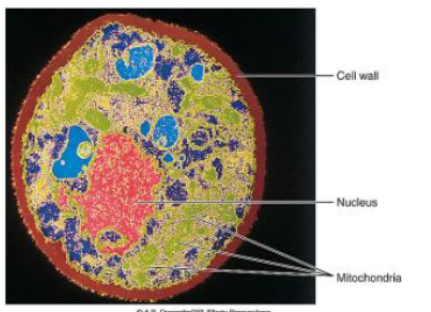
Eukaryotic
All members of the domain Eukarya are [__] (adj.)
contains membrane-bound organelles
eg. nucleus, mitochondria, endoplasmic reticulum (ER), etc.
more complex
single cell or multicellular organisms
eg. algae, fungi, protozoa, helminths
can undergo both asexual and sexual reproduction
Fungi
Eukaryote that can be single-celled (yeast), or multicellular (molds, mushroom)
cell wall consists of chitin → same sugar found in exoskeletons of insects and crustaceans
major decomposers
excretes enzymes to degrade larger molecules
exist in many places
mostly terrestial (air, soil, surfaes)
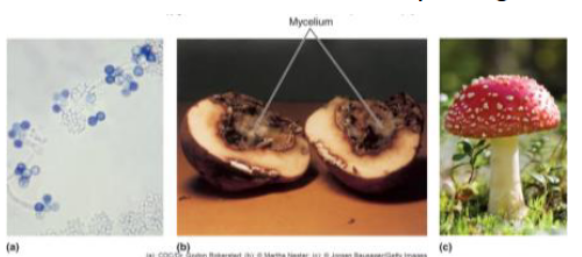
some pathogenic
large amount cause disease in plants
only a few cause disease in humans
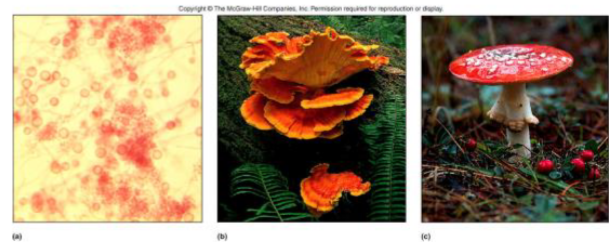
yeasts
Single-celled fungi
spherical oval or cylindrical
reproduces through binary fission or budding
budding: asexual reproduction wherein the nucleus divides by mitosis and migrates into a smaller cell known as a bud
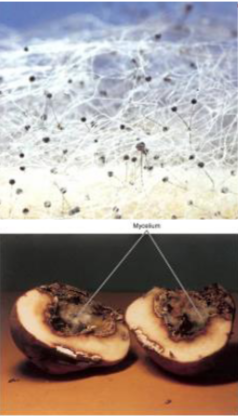
molds
Filamentous, multicellular fungi containing hypa (plural: hyphae): microscopic filament of mold that branches and twists to form mycelium
single celled reproductive spore (sporangium) germinates and develops in hyphae
dimorphic fungi
Fungi that can grow as yeast (single-celled) or mold (multi-cellular) depending on the environment
Many pathogenic fungi are [__]!
When they are out in the environment, they are in mold form
When the are causing an infection, they are in yeast form
mycoses
Immunocompromised individuals are more susceptible to fungal disease
Fungi can cause disease in 3 ways:
allergic reaction, from fungal spore inhalation
fungal toxin reaction
may have hallucinogenic properties
certain species produces aflatoxin, a toxin implicated in cancer
[__]: fungi that grows on or in the body. fungal infection
eg. Candida albicans: yeast part of normal flora
→ overgrowth due to change in pH or antibiotic therapy can lead to:
dermitis: creates ulceration of the skin
thrush infections (vaginal, oral) → first sign of being immunocompromised
![<p><strong>Immunocompromised</strong> individuals are more susceptible to fungal disease</p><p><u>Fungi can cause disease in 3 ways:</u></p><ul><li><p><mark data-color="blue" style="background-color: blue; color: inherit;">allergic reaction</mark>, from fungal spore inhalation</p></li><li><p><mark data-color="blue" style="background-color: blue; color: inherit;">fungal toxin reaction</mark></p><ul><li><p>may have hallucinogenic properties</p></li><li><p>certain species produces <strong><mark data-color="purple" style="background-color: purple; color: inherit;">aflatoxin</mark></strong>,<mark data-color="yellow" style="background-color: yellow; color: inherit;"> a toxin implicated in cancer</mark></p></li></ul></li><li><p><mark data-color="blue" style="background-color: blue; color: inherit;">[__]</mark>: fungi that grows on or in the body. <mark data-color="yellow" style="background-color: yellow; color: inherit;">fungal infection</mark></p><ul><li><p><u>eg.</u> <strong><em><mark data-color="purple" style="background-color: purple; color: inherit;">Candida albicans</mark></em></strong><mark data-color="yellow" style="background-color: yellow; color: inherit;">: yeast part of normal flora</mark></p><ul><li><p>→ overgrowth due to change in pH or antibiotic therapy <u>can lead to</u>:</p></li><li><p><strong><mark data-color="yellow" style="background-color: yellow; color: inherit;">dermitis</mark></strong>: <mark data-color="yellow" style="background-color: yellow; color: inherit;">creates ulceration of the skin</mark></p></li><li><p><strong><mark data-color="yellow" style="background-color: yellow; color: inherit;">thrush</mark></strong><mark data-color="yellow" style="background-color: yellow; color: inherit;"> infections</mark> (vaginal, oral) → <mark data-color="yellow" style="background-color: yellow; color: inherit;">first sign of being immunocompromised</mark></p></li></ul></li></ul></li></ul><p></p>](https://assets.knowt.com/user-attachments/65447563-5619-4d1c-a4e3-ae459886b67f.png)
lactobacilli
Women of Reproductive age typically have this bacteria in their vaginal canal that breaks down sugar and produces a lot of acid → maintains acidity that keeps Candida albicans yeast in check
When they take antibiotics, [__] die » Candida albicans can overgrow in the higher pH
hallucinogen toxin
The Economic Importance of Fungi lies in their ability to
destroy human food supply → cause starvation
spoilage of food and crops
notably, the Irish Potato Famine from 1845-1847
water mold decimated crops
est. 1.5 million people died → 25% of Ireland population
produce toxins
Aflatoxins produced by Aspergillus species, which is carcinogenic
found in grains and peanuts
[__] produced by rye mold (Claviceps purpurea) → produces ergot toxin → causes ergotism: disease of severe convulsions, hallucinations, and blood constriction
this is responsible for Salem Witch Trials
produce commercialized products
eg. beer, wine, bread, cheese, antimicrobial agents
aid in genetic and biochemical studies
yeast is genetically engineered to make human products (eg. human insulin gene and hepatitis B vaccine)
much better than bacteria as they secrete products outside automatically; do not have to be lysed like bacteria
Algae
A photosynthetic (contains chlorophyll) Eukaryote that can be unicellular (microscopic) or multicellular (macroscopic)
found in both fresh and salt water, alongside soil
rigid cell wall is made out of cellulose
has various types:
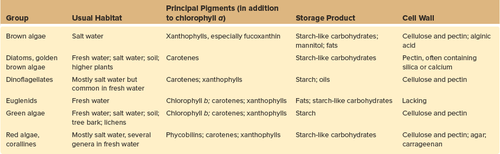
[__] doesn’t cause disease directly
has toxins which are poisonous to humans → cause disease
seasonal algal blooms: a rapid increase in population of microscopic algae in a body of water
eg. “Red tide” caused by dinoflagellates
» when shellfish eat the dinoflagellates, they produce neurotoxins
» humans ingesting shellfish suffer paralytic shellfish poisoning → die primarily from respiratory failure
![<p><mark data-color="yellow" style="background-color: yellow; color: inherit;">A photosynthetic </mark>(contains chlorophyll) <mark data-color="yellow" style="background-color: yellow; color: inherit;">Eukaryote that can be </mark><u><mark data-color="yellow" style="background-color: yellow; color: inherit;">unicellular</mark></u><mark data-color="yellow" style="background-color: yellow; color: inherit;"> (</mark><strong><mark data-color="yellow" style="background-color: yellow; color: inherit;">microscopic</mark></strong><mark data-color="yellow" style="background-color: yellow; color: inherit;">) or </mark><u><mark data-color="yellow" style="background-color: yellow; color: inherit;">multicellular</mark></u><mark data-color="yellow" style="background-color: yellow; color: inherit;"> (</mark><strong><mark data-color="yellow" style="background-color: yellow; color: inherit;">macroscopic</mark></strong><mark data-color="yellow" style="background-color: yellow; color: inherit;">)</mark></p><ul><li><p>found in both fresh and salt water, alongside soil</p></li><li><p>rigid cell wall is made out of <strong><mark data-color="purple" style="background-color: purple; color: inherit;">cellulose</mark></strong></p></li></ul><p></p><p><u>has various types:</u></p><img src="https://assets.knowt.com/user-attachments/ab5b9ede-e105-4957-8409-2ce6ae984528.png" data-width="100%" data-align="center"><p>[__] doesn’t cause disease directly</p><ul><li><p>has toxins which are poisonous to humans → cause disease</p></li><li><p><strong><mark data-color="purple" style="background-color: purple; color: inherit;">seasonal algal blooms</mark></strong>: a rapid increase in population of microscopic algae in a body of water</p><ul><li><p><u><mark data-color="purple" style="background-color: purple; color: inherit;">eg.</mark></u><mark data-color="purple" style="background-color: purple; color: inherit;"> “Red tide”</mark><mark data-color="yellow" style="background-color: yellow; color: inherit;"> caused by </mark><strong><mark data-color="yellow" style="background-color: yellow; color: inherit;">dinoflagellates</mark></strong></p><ul><li><p>» when shellfish eat the dinoflagellates, they produce neurotoxins</p></li><li><p>» humans ingesting shellfish suffer paralytic shellfish poisoning → die primarily from respiratory failure</p></li></ul></li></ul></li></ul><p></p>](https://assets.knowt.com/user-attachments/26a1c984-c154-4f26-874a-cfae8257b104.png)
Protozoa
Microscopic, single-celled Eukaryote that is found in water, on land, and in parasites. [__] → “animal-like”
complex; much larger than a prokaryote
has a complex life cycle
lacks a rigid cell wall
mostly motile through a cilia, flagella, or pseudopodia (temporary arm projection)
Many cause disease
Giardia lamblia → causes giardiasis
Trichomonas → STDs
Plasmodium → malaria
Toxoplasma → toxoplasmosis
![<p><mark data-color="yellow" style="background-color: yellow; color: inherit;">Microscopic, single-celled Eukaryote that is found in water, on land, and in parasites. [__] → “animal-like”</mark></p><ul><li><p>complex; much larger than a prokaryote</p><ul><li><p>has a complex life cycle</p></li></ul></li><li><p>lacks a rigid cell wall</p></li><li><p>mostly motile through a cilia, flagella, or pseudopodia (temporary arm projection)</p></li></ul><p></p><p><u>Many cause disease</u></p><ul><li><p><strong><em><mark data-color="yellow" style="background-color: yellow; color: inherit;">Giardia lamblia</mark></em></strong><mark data-color="yellow" style="background-color: yellow; color: inherit;"> </mark>→ causes <strong><mark data-color="purple" style="background-color: purple; color: inherit;">giardiasis</mark></strong></p></li><li><p><strong><em><mark data-color="yellow" style="background-color: yellow; color: inherit;">Trichomonas</mark></em></strong><mark data-color="yellow" style="background-color: yellow; color: inherit;"> </mark>→ <mark data-color="purple" style="background-color: purple; color: inherit;">STDs</mark></p></li><li><p><strong><em><mark data-color="yellow" style="background-color: yellow; color: inherit;">Plasmodium</mark></em></strong> → <strong><mark data-color="purple" style="background-color: purple; color: inherit;">malaria</mark></strong></p></li><li><p><strong><em><mark data-color="yellow" style="background-color: yellow; color: inherit;">Toxoplasma</mark></em></strong><em><mark data-color="yellow" style="background-color: yellow; color: inherit;"> </mark>→ </em><strong><mark data-color="purple" style="background-color: purple; color: inherit;">toxoplasmosis</mark></strong></p></li></ul><p></p>](https://assets.knowt.com/user-attachments/59a73588-3a34-405b-9420-3e0267dfece5.png)
Giarda lamblia
The protozoa responsible for causing giardiasis: gastrointestinal infection → very contractive diarrheal illness that is often asymptomatic
forms cyst that is shed in feces of animals and humans, which contaminates water that could be drunk
symptoms (if they occur) are foraminating (foamy/gassy) diarrhea → “explosive diarrhea”
can stay with person for 30 years
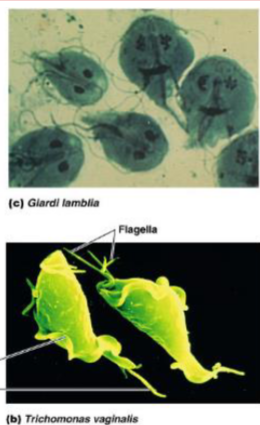
Trichomonas
Protozoa responsible for causing STDs
[__] vaginalis effects seen mostly in females as vaginitis (inflammation/infection of vagina); less outward symptoms in males
causes irritation, no long-term effects
identifiable by wet mounts
![<p><mark data-color="yellow" style="background-color: yellow; color: inherit;">Protozoa responsible for causing STDs</mark></p><ul><li><p><mark data-color="purple" style="background-color: purple; color: inherit;">[__] </mark><em><mark data-color="purple" style="background-color: purple; color: inherit;">vaginalis</mark></em> effects seen mostly in females as <mark data-color="purple" style="background-color: purple; color: inherit;">vaginitis</mark> (inflammation/infection of vagina); less outward symptoms in males</p></li><li><p>causes irritation, no long-term effects</p></li><li><p>identifiable by wet mounts</p></li></ul><p></p>](https://assets.knowt.com/user-attachments/bfe7500e-c58c-430c-8d9b-8c101deb409b.png)
Plasmodium
An intracellular pathogenic protozoa that occupies red blood cells and causes malaria: disease with flu-like fever symptoms and pain in joints and muscles
transmitted by mosquitoes
migrates to the liver and then the RBCs
no.1 cause of death of pregnant women in the world; (no.1 cause of death in the US is domestic violence)
infects ~219 million / year » ~660,000 deaths
identified by blood smear
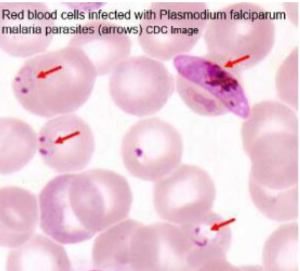
Toxoplasma
Protozoa associated with causing toxoplasmosis: disease that affects the brain through hemolytic processes, leading to bleeding and dementia,
mainly associated with cats → shed cysts in their feces in litter box
when infected, pregnant women are likely to pass disease unto fetus (crosses placenta)
immunocompromised individuals contract disease through consumption of infected beef
This protozoa and disease can be identified by brain biopsy
helminths
Multicellular, Eukaryotic parasitic worms. Includes:
free-living and parasitic worms
roundworm: [__] with cylindrical tapered body. i.e, (nematodes)
flat worms: [__] with flat body form. further divided into
tapeworms (cestodes)
flukes (trematodes)
obtained from water and soil
common in children all over the world in developing countries
![<p><mark data-color="yellow" style="background-color: yellow; color: inherit;">Multicellular, Eukaryotic parasitic worms. </mark><u><mark data-color="yellow" style="background-color: yellow; color: inherit;">Includes</mark></u><mark data-color="yellow" style="background-color: yellow; color: inherit;">:</mark></p><ul><li><p>free-living and parasitic worms</p></li><li><p><strong><mark data-color="purple" style="background-color: purple; color: inherit;">roundworm</mark></strong>: [__] with cylindrical tapered body. i.e, (<strong><mark data-color="purple" style="background-color: purple; color: inherit;">nematodes</mark></strong>)</p></li><li><p><mark data-color="purple" style="background-color: purple; color: inherit;">flat worms</mark>: [__] with flat body form. further divided into</p><ul><li><p><strong><mark data-color="blue" style="background-color: blue; color: inherit;">tapeworms (cestodes)</mark></strong></p></li><li><p><strong><mark data-color="blue" style="background-color: blue; color: inherit;">flukes (trematodes)</mark></strong></p></li></ul></li></ul><ul><li><p>obtained from water and soil</p></li><li><p>common in children all over the world in developing countries</p></li></ul><p></p>](https://assets.knowt.com/user-attachments/36df99eb-3785-4b99-b85e-ffd056538b13.png)
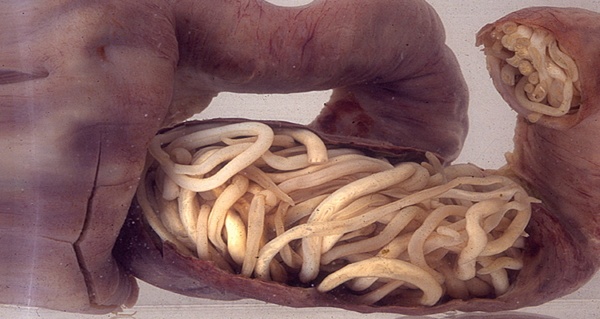
Nematode
Helminth; also known as a round worm.
Invades GI tract and bloodstream
pinworms » ingested in food
symptoms of anal itching come from [__]s depositioning their eggs in perianal skin
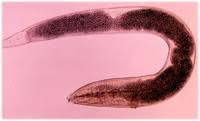
Ascaris » ingested in fish
lives in GI tract; robs host of nutrients
→ children get malnourished
→ GI tract gets blocked
→ can enter bloodstream and settle in the lungs
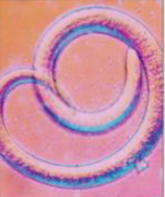
Trichinella » ingested in animal flesh
reproduced in the GI tract
larvae travels to and encyst in the muscles
Cestode
Flatworm also known as a tapeworm or flatworms
Contracted from eating undercooked raw meat (beef and pork) or fish
Remains in GI tract and rob host of nutrients or migrate to muscles to encyst
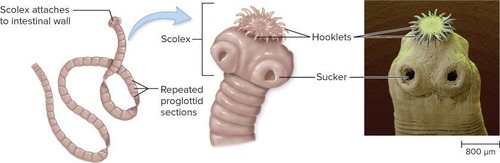
can be 30m long
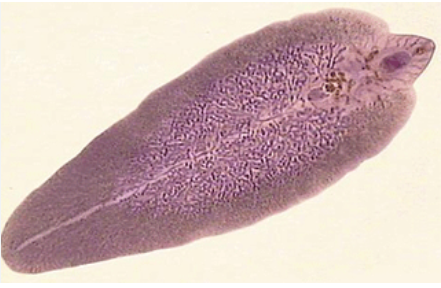
Trematode
Flatworm also known as a fluke
found in lakes and ponds
transmitted through undercooked cray
sucks fluid from host
arthropods
Multicellular parasite that serves as a vector of transmission
i.e, they can transmit pathogens to humans directly, or indirectly as an organism that the disease can multiply within (like a vector)
Insects
» mosquitos — transmits
→ malaria; symptoms are fevers and chills
→ dengue fever; fever, headache, bleeding and shock
→ West Nile Virus; fever, nausea, convulsions, coma
» fleas → plague (caused by Yesinia pestis);
fever, headache, confusion, enlarged lymph nodes, skin hemorrhage
Ticks
transmit Rocky Mountain Spotted Fever ; fever, hemorrhagic rash, confusion
→ Lyme Disease; fever, rash, joint pain, nervous system impairment
Lice (eg. body lice)
» transmission of typhus; fever, hemorrhagic rash, confusion
and other fevers
Arachnids (eg. mites)
» trigger asthma
» cause intense itching