Hemic & Lymphatic problems
 Call Kai
 Learn
Learn Practice Test
 Spaced Repetition
 Match
Match Flashcards
 Knowt Play
1/35

There's no tags or description
Looks like no tags are added yet.
Name | Mastery | Learn | Test | Matching | Spaced | Call with Kai |
|---|
No analytics yet
Send a link to your students to track their progress
36 Terms
Canine:You have a 20 kg dog with a PCV of 15%. You wish to raise his PCV to 25%. How much fresh whole blood should you administer?
mL whole blood= (Body weight kg x blood volume mL/kg x (desired PCV- patient PCV))/ Donor blood PCV
(20×90×10)/ 40
18000/40= 450mL
Canine:What tumor is the most common cause for hypercalcemia in dogs
Lymphoma
(T- lymphoma especialy)
Canine:Side effects of Azathioprine
Hepatotoxicity
Bone marrow suppression
GI upset
Canine:A blood smear shows pyriform-shaped structures insiderb. What is it most likely
A Babesia infection
Canine:How would a dog with Cutaneous hemangiosarcoma present
A red/bleeding mass
Usually on non-haired areas of the skin
Canine:Prognosis for Cutaneous hemangiosarcoma
The median survival time for cutaneous hemangiosarcoma is 780 days, although the prognosis is better in cases that are detected early and with complete excision. Chemotherapy is only recommended if subcutaneous spread is present or if the tumor cannot be completely excised.
Canine:What type of coagulopathy is often asociated w/ splenic hemangiosarcoma
DIC
Canine:What type of tumor is associated with causing GI ulcers, perioperative hypotension, and coagulation abnormalities in dogs?
mast cells release histamine, heparin, and other vasoactive amines. Histamine can cause ulcers via activation of H2 receptors on gastric parietal cells. Heparin can cause Coagulopathy. Histamine and other vasoactive amines can lead to vasodilation and hypotension.
A dog presents with a nonspecific history of slightly decreased appetite, lethargy, and odd behavior. A leukogram shows the following values:
WBC 22,385 cells/uL (5,000-14,000 cells/uL)
band neutrophils 100 cells/uL (0-450 cells/uL)
segmented neutrophils 20,432 cells/uL (2,900-12,000 cells/uL)
lymphocytes 382 cells/uL (400-2,900 cells/uL)
monocytes 1552 cells/uL (100-1,400 cells/uL)
eosinophils 9 cells/uL (0-1,300 cells/uL)
basophils 5 cells/uL (0-140 cells/uL)
What is your interpretation of the leukogram?
A.Stress leukogram
B.Infection
C.Left shift
D.Normal
E.Degenerative left shift
The correct answer is stress leukogram. You can see the classic mild neutrophilia along with lymphopenia and monocytosis. Although there are bands present in the blood work, this is a normal amount according to reference levels provided and is thereby not considered a left shift.
A 1-year-old male castrated Basset Hound presents for epistaxis from both nostrils, a small amount from blood from the right and a larger amount from the left. There is no history of trauma but he does go for frequent walks, and as a typical Basset, usually has his nose to the ground. His heart and lungs sound normal. You note a few ecchymotic hemorrhages on the thin skin under his abdominal region. You discuss the various causes of this issue with the owner and perform some labwork, including a coagulation panel, and the important values to note are as follows:
PCV 34%
Reticulocytes 110K
Platelets 180K/uL (143-448 K/uL)
Prothrombin Time (PT) 6.9s (6.3-13.3 seconds)
Partial Thromboplastin Time (PTT) 10.9s (10.6-16.8 seconds)
Based on this information, what is your top differential?
A.Nasal foreign body
B.Immune-mediated thrombocytopenia
C.Canine thrombopathia
D.Rodenticide toxicity
The correct answer is canine thrombopathia. The disease is an autosomal recessive trait seen in Basset Hounds where platelets fail to aggregate and secrete their granules in response to normal stimuli. These dogs are at an increased risk for bleeding spontaneously, and an injury or surgical procedure could cause excessive hemorrhage. Platelet numbers and coagulation parameters are normal in this condition. It isn't an issue with platelet number, but of function.
Rodenticide would cause elevated clotting times.
Immune-mediated thrombocytopenia would cause a low platelet count.
A nasal foreign body would be less likely to cause a bilateral bleed and would not attribute to the ecchymotic hemorrhages noted on the abdominal skin.
Canine:common finding on a complete blood count in a dog with a ruptured splenic hemangiosarcoma?
Schistocytes
Thrombocytopenia
Anemia (not with heinz bodies)
Leukocytosis
Bovine:Causes of acute hemolysis in cattle
Castor bean
Clostridium novyi type D (C. Hemolyticum)
Water deprivation followed by free access to water
Bovine:What test is the most definitive for Lymphoma (BLV)
ELISA for BLV antibodies
Biopsy with immunohistochem: RARELY DONE
Bovine:Difference between anaplasmosis and babesiosis(piroplasmosis)
Babesia causes hemoglobinuria
Bovine:What type of hemolysis is caused by Piroplasmosis(Babesiosis and Clostridium novyi type D (bacilliary hemoglobinuria
Intravascullar hemolysis
Dark urine
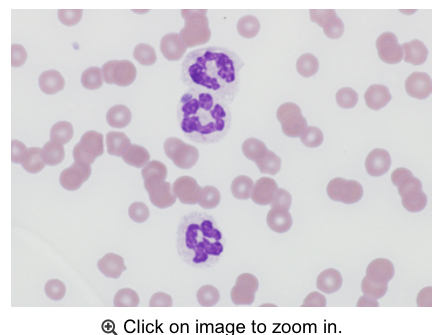
Equine:After doing a blood culture and seeing morula within a neutrophil, how can you confirm this is Anaplasmosis
PCR
And to treat, oxytetracycline
Equine:Clinical Signs of Anaplasmosis
Fever
Lethargy
Tachycardia
Limb edema
Equine:What would the CBC results of a horse with Anaplasmosis be
Leukopenia
Neutropenia
Thrombocytopenia
Equine:What is the test to diagnose Corynebacterium pseudotuberculosis infection with internal abscesses in horses
Synergistic hemolysis inhibition test
Equine:How much sodium bicarbonate must be given to a 470kg horse that has a base deficit of 13 to completely correct this deficit?
HCO3 deficit= 0.4 * BW *base deficit
0.4 ×470kg * 13= 244
Base Deficit= amount of base needed to add to a solution to achieve pH7.4
HCO3 concentration in the blood= 22-24mEq/L
Base Deficit = normal concentration- patient concentration
Equine:How to treat a horse with warfarin toxicosis
Vitamin K1 SQ:
1 to 2 L plasma
Replenish clotting factors
Gives horse time to synthesize them after vitamin K is replaced
Equine:What would be on the CBC of a horse with hemolytic anemia that has been going on for 10 + days
Normocytic, Normochromic anemia
Uncommon to see RBC morphology changes in horses
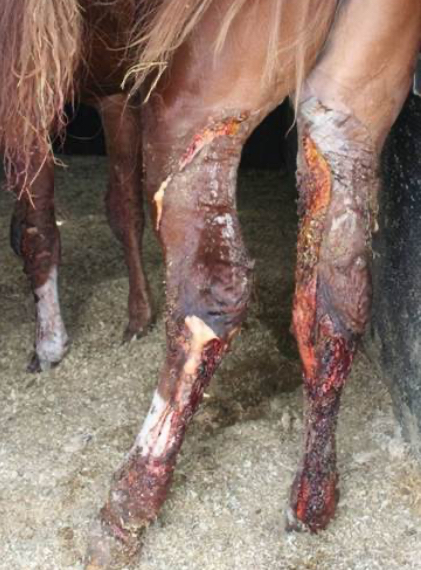
Equine:What type of Sensitivity is Purpura hemorrhagica
Type III Hypersensitivity
Accumulation of antigen-antibody complexes that deposit on blood vessel walls and activate a strong immune response (vasculitis). The leaky blood vessels lead to hemorrhage and edema.
Equine:For neonatal isoerythrolysis to occur, what pairs must mate?
Stallion Positive for Qa/Aa
Mare Negative for Qa/Aa
Equine:What is the Coggin’s test effective diagnosing for EIA
Chronic asymptomatic carriers
Equine:Causes of Heinz body anemia in horses
Methylene blue
Red maple leaf (wilted)
Phenothiazines
Molybdenum deficiency
Brassica, onions, rye grass
Equine:What is the most sensitive test for detecting carriers of Strangles
PCR of a guttural pouch wash for the S.equi M protein (SeM) gene
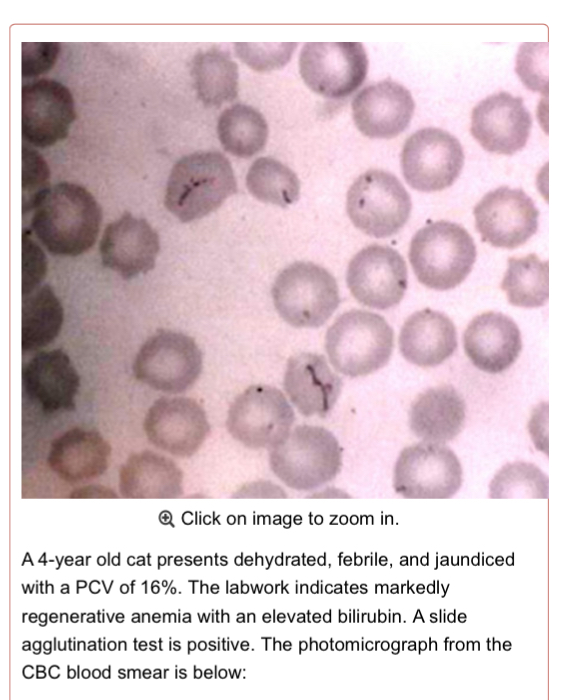
Feline: A Cat is presented with severe mycoplasma felis infection (+ agglutination test). The cat is dehydrated, febrile with a pcv of 16%. How is this situation best treated
Doxycycline + Prednisolone
A steroid is also given because there is rampant RBC destruction via immune system (+ agglutination test)
Feline:What is a physiologic leukogram
Mild case of Neutrophilia
Normal to increased Lymphocytes
No monocytosis
Cats who get stressed/excited (epinephrine-mediated)
Feline: Where are feline Cutaneous Mast cells most commonly located
Face and Head and rarely metastasize
This is the second most common type of skin tumor in the cat
Feline:What test should you start with to evaluate the coagulation system
BMBT: screens for defects in primary hemostasis
Feline:What type of anemia would a cat with mycoplasma hemofelis have
Regenerative Anemia
Feline:Why is it better to prevent cytauxzoon felis than treat it
Its challenging and costly to treat so prevention is the goal
TX: Antimalarial (atovaquone) combined w/ antimicrobial azithromycin, fluids, heparin, supportive care
Feline:What should you do when a patient who is taking prednisolone to treat his IMHA shows signs of congestive failure
Taper the corticosteroid over the next 5-7 days while starting a different immunosuppressant and treat the CHF
Corticosteroids are associated w/ congestive heart failure
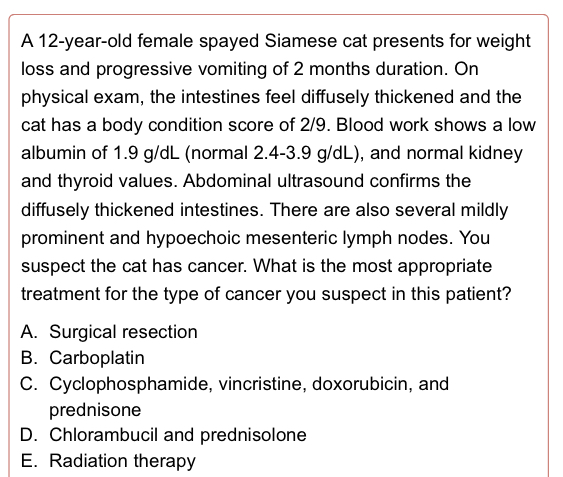
Feline:
This cat has small cell or low grade ( diffusesly thickened) intestinal lymphoma so treat with
Chlorambucil + Prednisolone
Feline:Describe what a cat with high grade or large cell lymphoma would manifest as
A large focal mass