Triage and Stabilization of Small Animal Emergencies
 Call Kai
 Learn
Learn Practice Test
 Spaced Repetition
 Match
Match Flashcards
 Knowt Play
1/25

There's no tags or description
Looks like no tags are added yet.
Name | Mastery | Learn | Test | Matching | Spaced | Call with Kai | Chat |
|---|
No analytics yet
Send a link to your students to track their progress
26 Terms
What is “triage”?
• Goals:
Efficiently separate patients that are stable to wait from those that require immediate medical attention
Prioritise cases by medical urgency
What are the stages of emergency evaluation?
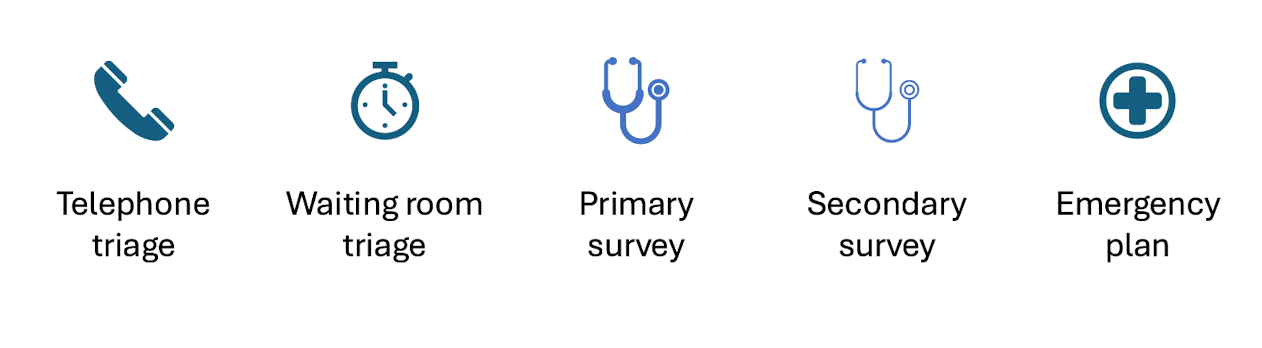
When providing advice on first aid and transport during the telephone triage, what information should you provide?
NEED TO KNOW: Current concern/main complaint, the pet and owner details, payment policy, advice on first aid and transport (See below), directions, and prepare for arrival.
• Often best approach to get the animal to the hospital as soon as is safe
• Animals that have experienced a trauma can be unpredictable and a muzzle should be considered
• Blankets can be used as makeshift stretchers
• Significant bleeding may require a temporary pressure bandage
• Topical toxins - wash
• Heat stroke - soak in cold water
What are the features of triage when the animal presents in the waiting room?
• Stable vs. immediate care (CPA/shock)
• Based on vital signs
ABC
• Includes brief history (presenting complaint) and CPR code status
• Brief focused physical exam
• Update traffic light system
Red: Critical Unstable
Amber: Urgent/potentially unstable
Green: Stable
Describe or walk through how you would establish whether a patient is stable or unstable.

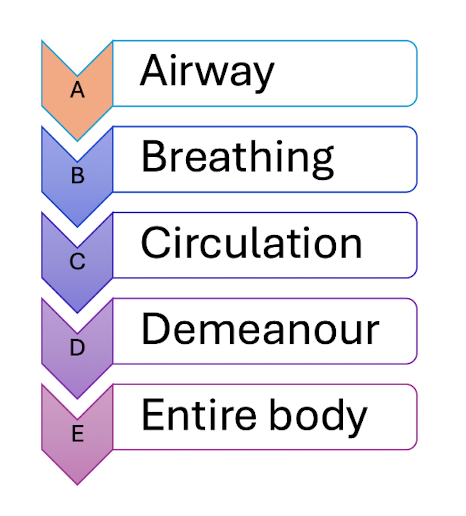
What is the ABCDE approach to emergency triage?
The ABCDE Approach is a systematic, sequential tool used in emergency medical and trauma care to rapidly identify and treat life-threatening conditions
Describe what the primary survey evaluates.
• Primary survey and triage may be simultaneous
• More detailed evaluation of same physical parameters as triage exam
• Still quick, <2 minutes
• Goals: Identify and stabilise life-threatening problems
Describe what the secondary survey evaluates.
• Full physical examination
• Body weight
• Detailed history
• Estimate
• Goals:
Full understanding of the patient's conditions
Development of comprehensive diagnostic and treatment plan
What questions should you ask when evaluating the airway?
• Is there a patent airway?
• Is the patient breathing?
• Is there stridor or stertor?
• Are there signs of obstruction?
What questions should you ask when evaluating the breathing?
• Respiratory rate and effort
• Auscultation (increase/decreased/ or abnormal sounds)
• Mucous membrane colour
• T-POCUS (thoracic point-of- care ultrasound)
• Pulse oximetry
• (Arterial blood gases)
If the airway is not patent or the patient has stopped breathing, how can you stabilize the patient?

When is a patient considered to have hypoxemia, and how can you provide oxygen?
• Hypoxemia - SpO2 <95%, Pa02 <80mmHg
Face Mask, Oxygen cages (Temp + CO2 controlled but use O2++), Nasal prongs, oxygen hood, nasal oxygen catheters
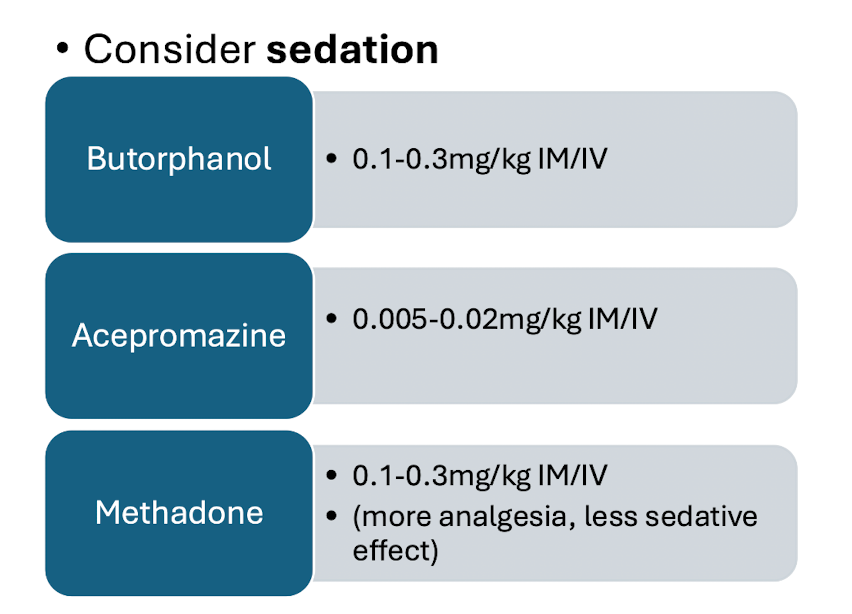
When presented with a patient under respiratory distress, what drugs can be used to induce sedation?
Butorphanol - ideal drug of choice, mixed agonist at k-receptors, antagonist at u-receptors, has more of a sedative than analgesic, IV is ideal - small doses
Acepromazine - can cause vasodilation, effecting BP
Methadone - full u-agonist opioid, great anelgesic, good for trauma patients
When considering POCUS to stabilize a patient’s breathing, what information might you be able to gather?
• Consider POCUS
Pleural effusion
Pneumothorax
B lines (pulmonary oedema
Consolidation
• Consider Thoracocentesis
diagnostic +/- therapeutic
What questions should you ask when evaluating the circulation?
• Assessment of tissue perfusion on clinical exam:
Mucous membrane colour
CRT
Auscultation of heart and pulse palpation
Core body temperature - usually by rectal temperature
• Blood pressure measurement
• ECG
• Cardiac Point of Care Ultrasound
• Blood lactate (normal <2.5mmol/L)
What is shock?
Shock - Severe imbalance between oxygen supply and demand

What are the first steps when trying to stabilize a circulatory issue?
• Establish venous access
• Fluid resuscitation
Goal directed therapy
Indicated in shock unless cardiogenic
• Blood products
pRBCs, plasma, whole blood
• Pericardiocentesis
What is goal-directed fluid therapy and how is this provided to improve circulatory signs?
The principle behind GDT is to maximize tissue oxygen delivery by achieving a maximum hemodynamic status with the required amount of fluid therapy.
• Fluid types:
Crystalloid vs Colloid
• Fluid Challenge (usually isotonic crystalloid): (Attempt max of 3 times)
Dogs - 10-20ml/kg intravenous bolus
Cats - 5-10ml/kg intravenous bolus (Cats more prone to fluid overload_
• Reassess perfusion parameters
What questions should you ask when evaluating the demeanour?

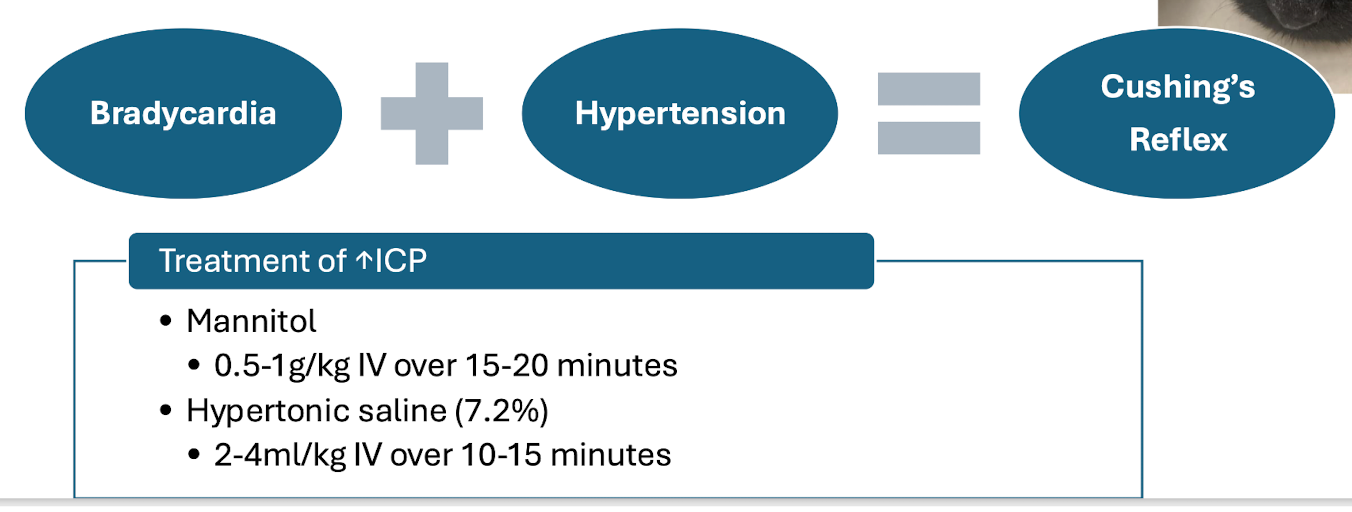
When assessing demeanour, how is an increased intracranial pressure treated?
**What is the cushing reflex?
Perform basic neurological exam
Cushing Reflex: emergency, The Cushing reflex in dogs is a life-threatening veterinary emergency that occurs when dangerously high intracranial pressure (ICP) inside the skull triggers a desperate compensatory response by the nervous system to keep blood flowing to the brain, signals brain herniation is imminent
What drugs are used to treat seizures?

If the animal is experiencing decreased mentation, what should be considered as differentials?

What questions should you ask when evaluating the entire body?
• Basic abdominal palpation
Blocked bladder
Severe pain
Fluid thrill
• Identification of any life-threatening injuries such as spinal fractures, arterial bleeding or open body cavities.
• Abdominal POCUS
• Consider decontamination
E.g. bathing cats exposed to permethrin
Inducing emesis for recently ingested toxins
• Consider temporary pressure bandages
Open wounds should be covered to prevent further contamination and blood loss
Arterial bleeding may need a tourniquet
• Penetrating objects should NOT be removed until conditions are controlled, and a full understanding of the patient's condition is established
What are the main features of the point of care ultrasound, ie what are the goals of this diagnostic?
• Ultrasonography is becoming more widely available as a cage- side tool for emergency patients
• Extension of triage exam but does NOT replace basic ABCDE principles
• Goal is to answer specific questions - most commonly the detection of free fluid within a cavity
• A free fluid scan should ideally be performed in all trauma patients and repeated following fluid resuscitation
What is the importance of vascular access in critically ill patients?
• Intravenous access should be obtained ASAP in all critically ill patients for administration of fluids and drugs
• In dyspnoeic animals, this may need to be delayed to allow for stabilisation in oxygen therapy
• Options include:
Peripheral venous catheter - cephalic/saphenous
Central venous catheter
(PICC)
Intraosseous catheter - EZ-1O gun or spinal needle
Venous cutdown
An absent glide sign is indicative of a?
Pneumothorax
The glide sign (also called lung sliding) is a shimmering, to-and-fro motion of the lung against the chest wall seen during breathing on an ultrasound