AQA a level astrophysics
 Call Kai
 Learn
Learn Practice Test
 Spaced Repetition
 Match
Match Flashcards
 Knowt Play
1/63

There's no tags or description
Looks like no tags are added yet.
Name | Mastery | Learn | Test | Matching | Spaced | Call with Kai |
|---|
No analytics yet
Send a link to your students to track their progress
64 Terms
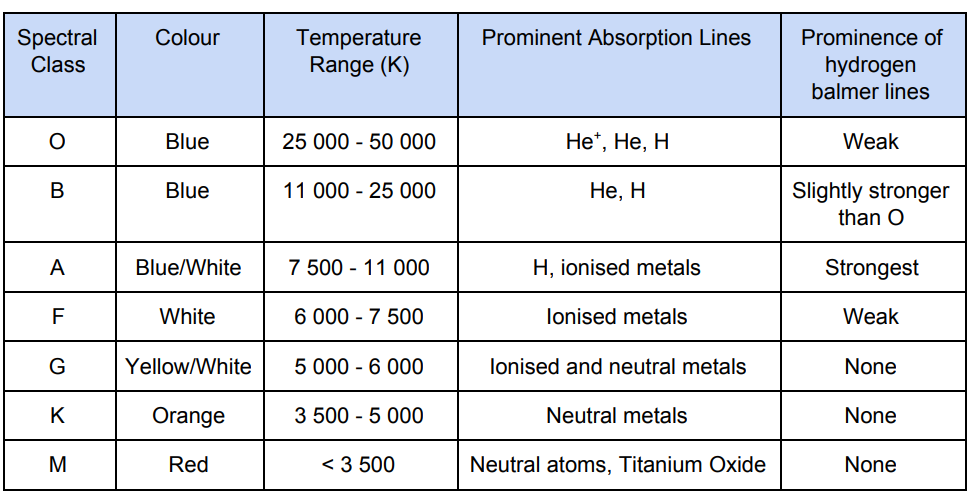
describe table of Spectral Class, Intrinsic Colour, Temperature, and Prominent Absorption lines
remember: Oh Be A Fine Girl, Kiss Me
based on the strength of absorption lines
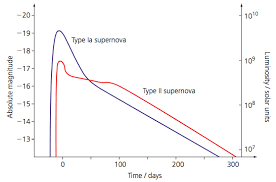
describe the T1A supernova light curve and how one is formed and how is used
peak at -19.3 peak absolute magnitude.
(about 20 days from the beginning of collapse)
When a white dwarf accumulates matter from its companion star in a binary system and explodes after reaching a critical mass
all occur at same critical mass and same peak mag so used as standard candle to calc distance of far away galaxies
equation for brightness
=L/(4nR²)
what is 1 astronomical unit
mean distance between earth and sun
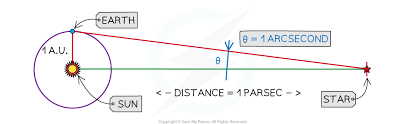
what is 1 parsec
distance that creater angle of 1 arcsecond when measured with an opposite side of 1 Au
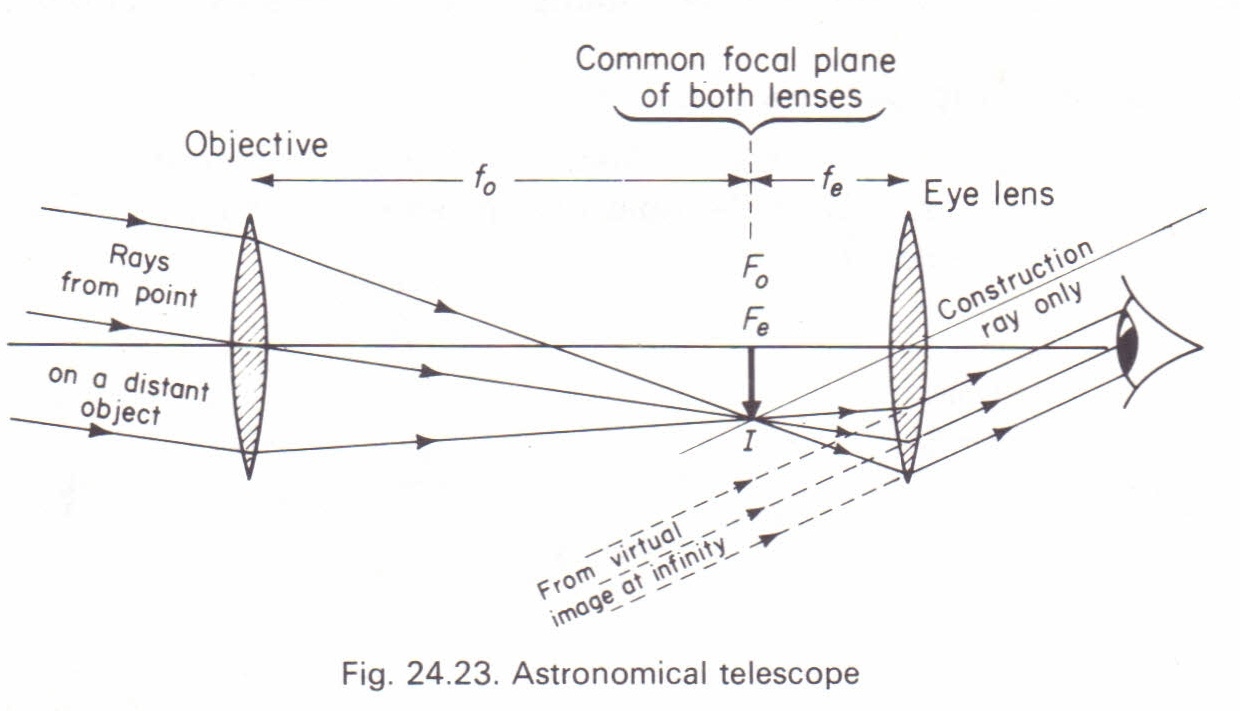
describe the normal adjustment refractor diagram
when the distance between the teo lenses is the sum of their focal lengths. AKA they share a principal focus
what is a newtionian reflecting telescope
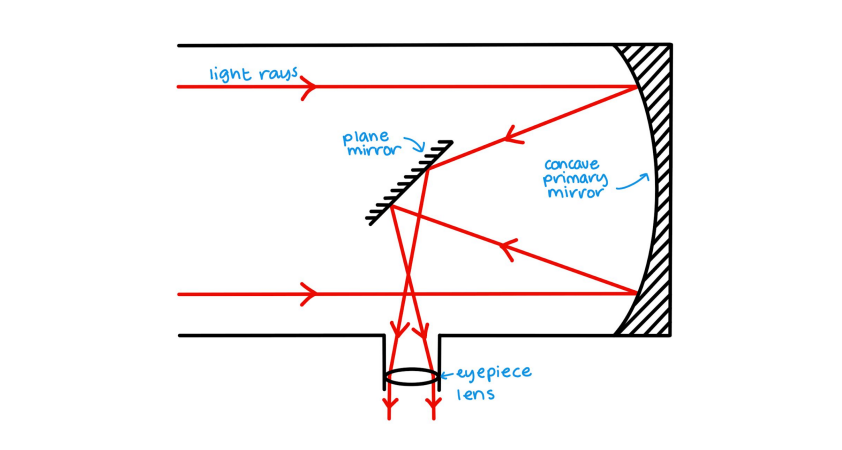
what is a reflecting telescope
use of a concave primary mirror.
very thin (less than 25nm thick) aluminium/silver coating so that smooth as possible and less distortion
light is collected and focused on eyepiece lense
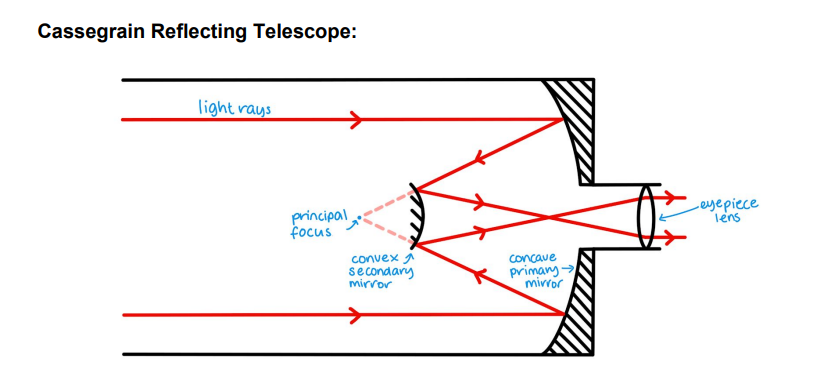
what is a cassegrain telescope
long focal length
convex mirror allows cassegrain to be shorter than the newtonian
what is a refracting telescope
two converging/convex lenses
objective lense: collects light to create a real image of a very distant object. must have long focal length and large radius to collect as much light as possible
eyepiece lense: magnifies image produced by objective lense so observer sees it. produces virtual image at infinity since light rays are parallel. reduces eye strain as dont need to refocus every time they look at image and object in sky.
power of a lense
measure of how closely a lense can focus a beam that is parallel to the principal axes
the shorter the focal length, the more powerful a lense
convering: positive
diverging : negative
measured it Dioptres (D)
what can be said when both angles in Normal refractor diagram are less than 10 degrees
angle subtended at eyepiece/ angle subtended at objective lense = objective focal length/ eyepiece focal length
what is chromatic abberation
when white light is shone thru a convex lense. blue is refracted more the red so red has a longer focal length than blue. they are focused at different points which cause images w/ coloured fringing .
it has very little effect on reflecting telescopes as it only occurs in eyepiece lense(newtonian) / small secondary convex lense (cassegrain)
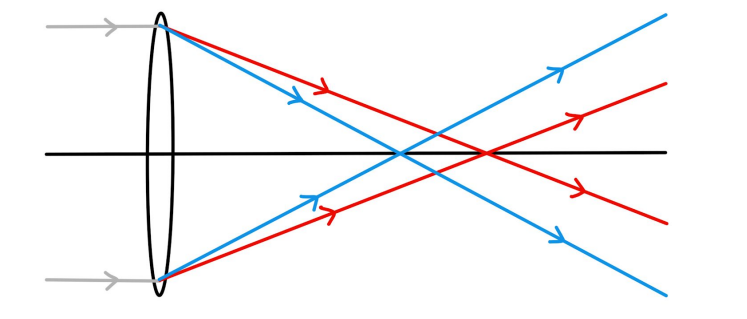
spherical aberration in lenses
the curvature of a lense causes rays at edge of lense to be focused in a different position → image blurring and distortion. most pronounced in lenses with large diameter
minimised by achromatic doublet: (also minimises chromatic) convex lense made of crown glass and a concave lense made of flint glass cemented together. brings all rays of light into focus at the same position
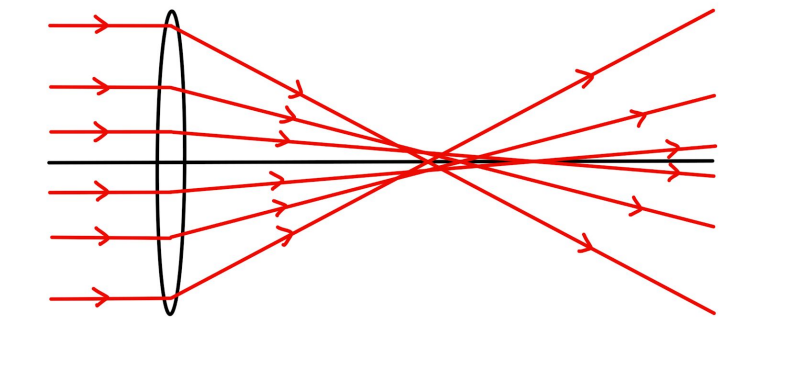
spherical aberration in mirrors
the curvature of a mirror causes rays at edge of lense to be focused in a different position → image blurring and distortion. most pronounced in mirrors with large diameter
avoided by using parabolic objective mirrors in reflecting telescopes
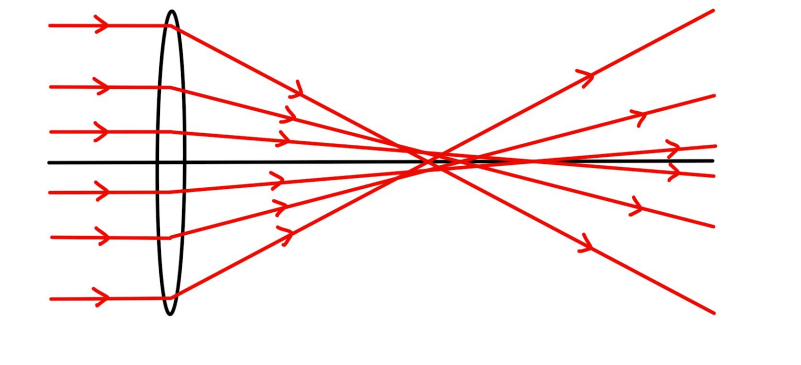
disadvantages of refracting telescopes
can only be supported by the edges
glass must be pure and free from defects. hard to do this for large diameter lenses
affected by chromatic and spherical aberration
incredible heavy, hard to move
advantages of reflecting telescopes
excellent image quality from jsut a few nanometers of Al/ Ag
mirrors unaffected by chromatic, spherical can be fixed by parabolic mirrors
not as heavy, easier to handle
mirrors can easily be supported from the back as u dont need to see thru them
large composite mirrors can be made from mirror segments
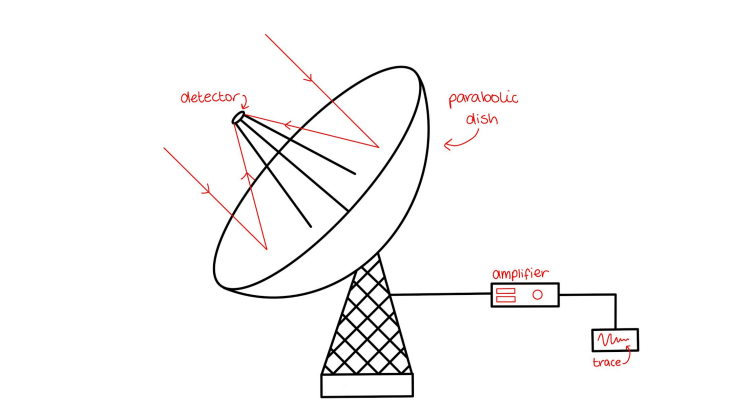
what is a radiotelescope
uses radio waves to create images
atmosphere does not absorb large range of radio waves so these can be built ground-based
in isolated locations to avoid interference with radio sources
infrared telescope
uses infrared radiation to create images
large concave mirror: focuses light on detector
cryogenic fluids to almost absolute 0: cool down the telescope as all objects emit IR as heat
well shielded: avoid thermal contamination from nearby objects and itself
used to observe cooler regions of space but atmosphere absorbs so launched into space and accessed remotely
UV telescope
uses UV radiation to create images
ozone layer blocks out all waves under 300 nm so must be positioned in space
Cassegrain. rays detected by solid state devices which use photoelectric effect to turn UV into electrons which go in circuit
used to observe interstellar medium and star formation regions
X-ray telescopes
use x-rays to create images
all xrays absorbed by atmosphere so need to be in space
such high energy taht using normal mirrors would pass right through
made from parabolic and hyperbolic mirrors- must be extremely smooth
rays skim off mirrors and come in contact with CCDs which convert light into electrical pulses
observe high energy events such as active galaxies, black holes, neutron stars
gamma telescopes
use gamma radiation to create images
do not use mirrors cuz gamma so high energy it would pass through
uses detectors made of layers of pixels
when gamma photons come in contact with pixel, they cause a signal in pixel.
observe gamma ray bursts, quasars, black holes, solar flares
2 types of gamma ray bursts
shortlived- 0.01-1 second. from merging neutron starts to form a black hole or a neutron star falling into a black hole
long lived- 10-1000 seconds type2 supernova (death of a massive star)
collecting power
a measure of ability of a lens/mirror to collect incident EM radiation
directly proportional to area of objective lense
the greater the CP the brighter the image formed
collecting power ∝ (objective diameter)2
resolving power
ability of a telescope to produce separate images of close together objects
for an image to be resolved, the angle from earth between the two objects must be atleast the minimum angular resolution (rayleigh criterion)
what are CCDs
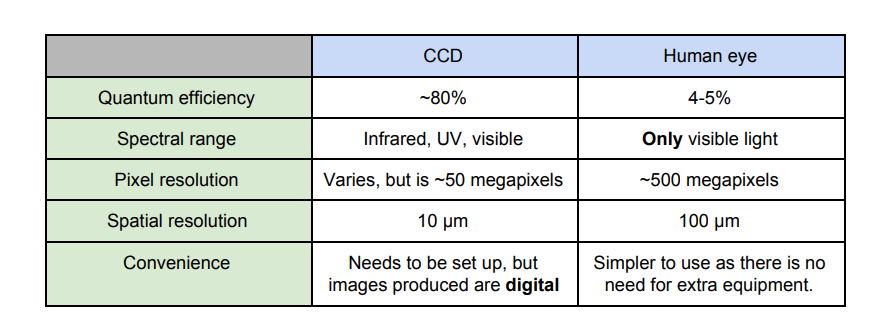
charge coupled devices. array of light sensitive pixels which become charged when exposed to light by the photoelectric effect
compare CCDs with human eye
+images can be shared and stored in CCDs
what are exoplanets
planets that are not in our solar system. they orbit stars but hard to detect cuz they are obscured by the light from their host stars
names of 2 methods to observe exoplanets
transit method
radial velocity method
what is transit method
observing intensity of light ouput of star. if a planet crosses infront of star, the intensity dips. if dips regularly, shows there may be planet orbiting it. if variation in regularity, may have multiple planets orbiting
size and period can be determined form intensity and duration of dips
only works if line of sigh is in plane of planets orbit, which is more likely for planets with small orbits as larger ones tend to be inclined
what is the radial velocity method
star and planet orbit a common centre of mass which causes a ‘wobble’ this causes a doppler shift in light received from star
most noticeable with high mass planets as higher grav pull on starr
blue shifted when moves towards earth, red shifted when moves away from earth
shows that something else near star that is exerting grav force on it
time period of doppler shift = time period of planets orbit
what is luminosity
rage of light energy released / power output
what is intensity
power received from star (luminosity) per unit area. Wm-2
therefore intensity of star follows inverse square law
the brightness
I = P/ 4πd2 where d is distance from star
what is apparent magnitude
how bright an object appears from earth.
what is the hippacros scale
logarithmic scale of apparent magnitude.
brightest stars = 1. faintest visible stars = 6
when magnitude -1, brightness x2.51
what is absolute magnitude
what the apparent magnitude would be if object was placed 10 parsecs away from earth.
brightest stars have negative absolute mag
what is a black body radiator
a body that is a perfect emitter and absorber of all possible wavelengths of radiation (stars)
what is stefans law
the luminosity (power output) is directly proportional to its surface area and absolute temperature4
used to compare luminosity, temp, and size of stars
P = σAT4
whats weins displacement law
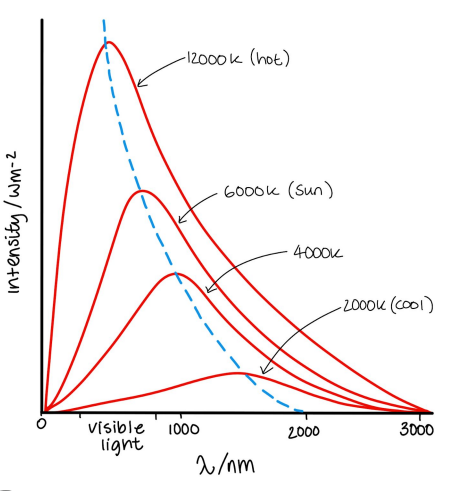
he peak wavelength (λmax) of emitted radiation is inversely proportional to the absolute temperature (T) of the object.
this shows peak λ decreases as temp increases meaning frequency increases and energy of wave increases
used to estimate temp of black body sources
describe how the black body curve
hydrogen balmer lines
caused by excitation of hydrogen from the n=2 state to higher/lower levels. found in O B A.
if temp too high, they wont show well because hydrogen excited to higher levels than n =2 / get ionised
if temp too low the H atoms are unlikely to become excited
the hertzsprung-russel diagram
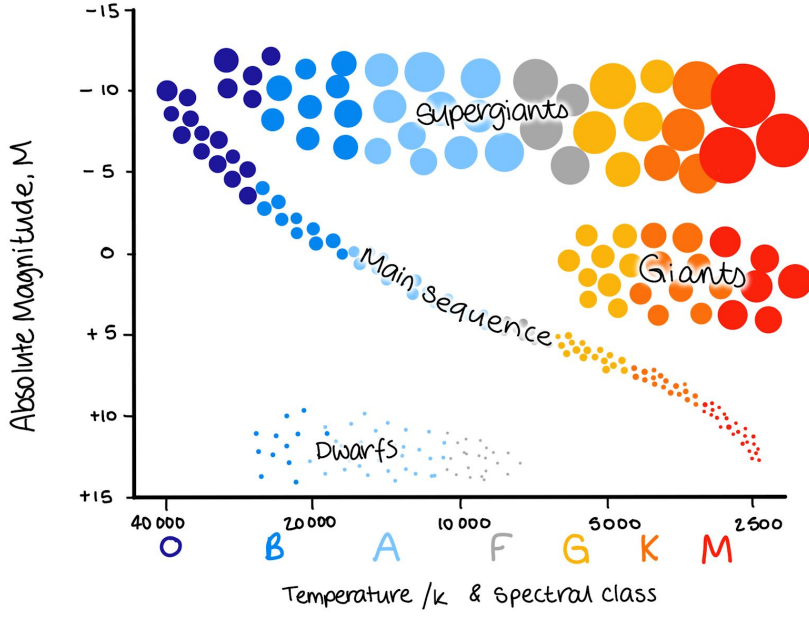
hertzsprung-russel diagram sequence
when main seq star uses up all hydrogen in core → red giant which is brighter and cooler
when red giant uses up all helium in core → ejects outer layers and becomes white dwarf which is hotter and dimmer
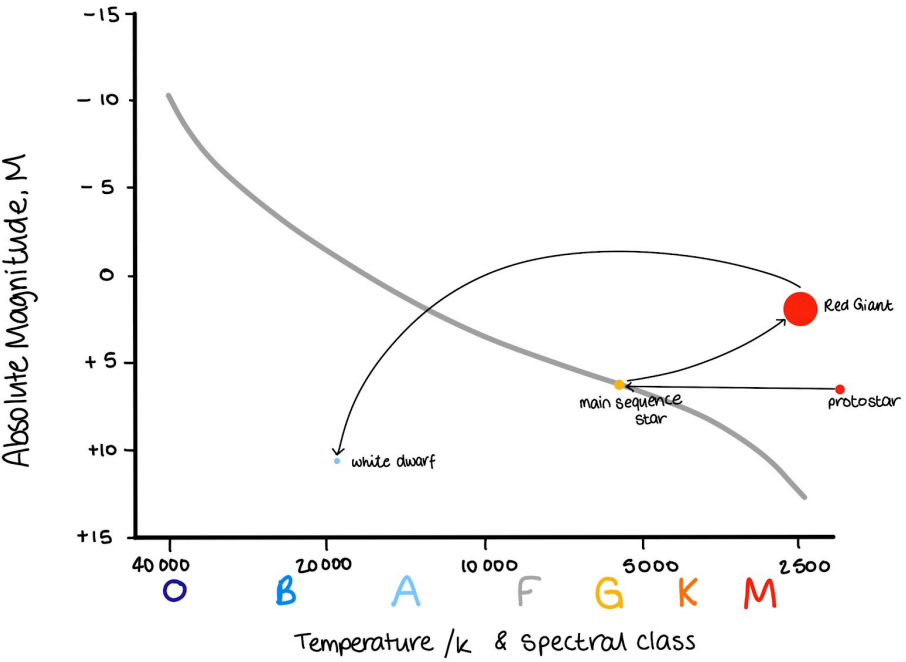
pathway of lifecycle of a star
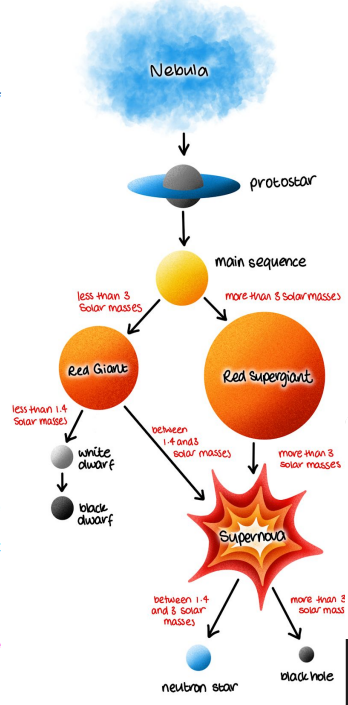
how is a protostar formed and what are its features
nebulae (clouds of gas and dust) have bits of varying masses which clump tgt under gravity
the clumps rotate and a gravity spins them inwards to form a denser centre (protostar)
has a circumstellar disc
when it gets hot enough it begins to fuse elements producing a stellar wind that blows away surrounding material
how is main sequence star formed and what are its features
when inward force of gravity = outward force of fusion, star is in equilibrium and is stable therefore main sequence
hydrogen nuclei fused into helium
the greater the mass, the shorted its main sequence period because it uses its fuel more quickly
how is a red giant formed and what are its features
when hydrogen runs out, the temp of core increases and begins fusing helium nuclei into heavier nuclei (C, O)
the outer layers expand and cool
happens to star < 3 solar masses
how is a white dwarf formed and what are its properties
when red giant uses up all fuel, fusion stops and core contracts as gravity > outward force of fusion
core becomes very dense
outer layers are thrown off, forming planetary nebula around core
will eventually cool to a black dwarf
for a star < 1.4 solar masses
how is a red supergiant formed and what are its properties
when a high mass star runs out of fuel, temperature increases and starts fusing helium nuclei together into much heavier elements, up to Fe
the collapse of these in a supernova cause gamma ray bursts
for a star > 3 solar masses
how is a type 2 supernova formed and what are its features
when all fuel runs out, fusion stops and core collapses inwards very suddenly and becomes rigid
outer layers fall inwards and rebound, launching them into space as a shockwave
elements heavier than iron are fused and flung out into space
rapidly increasing absolute magnitude
releases 1044 J of energy
happens to a giant > 1.4 solar masses
how is a neutron star formed and what are its features
when core of large star collapses, gravity is so strong it forces protons and electrons to fuse and form neutrons
incredibly dense- same density as nuclear matter
pulsars are spinning neutron stars that emit beams of radiation from its magnetic poles as they spin
for stars of solar mass between 1.4 and 3 solar masses
how is a black hole formed and what are its features
when core of giant star collapses, neutrons are unable to withstand gravity forcing them together
the grav pull is so strong not even light can escape
event horizon is point at which escape velocity ios greater than speed of light
happens to giants > 3 solar masses
what is a binary system
where two stars orbit a common mass
how r supermassive black holes formed and why are they thought to exist
the collapse of massive gas clouds while the galaxy was forming
several normal black holes merging tgt
a normal black hole that has accumulated huge amounts of matter over millions of years
stars and gas orbiting very fast near centre of galaxy so must have very strong grav field attracting them. therefore thought ot be supermassive black hole at centre of every galaxy
how do we know universe expansion is accelerating
type 1a supernovae have been seen to be dimmer than expected. therefore more distant than hubbles law predicted. suggests that its accelerating
what do we think is causing the universe expansion to be accelerating
Dark energy- has an overall repulsive effect throughout whole universe
gravity follows inverse square law but dark energy remains constant throughout whole universe therefore causes expansion to accelerate as it has greater effect than gravity
controversial cuz noone knows whats causing it
what is the doppler effect and what is it used for
compression or spreading out of wavelengths of a moving object
when an object is moving, wavelength increases behind them, decreases in front of them
used to identify binary systems (spectroscopic) and exoplanet detection
z = c/ v = f Δ/f = − λ Δ/λ
why is the wavelength ratio negative
wavelength is inversely proportional to speed
what is red/blue shift and how is it used
towards the earth- blue shift
away from the earth- red shift
used to prove universe ie expanding because the further away an object is, the more red shifted it is
z is positive for red shift
negative for blue shift
how can you use doppler effect to identify binary systems
when stars eclipse eachother, they are travelling perpendicular to observer line of sight so no doppler shift in line spectra
when one travelling away from observer and one is travelling towards, each spectral line is split into 2
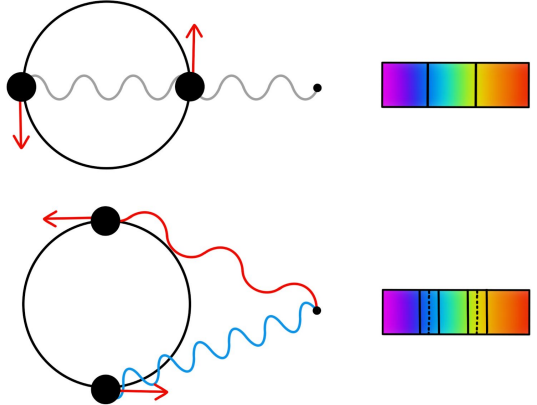
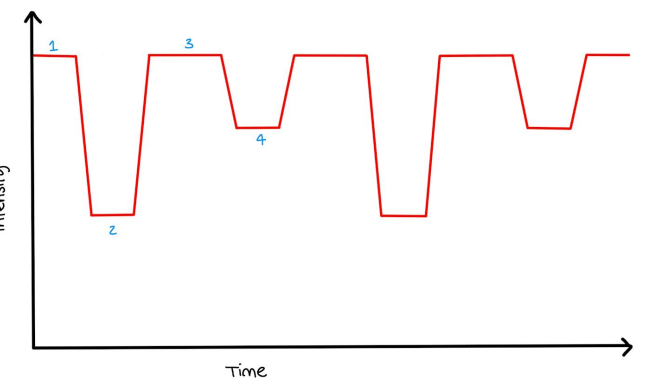
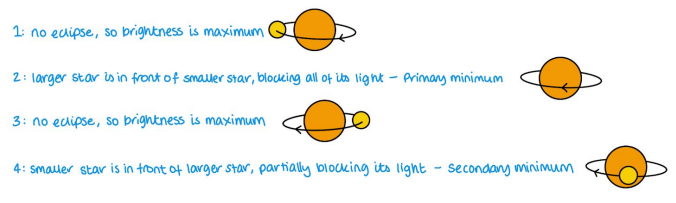
what is an eclipsing binary and explain the curve
Eclipsing binaries are when the plane of the orbit of the stars is in the line of sight from Earth to the system, meaning that the stars cross in front of each other as they orbit.
what is hubbles law
a galaxy’s recessional velocity is directly proportional to its distance from the Earth. It essentially states that the universe is expanding from a common starting point.
what is the hot big bang theory and what is the proof
universe began from one point which was infinitely small and hot. there was a huge explosion from this point and there was high energy radiation everywhere.
as the universe expanded and cooled, this radiation has lost energy and red shifted into radiowaves
→cosmological background microwave radiation, radiowave radiation that is detected from all direactions in space
in early stages of big bang, nuclear fusion converted H into He nuclei. only lasted a short period of time as universe cooled too much. approx ¼ of H nuclei fused into He
→ relative abundance ratio of H:He is 3:1
what is a quasar
an active galactic nucleus – a supermassive black hole surrounded by a disc of matter
as matter falls into black hole, jets of radiation emitted from the poles
Extremely large optical red-shifts
Very powerful light output - same as several galaxies
Their size being not much bigger than a star
radio emitter