Chapter 6: Choosing Interventions for Practice: Designs to Answer Efficacy Questions
 Studied by 3 people
 Call Kai
 Learn
Learn Practice Test
 Spaced Repetition
 Match
Match Flashcards
 Knowt Play
1/29

There's no tags or description
Looks like no tags are added yet.
Name | Mastery | Learn | Test | Matching | Spaced |
|---|
No study sessions yet.
30 Terms
randomization
R
nonrandomization
N
treatment
X
dependent variable or outcome
O
between-group comparison
comparison is made to identify the differences between two or more groups with different individuals in the groups
within-group comparison
comparison with the same individuals in the conditions being compared, most often a comparison of scores before and after an intervention
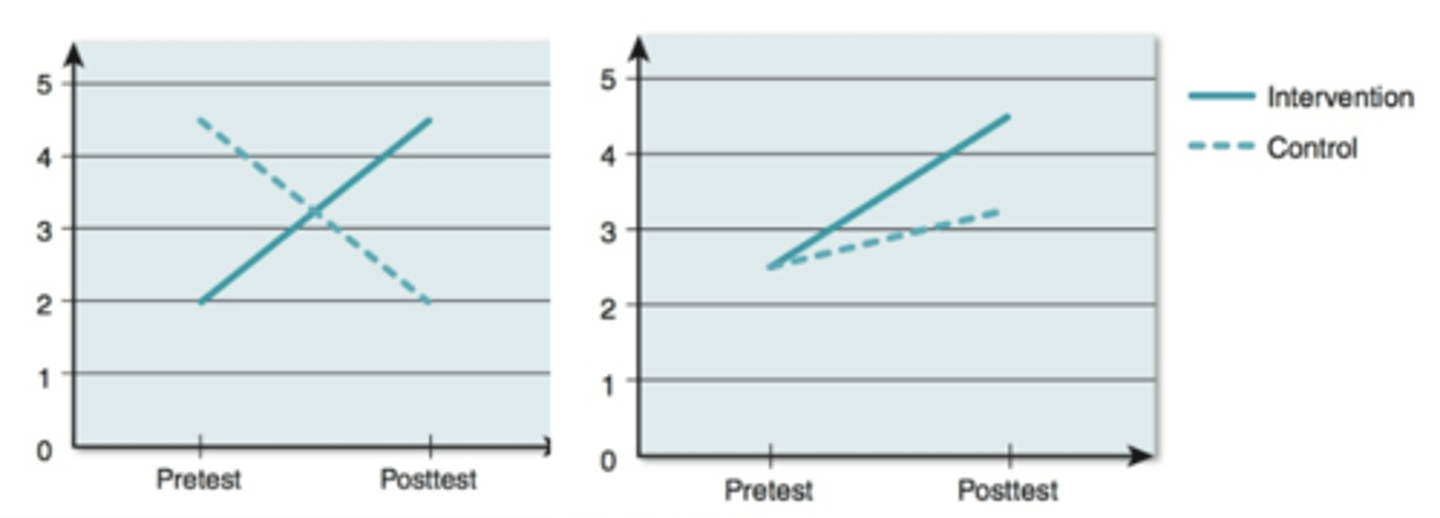
interaction effect
combines the between- and within-group comparisons, so an interaction is said to occur when there is a difference in how a group performs over time
analyses
Different types of _____________ used to determine if two groups differ over time.
- One common approach involves treating the pretest as a covariate and analyzing the difference in the posttest scores of the two groups using an analysis of covariance (ANCOVA).
main effects and interactions
any time the lines cross there is potential for an interaction
if the p value is lower that means the probability was due to chance.
designs without control groups
Technically not an experimental design
Pre-experimental design – may be used to determine whether an intervention has the potential to make a difference, before investing the time and money in a more extensive RCT
Level IV in hierarchy of evidence
Absence of control group = big limitation
O X O
randomized control trials (RCTs)
Extremely valuable to intervention research
Level II evidence
Control group - does not receive intervention or may receive placebo or standard treatment
Maturation may pose a threat to internal validity
Some RCTs may only have posttest
- Typically when a pretest would influence the outcome of the posttest (a testing threat to validity) or those in which it is expected that all participants will start out at a similar point
true RCT
R O O
R O X O (control group)
WITH A PRETEST
with comparison to standard treatment RCT
R O Xa O
R O Xb O
posttest only RCT
R X O
R O (control group)
crossover design
Level II evidence if participants are randomly assigned to groups
All participants receive the same treatment, but in a different order
Treatment vs. no treatment may be compared
- R O X O O
- R O O X O
Two interventions may be compared
- R O Xa O Xb O
- R O Xb O Xa O
nonrandomized controlled trials (NRCTs)
Participants do not have an equal chance of being assigned to a condition
Can lead to bias or differences between groups
Level III evidence
May ask for volunteers for intervention group and then match controls
May be used for pragmatic or ethical reasons
Cluster randomized control trial
Also referred to as quasi-experimental studies or nonequivalent control group designs
cluster randomized control trial
settings are randomly assigned to group
notation with true control group (NRCT)
N O O
N O X O
notation with comparison treatment (NRCT)
N O Xa O
N O Xb O
factorial designs
Can be randomized or nonrandomized
Distinguished from other designs in that they have more than one independent variable
Additional independent variable typically included to determine if the intervention had differential effects on that additional variable
Described in terms of the number of levels within each independent variable
For example, a study with two levels of the intervention, A and B, and two levels of gender, male and female, would be a 2 x 2 design
Results include main effects and interaction

single-subject designs
Compare an individual's response under different conditions
Cause-and-effect relationships can be inferred from a strong single-subject design study when there is a clear difference between behavior that occurs when an intervention is present and that which occurs when the intervention is absent.
Within-subjects design
Different notation
ABA design
Single-subject design
Example:
- The first A represents the initial phase of the study and comprises a baseline observation and collection of data.
- Then an intervention is provided, which is represented by the B phase. The same observation and collection of data continue.
- Finally, the intervention is removed, and observation and data collection continues, indicated by the second A.
- If a cause-and-effect relationship exists, a change in behavior occurs during the intervention
generalizability
major limitation of single-subject designs
replication
important in single subject designs
- with multiple participants, if the results are similar for all participants, you can have greater confidence that the intervention caused the outcome.
multiple baselines
use of __________ __________ strengths in single-subject designs
- ABAB design or ABABAB design
- If improvement during the intervention and a decline at baseline are consistently shown, evidence-based practitioners can be more assured that the intervention was effective and caused the change in behavior.
retrospective intervention studies
Researcher looks back at something that has already occurred and uses existing records to collect the data
Not experimental, observational
Sometimes these studies are called retrospective cohort studies because they utilize and compare existing groups (cohorts) of individuals.
disadvantage of RI studies
conditions cannot be controlled, and numerous threats to internal validity are likely present in the existing conditions.
advantage of RI studies
examine practices that have taken place in real-world clinical situations, the study can have greater external validity
sample size and intervention research
Larger sample reduces the likelihood of making a Type II error
Reduces sampling error so that the results of the study are more likely to reflect the true population
Larger number of participants = more reliable data
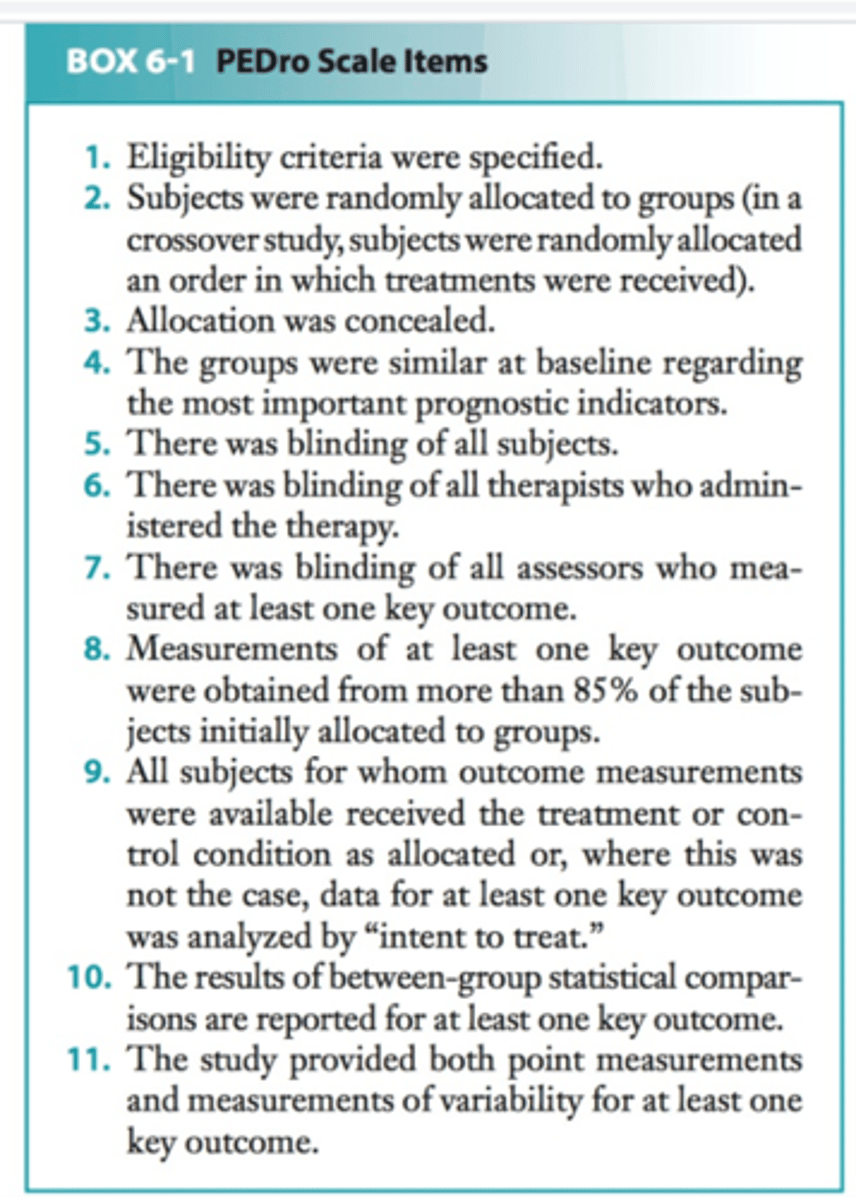
PEDro Scale
Numerical rating applied to a study to objectively assess the methodological quality of an individual study