Biol020
 Call Kai
 Learn
Learn Practice Test
 Spaced Repetition
 Match
Match Flashcards
 Knowt Play
1/128

There's no tags or description
Looks like no tags are added yet.
Name | Mastery | Learn | Test | Matching | Spaced | Call with Kai | Chat |
|---|
No analytics yet
Send a link to your students to track their progress
129 Terms
What is a solution?
A mixture of a compound (solute) in a liquid (solvent)
What is the concentration of the solute?
Mass of the solute/total volume
A solution can have more than one compound and each compound has _
A concentration
Concentration is commonly expressed in the following forms as mass over volume or in molarity:
g/l
mg/ml
µg/µl
Moles/liters = M
Concentration can also be expressed as a percentage where 1 gram of solute in 10 ml solvent =
10% solution
What does “X” mean in biology solution concentrations?
“X” shows how concentrated a solution is compared to the normal working concentration. A 1X solution is ready to use, while higher values like 10X are concentrated stock solutions that must be diluted before use
What does a 1X solution mean?
It is the normal working concentration and is ready to use
What is a 10X solution?
A concentrated stock solution that must be diluted before use
How do you dilute a 10X solution to make 1X?
Mix 1 part stock solution with 9 parts solvent
What does “10-fold dilution” mean?
The solution becomes 10 times less concentrated
What solvent is most commonly used in biology labs?
Water
Why should tap water not be used in biology solutions?
Tap water may contain impurities that affect experiments, always ask what water to use
Concentration is alwyas caluculated using the _ volume
The total or final. If two solutions are mixed, the final volume is the sum of them
If 1 liter of solution one is mixed with 4 liters of solution two, the final volume is _ liters, and _ liters is used in the concentration calculation
5
When making a solution starting from a dry reagent,
The reagent will add to the volume upon dissolving
A 100 ml solution of NaCl may have only 80 ml of water, but after dissolution, salt will increase the volume to _ ml
100
To calculate a dilution, what formula do you use?
c1v1 = c2v2
c = concentration
v = volume
What volume of 10X solution is needed to make 100 µl of a 1X solution?
c1 = 10X stock solution
v1 = unknown
c2 = 1X working concentration
v2 = 100 µl final volume
10X x v1 = 1X x 100 µl
v1 = (1X x 100 µl)/10X
v1 = 10 µl
The remaining 90 µl will be dH2O (distilled water) to make a total of 100 µl
If a solution requires multiple reagents being mixed together, the volume of each reagent is calculated using the dilution formula. These volumes are _
Added and subtracted from the total to determine the volume of water needed to complete the new solution
What does PCR mean?
Polymerase chain reaction
The DNA sequence of a genome is _
Dynamic
What is a genome?
The complete set of an organism’s DNA, including all of its genes and genetic information
If two individuals have sequence differences at the same place in the genome it is called a _
Polymorphism (poly = many, morph = form)
A difference of one nucleotide is called a _
Single nucleotide polymorphism or SNP
Sickle cell anemia is due to a _
SNP as the normal allele has a glutamic acid codon GAG whereas the disease allele has a valine GTG codon at exactly the same position in the protein, this is also a nonsynonymous difference (changing the protein function)
Synonymous Difference
A DNA change that does not change the amino acid and protein sequence (like TTT and TTC for phenylalanine), so the protein stays the same
Nonsynonymous Difference
A DNA change that does change the amino acid, which can alter the protein’s function
Insertion/Deletion (Indel) Polymorphism
Occurs when one or more nucleotide of DNA is present in one individual and absent in another
SNP’s and indels are the results of _
Errors during the DNA replication process
Using PCR,
We’re able to amplify DNA and is similar to DNA replication but is targeted and we are able to amplify regions of DNA that we are interested in
PCR happens in a _
Test tube
What do you need for a PCR experiment to take place?
Double distilled water (very sterile water)
2X MyTaq (reagent)
Primer Forward
Primer Reverse
What ia reagent?
A substance or chemical used in a reaction to detect, measure, examine, or produce another substance
What is polymerase?
An enzyme that builds long chains of DNA or RNA by adding nucleotides together
What does 2X MyTaq have?
It has the polymerase that is used for the amplification of the DNA, nucleotides for the DNA, and other buffers, along with the dye that makes it red
What are primers?
They are key to PCR, and they give you the selectivity or ability to target the DNA you’re interested in
Because a DNA is double-stranded, we have to target both strands that complement one another. In a polymerase chain reaction (PCR), this is done using two primers:
The forward primer binds to one DNA strand at the beginning of the target region, while the reverse primer binds to the complementary strand at the opposite end of the target region. DNA polymerase can only add nucleotides in the 5’ → 3’ direction, so having two primers allows both strands to be copied simultaneously. This lets PCR repeatedly amplify the specific DNA segment between the primers, doubling the amount of target DNA each cycle.
1 ml =
1000 µl
What are solutions?
A homogenous (uniformly distributed) mixtures of two or more substances and can be in any form f matter: solid, liquid, or gas
What are solutions essential to?
Most laboratory-based biomedical research
Examples of Solutions
Buffers, reaction mixers, cell culture media, cell lysates, etc.
To make a solution from a solid solute and a liquid solvent, you need to know:
The desired concentration (what units these will be in and if molarity or normality, the molecular or formula weight of the solute) and volume
What is normality?
Like molarity, but is used for ionic solutions to more accurately represent their ionic strength and is the number of moles of active ions per liter in a solution
What are often expressed in normality?
Acid and base concentrations
5 M =
5 moles per liter
How to Convert Moles into Grams: Say we need 5 moles per liter, and have a molecular weight of 75 g/mol
5 moles × 75 g/mol = 375 g
How to make 1L of a 5M solution of a substance with a molecular weight of 75 g/mol. How many grams of solute should we weigh out?
CV = Total Amount
1 L x 5 M (equivalent to 5 mol/L) = 5 mol
5 mol x 75 g/mol = 375 g of solute
Weight out 375 g and bring the volume to 1L with solvent
It’s important to weigh your dry solute first!
What is a dilution?
Using solvent to increase the volume and thus decrease the solute concentration
When diluting a solution, the total amount of the compound (moles or mass):
Does not change
We have 5M solution of NaCI. We want 100mL’s of a 0.5M solution
c1v1 = c2v2
5M x v1 = 0.5M x 100mL
v1 = (0.5M x 100mL)/5M
v1 = 10 mL
Add 10 mL of 5M NaCI to a container and bring the volume to 100mL with water
You want to make 500mL of solution containing: 50 mM NaCI and 2 mM MgCI2 from a 1 M stock solution. The molecular weight of NaCI is 58.44 g/mol
C x V = moles
.050 M x .500 L = .025 mol (remember mol/L = mol)
.025 mol × 58.44 g/mol = 1.46 g
C1V1 = C2V2
1 M x V1 = .002 M x .500 L
V1 = .001 L or 1 mL
Add 1.46 g NaCI
Add 1 mL MgCI2 stock
Add solvent until final volume is exactly 500mL
What is DNA polymerase?
Adds nucleotides during DNA replication
What is DNA?
Deoxyribonucleic acid, the molecule that stores genetic info in living organisms
What is RNA?
Ribonucleic acid, a molecule that helps use DNA’s instructions to make proteins
What are nucleotides?
Moleculues that make up DNA and RNA strands
What are enzymes?
A protein that speeds up chemical reactions in cells without being used up
What are proteins?
Molecules that build structures and carry out functions in cells, made of amino acids
What are amino acids?
The building blocks of protein
What is an allele?
A different version of the same gene
What is a codon?
A sequence of three nucleotides in mRNA that codes for a specific amino acid or a stop signal during protein synthesis
What is mRNA?
Messenger RNA, a molecule that carries instructions from DNA to the ribosome to make proteins
What is a transposable element?
A piece of DNA that can move to different locations in the genome (an insertion of mobile pieces of DNA)
What is a terminal inverted repeat?
Reversed matching DNA sequences found at the ends of a transposable element
Many SNPs that result in a synonymus difference occur at _
The third position of a codon
What is the difference between a nucleotide and a codon?
A nucleotide is a single DNA base (A, T, C, or G).
A codon is a sequence of 3 nucleotides that codes for an amino acid.
Example:
Nucleotides: A, T, C, G
Codons: ATG, GAG, TTT
A SNP (single nucleotide polymorphism) changes one nucleotide. For example, changing GAG to GTG changes the second nucleotide in the codon.
TIRS are a characteristic of TEs and looks like:

TEs account for over _ of the genomic DNA of many species
50%
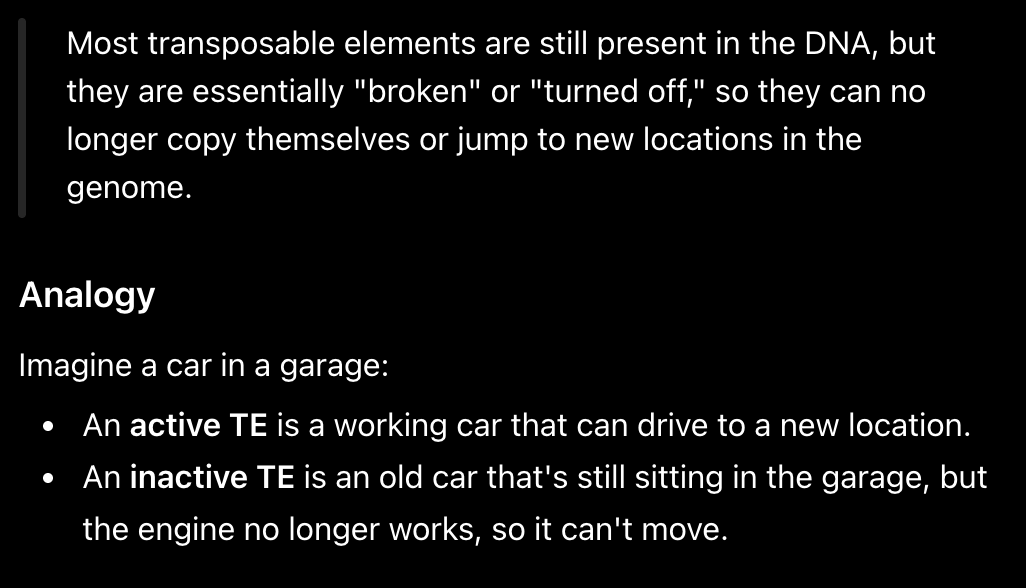
Most TEs in a genome are inactive meaning _
They can no longer move
What is a genome?
The complete set of DNA in an organism, including all genes and non-coding DNA. It contains all of the organism's genetic information.
When a TE can move, it means _
They can make copies of itself and insert those copies into new locations in the genome
Since TEs depend on the organism surviving, it is beneficial for them not to disrupt important genes.
So active TEs tend to insert into places where they are less likely to cause damage, such as:
Between genes → DNA regions that are not part of a gene.
Into other TEs → If a TE inserts into another TE, it is less likely to disrupt an important gene.
Into introns → Introns are parts of a gene that are removed from the RNA before a protein is made, so inserting there is often less harmful than inserting into an exon.
If a TE inserted into an important exon, it could break the gene and harm the organism
What can happen if a transposable element (TE) inserts into an exon of a gene that encodes an important protein?
A TE insertion into an exon can disrupt the gene's coding sequence, causing the protein to be made incorrectly or not at all. If the protein is important for normal cell function, this can lead to harmful effects, disease, or even death of the organism.
The TE itself usually remains in the genome, but because the insertion is harmful, the organism may have reduced survival or reproduction. As a result, that TE insertion is less likely to be passed on to future generations and may eventually disappear from the population through natural selection.
Exon
An exon is a region of a gene that is retained in the final mRNA after splicing. Exons contain the genetic information that is usually translated into a protein, while introns are removed before translation
An exon is made up of many nucleotides, and many of those nucleotides are grouped into codons that specify amino acids.
What does it mean to have a negative control?
Two types of controls that provide information about the experiment are positive and negative controls. With negative controls, as the name implies, no result should be observed
If a result is obsesved in the negative control,
It suggests that an error occurred during the experimental set-up or the reagents used were contaminated
What are positive controls for?
Used to confirm a previously characterized result in a new sample or to confirm that all reagents were added properly. Positive controls are not always available specially in a brand new experiment where all of the variables are new
Reactions are added to all _
Samples, including controls
The reaction for samples are composed of _
Reagents mixed together into a master mix
All PCR reactions contain _
Enzyme, dNTPs, buffer and water
The variable reagent (different from master mix) is added to _
A subset of the sample tubes
What do variable reagents contain?
They are the primers and/or the DNA template
Think of PCR as a _
DNA photocopier. If you start with one copy of a DNA segment, PCR can amplify it into millions of copies so scientists can study it
dNTPs
Deoxyribonucleotide Triphosphates
The building blocks of DNA that are used to create new DNA strands during PCR.
There are four dNTPs:
dATP (A)
dTTP (T)
dCTP (C)
dGTP (G)
Think of dNTPs as the individual LEGO bricks used to build a DNA strand.
What is an enzyme?
The enzyme used in PCR is usually Taq polymerase.
Its job is to:
Read the template DNA
Add the correct dNTPs
Build a new complementary DNA strand
Think of Taq polymerase as the construction worker assembling the LEGO bricks into a new DNA copy.
Why "Taq"?
It comes from the bacterium Thermus aquaticus.
It can survive the high temperatures used during PCR.
Buffer
A solution that maintains the proper chemical environment for the enzyme to function.
The buffer:
Maintains the correct pH
Provides salts and ions needed by Taq polymerase
Helps the reaction run efficiently
Think of the buffer as the workshop or construction site where the worker (Taq polymerase) can do its job properly.
PCR is _
DNA replication in a test tube and requires DNA Polymerase, nucleotides, template (DNA to be copied) and primers. The primers direct the polymerase to the region of the DNA for copying
What is our class master mix composed of?


What is this format called?
FASTA and is very common way to format DNA, RNA, and protein sequences. The first line is the “comment line” and starts with the greater-than sign (>). The comment line contains the name of the sequence and sometimes other information about the sequence. The sequence follows the comment line. Anytime you copy-and-paste sequence ALWAYS include the comment line!
MUSCLE meaning
A multiple sequence alignment (MSA) program used to compare DNA sequences to each other
Stands for MUltiple Sequence Comparison by Log-Expectation
What is Genetic Information Transfer (GIT)?
The processes that use the information stored in genes to produce a protein or a functional RNA
When does Genetic Information Transfer (GIT) begin?
When a gene is turned on (expressed)
Which enzyme performs transcription?
RNA polymerase
What is the first step of Genetic Information Transfer?
Transcription — copying DNA into pre-mRNA
Does DNA get converted into mRNA during transcription?
No. The DNA is copied (transcribed) into pre-mRNA and remains unchanged
After transcription the pre-mRNA is processed in three ways:
A cap is added to the start, a string of adenines is added to the end (poly-A tail), and then the pre-mRNA is spliced to remove the introns
4 Types of Nucleotides in DNA
Nucleotide | Base |
|---|---|
A | Adenine |
T | Thymine |
C | Cytosine |
G | Guanine |
4 Types of Nucleotides in RNA
DNA | RNA |
|---|---|
A | A |
T | U (Uracil) |
C | C |
G | G |
The coding sequence for a protein is not continuous in _
Eukaryotic genes. Instead, there is a region of coding sequence then a region of non-coding. That is followed by coding sequence, etc. The coding sequence is an exon while the non-coding is the intron (in between the exons). The introns are removed and the exons are spliced together in a process called splicing. (To splice means to join.) Splicing occurs in a very complex set of proteins and RNAs called the spliceosome. After splicing the coding sequence, is now continuous and the mRNA exits the nucleus
Splicing occurs in a very complex set of proteins and RNAs called the _
Spliceosome
In the _, the mRNA meets up with the machine that will decode the mRNA and produce a string of amino acids. What is the machine?
Cytoplasm, the machine is the ribosome and contains both proteins and rRNAs (ribosomal RNA)