(11) Anti-Gout Drugs
 Call Kai
 Learn
Learn Practice Test
 Spaced Repetition
 Match
Match Flashcards
 Knowt Play
1/34

There's no tags or description
Looks like no tags are added yet.
Name | Mastery | Learn | Test | Matching | Spaced | Call with Kai | Chat |
|---|
No analytics yet
Send a link to your students to track their progress
35 Terms
What is Gout?
↑ uric acid → monosodium urate crystals form → crystals deposit in joints → inflammation + pain
inflammatory arthritis common in men
Gout: Lifestyle factors
high meat/seafood intake
excessive alcohol
emotional stress/physical trauma
Why crystals form?
Uric acid is not very water-soluble.
Urate monoanion is much more soluble.
But if urate gets too high, even it cannot stay dissolved.
It precipitates → forms crystals → deposits in joints → gout.
uric acid facts
uric acid pKa = 5.7 (more acidic group) and 10.3 (more basic group)
At body pH, it is mainly the urate monoanion.
Treatment Strategies
Strategy | What you are doing | Drugs |
|---|---|---|
Acute gout/prophylaxis | ↓ inflammation | Colchicine |
Chronic gout | ↑ uric acid excretion | Probenecid, Lesinurad |
Chronic gout | ↓ uric acid formation | Allopurinol, Febuxostat |
Also know acute gout can involve NSAIDs such as indomethacin/naproxen and glucocorticoids.
COLCHICINE
topic overview
structure
metabolism
fun facts
COLCHICINE
fun facts
treats the inflammation, NOT the uric acid.
Can be used with probenecid.
COLCHICINE
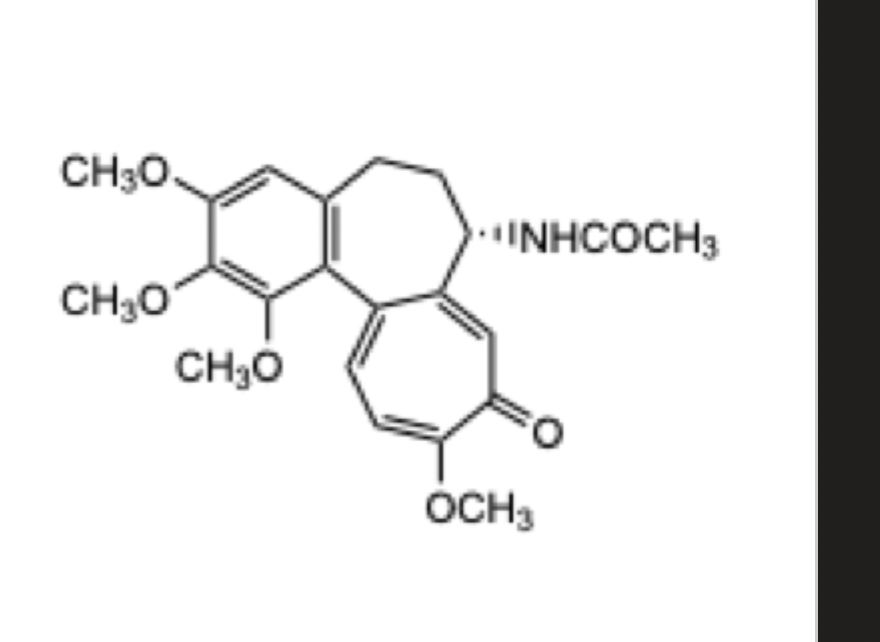
Structure
Several methoxy groups (oxygen attached to a methyl group (CH₃):)
Contains an amide (a carbonyl (C=O) attached to a nitrogen (N).
COLCHICINE
Metabolism
Phase I metabolism
CYP3A4 O-dealkylation = minor
remove the carbon group from O
Esterase amide hydrolysis = major
break the amide bond with water
PROBENECID
topics discussed
mechanism
structure
metabolism
fun facts
PROBENECID
mechanism
URAT1 normally reabsorbs uric acid in the kidney.
Reabsorption = uric acid goes from the kidney tubule back into the body.
Probenecid blocks URAT1 → ↓ reabsorption → ↑ uric acid excretion → ↓ serum uric acid.
PROBENECID
Structure
Recognize:
Carboxylic acid = acidic
Tertiary sulfonamide = neutral, NOT acidic
2 propyl groups

REFRESHER ONLY:

Primary sulfonamide: N has 2 H
Secondary sulfonamide: N has 1 H
Tertiary sulfonamide: N has 0 H
PROBENECID
fun facts
Poorly soluble in water/acidic media (like stomach)
Highly soluble in alkaline media (it loses H and becomes -)
Can cause mild GI irritation.
PROBENECID
Metabolism
ALL metabolites are ACTIVE → extended/longer duration of action (THAT’S WHY MOST IMPORTANT)
Phase 1:
(1) Propyl group → ω-oxidation → primary alcohol → aldehyde → carboxylic acid
Primary alcohol → alcohol dehydrogenase
Aldehyde → aldehyde dehydrogenase
(2) N-dealkylation can also occur
Phase II → glycine conjugation
PROBENECID
Metabolism - draw it out

LESINURAD
topics discussed
mechanism
structure
fun facts
metabolism
LESINURAD
mechanism
same uric-acid-excretion mechanism as probenecid.
Atropisomers
the same molecule can exist in two stable 3D shapes because rotation around a bond is restricted.
LESINURAD
Structure
2 stable atropisomers
Similar idea to chirality, BUT no chiral centers, — the difference comes from restricted bond rotation
Form 1 half-life = ~3.8 hr
Form 2 half-life = ~6.2 hr
Therefore form 2 lasts longe

LESINURAD
Metabolism
CYP2C9 = main Phase I CYP
CYP2C9 can oxidize near the cyclopropyl group (3-carbon ring.)
It can also oxidize the aromatic ring → epoxide
Epoxide → can form reactive oxygen species → possible connection to kidney toxicity
LESINURAD
Metabolism - show me

LESINURAD
fun facts
Black-box warning - ACUTE KIDNEY FAILURE
Lesinurad MUST be used with a xanthine oxidase (XO) inhibitor.
Do not use alone → kidney-failure concern increases!
Drug interactions
CYP2C9 inhibitor → ↓ lesinurad metabolism → ↑ lesinurad concentration → ↑ toxicity risk
CYP2C9 substrates (like NSAIDS) can also compete.
Professor connected this to NSAIDs, because many NSAIDs use CYP2C9 and may be used with gout drugs.
Explain the route to make uric acid - verbally
key route: Hypoxanthine → XO → Xanthine → XO → Uric acid
XO = xanthine oxidase
they are multiple purine routes to uric acid. examples below:
Adenine (purine) → hypoxanthine → xanthine → uric acid
Guanine (purine) → xanthine → uric acid
Explain the key route to make uric acid - draw it out

What is the mainw way to ↓ uric acid formation?
Block XO, which is done by ALLOPURINOL and FEBUXOSTAT
ALLOPURINOL
topic overview
mechanism
structure
metabolism
ALLOPURINOL
mechanism
Allopurinol =purine like/ hypoxanthine mimic
Hypoxanthine + xanthine ↑ and are excreted.
ALLOPURINOL
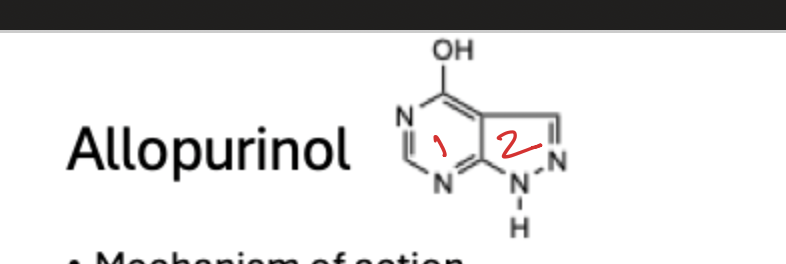
Structure
Allopurinol looks very similar to hypoxanthine.
Hypoxanthine = XO substrate
Allopurinol = XO inhibitor
The important structural difference discussed is the position of a nitrogen.

ALLOPURINOL
Metabolism
Allopurinol is BOTH:
XO inhibitor
XO substrate
Allopurinol → XO → Alloxanthine
Then: Alloxanthine also inhibits XO
Therefore: active metabolite → extended duration of action.
ALLOPURINOL
Metabolism - draw it out

FEBUXOSTAT
topics overview
fun facts
structure
metabolism
FEBUXOSTAT
fun facts
Major comparison 1
Allopurinol = purine-like / hypoxanthine mimic
Febuxostat = first NONPURINE
Comparison 2
Fewer side effects than allopurinol
used when a patient cannot tolerate allopurinol
Allopurinol is generally used first.
Comparison 3 = Duration
Allopurinol → active metabolite → longer duration
Febuxostat → more inactive metabolites → shorter duration than allopurinol
FEBUXOSTAT
Structure - draw it out

Remember, Neha Chopra is OG, but Neha Sharma is Copy Cat
FEBUXOSTAT
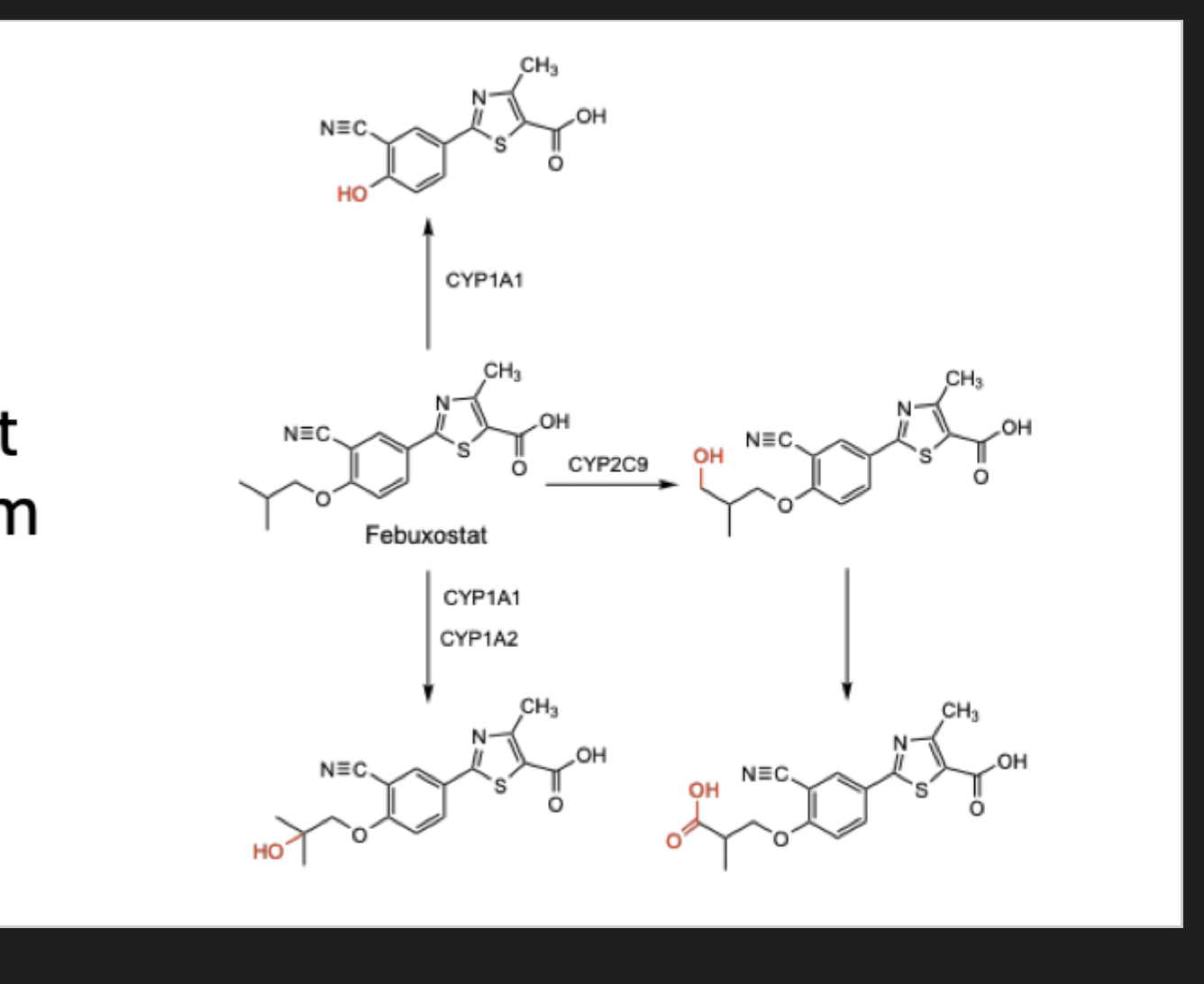
Metabolism
Phase 1
CYP1A1:
O-dealkylation → phenol
ω−1 oxidation
CYP2C9:
ω oxidation
Primary alcohol → carboxylic acid
Phase II → glucuronide conjugation
FEBUXOSTAT
Metabolism - draw it out