GEOL 238 Midterm 1
 Call Kai
 Learn
Learn Practice Test
 Spaced Repetition
 Match
Match Flashcards
 Knowt Play
1/191

Earn XP
Description and Tags
Name | Mastery | Learn | Test | Matching | Spaced | Call with Kai | Chat |
|---|
No analytics yet
Send a link to your students to track their progress
192 Terms
Sedimentology
The study of processes of formation, transport, and deposition of material that accumulates as sediment in continental and marine environments and eventually forms sedimentary rocks
3 resources provided by sedimentary rocks
Grow food on deposits formed by sedimentary processes
Contain most of the world’s fossil fuels
Obtain water from sedimentary deposits
Erosional systems
Areas of high relief where sediment is produced and transported downstream
Depositional systems
Areas of low relief where sediment deposition creates sedimentary archives
Weathering
Physical, chemical, and biological processes that act to break down rock
Erosion
Physical (or biological) removal of weathered sediments or other material
2 types of weathering (both types work simultaneously and enforce each other)
Physical weathering
Chemical weathering
Physical weathering
Physical forces breaking rocks into smaller pieces
Chemical weathering
Chemical transformation of rock into new compounds
4 methods of physical weathering
Unloading/Stress Release
Volume Changes
Biological Agents
Abrasion
4 methods of volume changes (physical weathering)
Insolation Weathering
Freeze-Thaw (Frost) Weathering
Salt Weathering
Wetting/Drying
Unloading/Stress Release
Overlying rock is eroded, compressional stress is reduced and rock unit “rebounds” upward
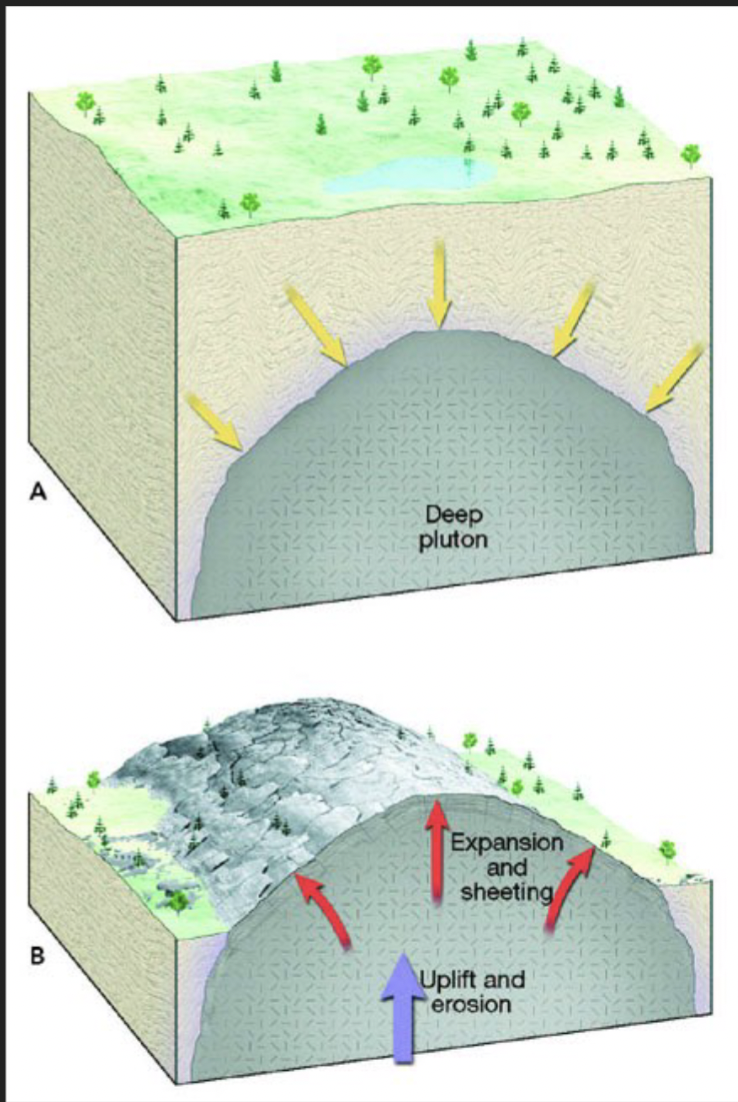
Sheeting occurs due to…
Process of unloading/stress release
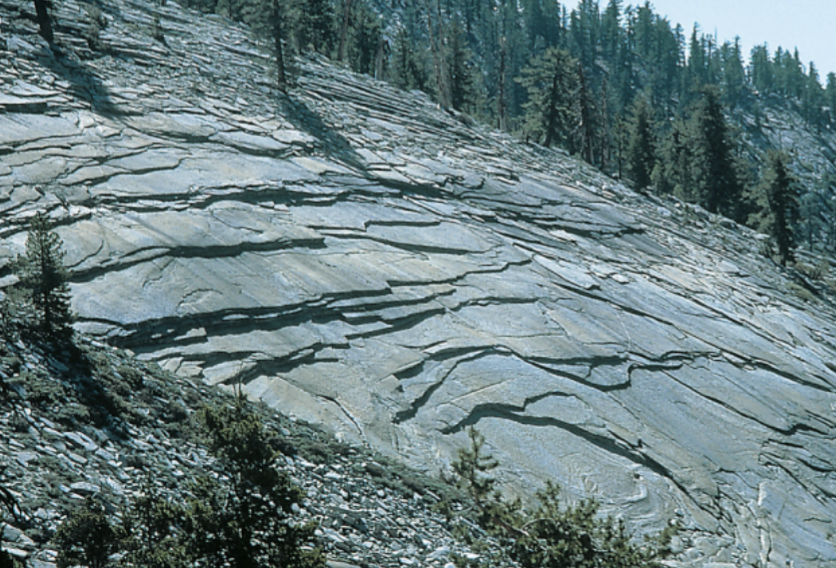
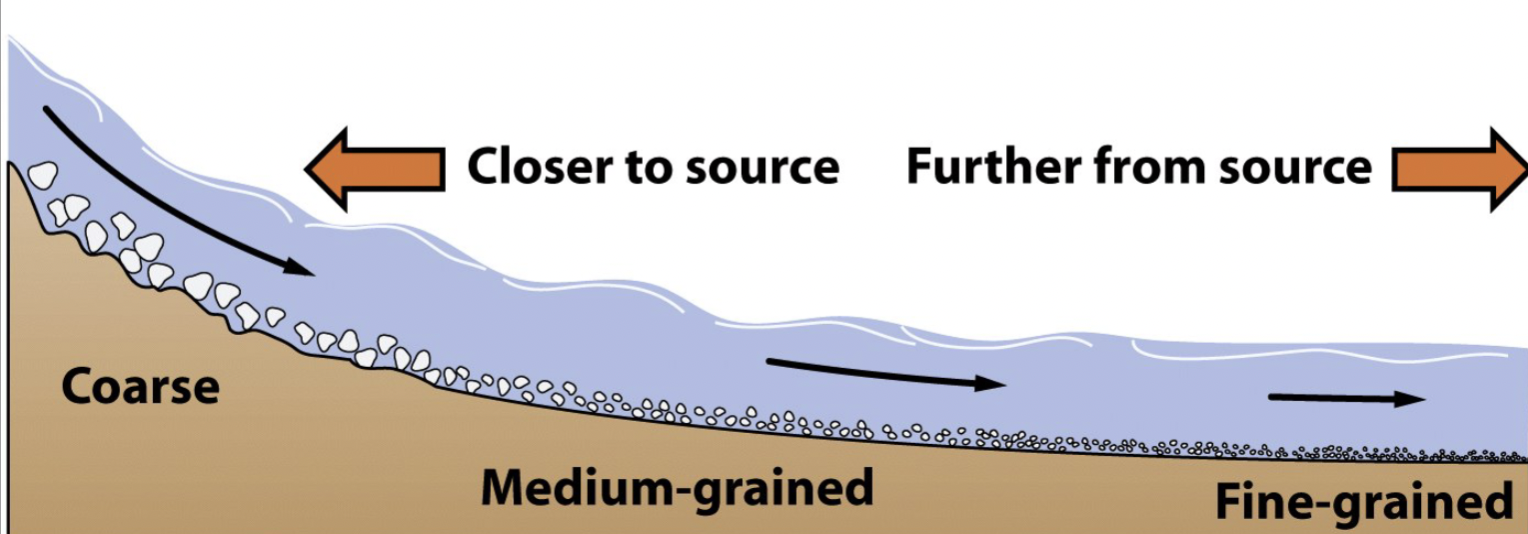
How abrasion affects grain size (during erosion + transport)
During transport, grains bash against each other and become more rounded and break down
COARSE —> MEDIUM —> FINE
3 methods of chemical weathering
Simple Solution (“congruent dissolution”)
Hydrolysis (“incongruent dissolution”)
Oxidation and Reduction (Redox)
Oxidation
Extraction of electrons from a substance
Reduction
Addition of electrons to a substance
Oxidation and Reduction (Redox)
Loss of electron from an element in a mineral (often Fe or Mn), resulting in formation of oxides or hydroxides (if water present)
Simple Solution (“congruent dissolution”)
Mineral completely dissolves (ex. calcite, gypsum, halite)
Occurs more quickly in acidic water

Main solid product of hydrolysis….
Clay minerals (such as kaolinite)
Hydrolysis
Hydrogen ion attacks and replaces other positive ions; which results in dissolved ions and solid products
Occurs in pure water but is faster if water is acidic
Common weathering type in silicate minerals

Mineral type that experiences simple solution
Highly soluble minerals (calcite, gypsum, halite)
Quartz
Carbonate rocks
Mineral type that experiences hydrolysis
Silicate minerals
Mineral type that experiences redox
Iron sulfides
Fe- and Mn-bearing silicates
Products of weathering feldspar….
Clay minerals + ions + SiO2
Products of weathering Fe-Mg minerals….
Clay minerals + ions + SiO2 + Fe-oxides
Product of weathering quartz…
Quartz grains
Product of weathering calcite…
Ions
3 types of products of weathering
Source-rock residues (chemically resistant minerals and rock fragments)
Secondary minerals (formed in situ)
Soluble constituents (released from source rocks)
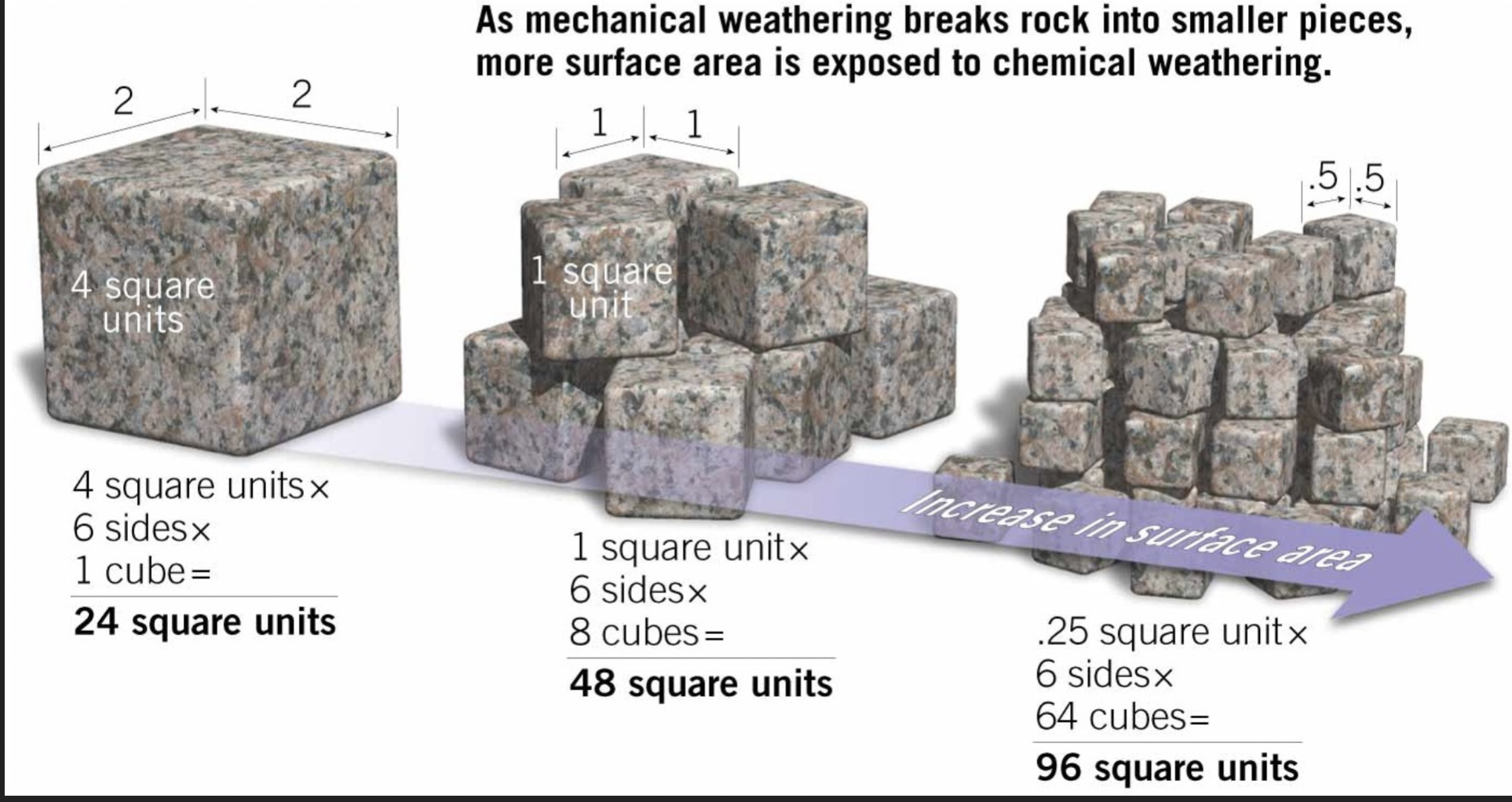
How surface area affects weathering
Mechanical weathering breaks rock into smaller pieces, therefore more surface area for chemical weathering
Differential weathering
Weathering affects rocks/minerals differently based on the mineral hardness + planes of weakness
2 characteristics of more resistant rocks (i.e granite)
Hard minerals
Crystals interlocked
2 characteristics of less resistant rocks (i.e schist)
Soft minerals
Crystals platy
Most stable mineral is…
Quartz
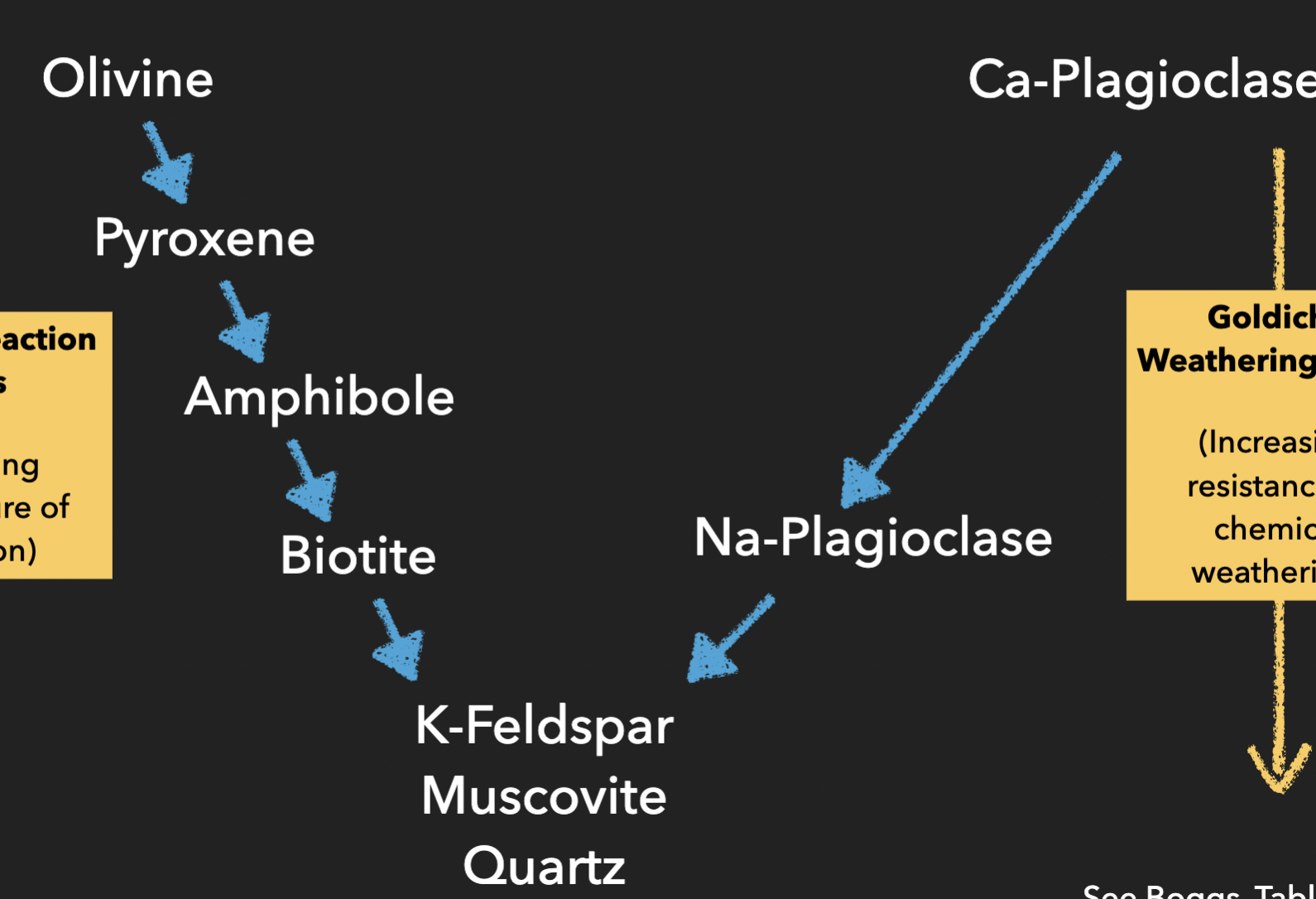
Goldich’s Weathering Series
Reverse of Bowen’s reaction series; series of increasing resistance to chemical weathering from least resistant (olivine) to most resistant (quartz)
4 factors that affect nature of sediment
Source area composition
Amount of weathering
Climate
Transport processes
Simplified path of sediment travel
SOURCE (erosional systems) —> SINK (depositional systems)
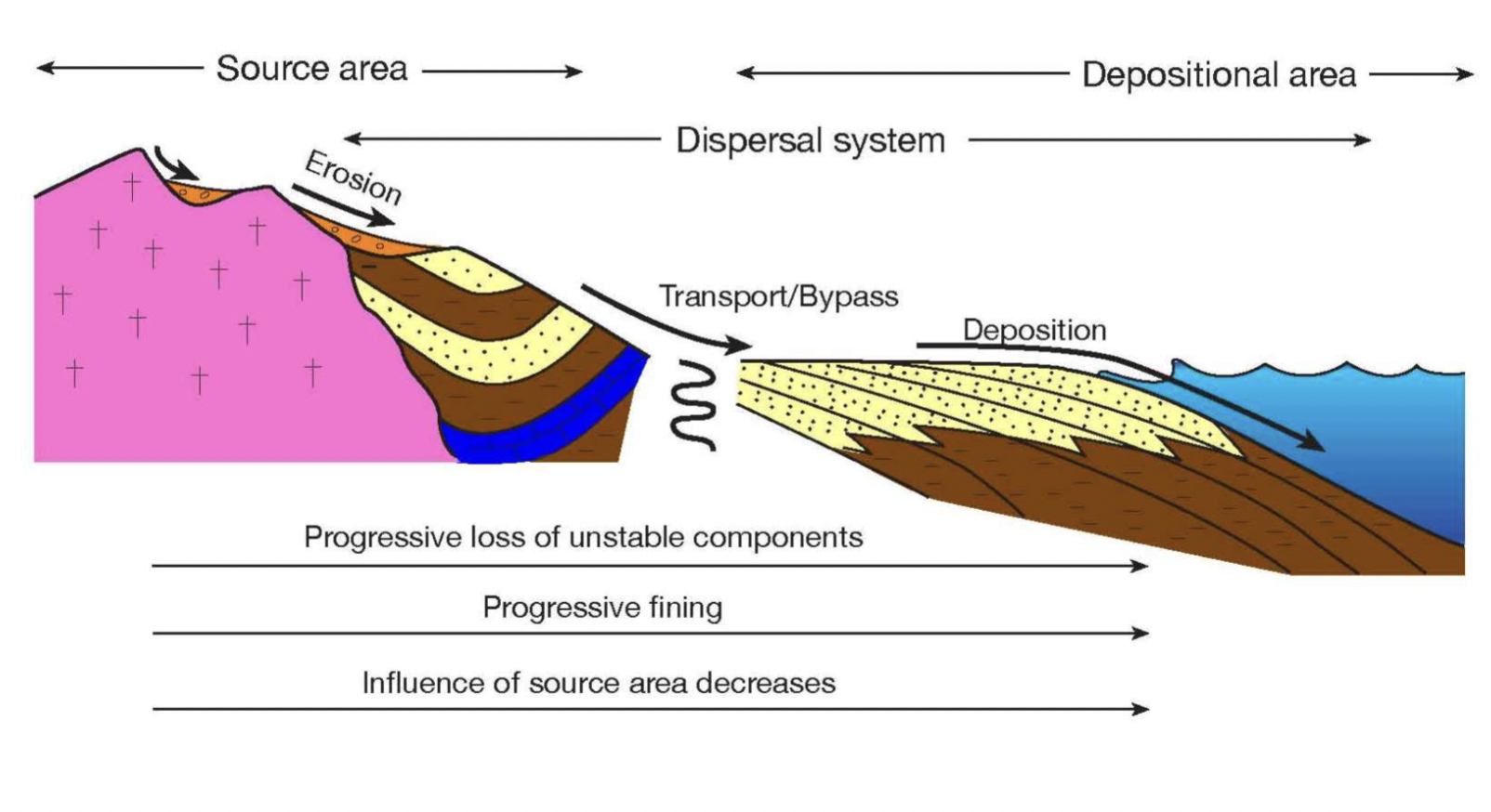
2 major elements that affect stratigraphic record
Allogenic forcing
Autogenic forcing
Allogenic forcing
Controls external to the depositional system (ex. climate change, tectonics, sea-level)
Autogenic forcing
Controls internal to the system (ex. river avulsion, dune migration, delta lobe switching)
Compositional maturity
Degree to which sediment contains resistant grains (quartz and stable heavy minerals like magnetite, apatite, rutile, zircon)
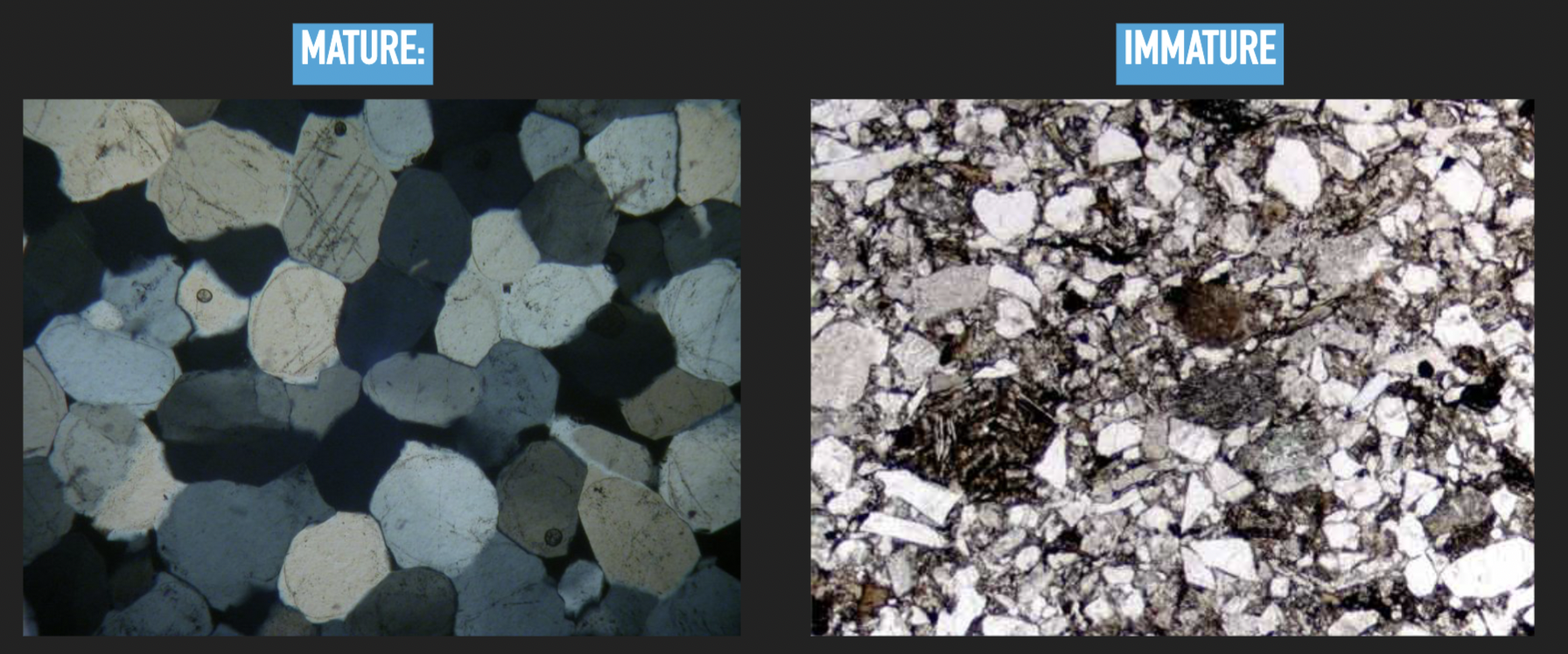
3 reasons for high compositional maturity
Warm/humid source region
Very long transport distance
Source rock was already mature
Climates where chemical weathering is the strongest….
Warm, wet climates
Textural maturity
Depends on 3 things:
Removal of clay
Sorting of non-clay portion
Roundness of grains
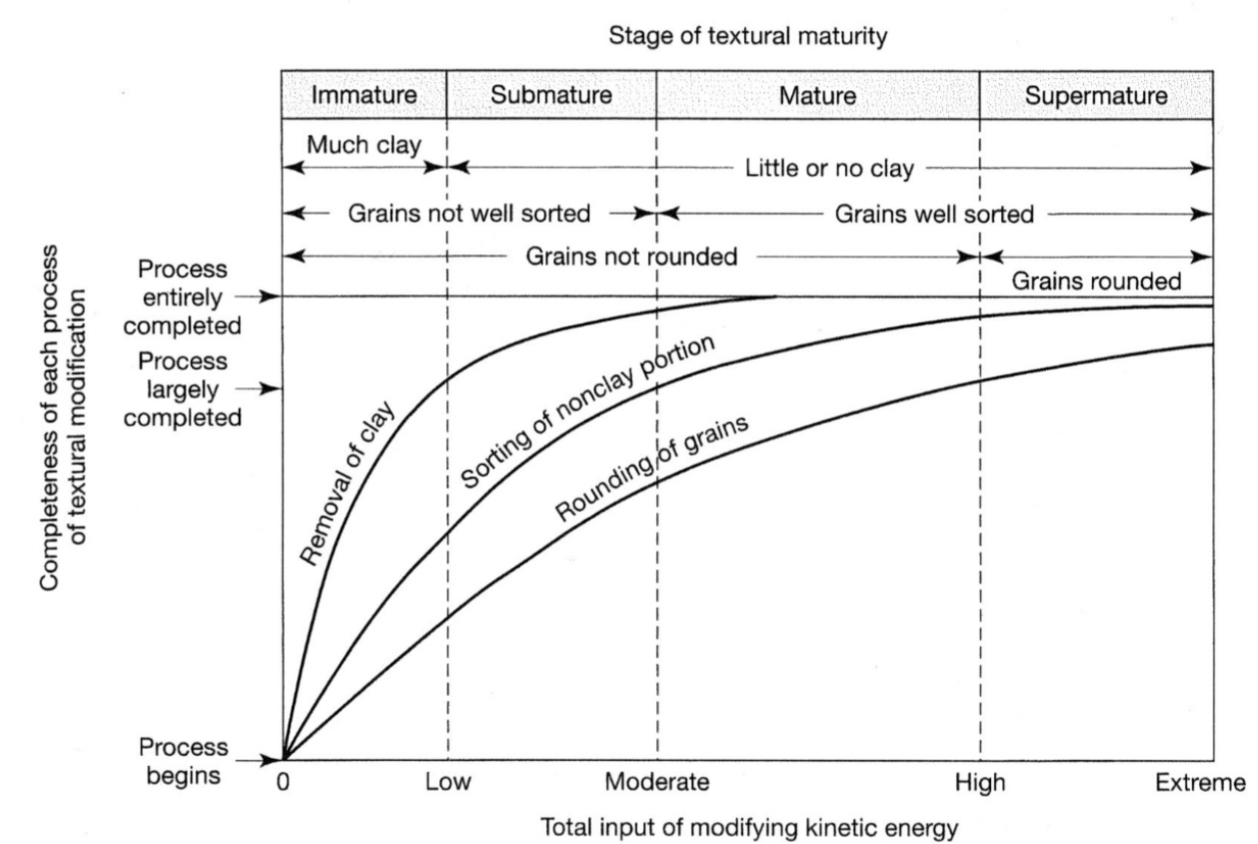
Cause of increasing textural maturity….
More transport
4 factors that affect grain size and shape
Composition of source region
Transport distance
Transport processes
Local climate
3 techniques to determine sediment provenance
QFL (Quartz, Feldspar, Lithics) plot
Strontium isotopes (Sr-87/Sr-86)
Detrital zircons (U/Pb dating)
QFL plots
Determine tectonic setting of source regions; lithic fragments can include volcanic, metamorphic, sedimentary lithics
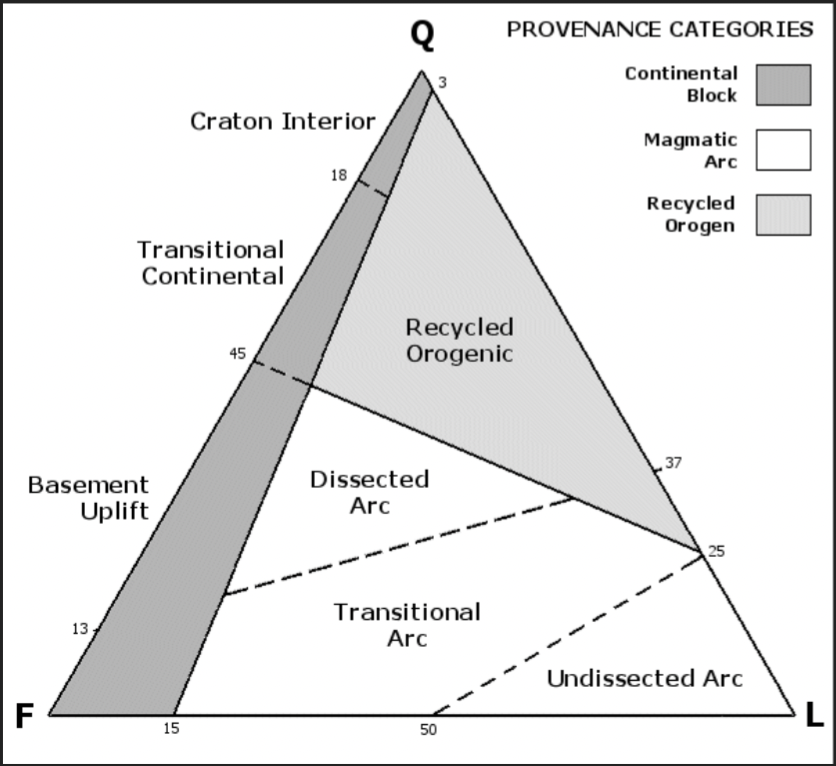
Strontium isotopes (Sr-87/Sr-86)
Continental crust is enriched in Sr-87/Sr-86
Primitive mantle and magma have low Sr-87/Sr-86
Ratio tracks continental influence on source rocks
Detrital zircons (U/Pb dating)
Detrital zircons using U/Pb dating can tell you age of source region as zircon crystals can survive multiple sedimentary cycles
Sedimentary basin
Depression capable of trapping sediment
Tectonic forces control size, shape, and location of basins
Dynamic entities
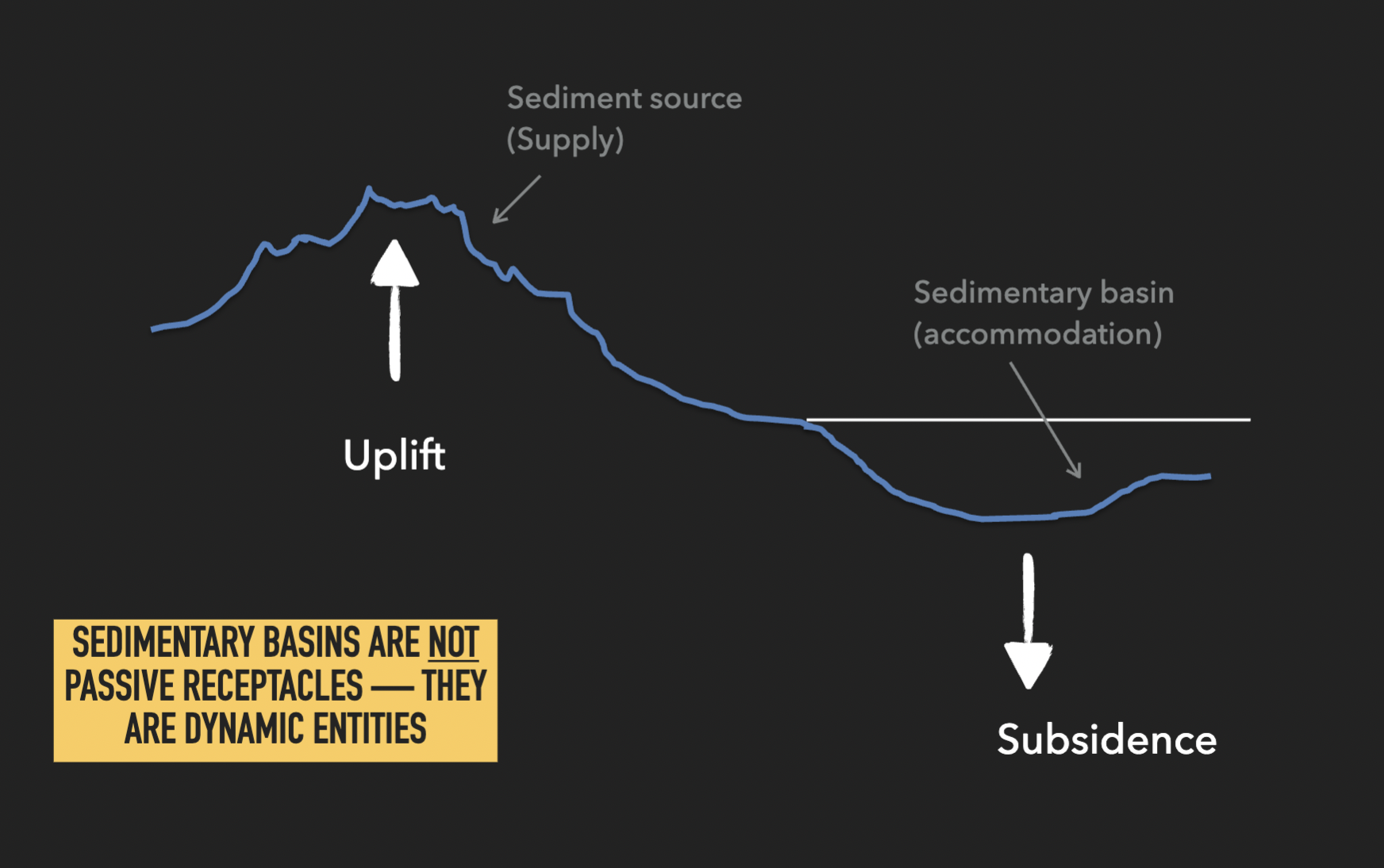
Accomodation
Space available for sediment to accumulate
How is permanent accomodation in basins created?
Subsidence allows for long-term sediment accumulation in basins
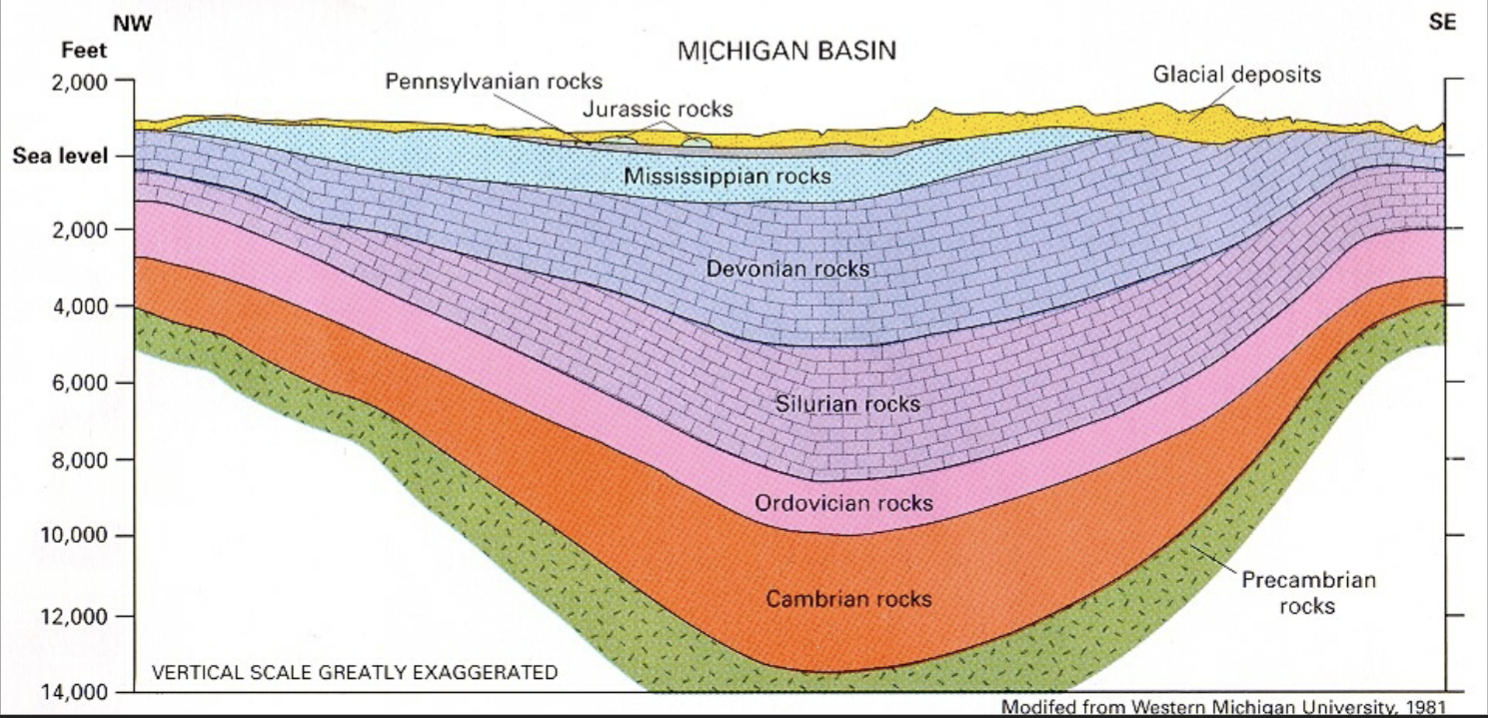
Subsidence
Physical sinking of Earth’s crust
4 Mechanisms of subsidence
Crustal thinning
Mantle-lithosphere thickening
Sedimentary and volcanic loading
Tectonic loading
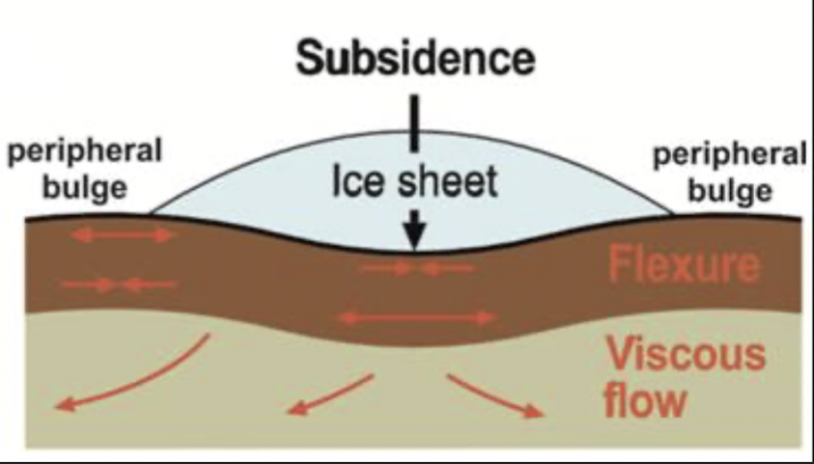
Isostasy
Isostatic compensation is an important part of sediment and volcanic loading— removing load from crust causing uplift (reverse of subsidence)
2 types of sedimentary basins
Rift-drift: lithospheric stretching/thermal effects
Divergent and intraplate settings
Some transform plate settings
Flexural: flexure of lithosphere from a load
Convergent plate settings
Some transform plate settings
Basins @ divergent plate boundaries
Rift valley extends so far that basins transition to a passive margin (‘drift’ part)
Sediment accumulates on continental margin=crust undergoes flexural subsidence
Basins @ convergent plate boundaries
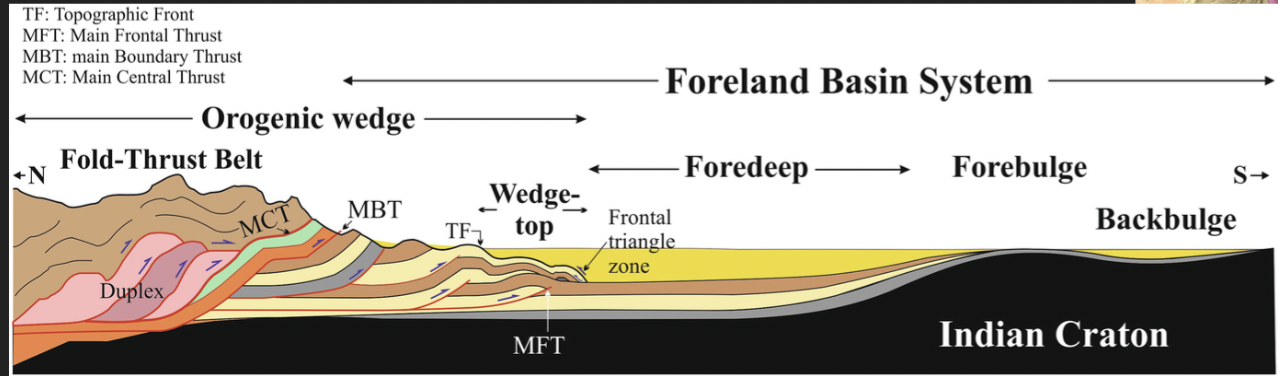
Foreland basins form parallel to mountain ranges
Crustal flexure from weight of the orogenic (mountain building) wedge
Subsidence primarily driven by flexure of underlying plate from weight of overlying plate
Ex. forearc basins at volcanic arcs
Strike slip basins
Pull apart or fault overstep basins
Information gained from basins’ sedimentary strata
Initial basin opening
Denudation of mountain ranges
Changing sea level
Changing climatic patterns
3 types of sedimentary rocks
Siliciclastic
Carbonaceous
Chemical/biochemical
Formation of siliciclastic rocks
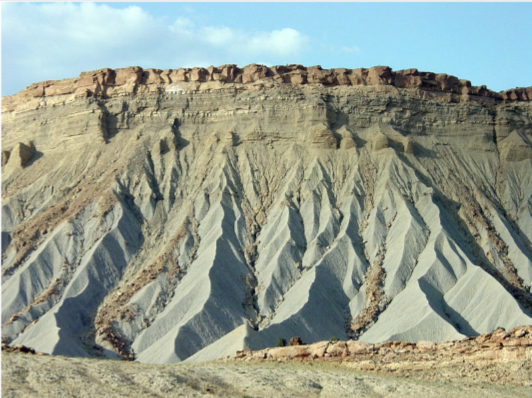
Made from clasts (fragments) of older rocks (e.g. sandstone, shale)
Formation of carbonaceous rocks
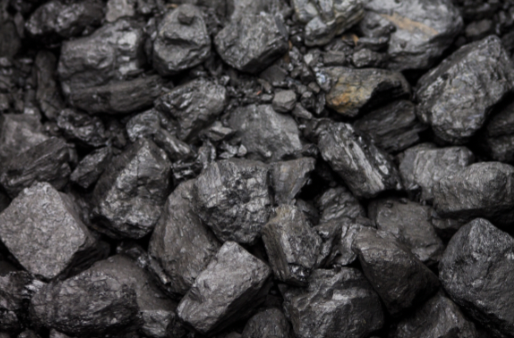
Accumulation and rapid burial of organic debris (e.g coal, oil shale)
Must have 10-20% organic material
Formation of chemical/biochemical rocks
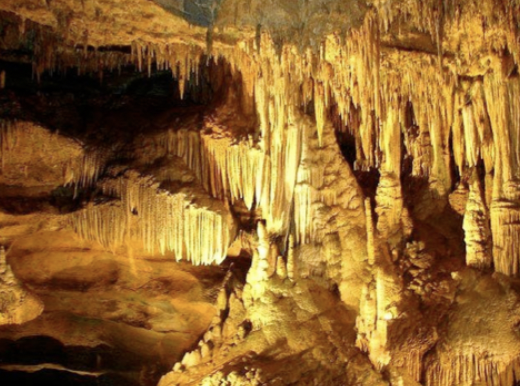
Precipitation of minerals from water (e.g limestone, evaporites)
Inorganic: from natural processes (evaporation)
Organic: from water-dwelling organisms
Framework grains
Large grains that generally form the most volumetrically important constituent of the rock
Matrix
Smaller grains that fill in the holes between framework grains (less than .03 mm in sandstone)
Cement
Crystals that precipitate in the spaces between grains
Porosity
Unfilled spaces between the grains, typically filled with liquid or gas
Carbonates
Class of sedimentary rocks composed primarily of carbonate minerals
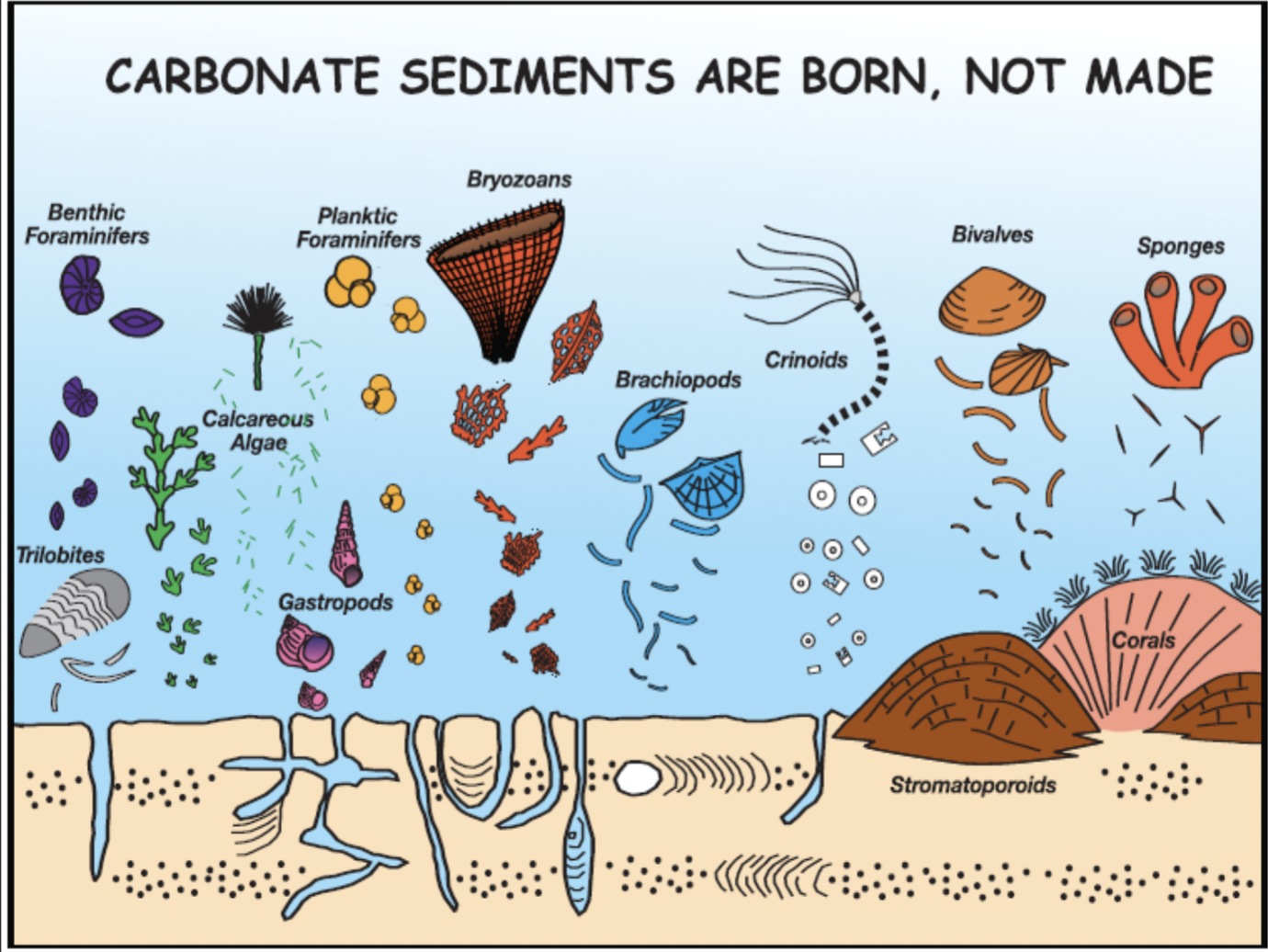
4 Factors carbonates need to form
Water clarity
Sunlight
Nutrient levels
Salinity
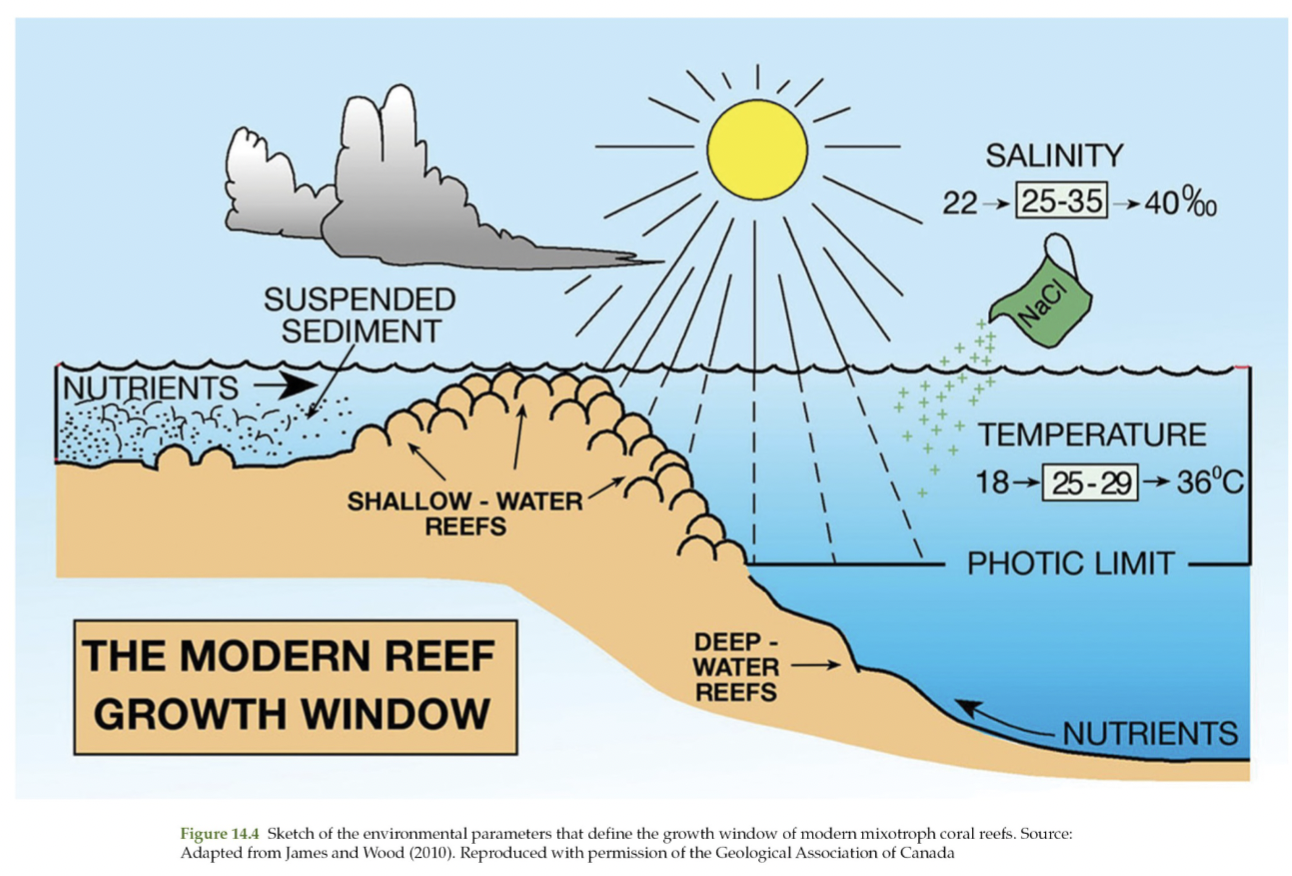
Optimal carbonate habitat
Shallow water provides optimal growth conditions
Carbonate sediment can form on the seafloor (benthic) or in the water column and settle to the seafloor
Evaporites
Composed of minerals that directly precipitate out of saline waters (contain halite, gypsum, anhydrite)
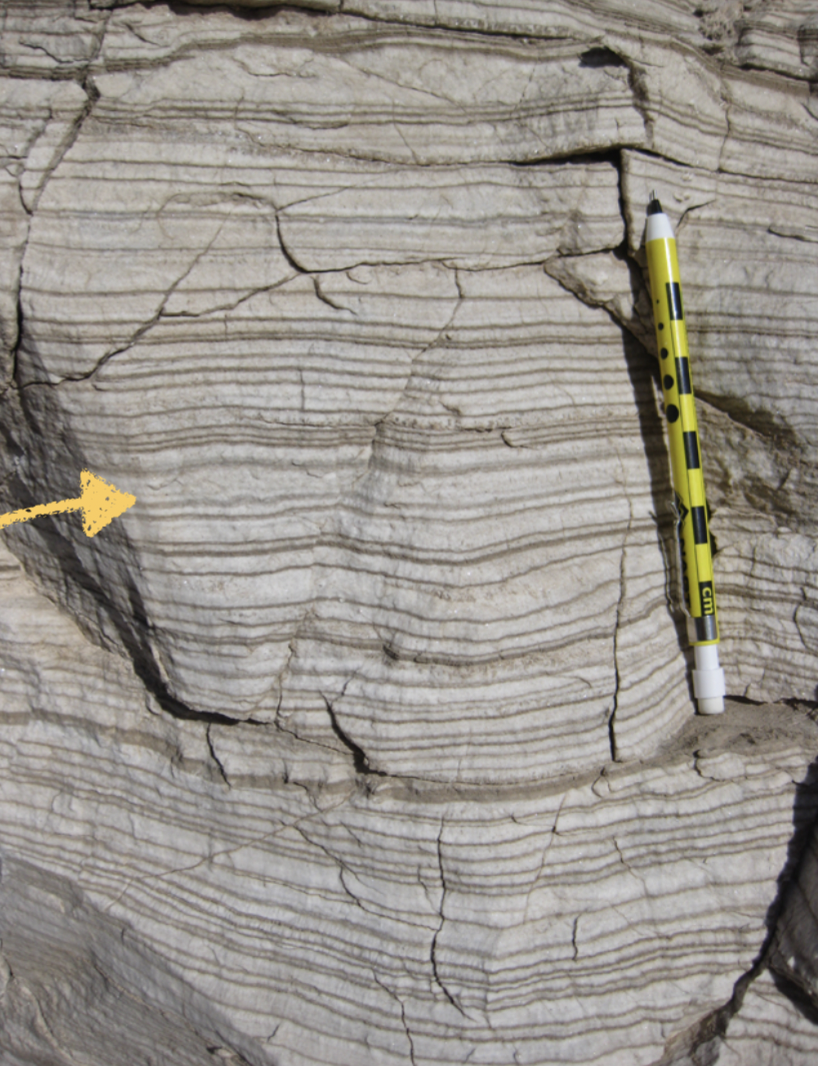
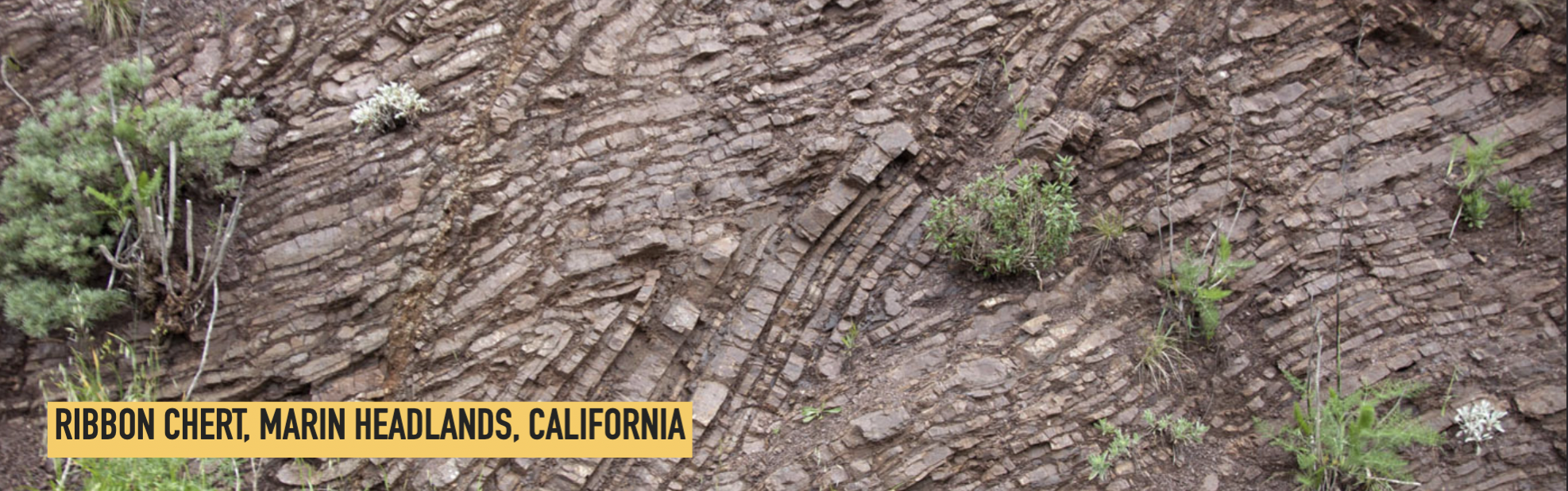
Chert
Rock composed dominantly of SiO2 that originates from accumulation of siliceous organisms (e.g. diatoms or radiolarians)
Can also be diagenetic or directly precipitate (debated)
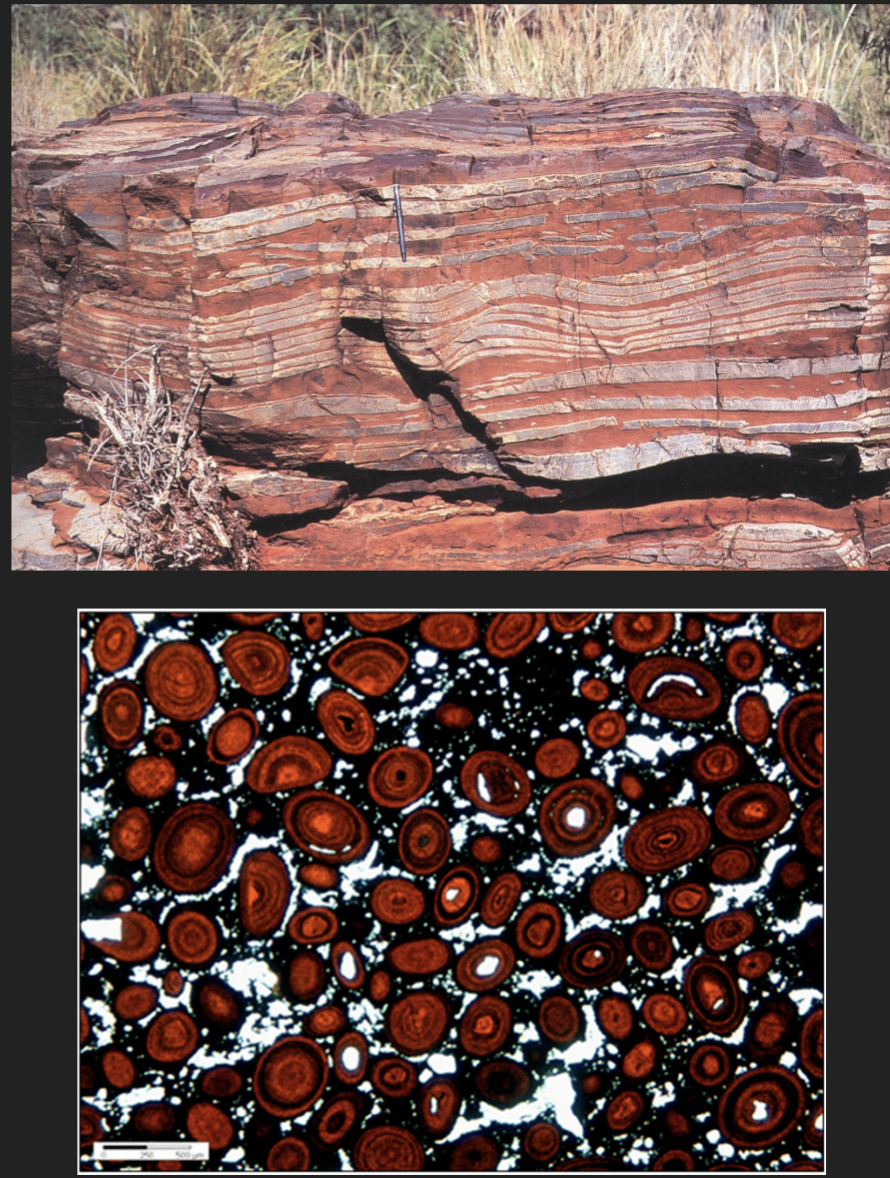
Iron-rich sedimentary rocks
Sedimentary rocks that contain at least 15% iron (rare but economically valuable)
2 kinds:
Iron formation: cherty iron-rich sediments (mainly precambrian)
Ironstone: noncherty non banded
iron-rich rocks
Phosphorites
Rocks enriched in phosphorus (more than 15% P2 O5)
Phosphorite nodules on present ocean floor
Upwelling of phosphorus rich waters from deep ocean and biologic incorporation of phosphate in body tissue seem to be important in formation
2 main ways to classify siliciclastic rocks
Grain size, shape and sorting
Transport processes
Transport distances
Grain composition
Source area
Transport processes
Wentworth grain size scale
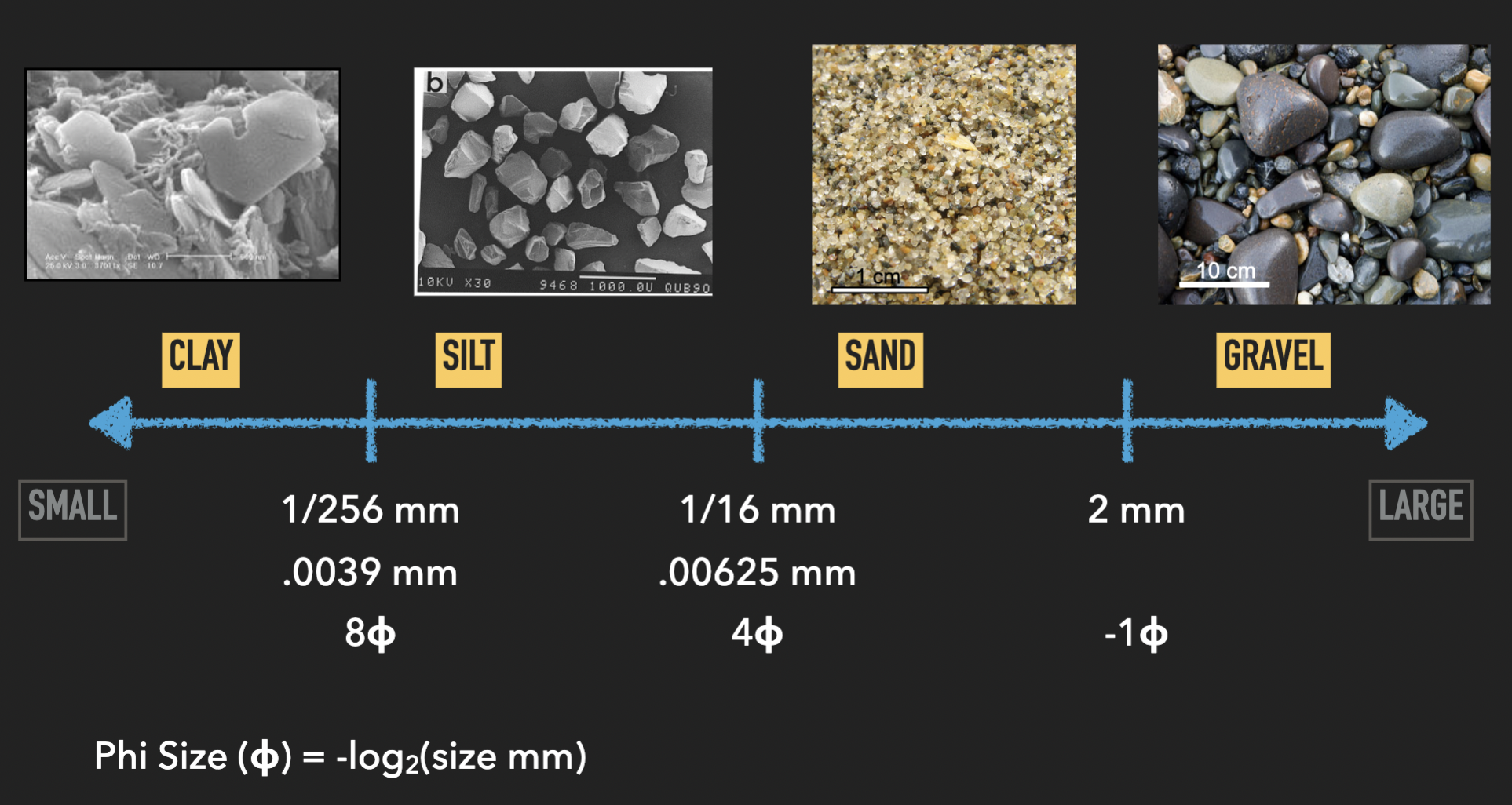
Siliciclastic rock classification scheme (3 main categories)
Conglomerate/breccia
Sandstone
Mudstone (Siltstone, claystone, and shale)
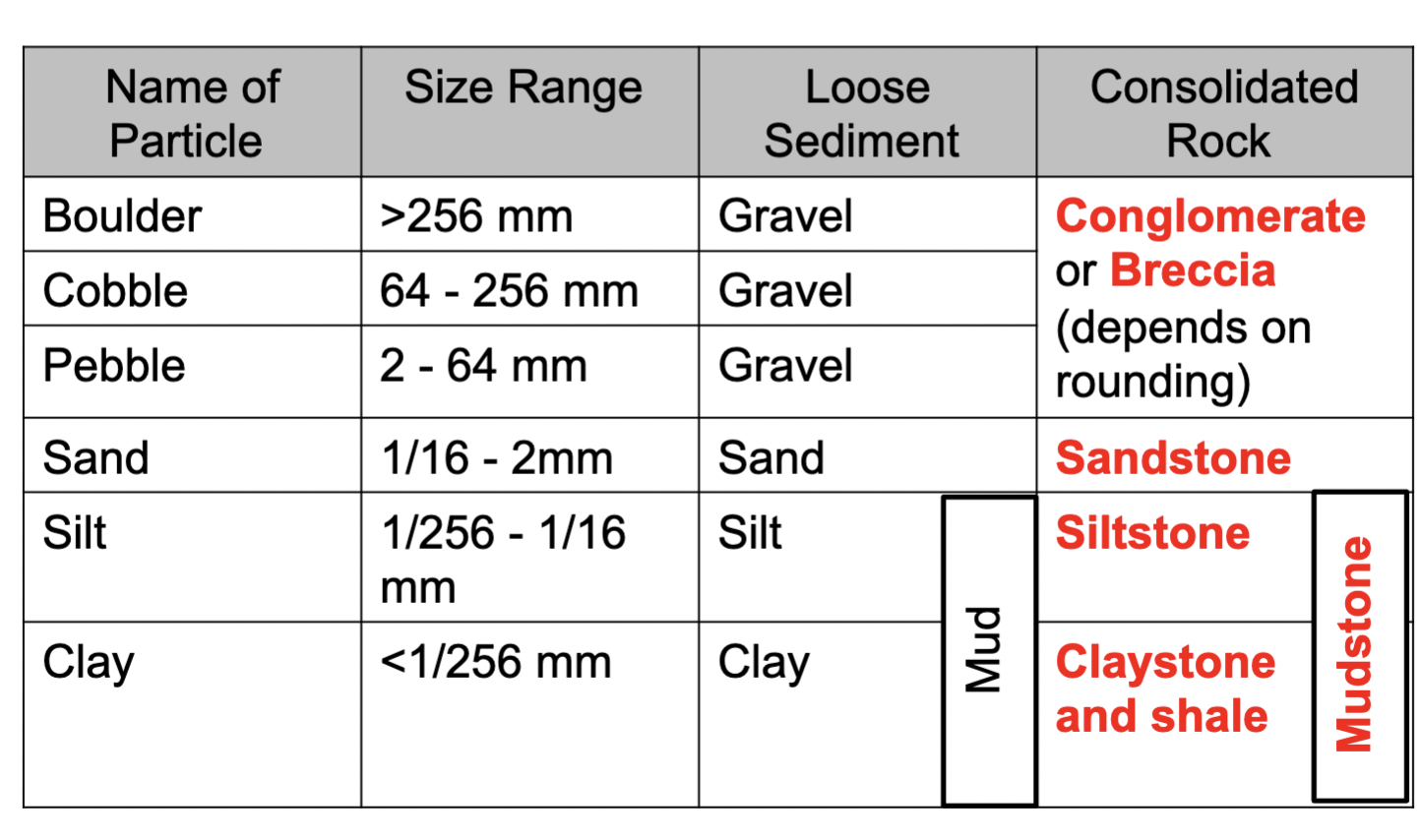
Boundary between clay/silt
1/256 mm
.0039 mm
8φ
Boundary between silt/sand
1/16 mm
.00625 mm
4φ
Boundary between sand/gravel
2 mm
-1φ
2 methods to estimate grain size
Sieving (particle passage through calibrated openings)
Particle size analyzers (Use laser diffraction or settling rates)
Sorting scheme
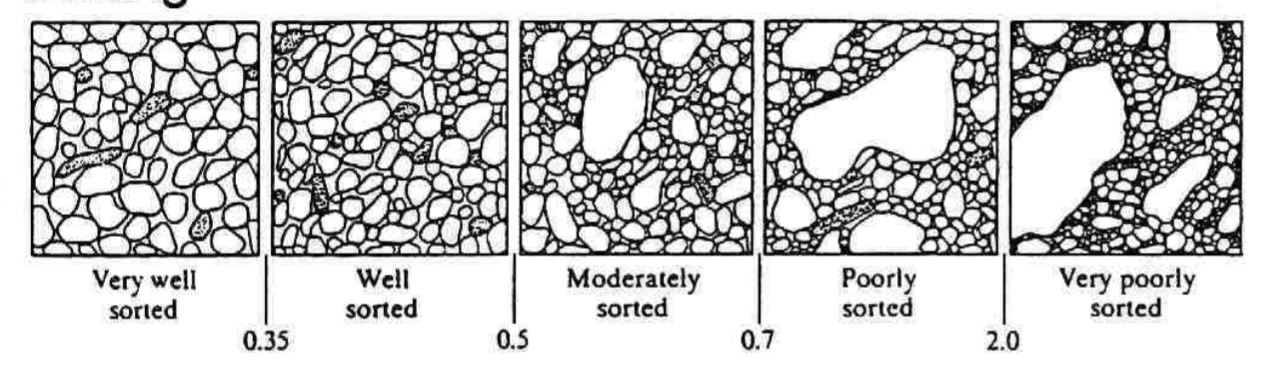
Angularity/roundness scheme
Sandstone classification scheme
Dott’s classification
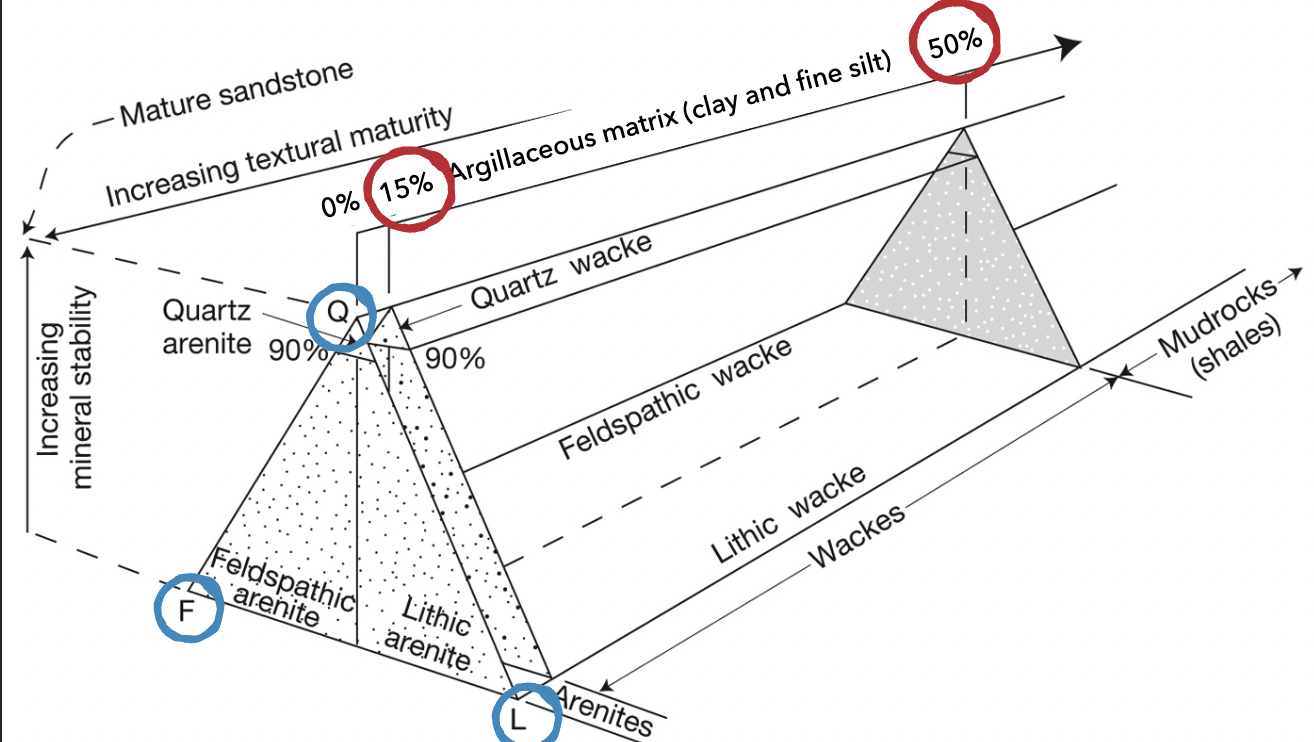
Mudstone classification scheme
Depends on grain size + fissility
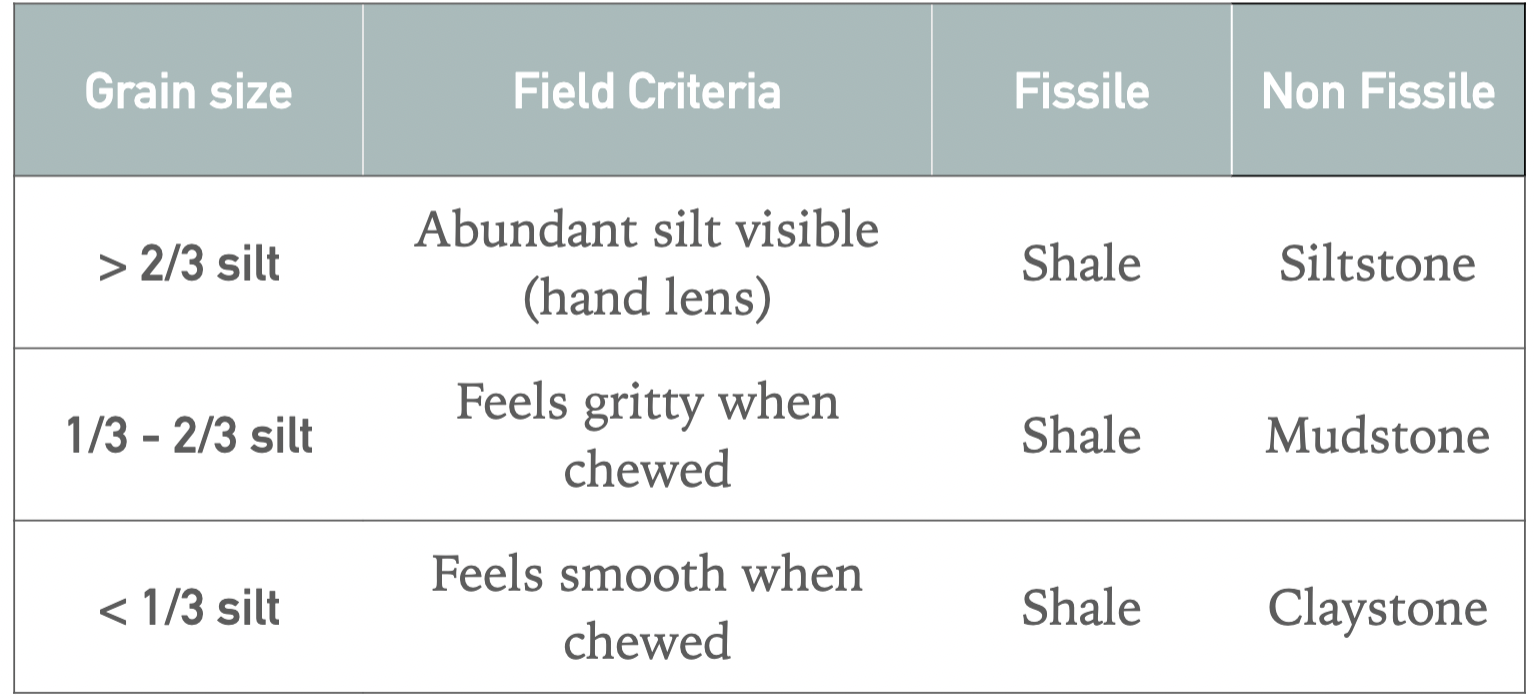
Conglomerate/breccia classification scheme
1. Clast angularity
Rounded = conglomerate
Angular = breccia
2. Clast-supported or floating in matrix?
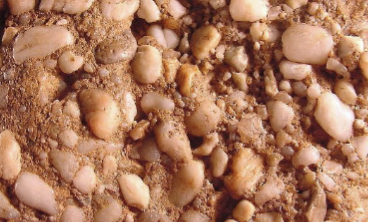
Clast-supported = orthoconglomerate
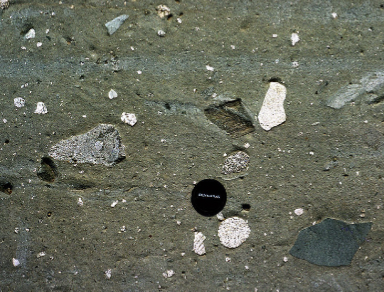
Matrix-supported = paraconglomerate
Orthoconglomerate origin
Transported by moving water
Paraconglomerate origin
Transported by ice or mass flow
Breccia origin
Generated in place (fault breccia) or minimal transport from high relief source (e.g. scree slope)
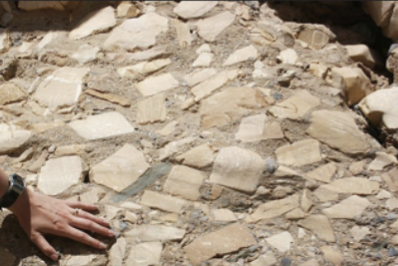
Naming conglomerates
Composition + Grain size + Texture
i.e quartz pebble orthoconglomerate
What forces cause a grain to move?
Fluid force must be great enough to overcome gravity and frictional forces
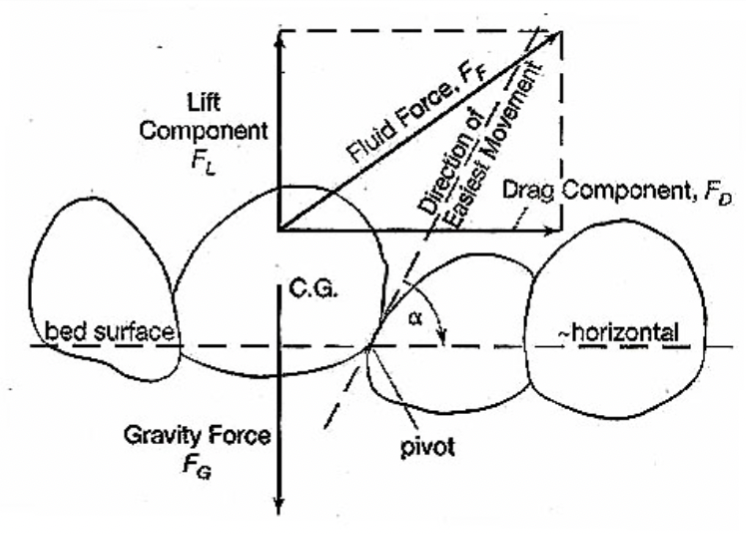
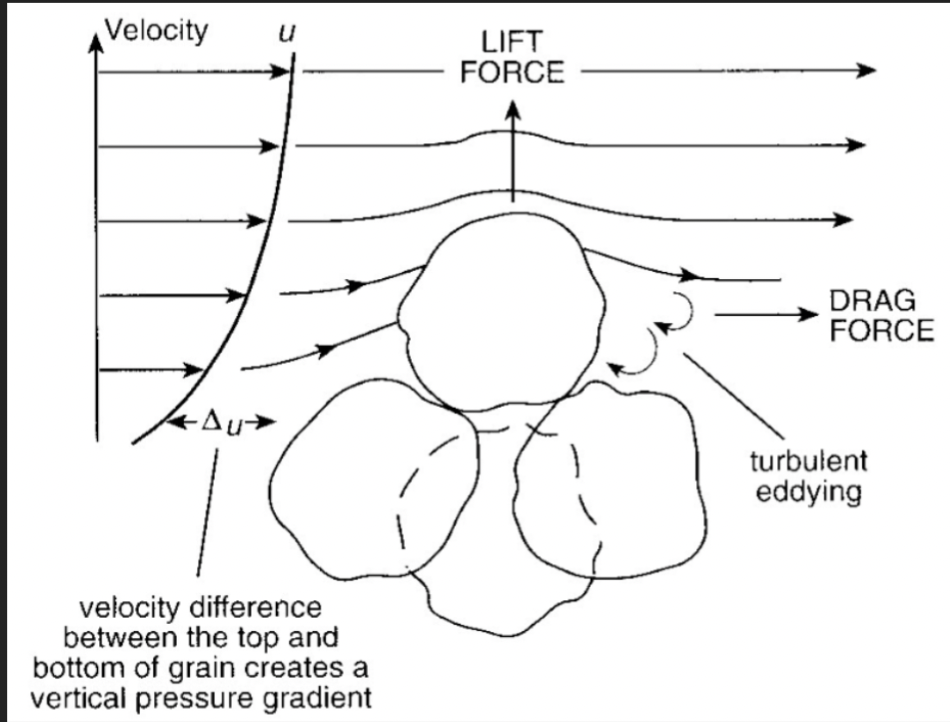
Bed (aka boundary) shear stress
The differential force a grain feels from bottom to top (difference in velocity btwn top/bottom of grain creates a vertical pressure gradient)
Turbulent flows = higher shear stress
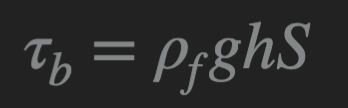
Formula for bed shear stress
ρ = fluid density
g = gravity
h = flow depth
S = bed slope
Critical shear stress (τcr)
The threshold of particle entrainment (being picked up); shear
forces overcome resisting forces (gravity, friction)
Shear (aka Shields) stress
Balance of driving vs resisting forces that tells us whether a grain will move
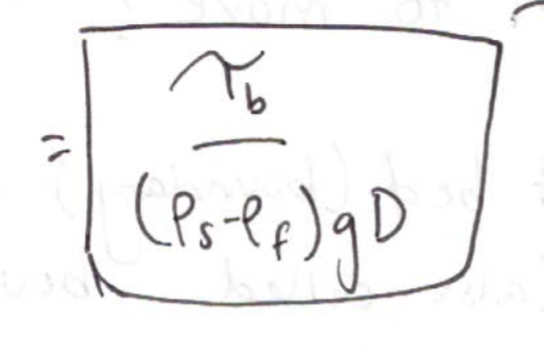
Formula for shear (aka Shields) stress
ρf = fluid density
ρs = grain density
g = gravity
τb = bed shear stress
D = grain size
Shear stress increases with….
Increasing bed shear stress and velocity
Shear stress decreases with….
With increasing ρ and grain size