Acids/Bases & Organic/Inorganic
 Call Kai
 Learn
Learn Practice Test
 Spaced Repetition
 Match
Match Flashcards
 Knowt Play
1/3

Earn XP
Description and Tags
Name | Mastery | Learn | Test | Matching | Spaced | Call with Kai | Chat |
|---|
No analytics yet
Send a link to your students to track their progress
4 Terms
Acidic, basic, and neutral solutions
Acids: cause more H+ in a solution
LESS than pH 7
Bases: cause more OH- in a solution
GREATER than pH 7
Neutral: H+ = OH-
= pH 7
pH: a scale that measures how acidic or basic a solution is.
Bases can neutralize acids: excess H+ ions get eliminated by OH- to form H2O.
Acid + Base → Water + Salt
→ Ex: HCl + NaOH → H2O + NaCl
Buffers
Absorb EXCESS acid or base to keep pH constant (important for homeostasis).
Blood pH must be kept between 7.35 and 7.45.
Stomach enzymes only function when the pH is kept between 2 - 4.
Buffers do not necessarily make solutions neutral, but the solution is at a certain pH level.
Organic & Inorganic compounds
Organic compounds: always contain C (and usually H) and have covalent bonding.
→ Ex: C6H12O6 (glucose), CO2
Inorganic compounds: usually have ionic bonding (between metals & non-metals) and have a small number of atoms (usually).
Essentially, inorganic compounds are “everything else”.
Living things are made up mostly of 6 elements.
→ C, H, O, N, P, S = 98% of mass
→ also Cl, Mg, Ca, K, Na, Fe, I, and other trace elements (C. HOPKINS Cafe)
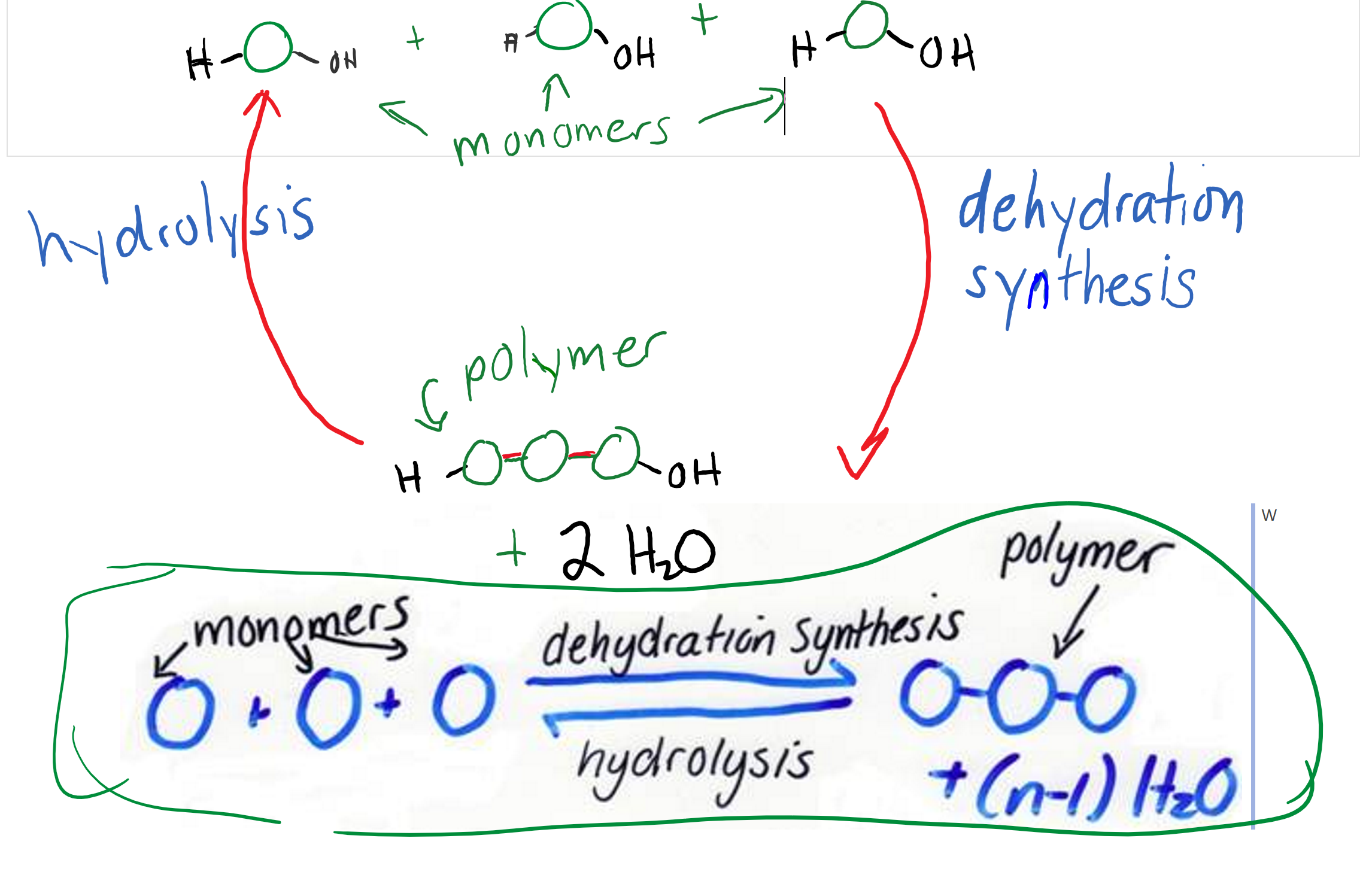
Hydrolysis vs. Dehydration synthesis
Most compounds in the body are formed by joining subunits (monomers) into chains (polymers).
Hydrolysis: a chemical reaction where water breaks a large molecule into 2 or more smaller ones.
Dehydration synthesis: two small molecules join together to form a larger molecule, releasing a molecule of water in the process.
Amino acids form proteins.
Sugars form carbohydrates.
Nucleotides form nucleic acids.
Fatty acids and glycerol form lipids (aka “fats”).