Language development
 Studied by 0 people
 Call Kai
 Learn
Learn Practice Test
 Spaced Repetition
 Match
Match Flashcards
 Knowt Play
1/23

There's no tags or description
Looks like no tags are added yet.
Name | Mastery | Learn | Test | Matching | Spaced |
|---|
No study sessions yet.
24 Terms
What is language according to Brown, (1965)
“an arbitrary system of symbols which taken together make it possible … to transmit and understand an infinite variety of messages”
Infants are born with a special sensitivity to
language
What speech and language abilities do newborns have
attend to speech in preference to other sounds
can discriminate all phonemes in all languages
can recognise mother’s voice and language at birth
can recognise a familiar from an unfamiliar utterance
What are the 4 main components that a child must acquire
phonology
rules governing the speech sounds of a language
semantics
meanings encoded by language
meanings are assigned to units of language (morphemes)
morphemes: whole words/grammatical markers
grammer
rules governing how words are built from morphemes and how words are combined (syntax)
pragmatics
rules governing how language is used in a given context
What happens in phonological development
2 months: cooing
6 months: consonants are added, and babbling begins
12 months: first words
phonological development mostly complete by school age
What happens in semantic development
young infants learn 1 to 3 words per month
12 months: children say their first words
but they comprehend more than they can produce
18 months: vocabulary learnt more rapidly (40 words/month)
semantic development parallels development in ability to categorise objects
What happens in grammatical development
syntax requires more than one word utterance
1.5-2.5 years: 2 word ‘telegraphic speech’ emerges
focuses on high content words
shows grammar: e.g. “mommy shoe” not “shoe mommy”
leave out small words and morphemes like “-s” “-ed”
but they comprehend these in adult speech
2-3 years": 3 word sentences appear
English speakers show correct subject-verb-object order
grammatical morphemes are added
not always correct: over-regularisation
e.g. ‘I have two foots’
complexity of grammatical structures steadily increase with age
What happens in pragmatic development
12 months: ‘conversational’ turn-taking is mastered:
games like peek-a-boo appear (child actively maintains flow)
preschool years: rules of successful interactions start to appear:
‘turnabout’: speaker comments on what partner said and then requests partner to speak again
middle childhood: children adapt their speech to the listener
What does the behaviourist theory, Skinner (1950s) propose about how language is learnt
Skinner proposed that language is learnt via operant conditioning
proposed that adults selectively reinforce child’s babbling sounds
reinforcement = parental approval, attention to child
believe that language is shaped
reinforce sounds into words
reinforce use of words in correct context
e.g. parent smiles when child says ‘doggie’ only when dog is present
propose that imitation is important to explain use of complex sentences
What are the 3 arguments in favour of the behaviourist theory
adults do reinforce children’s speech: “say please!”
explain why children learn local language and dialect
evidence that infants imitate adult speech
Papousek & Papouesk (1989)
found increasing imitation of mother’s speech sounds in infancy (pitch, duration & rhythm)
adult speech quality affects child’s learning:
Clarke-Stewart (1973)
found that infants whose mothers talk to them a lot have larger vocabularies
What are 3 limitations of the behaviourist theory
over-regularisation of grammatical rules
“my teacher holded the baby rabbits” (Pinker, 1995)
adults don’t use such words
suggests children develop grammatical rules
little evidence that mothers shape children’s grammar (Brown, 1969)
examined taped conversations between mother and child
found that mothers corrected content rather than grammar
mothers corrected “that pig” when pointing to sheep
mothers didn’t correct, e.g. “want cup”
rate of learning
school age children have about 10,000 word vocabulary
capable of innumerable complex sentences
reinforcement doesn't seem a practical explanation
What does the nativist theory, Chomsky (1960s) propose about the innate capacity for language acquisition
Chomsky (1960s) proposed innate capacity for language acquisition
Chomsky argues:
the wide variation in surface structure between language can be reduced to a common set of universal rules:
grammatical rules of deep structure shared by all languages
called these rules ‘universal grammar’
What is the ‘Language Acquisition Device’ (LAD) - nativist theory
humans possess an innate ‘Language Acquisition Device’ (LAD)
LAD detects statistical regularities in speech
forms hypotheses about them, e.g. ‘-ed’ = indicates past tense
LAD is capable of learning any language in this way
the rules of ‘universal grammar’ are innate and embodies in LAD
the LAD acquires the rules for transforming the surface structure of a language into deep structure
What are the 3 arguments in favour of nativist theory
nativists argue that the universal properties of language point to innate capabilities:
language occurs in all cultures
children go through the same stages of language development in all cultures
languages share certain universal features
pidgin & creole languages
Bickerton (1990)
studied language of immigrant workers in Hawaii in early 1900s
immigrants develop a pidgin to communicate
pidgin had no consistency word order, no tense etc.
but workers’ children developed a highly grammatical creole language
argued: the child doesn’t initially “learn” language, child possesses a genetic program for language
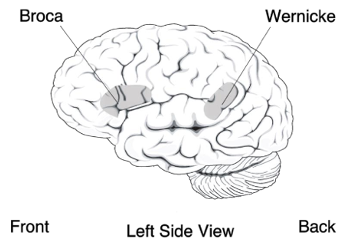
specific brain areas with localised language functions:
Broca’s area in frontal lobe (production)
Wernicke’s area in temporal lobe (comprehension)
What are the 3 limitations of the nativist theory
a single set of rules governing all languages (universal grammar) has not yet been identified
doesn’t acknowledge importance of cognitive development
language reflects understanding of the world
e.g. phrases like “all gone” emerge when able to solve advanced object permanence problems
ignores effects of social experience
What does the cognitive theory, Piaget propose about learning and language
Piaget proposed:
a child’s cognition is built from sensorimotor experience
child develops ‘schemas’ for objects and events
cognition precedes language
before age 2:
schemas represent sensorimotor information (actions and senses)
at around age 2:
child becomes capable of symbolic thought: can think in words
children develop rules of language, but not through LAD
language grows from broader cognitive abilities
What do the Piagetians argue - cognitive theory
linguistic ability reflects the child’s stage of cognitive development
children of a given age are alike in linguistic ability because they have had similar experiences, and thus have similar cognitions
What are 3 arguments in favour for cognitive theory
object permanence is taken as evidence for symbolic thought
language emerges after this is achieved
children’s first words are of familiar entities
they use knowledge of the world understood non-verbally through actions + senses
phrases like “all gone” emerge when able to solve advanced object permanence problems
What is one limitation of the cognitive theory
ignored the importance of social influences on learning
viewed children as little scientists, learning in a solitary way
ignored motivation and influence from people around them
What does the social interactionist theory argue
proposes that infants first learn about social world
provides basis for language
How do parents influence a child’s language - social interactionist theory
parents tend to assign meaning to child’s sounds & utterances
e.g. burp → “you really enjoyed that, didn’t you?”
When does conversational turn-taking occur - social interactionist theory
emerges at about 3 months (adult largely maintains flow)
12 months: games like peek-a-boo appear (child active in maintaining flow)
What are 2 arguments in favour of social interactionist theory
highlights importance of non-verbal social behaviours that are necessary for language development
can explain poor language skills of children raised with little or poor social interaction
What are 2 limitations of social interactionist theory
not clear how it explains development of grammar
ignores importance of fundamental perceptual & cognitive processes in language acquisition