Test
 Call Kai
 Learn
Learn Practice Test
 Spaced Repetition
 Match
Match Flashcards
 Knowt Play
1/45

Earn XP
Description and Tags
Research methods, learning, evolutionary, developmental
Name | Mastery | Learn | Test | Matching | Spaced | Call with Kai | Chat |
|---|
No analytics yet
Send a link to your students to track their progress
46 Terms
Define “Learning”
a situation where there are relatively long lasting changes in behaviour, and these changes are caused by environmental events (maturation, drugs, surgery)
Describe the Law of Effect
If a response is followed by a favourable consequence, the behaviour is more likely to occur again
E.g. if a cat in Thorndike’s puzzle box pulls the rope (response) & escapes (reiforcer), it’ll be more likely to pull rope again
Reinforcement most effective if it immediately follows responseGuaranteed by arranging contingency between response & reinforcement
Define “extinction”
If a response used to be followed by reinforcement, but reinforcement stops, it will be less likely to happen again
Describe feedback interaction
Example: trying to cook dinner but the kids are fighting - turn on TV to keep them quiet
My behaviour: negatively reinforced by removal of aversive stimulus (noisy fighting kids)
Kids’ behaviour: positively reinforced by presentation of appetitive stimulus (TV)
There’s a feedback interaction – you can’t change someone else’s behaviour without your own also changing
What is primary reinforcement?
reinforces behaviour because of their innate biological significance
Food, warmth, safety etc
What is secondary reinforcement?
previously neutral stimuli that have acquired reinforcing properties by being paired with primary reinforcers in organism’s history
Sound of food pellets, praise, money etc
What is continuous reinforcement?
every response is reinforced
What is intermittent reinforcement?
only some responses reinforced, usually according to a schedule of reinforcement
Ratio schedules: based on the number of responses emitted
Interval schedules: based on elapsed time
Fixed interval schedules (FI): reinforced after fixed amt of time has passed since last reinforcer
Variable interval schedule: reinforced after variable amt of time has passed since last reinforcer (on avg)
Fixed time schedule: same as FI but no response required
What’s an example of fixed interval schedules?
FI 15s means a response will be reinforced when 15 secs has elapsed since the last reinforcer
What’s an example of variable interval schedules?
VI 30 secs means a response will be reinforced 30 s on average since the last reinforcer
What’s an example of fixed time schedules?
Skinner (1948) - 15 secs FT with pigeons
Found idiosyncratic responding
Adventitious reinforcement of the behaviour occurring just before non-contingent reinforcer
Describe Differential Reinforcement of Other Behaviour (DRO)
Reinforcer delivered when fixed amount of time has elapsed since last response
Explicitly reinforces non-responding (omission training)
Unwanted behaviour → negative punishment
Other behaviour → positive reinforcement
Eliminates behaviour more effectively than extinction
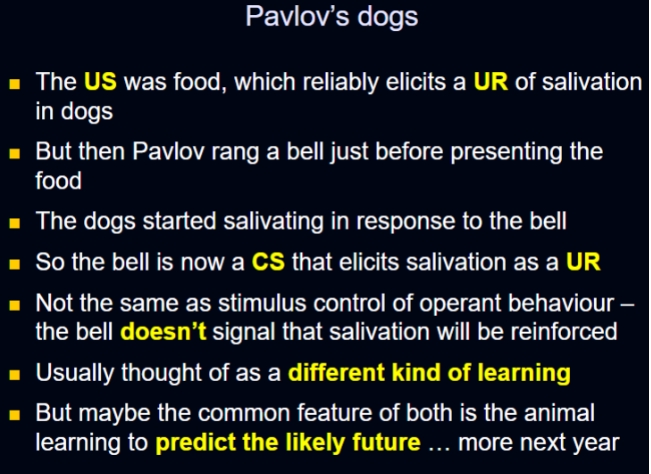
Describe Respondent conditioning
Respondent conditioning: learning association between 2 stimuli
Unconditioned stimulus that automatically elicits unconditioned response
Previously neutral stimulus reliably predicts the unconditioned stimulus
Hence, it becomes a conditioned stimulus that elicits the same response
Give an example of respondent conditioning
bullet point 4: UR is meant to be CR
Define “The Matching Law”
the % of responses on one alternative equals the % of reinforcers from that alternative
If a pigeon is trained to peck a yellow key for food reinforcement (VI schedule)
Its behaviour should change when we change key colour
Define “evolutionary psychology”
Scientific study of animal cognition & behaviour from evolutionary POV
Precisely controlled experiments used to learn abt how animals think & how it compares to how humans think
Experiments used to rule out alt accounts of animal cognition (e.g. the animal was trained)
Romantics vs Killjoys
Romantics: believe animals have capacity for theory of mind & using tools/language, having empathy etc
Killjoys: insist that animal behaviour can be explained using associative learning
Define “homology”
features shared between species due to shared descent
E.g. various species have 5 digits at the ends of their limbs (e.g. bats have 5 digits in their wings)
Define “analogy”
Analogy: concept of convergent evolution - not inheritance from starting point but converges at same endpoint
Torpedo body shape in sharks → dolphins (developed this shape later) → reptiles → penguins (birds)
Convergence occurs due to natural selection for different lineages to accommodate same function in shared environment
Necessary conditions for evolution by natural selection
Variation: different individuals in population has different morphologies, physiologies, behaviours
Heritability: variations must be heritable from parents to offspring
Differential fitness: if resources are limited, different phenotypes will have different survival & reproduction rates bc of differences in their design
Why study animal minds?
Shared ancestry: what we’ve inherited can be studied by identifying homologies with close relatives
Cognitive adaptations to environment: how natural selection has shaped our minds
Can be studied by looking for analogies in species living in similar environments
Animal minds can help us understand what makes us human & what features of our minds have been inherited by primates
Human uniqueness: tool use
Human ability to use tools believed to be unique to the species
Until Jane Goodall (primatologist) observed David Greybeard (chimpanzee) use a stick to pull termites out of a hole
Hence realisation that using tools wasn’t unique to humans (likely homologous w. chimpanzees)
Likely that features underlying ability to use tools in human physiology & cognition are also present in chimpanzees
Human uniqueness: language
Kanzi showed symbolic representation - could use pictures to refer to abstract things
Reasonable evidence that Kanzi could understand word order (e.g. difference btwn pouring water first/cola first in a sentence)
Some novel & spontaneous language use (e.g. ‘quiet’ & ‘water + bird’ when first seeing a swan)
Define “genotype”
what’s inherited
Set of DNA molecules contained in nucleus
Genotype particular to a trait
Define “phenotype”
what’s developed
Organism’s physiology, anatomy, behaviour
Describe chromosomes
thread-like structures contained in the cell nucleus
Occurs in pairs
Human somatic cells usually contain 23 pairs
Define “gene”
a stretch of DNA that produces a specific protein
Define “locus”
position of a gene on a chromosome (each has 2 alleles)
Define “allele”
alternative forms of a gene at the same locus
Define “homozygous”
when an organism possesses 2 identical alleles for a particular trait
Define “heterozygous”
when an organism possesses 2 different alleles for a particular trait
What is a dominant allele?
an allele that manifests its effects in both heterozygotes & homozygotes e.g. brown eyes
What is a recessive allele?
an allele that manifests its effects only in homozygotes e.g. blue eyes
Define “polygenic inheritance”
a trait whose phenotypic expression is influenced by many genes e.g. most psychological traits
Describe the Dunedin study (genes/aggression)
followed the lives of 1037 babies born between 1 April 1972 and 31 March 1973 at Queen Mary Maternity Hospital (carriers of MAOA gene)
Gene responsible for behaviour: Monoamine Oxidase (MAOA)
Metabolises neurotransmitters
E.g. norepinephrine, serotonin, dopamine
Describe the findings of the Dunedin study
Between ages 3-11, 8% of the children experience severe maltreatment
28% experienced probable maltreatment
64% experienced no maltreatment
Researchers examined the effects of maltreatment & MAOA activity over time
Children who experienced severe maltreatment were more likely to…
exhibit antisocial behaviours
Depicts how environment plays significant role in gene expression
MAOA gene has little to no effect on children who experienced no maltreatment
This gene is only associated with antisocial behaviour with children who experienced probable → severe maltreatment
What is the conclusion of the Dunedin study?
MAOA gene is not wholly responsible for violent behaviour, its effect depends on the environment
Define '“heritability”
The proportion of variation in a population that is attributable to genetic differences
Describe one methodological issue with twin studies
Shields (1962) - IQ heritability
40 pairs of separated identical twins
Found that the genetic variation in IQ compared to overall variation was 0.77
HOWEVER
Leon Kamin discovered that 27/40 were raised by close relatives
Environments were likely similar (separation/placement isn’t random)
Heritability estimate for the 27/40 is 0.83
Heritability estimate for the remaining 13 pairs is 0.51
Describe the dictator game
situational experiment where one player gets a ‘windfall endowment’ (e.g. $20) & is asked how much of it they’d willingly share with another player
Describe the Muller-Lyer illusion
shows that our brains interpret visual angles as depth cues. The PSE measures how strong this bias is
Western/Urban children had very high PSEs. They were strongly fooled by the illusion
Non-Western/Rural children had much lower PSEs. They were barely fooled at all
Describe cross-cultural data of the Muller-Lyer illusion + why
people from non-urban environments have lower PSEs, proving basic visual perception is not purely biological - it’s culturally constructed based on the physical environment we grow up in
Heinrich: Most psychology research is done on WEIRD populations (Western, Educated, Industrialized, Rich, Democratic)
Muller-Lyer illusion proves that if you only test American university students, you might conclude that this visual illusion is universal human trait
Describe over-imitation
children replicate actions that appear unnecessary, observed in settings where they are instructed through demonstrations
Condition 1: children & chimpanzees shown a demonstration on solving a puzzle box
Both replicate the function & nonfunctional steps to solve it
Condition 2: the box is transparent, ppts can see all the mechanisms inside
Chimpanzees did not imitate nonfunctional steps
Children still imitate nonfunctional steps
Define “conformity bias”
copying the majority
Define “prestige bias”
copying the successful