Week 2: Prokaryotes, Eukaryotes, Metabolism
 Call Kai
 Learn
Learn Practice Test
 Spaced Repetition
 Match
Match Flashcards
 Knowt Play
1/65

There's no tags or description
Looks like no tags are added yet.
Name | Mastery | Learn | Test | Matching | Spaced | Call with Kai | Chat |
|---|
No analytics yet
Send a link to your students to track their progress
66 Terms
What’s glycocalyx in bacteria
a secreted capsule or slime layer made of polysaccharides (sugars) and sometimes proteins or lipids
What are the two types of glycocalyx?
Capsule and Slime layer
What benefits does glycocalyx provide for bacteria?
-prevent dehydration
-aids in adhesion
-protection from phagocytosis (capsule)
-source of nutrients
-helps form biofilms
Which protein is bacterial flagella made of?
flagellin
define : atrichous
bacterium without flagella
How does bacterial flagella move when it “runs”?
bacteria are moving in a single direction
How does bacterial flagella move when it “tumbles”?
Bacteria tumble and as a result change direction of their movement
What’s the term used to define the movement of bacteria toward or away from a stimuli?
Taxis
What powers bacterial flagella to move ?
it is powered by the electron imbalance across the membrane that generates a gradient via proton motive force
How do flagella in eukaryotic cells move ?
they use ATP driven by motor proteins walking along microtubules

In which bacteria are axial filaments found?
Spirochetes
What function do fimbriae provide for bacteria ?
Hair-like appendages that are short, straight and thin, that are primarily used for adhesion to surfaces. Many to a cell.
What protein are fimbriae made of ?
pilin
What function do pili provide for bacterial cells ?
Involved in motility where the pilus extends, grabs, and retracts.
Involved in DNA transfer
Only a few to a cell.
what do all bacterial cells have?
-plasma membrane
-cytoplasm
-nucleotide
-ribosomes
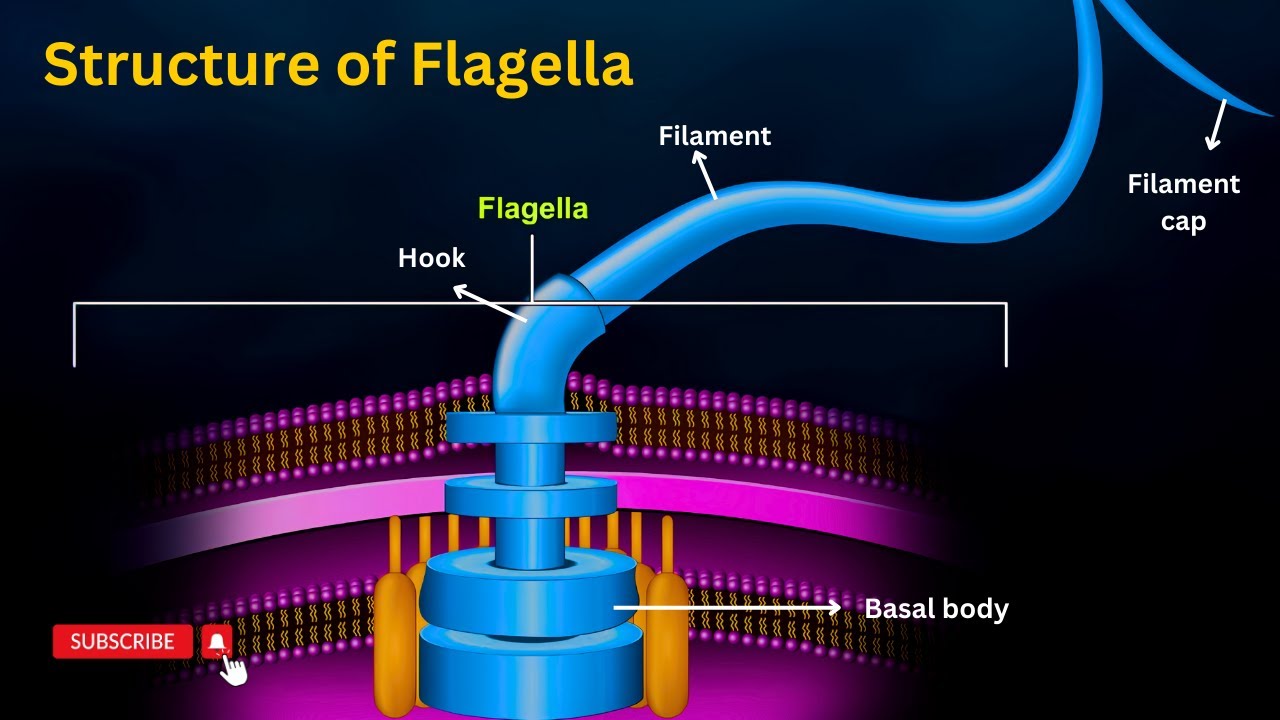
what are the 3 main parts of bacterial flagella?
-Filament; outermost region
-Hook; attaches to the filament
-Basal body; imbedded into to the cell wall and membrane
In which motion do eukaryotic flagella move ?
They move in a whip-like motion
what are eukaryotic flagella made of ?
-microtubles and tubulin proteins
Describe the arrangement of the microtubules in eukaryotic flagella
Microtubules are organized as 9 pairs in a ring + 2 microtubules in the center (9+2 array)

what’s a protoplast?
a wall-less gram positive cell
what’s a spheroplast?
a wall-less gram negative cell
What is passive transport?
-moving from high concentration to low concentration
-requires no energy
What is simple diffusion?
-a type of passive transport that requires no additional proteins while moving from high to low concentration
What is facilitated diffusion?
-A type of passive transport where additional proteins are required to move from high to low concentration
What is active transport?
-moving from low concentration to high concentration
-does require energy (ATP)
Define osmosis
the movement of water across a membrane from high water concentration to low water concentration
Define: solute concentration is lower outside than inside. As a result, water moves into the cell.
Hypotonic solution
Define: Solute concentration is high outside of the cell than the inside. As a result, water moves out of the cell
hypertonic solution
What is specific facilitated diffusion?
-The protein is selective. It recognizes and transports only one molecule or one class of molecules at a time
What is non-specific facilitated diffusion?
-The protein is not selective. It allows multiple different molecules through as long as they meet basic physical criteria
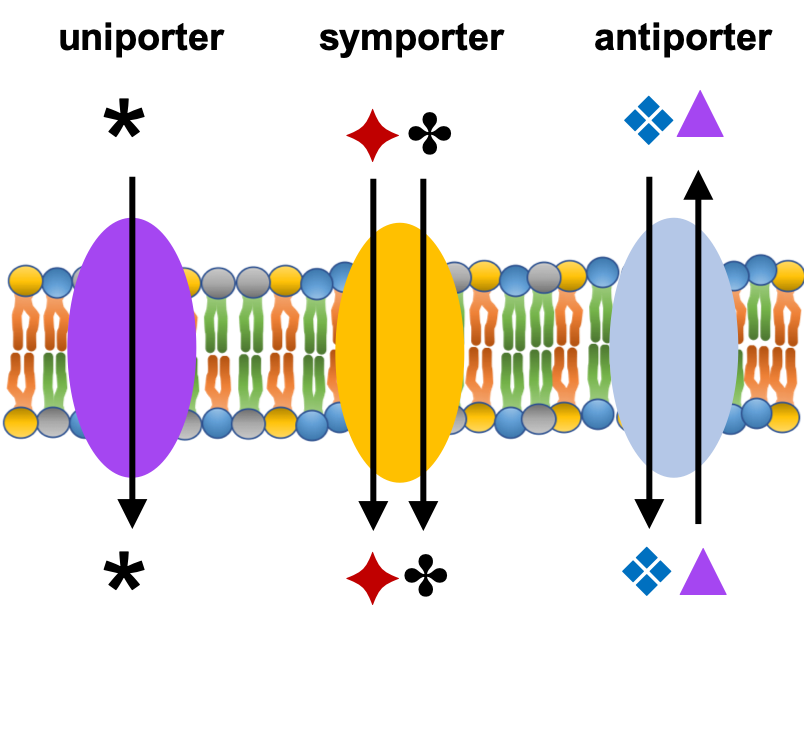
Define uniport
the movement of one molecule across the membrane in one direction

Define symport
the movement of 2 molecules, one by energy and one by diffusion; still in the same direction

Define antiport
the movement of 2 molecules in opposite directions across the membrane
What are sulfur granules and what’s their function?
-inclusion bodies found in some bacterial cells
-energy reserves that use sulfur in bacteria’s metabolism
What are gas vacuoles and what’s their function?
-inclusion bodies found in some bacterial cells
-protein-bounded, gas-filled structures that provide buoyancy; allows bacteria to position themselves in water/liquids
What are magnetosomes and what’s their function?
-inclusion bodies found in some bacterial cells
-allow bacteria to navigate (know which is up or down) using geomagnetic fields
Which subunits make up the bacterial ribosomes?
-30s and 50s
-combined = 70s
What is the glycocalyx of eukaryotic cells made of?
-made of carbohydrate chain attached to membrane proteins and lipids such as glycolipids, glycoproteins, and proteoglycans
What the purpose of glycocalyx in eukaryotic cells?
-protection
-cell-cell recognition
-immune signaling
What are 2 types of endocytosis in eukaryotes?
-phagocytosis
-pinocytosis
Define phagocytosis
the biological process through which cells engulf and digest solid particles or other cells; done through with pseudopods
Define pinocytosis
a process by which liquid droplets are ingested by living cells
Which subunits are eukaryotic ribosomes made of?
-40s
-60s
-combines = 80s
Which bacteria produce endospores?
Bacillus and Clostridium
Does the glycocalyx help with cell-cell recognition in bacterial cells?
No. Only in eukaryotes
Can prokaryotes/bacteria do endocytosis?
No
What is the function of the Golgi complex in eukaryotes?
it’s the cell’s central processing, modifying, sorting, and packaging center for proteins and lipids
List characteristics of mitochondria
-Electron transport chain
-Produces ATP
-Have 70s ribosome
-Have their own circular DNA
-Replicate autonomously
List characteristics of chloroplasts
-Site of photosynthesis
-Have their own circular DNA
-Have 70s ribosome
-Replicate independently
What’s the endosymbiosis theory?
Endosymbiosis theory states that mitochondria and chloroplasts originated as free‑living bacteria that were engulfed by an ancestral host cell and became permanent organelles.
Define: catabolism
the metabolic pathways that break large molecules into smaller ones and release energy.
Define: anabolism
the set of pathways that build complex molecules from smaller ones, using energy (ATP).
Define: metabolic pathway
a linked series of enzyme‑catalyzed chemical reactions inside a cell
Define: enzymes
organic catalysts that speed up the rate of a reaction, but are not used up; can be reused
Define: activation energy
the amount of energy required to start a reaction
What is collision theory?
It states that chemical reactions occur when atoms, ions, and molecules collide
What is an enzyme substrate complex?
-When a substrate has attached to an enzyme’s active site
What occurs to the substrate after it becomes part of the enzyme’s active site?
The substrate is transformed and rearranged into products that are released from the enzyme
What is the purpose for electron carriers?
-Assist enzymes in metabolism by transporting high‑energy electrons between metabolic reactions, allowing the cell to capture and use energy efficiently
List 3 electron carriers discussed in class
-NAD+
-NADP+
-FAD
What are competitive inhibitors?
A competitive inhibitor binds to the enzyme’s active site, competing directly with the substrate
What are non-competitive inhibitors?
A non‑competitive inhibitor binds to a site other than the active site (an allosteric site), changing the enzyme’s shape so the active site no longer works properly.
What factors can influence enzyme activity?
-temperature
-pH
-concentration of the enzymes and substrate
-inhibitors
-feedback inhibition
Define: transferase
an enzyme that transfers a functional group
Define: Ligase
an enzyme that joins molecules together; uses atp
Define: isomerase
an enzyme that rearranges atoms