Intercellular Communication - Ligands and Receptors
 Call Kai
 Learn
Learn Practice Test
 Spaced Repetition
 Match
Match Flashcards
 Knowt Play
1/4

There's no tags or description
Looks like no tags are added yet.
Name | Mastery | Learn | Test | Matching | Spaced | Call with Kai | Chat |
|---|
No analytics yet
Send a link to your students to track their progress
5 Terms
1. Selective recognition of the arriving signal via a receptor/signal complex
2. A means of amplification by producing soluble, intracellular messengers and reversible protein phosphorylation for signal transduction
3. Appropriate nature and duration of response
4. Graded nature of response: more stimuli → greater response
5. Mechanisms of control: feedback (+/-) and desensitization/resensitization
What are the common components of the interceullular signaling system?
Ligands: chemical signals, usually water soluble, extracellular compounds
Receptors: usually residing within the membrane
Second messengers: inside of the cell are produced following ligand-receptor interaction and are usually metabolites of abundant, pre-existing cellular components
Signal transduction: often involves a cascade of protein phosphorylation reactions in which protein kinase enzymes can be activated catalytically by phosphorylation and then activate 'downstream' kinases
What are the major classes of signal transduction networks?
Degradation of receptor
Hydrolysis of cAMP
Dephosphoryation
Diffusion of ligands
What are the types of feedback and control mechanisms operative in representative signaling systems?
Example in Kinase Cascades:
A series of protein phosphorylation reactions
protein kinases are catalytically activated by phosphorylation (utilizing ATP)
sequentially activate "downstream" kinases to amplify the signal exponentially
Role of protein phosphorylation in cell signal transduction
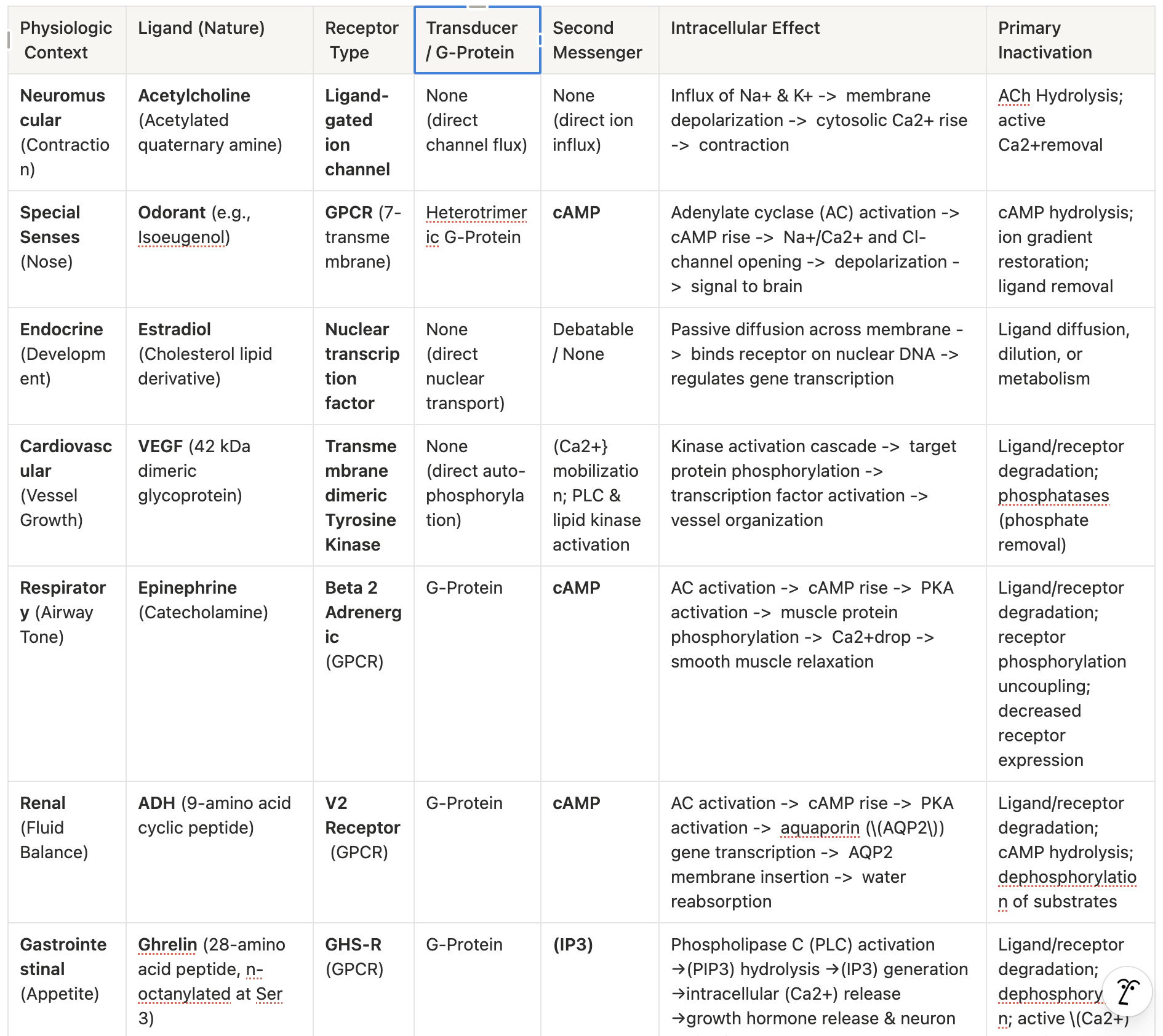
Comparative molecular pattern matrix (7): similarities in molecular patterns