Chapter 17: Alcohols and Phenols
 Call Kai
 Learn
Learn Practice Test
 Spaced Repetition
 Match
Match Flashcards
 Knowt Play
1/61

There's no tags or description
Looks like no tags are added yet.
Name | Mastery | Learn | Test | Matching | Spaced | Call with Kai | Chat |
|---|
No analytics yet
Send a link to your students to track their progress
62 Terms
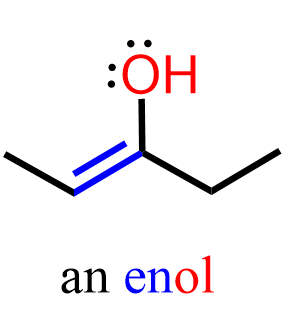
OH on sp2 Carbon
enol
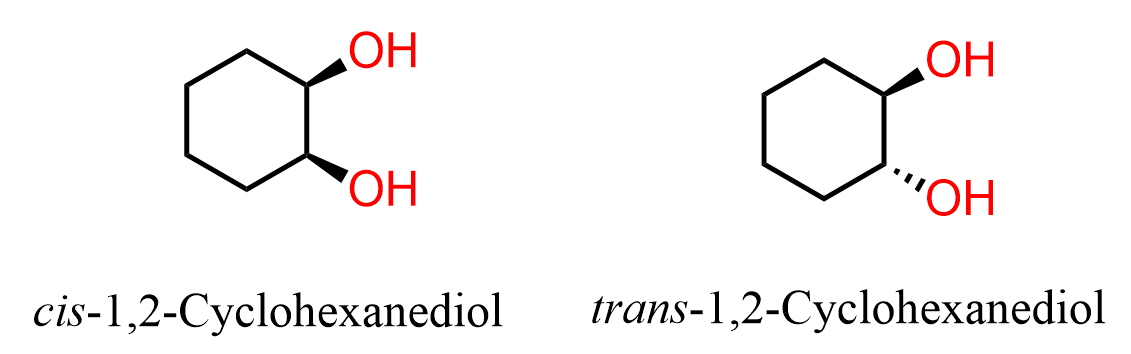
more than 1 hydroxy group
diol
Nucleophilicity
ability for an atom/ion/molecule to give away “extra” electrons & bonds
To identify a good nucleophile:
Have extra electrons to give away (negative charge or lone pair)
Up and to the left on the periodic table (also means a good/strong base)
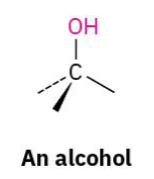
Alcohol
An alcohol is a molecule where an OH group is attached to an sp³ carbon (a normal alkyl carbon).
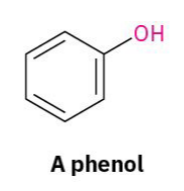
Phenol
A phenol is when the OH group is attached directly to a benzene ring. That one difference makes phenols much more acidic than alcohols.
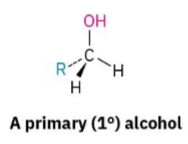
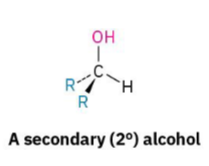
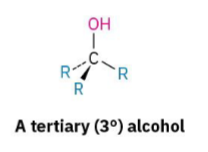
We classify alcohols by how many carbons are attached
to the carbon bearing the OH group. Always look at the carbon attached to the OH—not the oxygen.
Primary Alcohol
The OH-bearing carbon is attached to one other carbon (or none, as in methanol).
Secondary Alcohol
The OH-bearing carbon is attached to two carbons.
Tertiary Alcohol
The OH-bearing carbon is attached to three carbons.
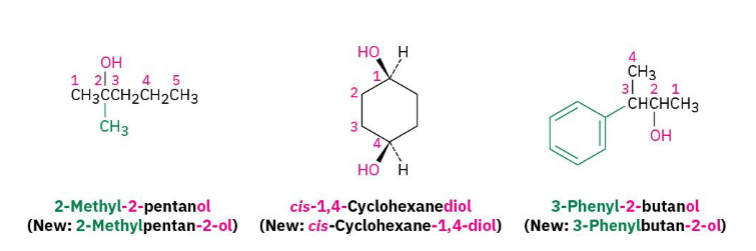
Naming Alcohols
Naming Steps
Find the longest carbon chain containing the OH group.
Number the chain so the OH gets the lowest possible number.
Replace the ending -ane with -ol.
Indicate the position of the OH.
Naming Phenols
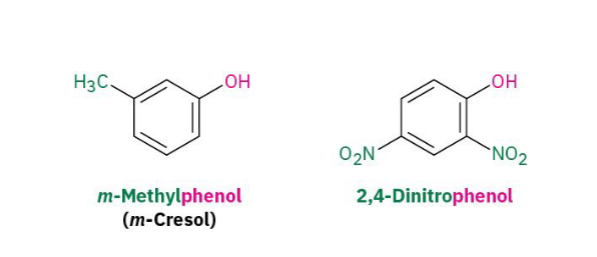
When the OH is attached directly to benzene, the parent name is phenol. Substituents are numbered relative to the OH group:
ortho (o-) = 1,2
meta (m-) = 1,3
para (p-) = 1,4
the melting points and boiling point of alcohols (dispersive forces, dipole-dipole, and hydrogen bonding) are
higher than that of alkyl halides (dispersive forces, dipoles) or alkanes (which just has dispersive forces)
Alcohols can act as weak bases because
the oxygen has lone pairs. Those lone pairs can grab a proton (H⁺).
Whenever a strong acid reacts with an alcohol
protonate the alcohol first. Turning –OH into –OH₂⁺ converts a poor leaving group into water, which is an excellent leaving group. This is the first step in many SN1 and dehydration mechanisms.
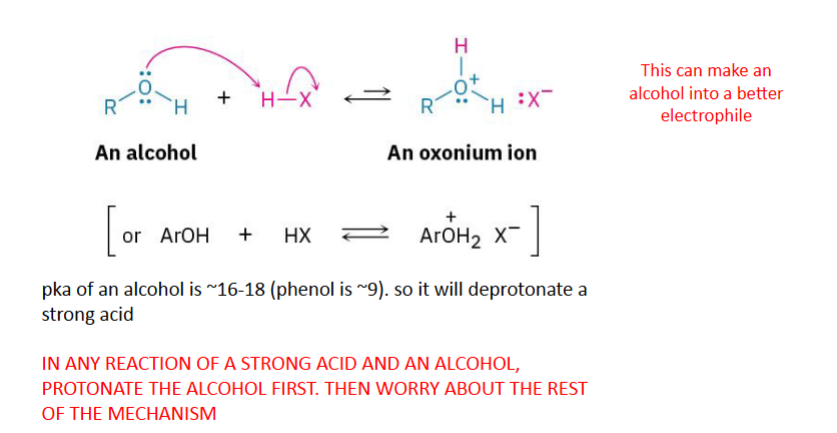
Alcohols can also donate their hydrogen, acting as weak acids.
A lower pKa means a stronger acid, so phenol is much more acidic than an alcohol.
Stability of Alcohols
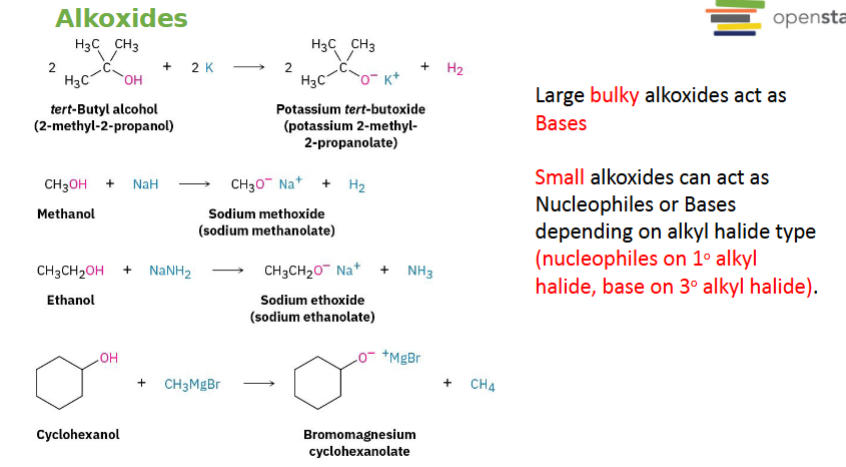
When an alcohol loses H⁺, it becomes an alkoxide ion (RO⁻). This negatively charged oxygen is now very reactive.
Two Jobs of an Alkoxide
Alkoxides can act as either:
1. A Base: Removes H⁺ from another molecule.
or
2. A Nucleophile: Attacks a carbon atom.
depends mostly on how bulky the alkoxide is and the type of alkyl halide it's reacting with.
Small alkoxides: Can do either SN2 or E2.
Large alkoxides:It is too bulky to easily attack carbon. Instead it removes a hydrogen. So it usually acts as a base (E2).
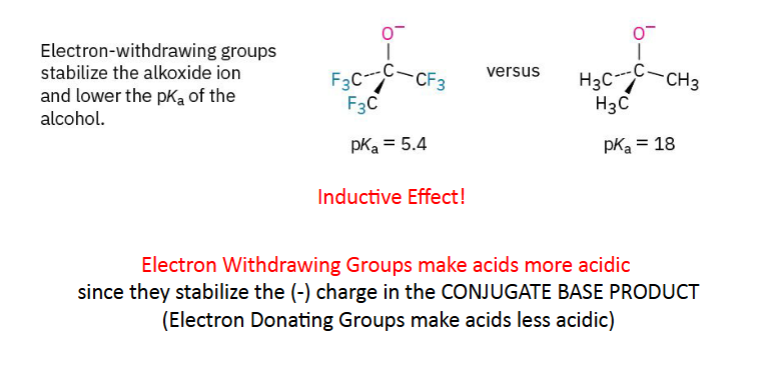
Alcohol Acidity
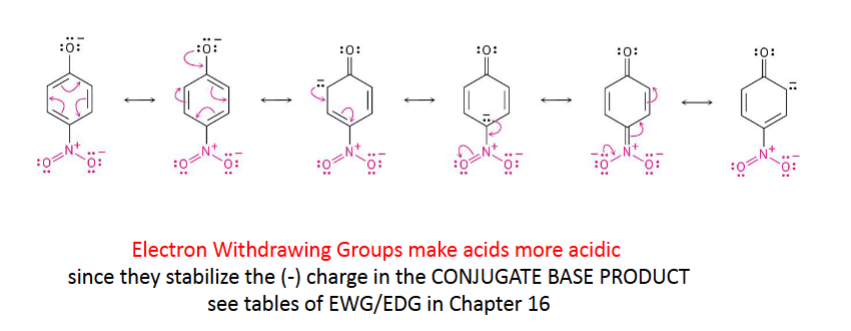
The inductive effect (the permanent shifting or pulling of electron density through single bonds caused by a difference in electronegativity between atoms. When a strong atom pulls shared electrons closer to itself, it creates a small chain reaction of partial positive and negative charges) Electron Withdrawing Groups make acids more acidic since they stabilize the (-) charge in the CONJUGATE BASE PRODUCT ("Electron Donating Groups make acids less acidic)
Phenol Acidity
Why is phenol much more acidic?
Remember :Alcohol pKa ≈16–18
Phenol pKa ≈9
Phenol: When phenol loses a proton, it forms a phenoxide ion. This ion is heavily stabilized by resonance. The negative charge on the oxygen atom delocalizes into the aromatic benzene ring, spreading the charge across multiple carbon atoms and lowering the molecule's overall energy.
Alcohol: When an alcohol loses a proton, it forms an alkoxide ion. This ion has no resonance stabilization. Furthermore, the alkyl groups in alcohols are electron-donating, which concentrates the negative charge on the oxygen, destabilizing the ion.
Substituted Phenols
Does the substituent change acidity? YES. Electron-Withdrawing Groups Increase acidity. They stabilize the phenoxide ion. Electron-Donating Groups Decrease acidity.
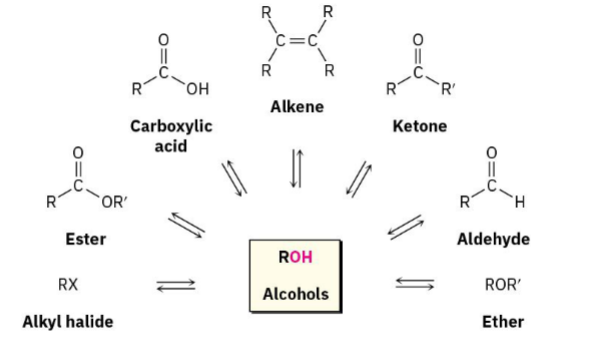
The central position of alcohols in organic chemistry. Alcohols can be prepared from, and converted into, many other kinds of compounds
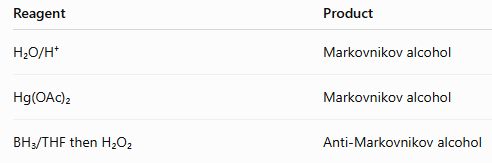
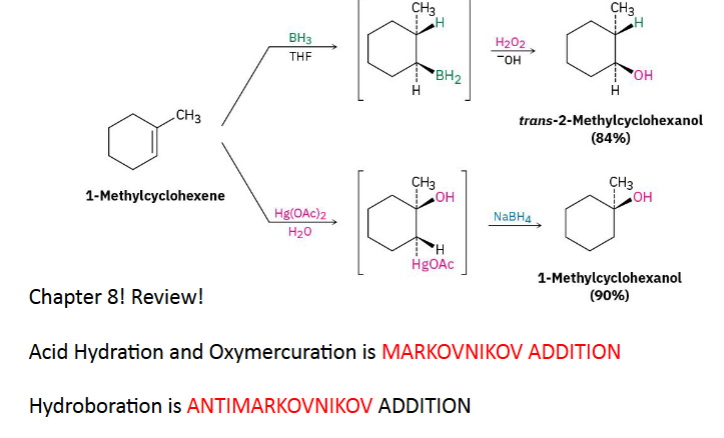
Alcohol Preparation: 3 Major Methods
Acid Hydration: Adds H-OH across a double bond
Oxymercuration (Both acid Hydration and oxymercuration are Markovnikov)
Hydroboration: Anti-Markovnikov
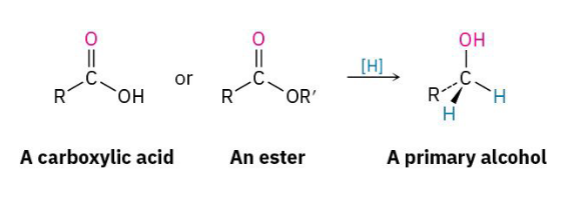
Reduction of Carbonyls
Now we're making alcohols from carbonyl compounds. Reduction means: Add H Remove double bond. Reduction always gives alcohols. Carbonyl to Alcohol.
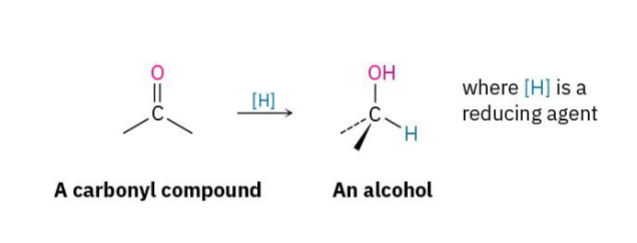
Reduction of Aldehydes and Ketones
NaBH4: Mild reducing agent. Reduces Aldehydes and Ketones. DOES NOT reduce Esters, Carboxylic acids or alkenes. The products: Aldehyde turns into Primary Alcohol, Ketone turns into Secondary alcohol
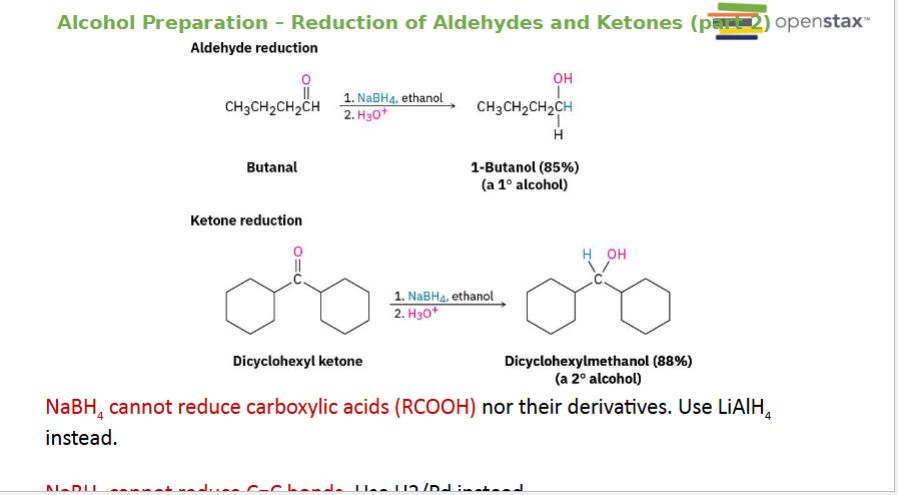
LiAlH4
Much stronger than NaBH4, it reduces:
Aldehydes
Ketones
Esters
Carboxylic Acids
Still does not reduce C=c, you would need H2/Pd for that.
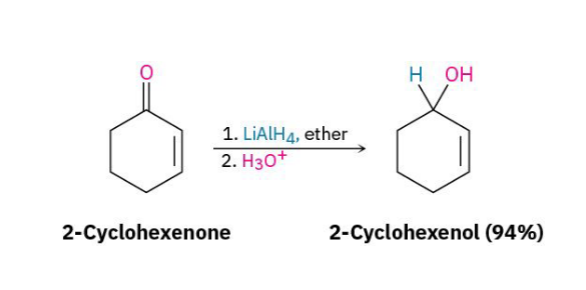
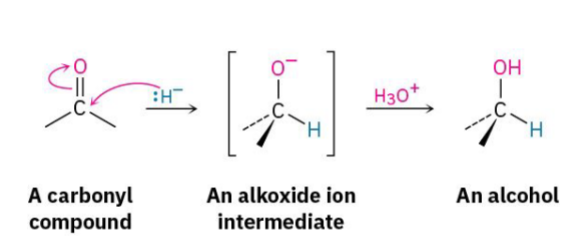
Reduction Mechanism
Hydride attacks carbonyl carbon.
Carbonyl opens.
Makes alkoxide.
Then
Acidic workup
adds H.
Alcohol formed.
Hydride ALWAYS attacks carbon.
Nature’s Reducing Agent
Nature uses NADPH instead of NaBH₄. Same idea. Hydride transfer. Produces alcohol.
Reduction of Carboxylic Acids and Esters
Only LiAlH₄ works.
NaBH₄ is NOT strong enough.
Grignard Reagents
RMgX
R = carbon group
Mg = magnesium
X = Br, Cl, or I
Unlike reduction (which keeps the same number of carbons), Grignard reactions build bigger molecules by making a new carbon–carbon (C–C) bond.
Suppose Carbonyl has 6 carbons , Grignard has 1 carbon Product should have 7 carbons.
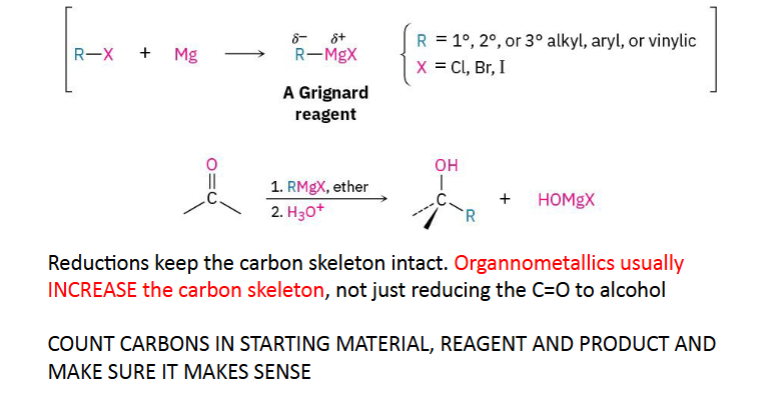
Grignard react with Esters
Esters react TWICE:
Step 1
Grignard attacks, Makes a ketone.
Step 2
A second Grignard attacks, Makes an alcohol.
never mix grignards with
water
alcohols
strong acids
The Grignard acts as a strong base instead of a nucleophile and is destroyed before it can make a C–C bond. Water kills Grignards.
Product depends on carbonyl
Formaldehyde = Primary alcohol
Aldehyde = Secondary alcohol
Ketone = Tertiary alcohol
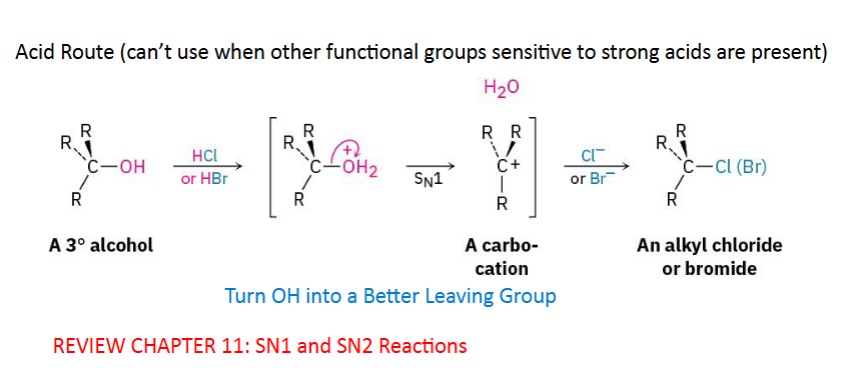
Converting Alcohols into Alkyl Halides (Acid Route)
Replace OH with Br or Cl. OH is a terrible leaving group, turn it into a better leaving group first.
Acid Route: Protonate OH into OH2 +, water leaves easily. Water is a good leaving group
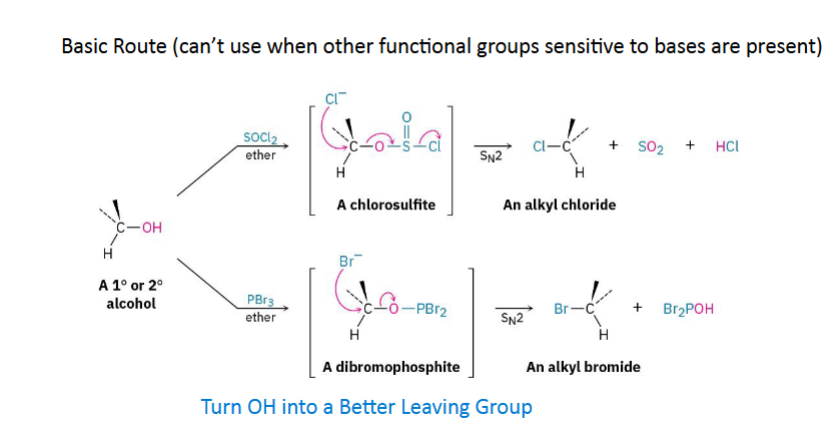
Converting Alcohols into Alkyl Halides (Basic Route)
Uses reagents like PBr3, SOCl2 instead of a strong acid
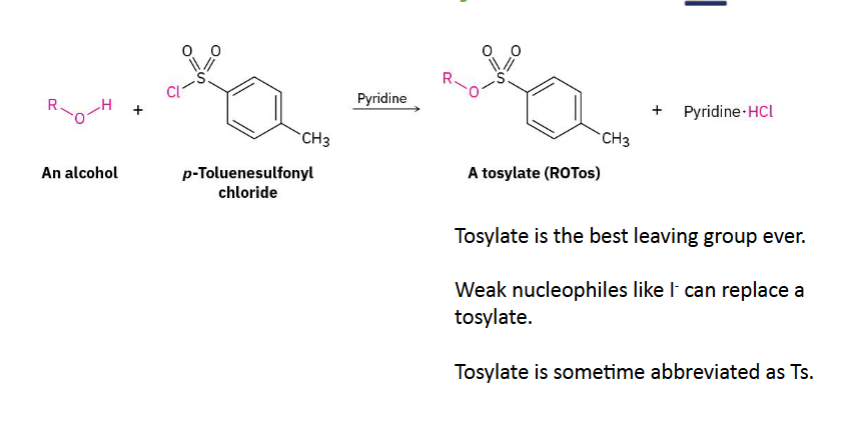
Tosylates
One of the BEST leaving groups. (OTs) Made using TsCl. The OH becomes OTs. We did not replace the OH, only changed it into a better leaving group. Making SN2 easy.
OH
↓
TsCl
↓
OTs
↓
Now SN2 becomes easy.
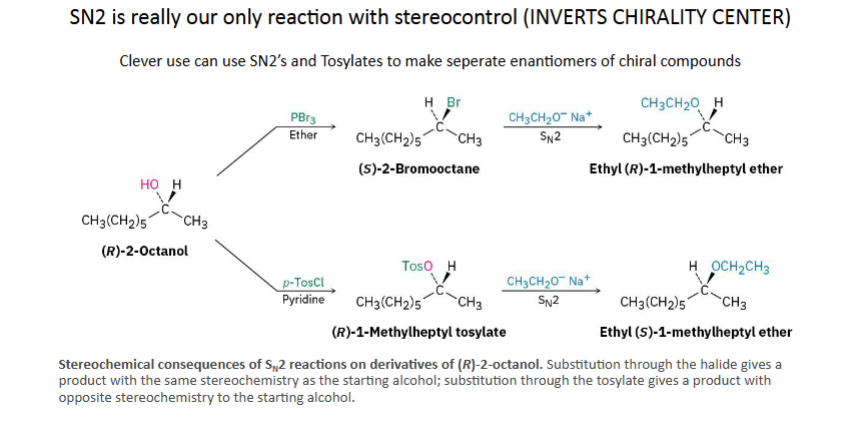
SN2 & Tosylates question
An SN2 will cause an inversion in tosylaters (Question also about backside attacks and e1 e1 sn1 sn2)
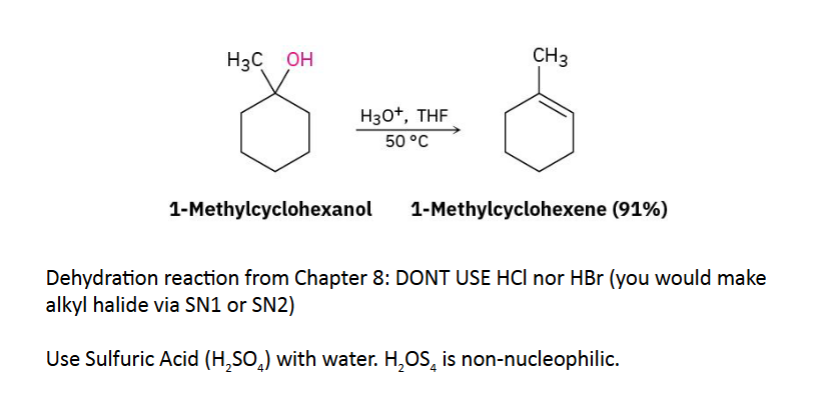
Dehydration of Alcohols
Reagent: H2SO4 & H2O
the goal is to turn an alcohol into an alkene (dehydration, water is removed).
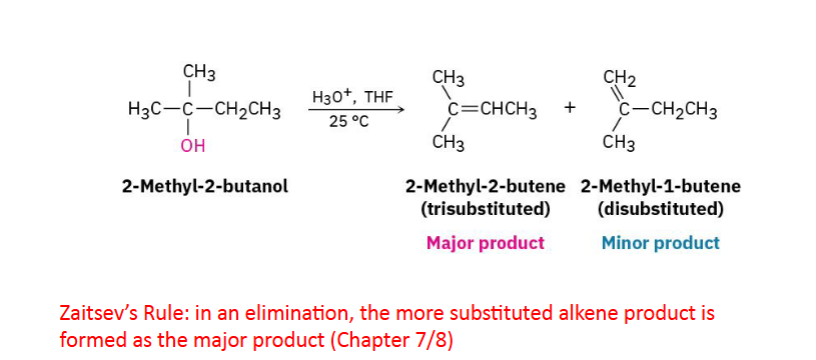
Zaitsev’s Rule
In an elimination, The Most substituted alkene is usually the Major product. More substituted ↓ More stable ↓ Major product
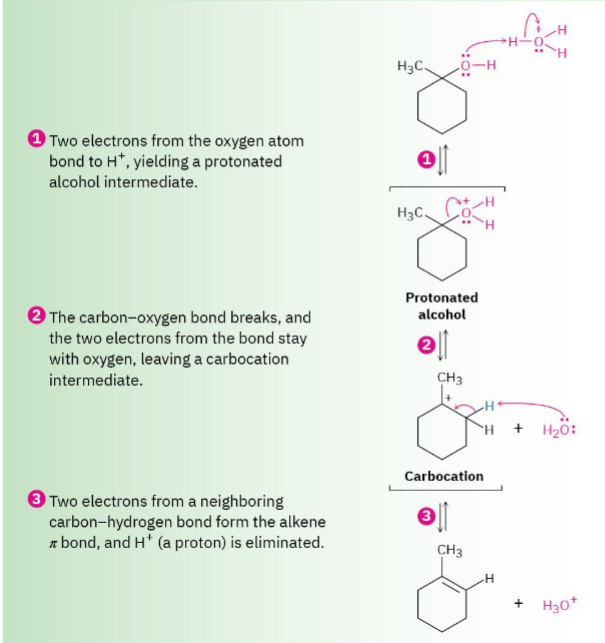
E1 Dehydration Mechanism
Mechanism for the acid-catalyzed dehydration of a
tertiary alcohol to yield an alkene. The process is an E1
reaction and involves a carbocation intermediate
Tertiary alcohols usually dehydrate through E1.
Steps
Protonate OH.
↓
Water leaves.
↓
Carbocation forms.
↓
Lose H.
↓
Alkene forms.
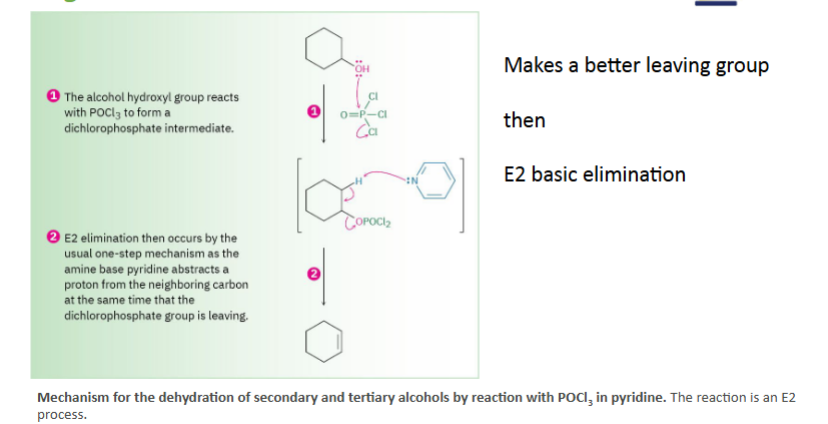
Basic Dehydration (POCl3)
Instead of acid, use POCl3 + Pyridine, this follows an E2 mechanism
Steps
POCl₃ converts OH into a better leaving group.
Pyridine removes H.
Double bond forms.
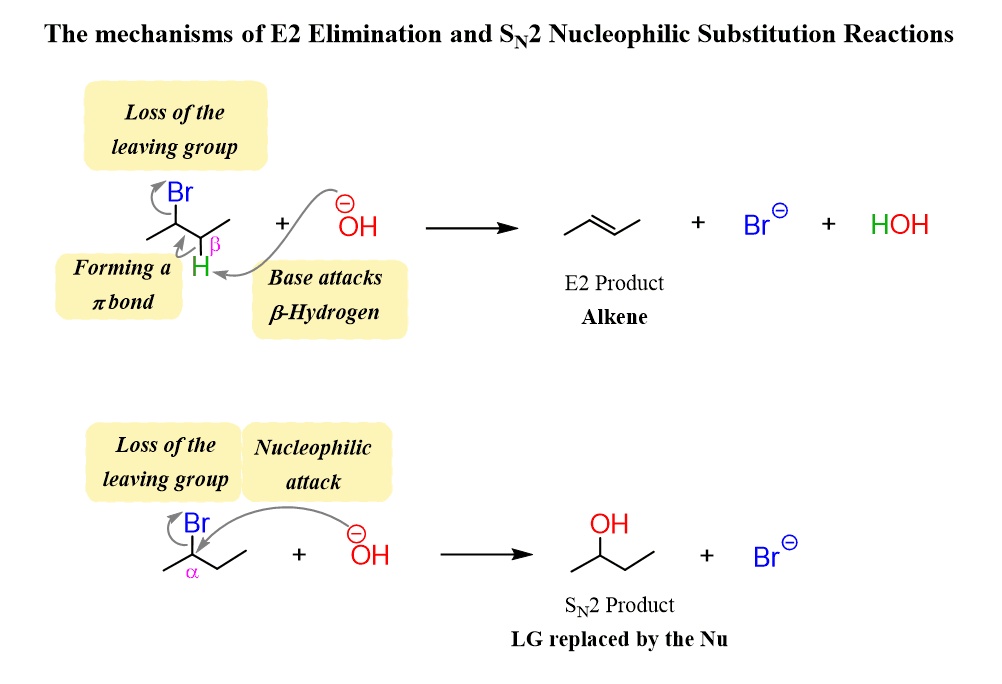
E2
elimination reaction where a molecule loses two atoms (usually H and a leaving group like Br or Cl) at the same time, forming a double bond (alkene).
For an E2 reaction, you need a strong base and a good leaving group
E2 = Elimination + 2 things leave + One step
No intermediate, no carbocation
Base grabs a hydrogen
As hydrogen leaves, C-H bond electrons move to make double bond
At the same time, Br leaves, everything happens at the same time
Good leaving group
Down to the right on the periodic table (or a weak base, the opposite of a good nucleophile)
How to turn things into better leaving groups?
Protonate: Add H+, so when it leaves, it leaves as H2O, which is a good leaving group.
Replace with Halide: Replace OH with a halide
Summary (Part 1)
Acidity
✅ Electron-withdrawing groups increase acidity.
✅ Electron-donating groups decrease acidity.
✅ Resonance stabilizes phenoxide, making phenols more acidic than alcohols.
Alkoxides
✅ Small alkoxides = nucleophiles or bases.
✅ Bulky alkoxides (like tert-butoxide) = mostly bases (E2).
Preparing Alcohols
✅ Acid hydration → Markovnikov alcohol.
✅ Oxymercuration → Markovnikov alcohol (no rearrangements).
✅ Hydroboration → Anti-Markovnikov alcohol (syn addition).
Reduction Reagents
NaBH₄
Reduces aldehydes and ketones only.
LiAlH₄
Reduces aldehydes, ketones, esters, and carboxylic acids.
H₂/Pd
Reduces C=C double bonds.
Carbonyl Products
Aldehyde → Primary alcohol
Ketone → Secondary alcohol
Carboxylic acid → Primary alcohol (LiAlH₄ only)
Ester → Primary alcohol (LiAlH₄ only)
Summary (Part 2)
Grignard Reactions
✅ Build NEW carbon-carbon bonds.
✅ Carbonyl + Grignard → Alcohol.
✅ Count carbons before drawing products.
✅ Never use water, alcohols, or acids with a Grignard.
Alcohol → Alkyl Halide
Remember:
OH is a bad leaving group.
Make it better using:
HBr
PBr₃
SOCl₂
TsCl (tosylate formation)
Tosylates
OTs is one of the best leaving groups.
SN2 reactions on tosylates give inversion of configuration.
Dehydration
Acid route:
H₂SO₄
E1
Carbocation intermediate
Rearrangements possible
Basic route:
POCl₃/pyridine
E2
No carbocation
No rearrangements
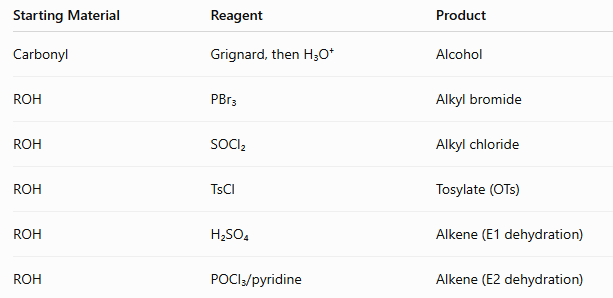
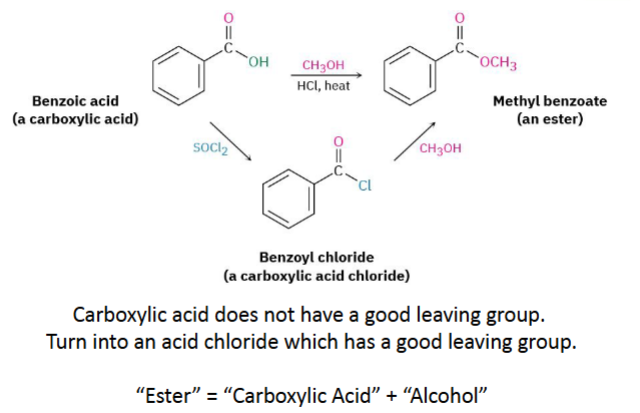
Conversion of Alcohols into Esters
Alcohols can react with carboxylic acids to form esters.
Carboxylic acid is a poor leaving group, so it can be converted into acid chloride making it a better leaving group.
Acid + Alcohol = Ester
Oxidation of Alcohols
a reaction that increases the number of bonds to oxygen or other electronegative atoms, or decreases the number of carbon-hydrogen (C-H) bonds
Oxidation usually means
More C–O bonds
Fewer C–H bonds
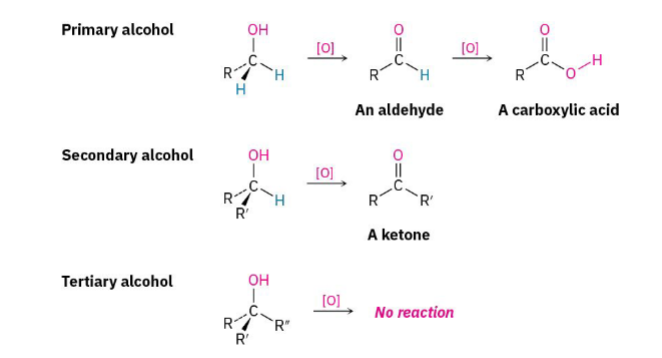
Alcohols become carbonyl compounds.
Products: Primary Alcohol to Aldehyde to Carboxylic Acid (if oxidation continues).
Secondary Alcohol = Ketone
Tertiary Alcohol usually No reaction because there is no hydrogen on the OH-bearing carbon
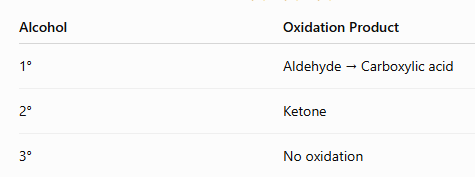
Oxidation products for Alcohols
see image
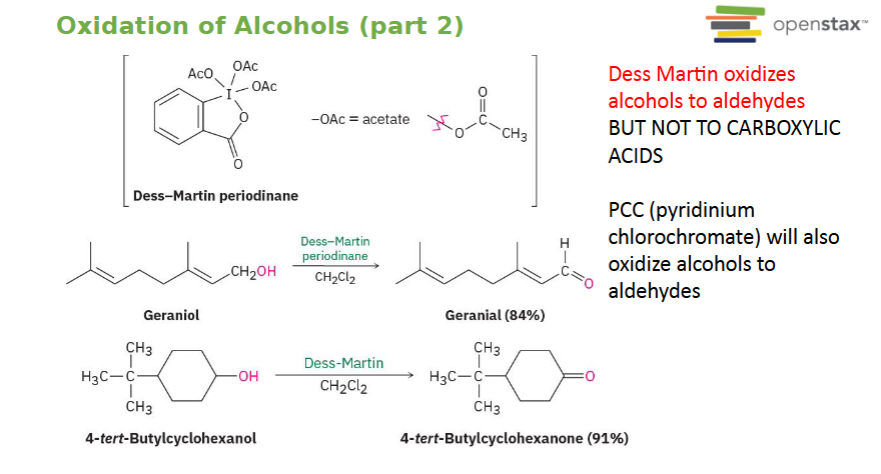
PCC (Pyridinium chlorochromate)
Changes Primary alcohol into Aldehyde
Stops there.
Turns Secondary alcohol into Ketone
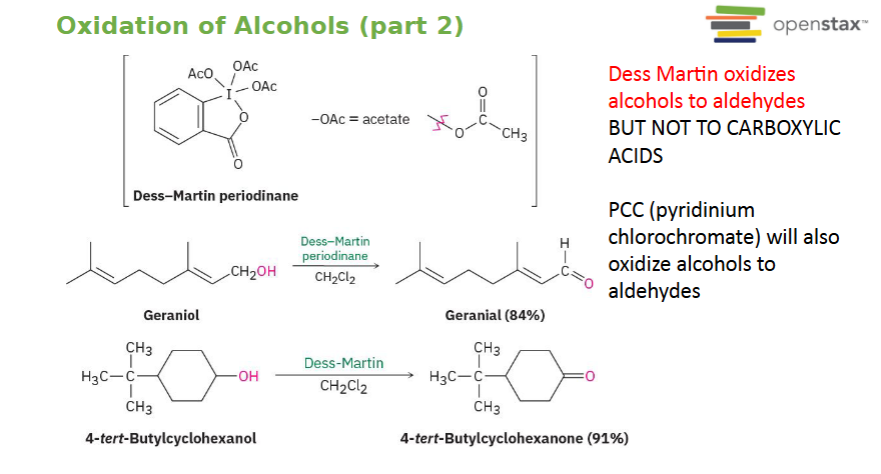
Dess-Martin Periodinane
Very similar. Also stops at aldehydes. Dess–Martin oxidizes alcohols to aldehydes but not to carboxylic acids. PCC behaves similarly for primary alcohols.
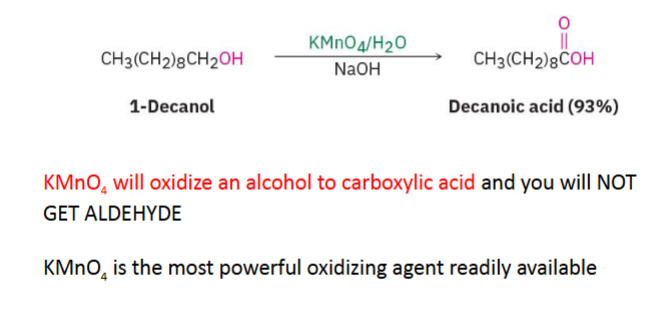
KMnO4 (Potassium permanganate)
One of the strongest oxidizing agents used. Primary alcohol into Carboxylic acid NOT aldehyde.
The aldehyde is immediately oxidized again. Secondary alcohol into ketone, and tertiary alcohol no rxn.
Protection of Alcohols
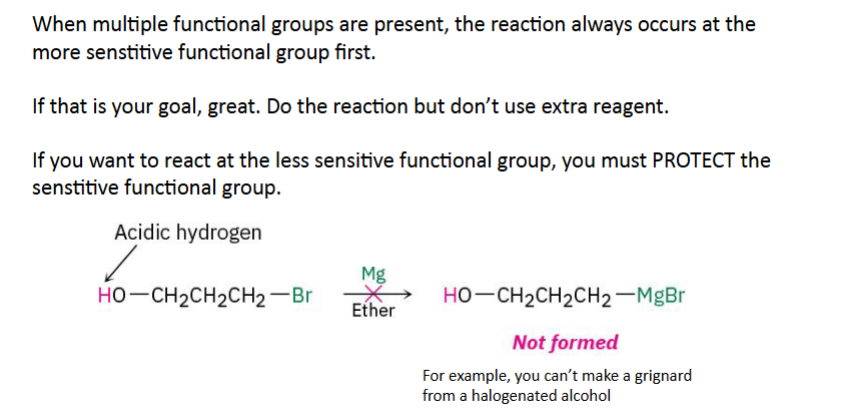
Sometimes you don't want the alcohol to react.
Instead You temporarily hide it. This is called Protection. Imagine a molecule has
OH
Br
You want to make a Grignard reagent.
Problem:
The OH destroys the Grignard.
Solution:
Protect the alcohol first.
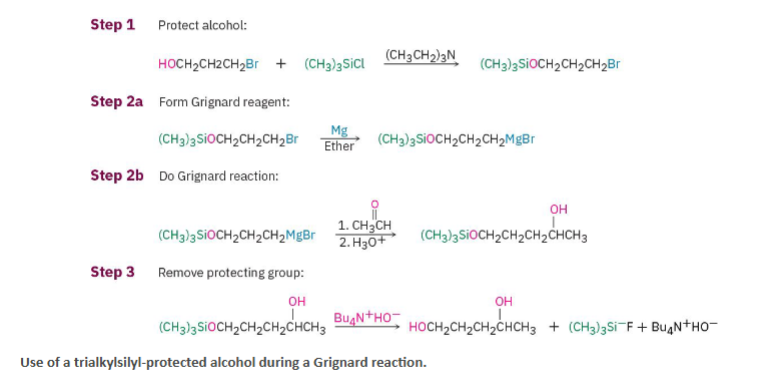
The slide uses this exact idea: you can't successfully make a Grignard from a halogenated alcohol unless the alcohol is protected.
Protecting Alcohol Steps
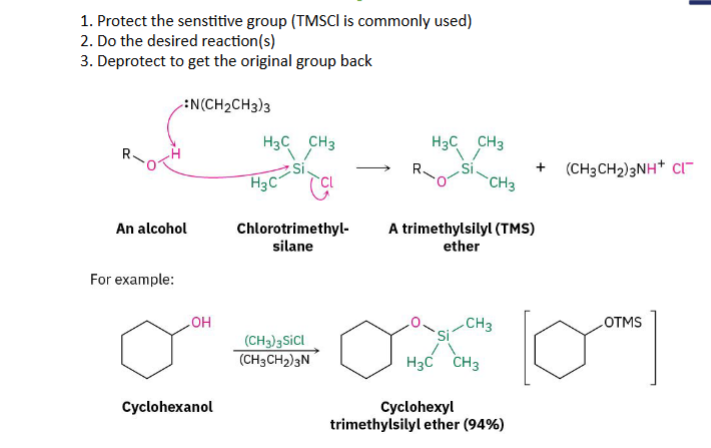
Protect alcohol: Use TMSCl. Alcohol becomes RO-TMS
Do desired reaction, alcohol stays safe.
Remove protection and get original alcohol back.
Protect, react, deprotect
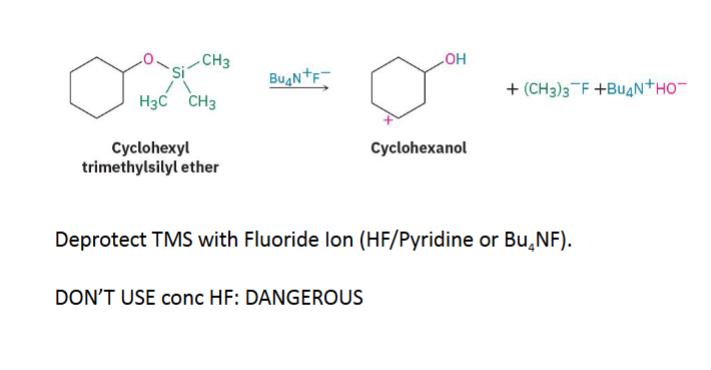
How do we remove TMS?
Use flouride:
HF/Pyridine
Bu₄NF (tetrabutylammonium fluoride)
Protected Alcohol During a Grignard Reaction
Protect alcohol
Perform Grignard rxn
Remove protecting group
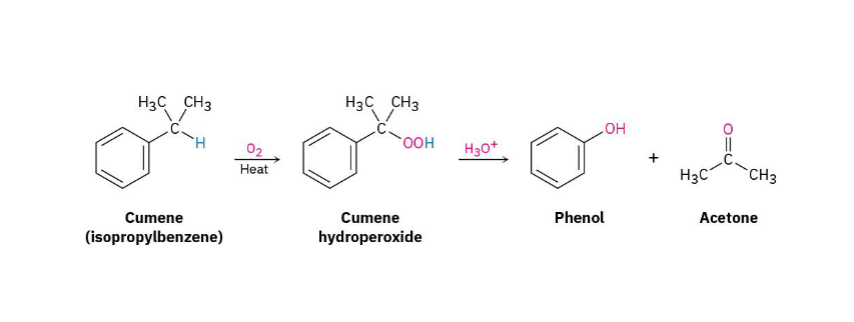
Cumene Conversion into Phenol and Acetone
see image
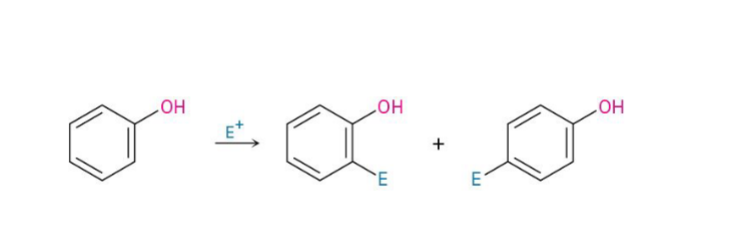
Reactions of Phenols
Phenol strongly activates the benzene ring because the oxygen donates electron density through resonance. As a result:
Electrophilic aromatic substitution happens more easily.
New groups usually go to the ortho and para positions.
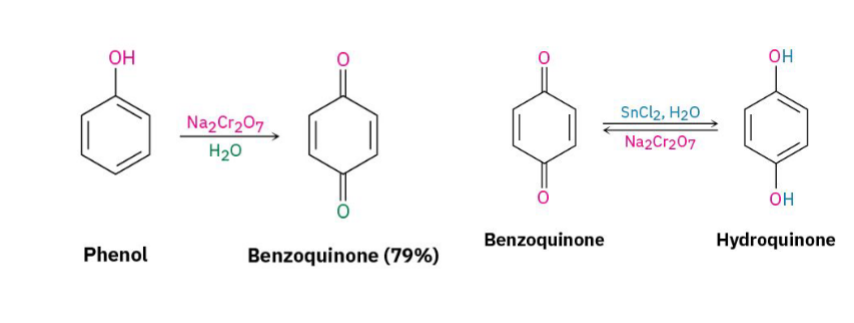
Oxidation of Phenols (Quinones)
Phenols can be oxidized. Product: Quinone
Quinones contain two carbonyl groups on the aromatic ring.
These compounds are important in biology (for example, electron transport) and industrial chemistry.
Phenol, oxidation = Quinone
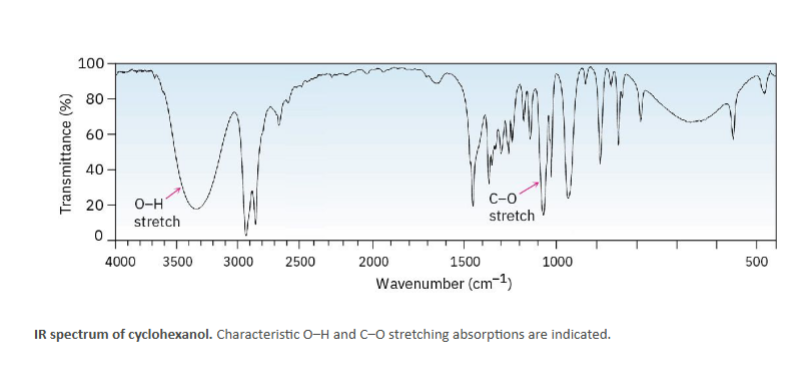
IR Spec: How do alcohols look in IR?
O–H Stretch, Very broad. Approximately: 3200–3600 cm⁻¹. This is usually the easiest way to recognize an alcohol.
C–O Stretch Usually 1000–1200 cm⁻¹
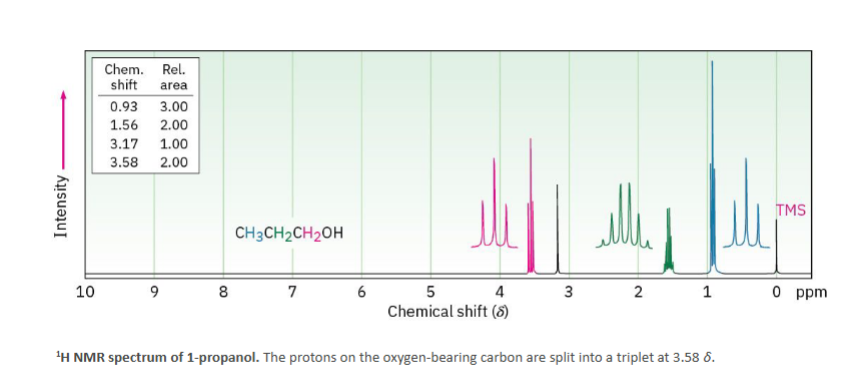
1H NMR of alcohols
you don’t always see the OH in 1H NMR The hydrogen exchanges rapidly with water or other alcohol molecules.
Because of this:
OH may appear
Broad
Small
In different positions
Or disappear after a D₂O shake
The hydrogen attached to the carbon bearing the OH usually appears around
3–4 ppm
because oxygen pulls electron density away.
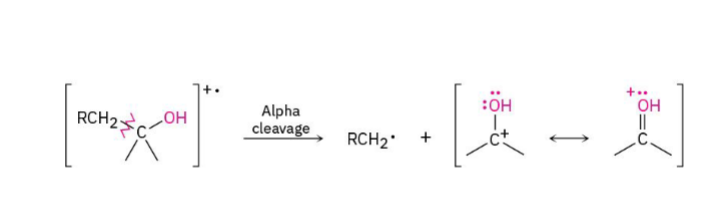
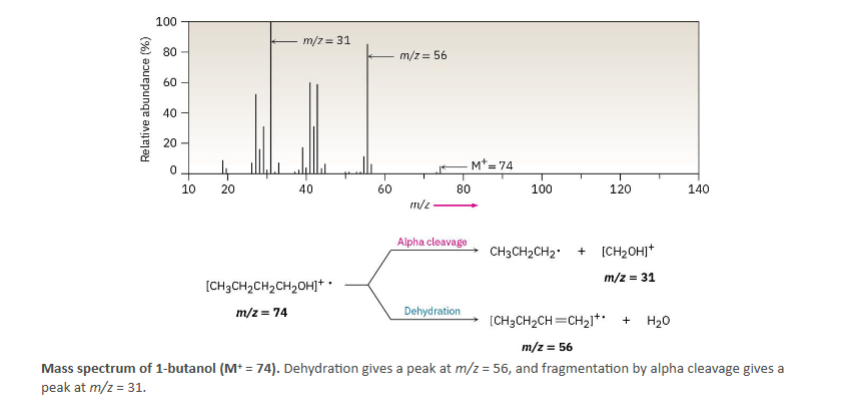
Mass Spec: Alpha cleavage
Alcohols commonly fragment next to the carbon attached to oxygen.
This is called alpha cleavage: The bond adjacent to the OH-bearing carbon breaks, producing characteristic fragments.
Mass Spec: Dehydration
Alcohols often lose H2O during mass spec, this is called dehydration.
Molecular ion (M⁺) = 74
Dehydration peak = m/z 56
Alpha cleavage fragment = m/z 31
Summary (Part 3)
Alcohol Classification
1°, 2°, and 3° alcohols
Acidity
Phenols are more acidic than alcohols because of resonance.
Electron-withdrawing groups increase acidity.
Electron-donating groups decrease acidity.
Reduction
NaBH₄ → aldehydes and ketones
LiAlH₄ → aldehydes, ketones, esters, and carboxylic acids
Grignards
Build C–C bonds
Never use water, alcohols, or acids
Always count carbons
Conversions
PBr₃ → RBr
SOCl₂ → RCl
TsCl → OTs
Dehydration
H₂SO₄ → E1
POCl₃/pyridine → E2
Oxidation
PCC/Dess–Martin stop at aldehydes.
KMnO₄ oxidizes primary alcohols all the way to carboxylic acids.
Protection
TMSCl protects alcohols.
Fluoride removes TMS.
Spectroscopy
IR: broad O–H stretch at 3200–3600 cm⁻¹
¹H NMR: OH signal may be broad or absent; CH attached to O appears around 3–4 ppm
Mass spectrometry: watch for alpha cleavage and loss of H₂O