L3 - Cladistics: Charting relationships
 Call Kai
 Learn
Learn Practice Test
 Spaced Repetition
 Match
Match Flashcards
 Knowt Play
1/30

There's no tags or description
Looks like no tags are added yet.
Name | Mastery | Learn | Test | Matching | Spaced | Call with Kai | Chat |
|---|
No analytics yet
Send a link to your students to track their progress
31 Terms
Who came up with the Linnaean classification?
Carl Linnaeus
What are the three kingdoms of Linnean classification?
Animal
Vegetable
Mineral
What was the name of the book Carl Linnaeus published?
System a Naturae - Latin?
What are the 4 hierarchical levels a kingdom is divided into?
Class → Order → Genus → Species
missing family
What are the 6 classes for the animal kingdom?
Mammalia
Aves (birds)
Amphibia (including reptiles and some fish)
Pisces (fish, including whales)
Insecta - all arthropods, not just insects
Vermes - all other invertebrates, including worms, mollusks and echinoderms like sea urchins
What are some similar classification systems we have to Linnaeus classification?
Still have a hierarchical system
Still us scientific binomial naming system developed to name life forms
What is the Binomial naming system? Provide an example and the rules
Rules:
Generic name and a specific name
The first letter of the genus is capitalized; the first letter of the species is not
Species is italicized
Species names can be repeated for many genera but a genus name can be used only once
Example:
Homo sapiens
How do we determine if animals are closely related?
DNA and Fossils
What was the old way of determining whether two species were closely related?
Taxonomy
What is the hierarchical system used today?

What is the difference between a Phylogenetic tree and a Cladogram?
Phylogenetic tree = depicts change through TIME
Cladogram = a diagram based on shared characteristics/morphology
Define a cladogram
a HYPOTHESIS in diagram form showing the possible relationships between organisms
What is Parsimony?
The simplest solution
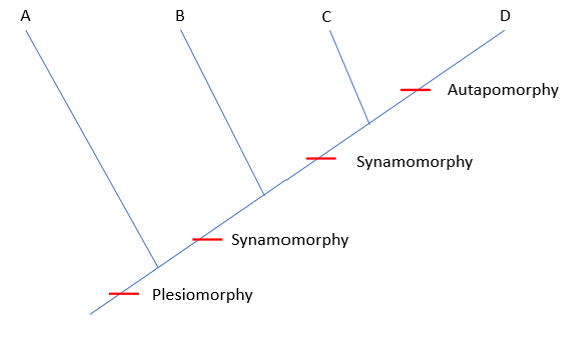
Define Plesiomorphy
Ancestral character trait, shared by all in cladogram

Define Synapomorphy
Shared derived trait; shared by two or more taxa and their most recent common ancestor

Define Autapomorphy
Uniquely derived character trait
Define convergent evolution
Organisms not closely related independently evolve similar traits as a result of having to adapt to similar environments or ecological niches

How can cladistics indicate that similarities are due to convergance?
Cladistic analysis would find more shared derived characteristics with other groups
What is the main rule in cladistics?
Must be monophyletic (a common ancestor and all of it’s descendants)
Define Paraphyletic
A grouping that does not include all of its descendants
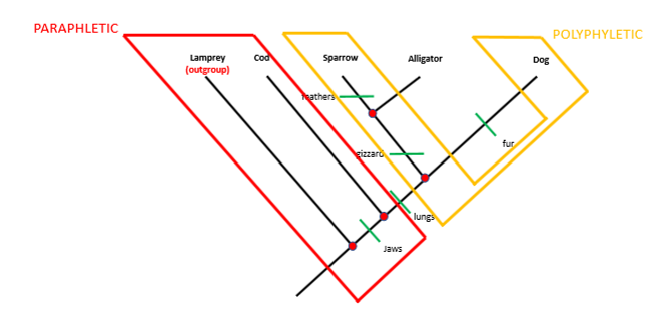
Define Polyphyletic
A grouping that is made of members from unrelated ancestors
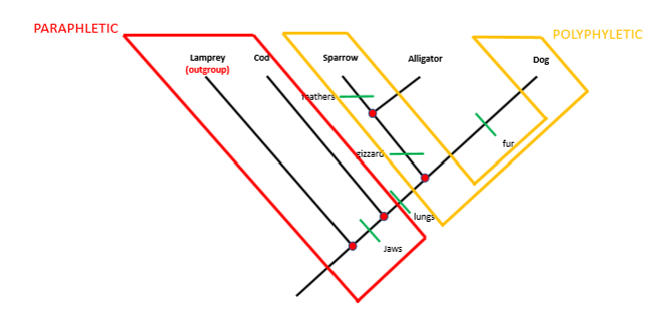

Which group is Polyphyletic?
Group 1

What group is Paraphyletic?
Group 3

What group is Monophyletic?
Group 2
Define a Protostome
Protostomia = the clade of animals once thought to be characterized by the creature's blastopore becoming its mouth during embryonic development.
First opening becomes mouth

Define a Deuterostome
Embryo's first opening (the blastopore) becomes the anus

When did the Deuterostomia and Protostomia trait split in the Kingdom Animalia cladogram?
670 Ma? - Sometime in the pre-cambrian
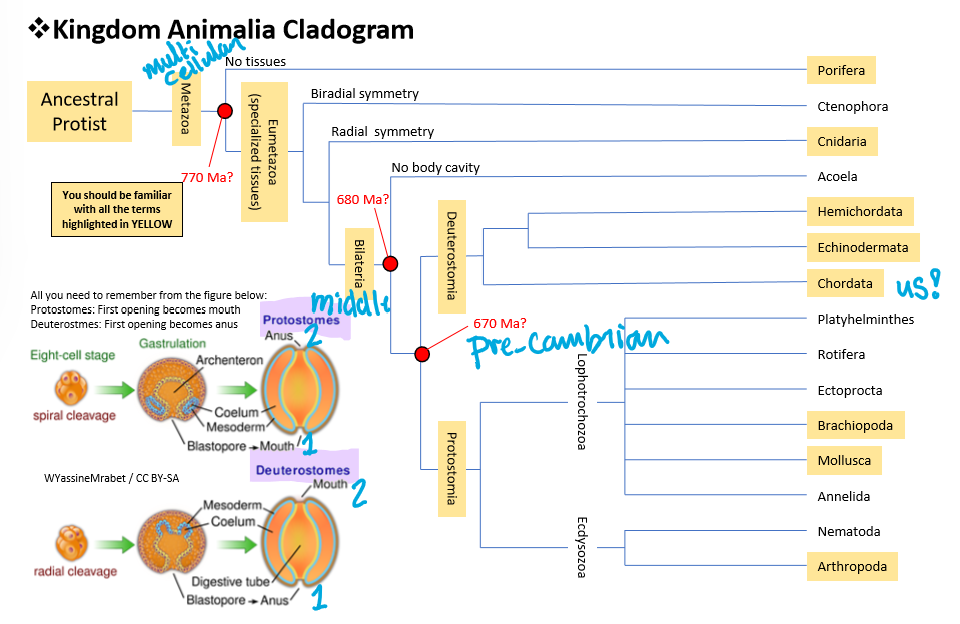
What does Metazoa mean?
multicellular organism

Define Eumetazoa. When did this trait split in the kingdom animalia cladogram?
a major subkingdom or clade of animals that includes all multicellular forms with true differentiated tissues, leaving out only sponges and a few other simple groups
multicellular with specialized tissues
770 Ma?

Define Bilateria. When did this trait split in the kingdom animalia cladogram?
Bilateria = a group of animals that have bilateral symmetry, meaning their bodies can be divided into matching left and right halves along a central axis
680 Ma?
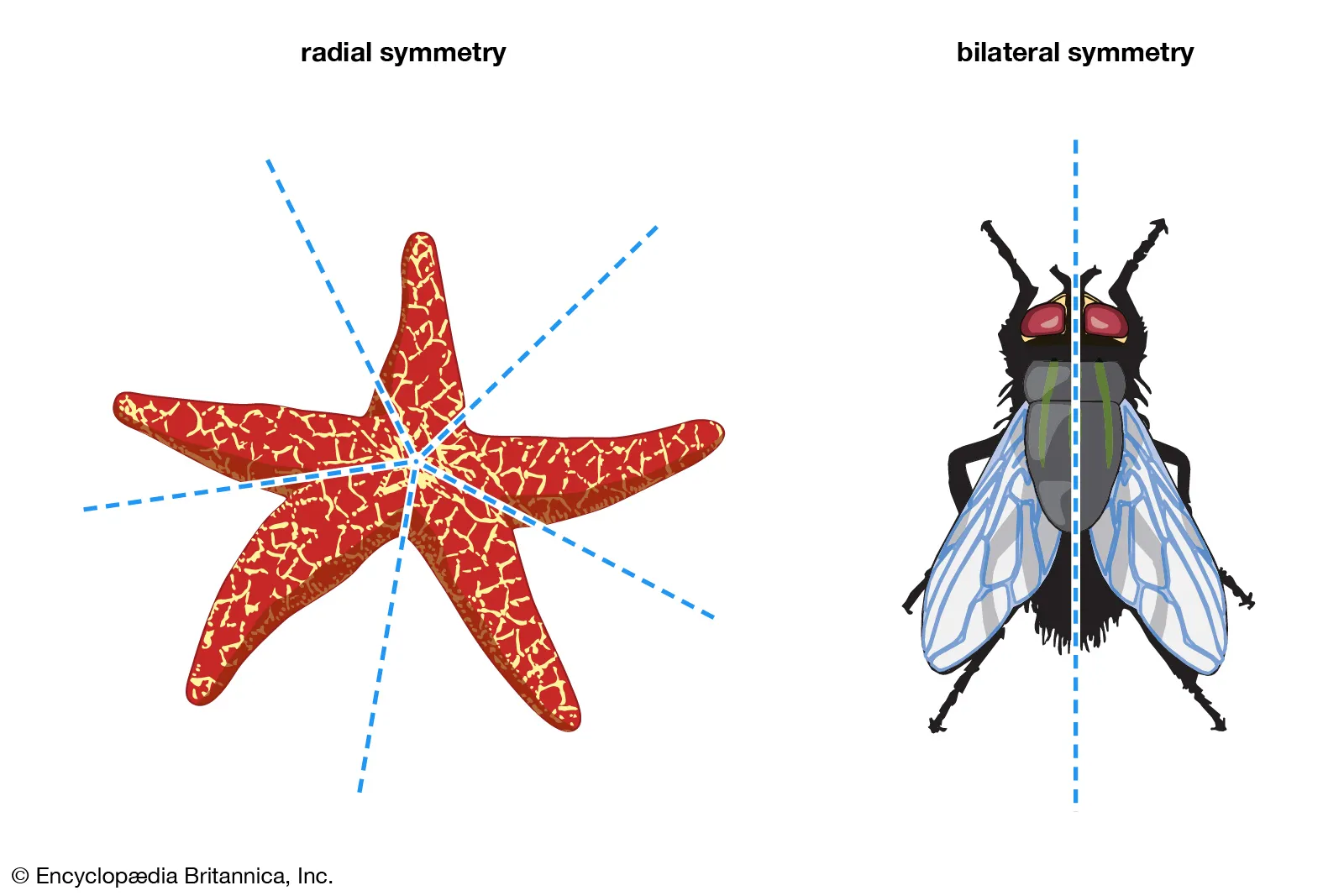
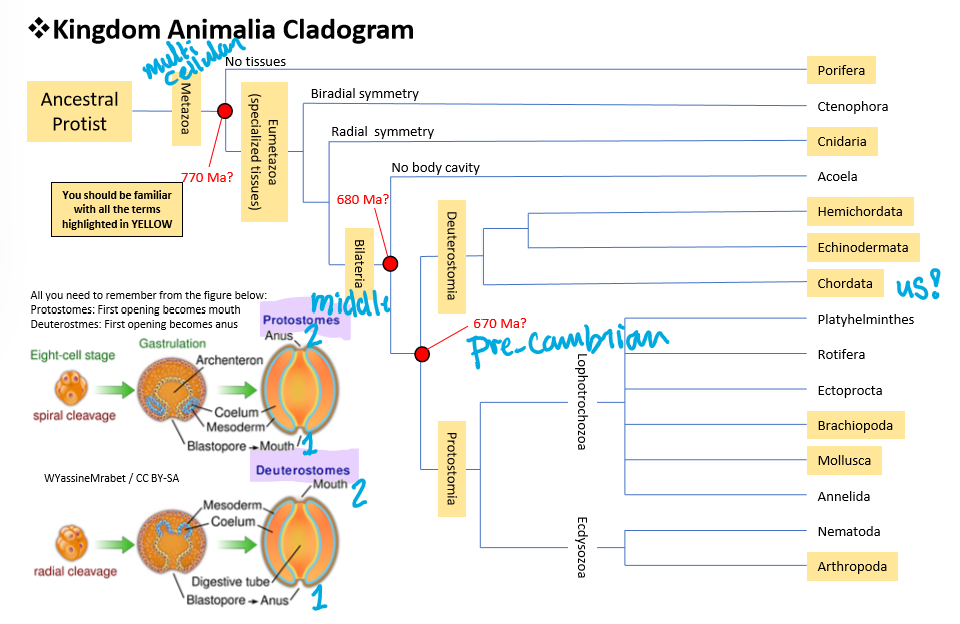
Note the characteristics and relationships between the 6 major animal phyla