Photosynthesis - Chp 11
 Call Kai
 Learn
Learn Practice Test
 Spaced Repetition
 Match
Match Flashcards
 Knowt Play
1/36

There's no tags or description
Looks like no tags are added yet.
Name | Mastery | Learn | Test | Matching | Spaced | Call with Kai | Chat |
|---|
No analytics yet
Send a link to your students to track their progress
37 Terms
Photosynthesis
The process in which plants make food (carobohydrates) and oxygen using energy from the sun, water from the soil, and carbon dioxide from the atmosphere
Light energy → Chemical energy
Role of photosynthesis
plants use it to make food
animals get their food from plants
produces oxygen for respiration to release energy
responsible for forming fossil fuels
removes carbon dioxide from the air
Balanced equation for photosynthesis
6CO₂ + 6H₂O → C₆H₁₂O₆ + 6O₂
Where does photosynthesis occur
the leaf's cells in the chloroplast
Where are most chloroplasts found
along the edge of the palisade (top) layer of the leaf to absorb sunlight
What pigment is required for photosynthesis
chlorophyll
What adaptations do leaves have for photosynthesis
Stomata - allow for gaseous exchange, open during the day to allow CO₂ in for photosynthesis, closed at night which reduces transpiration
Air spaces - allow for diffusion of CO₂ and H₂O withing the leaf
Thin - for rapid diffusion of CO₂ and O₂ out, allows all cells to capture light
Cuticles prevents excessive water loss, transparent, allows light through for photosynthesis
Leaf flattened - gives large surface area for maximum absorption of light and CO₂
What 4 things are required for photosythesis
carbon dioxide
water
light energy
chlorophyll
What are the products of photosythesis
glucose
oxygen
Photophosphorylation
process of adding a phosphate group to ADP to form ATP using light energy
Key events of photosynthesis
light is absorbed
water is split
products are produced
light energised electrons
glucose is formed
Event 1 - light is absorbed
light reaches the plant and is trapped by the chlorophyll in the chloroplast
trapped light provides the energy the plants need to make glucose
Event 2 - water is split
the trapped light energy is used to split 2 water molecules into oxygen molecules (O₂), protons (H⁺), and electrons (e⁻)
2H₂O → 4H⁺ + 4e⁻ + O₂
Event 3 - products of split water are stored
electrons passed to the chlorophyll
protons are stored in the proton pool in the chloroplast for later use
oxygen may pass out of the leaf into the atmosphere or may be used for plant respiration
Event 4 - light energises electrons
electrons that were passed to the chlorophyll become energised by some of the trapped light energy, and become high-energy electrons
Event 5 - glucose is formed
high energy electrons along with protons from the proton pool are combined with carbon dioxide to form glucose
Sources of light for plants
sunlight is a natural source of light for plants
artificial light can also be used, particularly in greenhouses to stimulate growth
plants absorb all colours of white light other than green, which they will reflect, this is why most plants are green
Sources of carbon dioxide for plants
get most of their carbons dioxide from the atmosphere, which is external
a small amount is gained internally from their own cellular respiration
What can be used to increase photosynthesis in an agricultural environment?
artificial light will increase growth up to a certain saturation point where no more light will be absorbed and the rate of photosynthesis will level off
artificial sources of carbon dioxide are used, such as burning gas
Sources of water for plants
water is absorbed from the soil by the roots of the plant, then transported through the xylem
Limiting factors to photosynthesis
slowed down if necessary factors such as light, CO₂, or water are short in supply
light will increase the rate until it reaches its saturation point, at which it levels off
maintain an optimum temperature
Role of NADP
electron acceptor during the light stage
Role of NADP-
proton acceptor during the light stage
Overview: The light stage
light dependant stage
2 pathways within this stage: Cyclic photophosphorylation (pathway 1) and Non-cyclic photophosphorylation (pathway 2)
Makes ATP and NADPH
not controlled by enzymes
Overview: The dark stage
light independent stage
Uses ATP and NADPH
is controlled by enzymes and can be affected by temperature
Where does the light stage occur?
the granum of the chloroplast
Where does the dark stage occur?
the stroma of the chloroplast
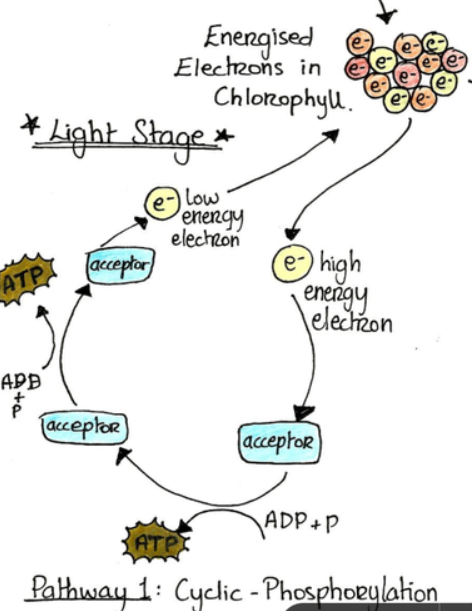
Cyclic phosphorylation (pathway 1) process
electrons pass from the first electron acceptor to a series of other electron acceptors and back again to the chlorophyll
as the electrons are passed around as they lose energy
this energy is used to join a phosphate to ADP to form the high energy carrier ATP
water is also formed in this process
the electron travels in a cycle and returns to its original chlorophyll
Non-cyclic phosphorylation (pathway 2) process
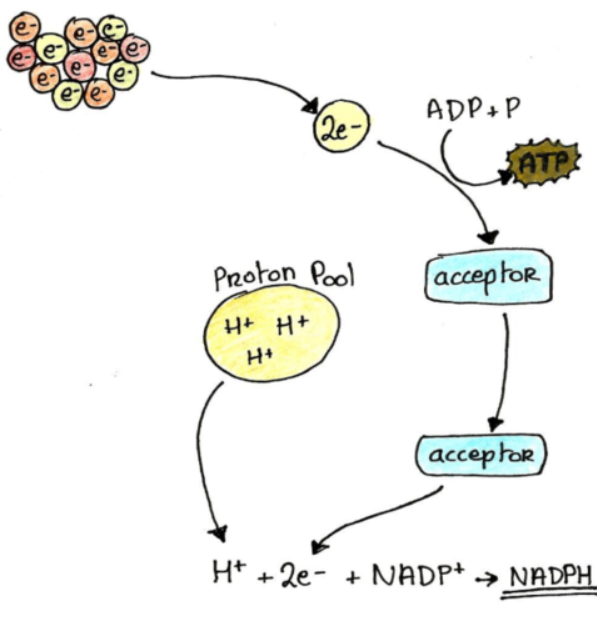
2 high energy electrons at a time are passed from the chlorophyll
they do not return to the chlorophyll
they lose energy as they pass from electron acceptor to electron acceptor and this energy is used to make more ATP
the 2 electrons become low energy electrons and combine with NADP⁺ to form NADP-
the chlorophyll molecule is now short of electrons and gains more from the splitting of water
protons that were stored in the proton pool are attracted to NADP- and combine with it to form NADPH
H⁺ + 2e⁻ + NADP⁺ → NADPH
Photolysis
the splitting of water into O₂, H⁺ and electrons using light energy
What are the end products of the light stage?
ATP which provides energy for the dark stage
NADPH this will provide protons + energised electrons for the dark stage
Oxygen is made when the water is split
Dark stage process
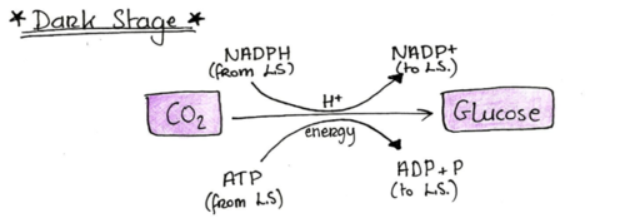
carbon dioxide from the air enters the chloroplast where they combine with protons + electrons to form glucose
this requires energy and protons + electrons
it uses energy got from breaking down ATP
it uses hydrogen ions and electrons from breaking NADPH into NADP⁺
carbon dioxide is reduced to glucose
What plant is used in the experiment for photosynthesis?
Elodea (pond weed)
Why is the plant used in the experiment?
it is an underwater plant, so it is possible to see the bubbles of oxygen released by the plant as it respires, passing through the water
the number of bubbles indicates the rate of photosynthesis
How is the rate of reaction observed?
count the bubbles per minute
What is the independent variable?
distance between the lamp and the plant
What are constants in the experiment?
- temperature is kept constant using a water bath and thermometer
- CO₂ concentration is kept constant using sodium bicarbonate in excess to make sure water is saturated with CO₂ keeping levels constant