The Accounting Cycle - ACC 210 Exam 1 - Chapter 1
 Call Kai
 Learn
Learn Practice Test
 Spaced Repetition
 Match
Match Flashcards
 Knowt Play
1/52

There's no tags or description
Looks like no tags are added yet.
Name | Mastery | Learn | Test | Matching | Spaced | Call with Kai | Chat |
|---|
No analytics yet
Send a link to your students to track their progress
53 Terms
Accounting
A system of maintaining records of a company’s operations and communicating that information to decision makers
Accounting is referred to as…
…the language of business
Financial accounting
Measurement of business activities of a company and communication of those measurements to decision makers outside of the company (external reporting).
Who is financial accounting useful to?
investors and creditors
can be useful to managers
Managerial Accounting
Focuses on information provided to managers only (internal reporting).
Investors
Want to make good decisions related to buying or selling their shares of company stock.
Creditors
Lend money to a company, expecting to be paid back the loan amount plus interest.
Assets
Resources of a company.
Liabilities
Amounts owed to creditors.
Stockholders’ equity
Owners’ claims to resources, which arise primarily from contributions by the owners and company operations. Also, shareholders’ equity, owners’ equity, or just equity.
Claim to resources
Liabilities + stockholders equity
Fundamental Accounting Equation
Assets = Liabilities + Stockholders’ equity

Revenues
Amounts recognized when the company sells products or services to customers.
Expenses
Costs of providing products and services and other business activities during the current period.
Net income Equation (sometimes referred to as earnings or profits)
NE = Revenue - Expenses
Dividends
Distributions to stockholders, typically in the form of cash.
Dividends are NOT…
An expense
Sole Proprietorship + Advantages
Simple to establish
Owner-controlled
Tax advantages
Partnership + Advantages
Simple to establish
Shared control
Broader skills and resources
Tax advantages
Corporation + Advantages
Easier to transfer ownership
Easier to raise funds
No personal liability
Why do we say corporations suffer from "double taxation"?
They pay taxes on the corporate level and, if distributed, dividends are taxed at the individual level as well
Corporate limited liability means…
Stockholders of corporations are not personally liable for corporate debts
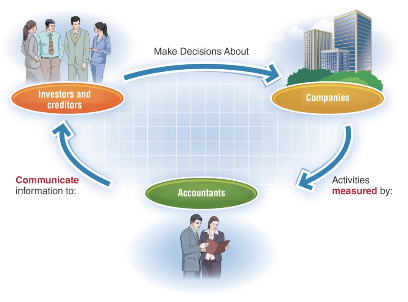
The Role of Financial Accounting
Provides a service to make resource allocation decisions
Accounting is the process of measuring business activity in monetary terms
Three Categories of Business Activity
Financing activities: transactions with investors and creditors
Investing activities: transactions involving the purchase of resources that are expected to benefit the company
Operating activities: transactions related to primary operations
Purchasing equipment for a business is an example of what kind of business activities?
Investing activities
Four basic financial statements that summarize a business:
income statement
statement of stockholders’ equity
balance sheet
statement of cash flows
Plus footnotes (Communication/data to users)
Clarify and expand on information in financial statements
Plus MD&A (Communication/data to users)
Opportunity to describe future plans and place past performance in context
Income statement
reports the company’s revenues and expenses over an interval of time
If revenues > expenses, then net income
If revenues > expenses, then net loss
Statement of Stockholders’ Equity
Stockholders’ equity = common stock + retained earnings
common stock = external source
retained earnings = internal source
Balance sheet
Presents the financial position of the company on a particular date
Resources = assets
Liabilities and stockholders’ equity
Organized in the same way as the fundamental accounting equation
The retained earnings account balance changes due to…
Net income or loss adjusted for any dividends paid to stockholders
Statement of Cash Flows
Measures activities involving cash receipts and cash payments over an interval of time
Operation cash flows —> cash transactions involving revenues and expenses
Investing cash flows —> cash transactions involving purchase and sale of long-term assets
Financing cash flows —> cash transactions involving lenders and stockholders
The Statement of Cash Flows covers…
The same time period as the income statement. Both are flow reports that measure financial activity over a span of time
Elements of an Annual Report
Management Discussion and Analysis (MD&A) - Presents management’s view on the company’s ability to fund operations and expansion, and its results of operations
Notes to the financial statements - clarify additional details, provide additional details
Auditors’ report - Auditors’ opinion on the fairness of the presentation of the financial position
The footnotes
Auditors
Trained individuals hired by a company as an independent party to express a professional opinion of the extent to which financial statements are prepared in accordance with GAAP
Role of Auditors
Help ensure that management has appropriately applied GAAP in preparing the company’s financial statements
Help investors and creditors in their decisions by adding credibility to the financial statements
Auditors must…
Be certified public accountants to sign and issue official audit opinions for public and private companies
Generally Accepted Accounting Principles (GAAP)
Rules for the U.S.
Common set of rules, standards, and procedures for financial reporting
The financial accounting rules we follow in the US are known as
GAAP
Objectives of Financial Accounting
Is useful to investors and creditors making decisions
Helps to predict cash flows
Tells about economic resources, claims to resources, and changes in resources and claims
Conceptual Framework Appendix
Qualitative characteristics
Enhancing qualitative characteristics
Cost-effectiveness constraint
Underlying assumptions
Assumptions that underlie GAAP
Economic entity
Monetary unit
Periodicity
Going concern
Qualitative Characteristics of Useful Financial Information
Relevance:
Confirmatory value
Predictive value
Materiality
Faithful representation:
Completeness
Neutrality
Freedom from error
Decision Usefulness:
Comparability (consistency)
Verifiability
Timeliness
Understandability
Retained earnings equation
Beginning Retained Earnings + Net Income (or Loss) − Dividends Paid
Which financial statement is generally prepared first?
Income statement
Which financial statement is generally prepared second?
statement of stockholders equity
Which financial statement is generally prepared third?
Balance sheet
Receiving a dividend would be classified as a(n):
Operating Activity
Paying a dividend would be classified as a(n):
Financing activity
The Securities and Exchange Commission defines a public company as one that:
Has its securities sold to the public.
An amount is considered material if…
Its omission from or misstatement in a company’s financial statements could influence a user’s decision about the company
The cost constraint suggests that
The benefits of providing financial information must exceed the costs of gathering, processing, auditing, and distributing it