TEAS 7 muscular system
 Call Kai
 Learn
Learn Practice Test
 Spaced Repetition
 Match
Match Flashcards
 Knowt Play
1/10

Earn XP
Description and Tags
Anatomy
Name | Mastery | Learn | Test | Matching | Spaced | Call with Kai | Chat |
|---|
No analytics yet
Send a link to your students to track their progress
11 Terms
Function
Allow body to move, support & stabalize the body, provide protection, & produce heat
Composed of muscle cells & tissues that bring about movement of organs or body parts
Muscles
Fibrous tissue with the ability to contract to move body parts
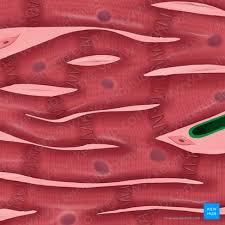
Cardiac muscle
Involuntary control - controlled by autonomic nervous system
Strong
HEART tissue that pumpd blood throughout the body
Has banded striations caused by protein fibers
Has branched structure and intercalated discs that allow electrical impulse conduction (Allows heart to beat)
Smooth muscle
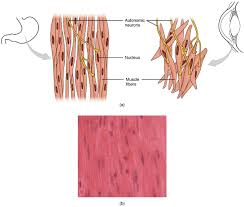
Involuntary control - controlled by autonomic nervous system
Weakest muscle type
Narrow, spindle shaped cells w. a single centrally located nucleus
Found in digestive system, veins, arteries, bladder, & eyes
Skeletal muscle
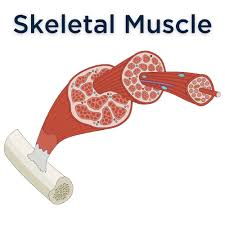
Voluntary control - Controlled by somatic nervous system
Highly organized tissues that attach to bones or skin to produce movements
Found in tounge, diapragm, upper esophogus
Striated, strong muscle cells
Fibers are long, straight, & multinucleated
Key characteristic of all muscle types
Extensibility
Muscle can be stretched or extended
Elasticity
Muscle can return to original length when relaxed
Excitability
Muscle can respond to stimulus from a motor neuron or hormone
Contractability
Muscle can shrink or contract
Sacromeres
The basic unit of striated muscle (skeletal and cardiac muscle)
microscopic segment that allows muscles to generate force and contract
Thin & thick filaments don’t shorten, they slide
bordered by Z discs and contains overlapping protein filaments: thin actin and thick myosi
Process of muscle contraction
Nuerons signal originates in the CNS (the brain or spinal cord)
Travels outward via motor neurons (a part of the Peripheral Nervous System) to the muscles.
A sarcomere is bordered by Z discs and contains overlapping protein filaments: thin actin and thick myosin. Muscles contract when these filaments slide past each other, pulling the Z discs closer and shortening the sarcomere
Actina nd myosin stay the same length
Actin
Thin filaments
Protein that forms the contractile filaments of muscle cells
Myosin
Thick filament
Fibrous globulin of muscles that can split ATP & react to actin in muscle contraction
Muscular system disorders
Muscular dystrophy- Gentic disorder
Abnormal genes interfere with protein production needed to form healthy muscles
Muscles progressively degenerate and weaken
Compromises both voluntary and involuntary movement
Muscle strain- Injury
Stretching/ tearing of muscles
Muscle sprain- Injury
Injury to supporting tendons & ligaments of a msucle
Tendonitis-
Inflammation of tendon
Amyotrophic lateral sclerosis (ALS)- Lou Gehrig’s disease
Motor nuerons degenerate and die, causes loss of voluntary movement.
Spinal cord injuries, Viral infections (polio), & bacterial infections (Tetanus & botulism) can also affect muscles