Karimi Cronic Coronary Disease
 Call Kai
 Learn
Learn Practice Test
 Spaced Repetition
 Match
Match Flashcards
 Knowt Play
1/15

There's no tags or description
Looks like no tags are added yet.
Name | Mastery | Learn | Test | Matching | Spaced | Call with Kai | Chat |
|---|
No analytics yet
Send a link to your students to track their progress
16 Terms
Define Coronary Artery Disease (CAD) and Chronic Coronary Disease (CCD)*
Coronary Artery Disease is an umbrella term that encompasses both chronic coronary disease and acute coronary syndrome (ACS)
Chronic Coronary Disease (CCD): note that term has shifted from “stable ischemic heart disease” to CCD. Major manifestation is the buildup of atherosclerotic plaques (fatty deposits) in the epicardial vessels, and it frequently presents as chronic stable angina.
Know the main risk factors for CAD
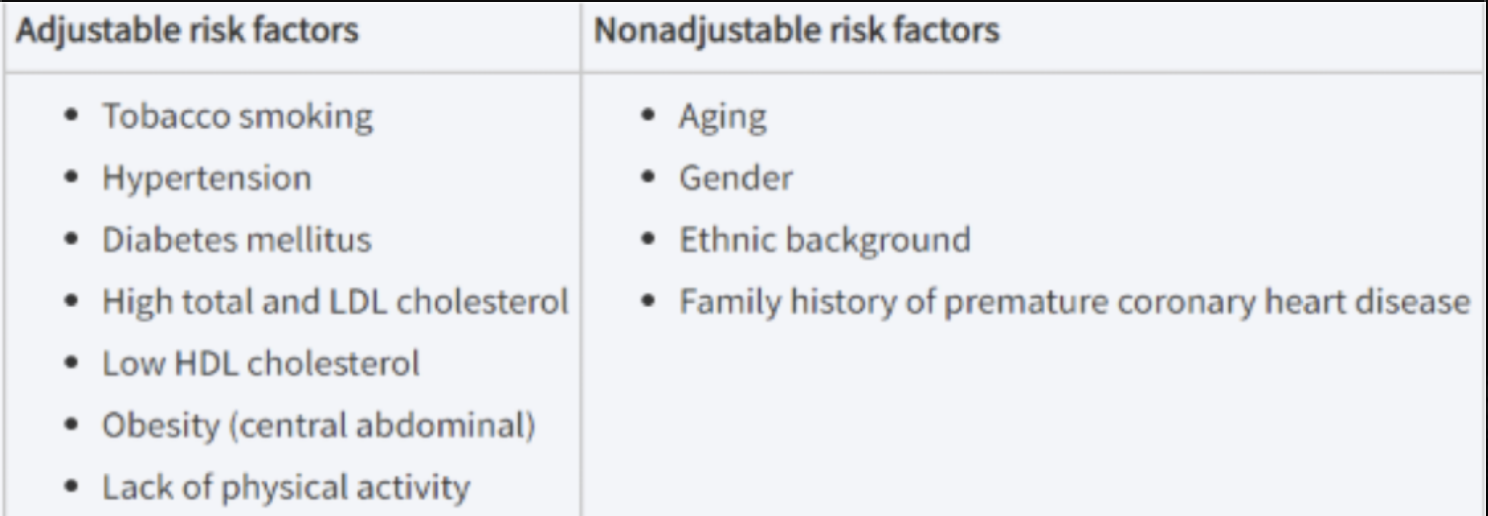
Prevention: a healthy weight + lifestyle with tobacco cessation, physical activity, and control of BP can prevent 80%
Describe the pathophysiology of different types of angina and the major determinants of cardiac oxygen demands
Atherosclerotic (classic) Angina: Triggered by exertion and relieved by rest. Pain is partially caused by metabolites (like lactic acid, adenosine, and bradykinin) produced during anaerobic oxidation
Microvascular Angina: caused by atherosclerosis in the endocardial vessels rather than epicardial vessels; more common in females
Vasospastic (Prinzmetal) Angina: caused by reversible spasms of epicardial coronary vessels, often occurring at rest or even during sleep
Unstable Angina: precipitated by unstable plaque rupture and typically does not subside with rest
Oxygen demands: Intramyocardial fiber tension is the primary determinant of myocardial oxygen demand (higher tension = higher oxygen requirement). This tension is influenced by diastolic factors (blood volume and venous tones) and systolic factors (peripheral resistance, heart rate, heart force, and ejection time). All these factors, except blood volume, are controlled by sympathetic discharge

Atherosclerotic (classic) Angina

Microvascular Angina

Vasospastic (Prinzmetal) Angina

Unstable Angina

Physiological Determinants of Myocardial Oxygen Demand
Physiological Determinants of Myocardial Oxygen Demand
The intramyocardial fiber tension determine the myocardial oxygen demand: increase tension = increase oxygen requirement
All factors, except the blood volume are influenced by sympathetic discharge
Reducing any of these factors improve angina

Define the underlying cause for an atherosclerotic plaque
Plaque Formation
Manifestation of CCD is buildup of atherosclerotic plaques (fatty deposits) in epicardial vessels
Atherosclerosis begins early 20s and becomes pathologic as people get closer to 50s and beyond
Irritants (like smoking, stress, LDL, hypertension) damage the endothelial cells lining blood vessels. This attracts LDL, which oxidizes and forms fatty streaks. Monocytes become macrophages, engulf the oxidized LDL, and turn into foam cells. Foam cells release cytokines, attracting more monocytes in vicious cycles. Smooth muscle cells eventually secrete a fibrous cap and release calcium to harden the plaque creating a brittle obstruction.
Define the underlying cause for substernal and referred pain in angina
Angina Pectoris (Chest Pain)
“Strangling” pressure-like pain
Manifestation most often substernally but can occur in other areas shown here
Other symptoms: nausea, vomiting, dyspnea, diaphoresis
Can be provoked by emotion, cold, temperatures, stress, or heavy meals
It is relieved by rest or sublingual nitroglycerin (decrease oxygen demand and increase oxygen delivery)

Referred Pain in Angina
Non-substernal pain is referred pain
Ex. patient senses pain in the arm and parts of the stomach but the original site of injury is the heart
This is due to a mix-up of nervous coming from regions of the body where they intersect (for instance, somatic neurons (T1-T4) with a sympathetic neuron in the spinal cord
Results in a convergence of these neurons with a single higher order neurons

Treatments of Angina
Goal in atherosclerosis and microvascular angina: balance O2 supply and demand
Vasospastic angina goal: reduce spasms to increase O2 supply
Short-term treatment:
symptom management
decreased duration
Frequency and intensity of angina symptoms
Maintain daily activities
Long-term treatment:
Decrease morbidity (prevent MI, HF, need for revascularization)
Decrease mortality
Decrease adjustable risk factors
Recall the strategies and drug targets for relief of anginal pain
Increase oxygen delivery or reduced oxygen demand
For atherosclerotic and microvascular angina, the goal is to balance O2 supply and demand
For vascular angina, the goal is to reduce spasms to increase O2 supply
Short-term treatments aim to manage symptoms, decrease the intensity of pain, and maintain daily activities
Contrast the therapeutic and major adverse effects of nitrates, β blockers, and calcium channel blockers when used for angina
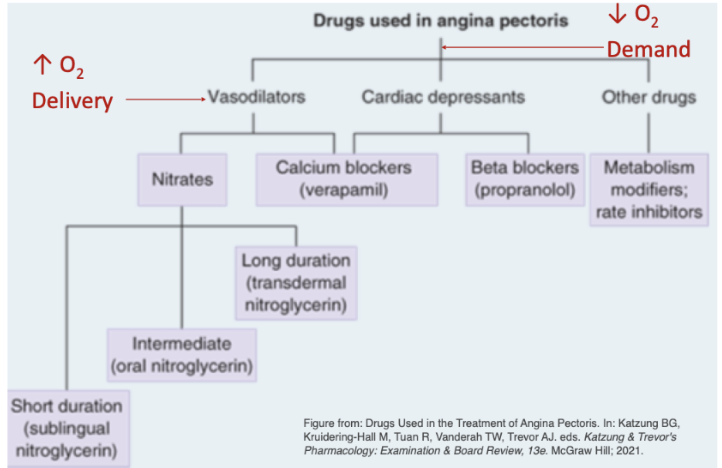
Drugs strategies for treatment include increasing O2 delivery or reducing O2 demands
Traditional pharmacologic therapies include nitrates, calcium channel blockers, and B blockers, and metabolism modifiers, that are able to reduce the cardiac O2 demand
Also, nitrates and CCBs increase oxygen delivery by reducing spasm in vasospastic angina
Beta Blockers
All B blockers are effective in the prophylaxis and atherosclerotic angina attacks (particularly for ongoing angina and have no value in acute attack)
1st line for atherosclerotic angina (not useful in vasospastic angina)
B blockers reduce cardiac work and oxygen demand
Decrease BP (decrease renin release) and decrease HR (decrease chronotropy)
Decrease contractility (decrease inotropy)
Metoprolol succinate: 1st line BB but be careful with abrupt D/C → exacerbations of angina pectoris and possibly MI
Nitrates
Nitroglycerin; isosorbide mononitrate; isosorbide dinitrate
The above agents have identical mechanics of action and similar toxicities
Aldehyde dehydrogenase-2 (ALDH2) catalyzes nitroglycerin to nitric oxide (NO) which in turn activates the soluble guanylyl cyclase to convert GTP to cGMP
cGMP dephosphorylates myosin ight chains which leads to the relaxation of vascular smooth muscle cells
Nitrate selectivity: veins > arteries > arterioles
Nitrates encourage a high degree of venodilation (primarily effect to reduce O2 demand)
They reduce venous tone
They also dilate arteries at higher doses (secondary effect)
Moderately decrease afterload and helps coronaries deliver O2
Predominantly dilates the epicardial coronary arteries
As opposed to the small coronary arterioles
Toxicity
ADEs: tachycardia, orthostatic hypotension, dizziness, and throbbing headache
Nitrates promote synthesis of cGMP in the vascular smooth muscle cells (leading to smooth muscle relaxation)
Phosphodiesterase isoform (PDE5) metabolized (reduces) cGMP which results in the smooth muscle constriction
Sildenafil (viagra) as a PDE5 inhibitor increases inflow of blood to treat erectile dysfunction
Nitrates should NOT be used in combo with sildenafil or other PDE-5 inhibitors due to severe hypotensive effect
Both increase cGMP and result in significantly lower organ perfusion
Patients should be advised to not take andy PDE5 inhibitors when they take any form of nitrates (at least within 24hrs, with tadalafil is used bc has plunged t ½ )
Calcium Channel Blockers
The L-type calcium channel is the dominant type of calcium channel in cardiac and smooth muscle. A few calcium channels blockers:
Amlodipine
Felodipine
Nifedipine
Diltiazem
Verapamil
CCBs are useful as prophylactic therapy in both atherosclerotic angina and vasospastic angina
CCBs can cause constipation, peripheral edema, nausea, flushing, and dizziness
Physiologic Effects
CCBs block voltage gated L-type calcium channels in cardiac and smooth muscle:
DPHs
Decrease BP, increase HR
Increase coronary vasodilation (increase O2 delivery)
Increase arterial vasodilation
Verapil and diltiazem
Decrease BP and HR
Increase vasodilation (increase O2 delivery)
Decrease contractility
Combo
HTN - monotherapy with CCB or BB
Doesn't work → combination of two (especially with MI hx) or 2 diff CCB (DHP/NDHP)
Sodium Channel Blockers
Ranolazine is a selective inhibitor of late Na+ influx into cardiomyocytes. By blocking the lat sodium current, it is though to reduce calcium overload, increasing relaxing of the heart muscle (decrease O2 demand)
While it can be used in combo with other 3 classes, often used with patients cannot tolerate beta blockers, CCBs, or long acting nitrates (transdermal
Minor, useful effects:
Increased glucose oxidation that leads to more ATP production for each consumed oxygen molecule
Small amount of beta blocking activity
