Changing spaces making places- CASE STUDY: LYMPSTONE
 Call Kai
 Learn
Learn Practice Test
 Spaced Repetition
 Match
Match Flashcards
 Knowt Play
1/3

There's no tags or description
Looks like no tags are added yet.
Name | Mastery | Learn | Test | Matching | Spaced | Call with Kai | Chat |
|---|
No analytics yet
Send a link to your students to track their progress
4 Terms
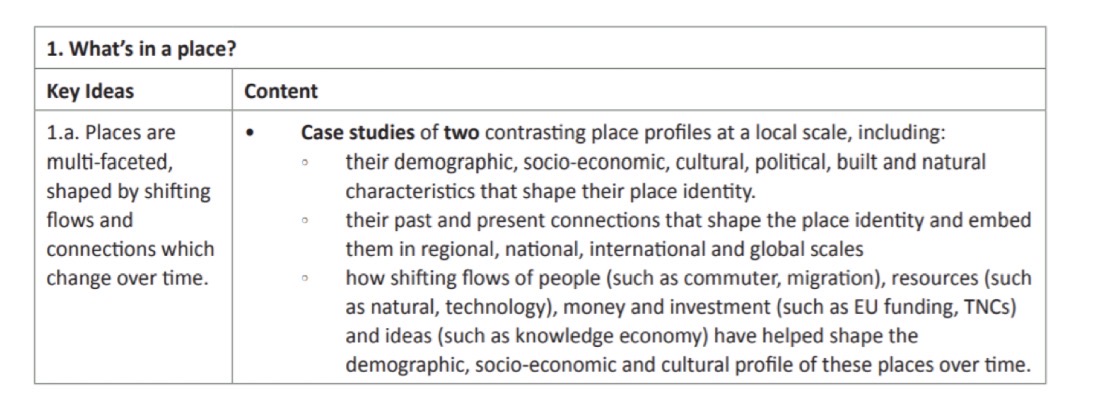
Demographic, socioeconomic, cultural, political, built and natural characteristics that shape place identity
Demographic: (age, ethnicity etc)
16.6 people per hectare
55.6% of people are 16-64
24.6% are over 65
Population is 1800
51.7% female
93.6% of people born in the UK
97.4% white ethnicity
49.6% Christian
0.17% Muslim
94.4% UK identity only
25% of people work in professional occupations (careers requiring specialist knowledge, advanced education, formal training)
Socioeconomic:
53.5% economically active
66% own their own house
Unemployment rate is 3.8%
Average number of people per household 2.3 people
Car availability- 12.7% no access to car or van
4.1% have very bad health
100% of students passed at least 2 A Levels in 2015
Cultural:
the rhythm of the cultural year is a long established one based upon the Christian year with Christmas and Easter as key times in the calendar. (50% Christian)
Not a wide range of cultures shown by demographic data
Political:
Lympstone has a parish council with 11 elected people serving on this local government body
Parish council has various powers and duties focused on local matters—> examples of community affairs include lighting local roads, providing and equipping community facilities such as a village hall, playground or local sports field
Powers are relatively limited as both a district and county council exist above the parish council
Lympstone is part of an area which elects two district councillors and one county councillor.
Parliamentary constituency that includes Lympstone has an electorate of just over 72,000 and returns one MP
Built:
Changes in built environment
Former low-order shops closed- converted to residences
New housing constructed, including large houses on the cliff top of the villages periphery
Heart of the village subject to strict planning rules and local residents protect the architecture
Natural characteristics:
Lympstone occupies a small valley cut by Wotton Brook through the red breccia cliffs which mark the edge of the Exe estuary.
Estensive tidal mudflats extend into the estuary which is 1.5km wide at Lympstone
Small beach of pebbles and gravel runs along the foot of the cliff
Their past and present connections that shape the place identity and embed them in regional, national, international and global scales
Past characteristics:
the Saxons established Lympstone, having forced out the original Celtic inhabitants from the region.
Connections with Europe continued with the Norman Conquest where ownership of the area was tied to a succession of French families, such as the Traceys and the de Courtlands.
By the 13th century, Lympstone was one of the many small ports near Exeter which had cross channel trade links
Shipbuilding thrived in the 19th century. As the scale of ships increased the industry ceased. The estuary was used for fishing, shellfish industry.
In the 1840s Lympstone started to attract many wealthy tourists from Exeter. Lympstone began to change and grow during the 19th century as built environments expanded to accommodate visitors.
In 1861 the railway arrived—> improving connectivity regionally and nationally. Time-space compression allowed the shellfish industry to access a wider market, and local residents could travel more easily to Exeter
20th century: it became a dormitory settlement for Exeter—> many live in Lympstone and commute to jobs with higher pay in Exeter
Still classed as a small village (1800 residents), retained strong sense of community
Present day characteristics:
Ageing community
Commuter village (dormitory settlement) for Exeter
Strong sense of place preserved by strict planning
Knowledge-based economy and high home ownership
Situated within a flood-prone river Exe estuary setting with distinct red breccia cliffs. Situated by the mouth of the river Exe, has a single railway line, A376 connecting Lympstone to the North and South.
High educational attainment
Limited diversity
How shifting flows of people, resources, money and investment, and ideas helped shape the demographic, socioeconomic and cultural profile of these places over time
Change over time:
growth of the knowledge economy (production of goods and services is based primarily upon knowledge intensive activities) in the UK has had a positive impact on Lympstone
15% of residents have a manager, director or senior official status , 25% work in professional occupations
High rates of home ownership reflect wealth and investment in property
Older, wealthier residents are attracted to Lympstone
Benefitted from the growth in tertiary and quaternary jobs
Nearby Exeter has a big hospital, university, major hi-tech companies
Many people live in villages like Lympstone and commute to Exeter, younger people move to Exeter for university
Migration has not had an impact on Lympstone due to its rurality and location away from London.
Few historic connections to foreign locations.
Maintains a stable, traditional English cultural identity