Exam 1
 Call Kai
 Learn
Learn Practice Test
 Spaced Repetition
 Match
Match Flashcards
 Knowt Play
1/152

There's no tags or description
Looks like no tags are added yet.
Name | Mastery | Learn | Test | Matching | Spaced | Call with Kai | Chat |
|---|
No analytics yet
Send a link to your students to track their progress
153 Terms
What is cognitive psychology?
The scientific study of mental processes by which humans learn about the world (acquire knowledge) and interact with the world (use knowledge)
What is the biggest challenge for cognitive psychology?
The mind is unobservable
What did Wilhelm Wundt advocate for?
Introspection
What is the introspection method?
Think of how your mind works and understand it that way
What is the problem with introspection?
It doesn’t account for unconscious processes, there needs to be scientific study
What did Thorndike discover?
Operant conditioning
What is operant conditioning?
Behaviors that are rewarded increase in frequency
What did Pavlov discover?
classical conditioning
What is classical conditioning?
Nervous system detects pairings of neutral stimuli with significant stimuli
What is behaviorism?
We cannot observe mental processes and should focus on observable behavior to study the mind
What did John Watson and B.F. Skinner advocate for?
Radical behaviorism
What is radical behaviorism?
There are no mental processes and all behavior is the result of simple conditioning
What was the main downfall of behaviorism?
Inability of behaviorism to explain human language
What is falsifiability?
Theories about the mind are scientific as long as they make testable predictions and can potentially be disproven
Why did Noam Chomsky refute behaviorism?
There is a lack of overt reinforcement when learning a language and it does not explain how we can easily generate novel, rule-based sentences
What 3 legacies did behaviorism leave behind?
Introspection no longer considered valid evidence, importance of rigorous experimental designs, and explanations of some aspects of human behavior
What is the cognitive approach?
emphasizes the study of mental processes in trying to understand the mind, explain behavior in terms of the mind
What is the computational view of the mind?
the mind is SOMEHOW like a computer, but the mind is still very different
What is the information processing perspective?
The mind is described as processing information through a sequence of stages
What did Donders establish/study?
mental chronometry
What is mental chronometry?
The study of the time course of mental processes
aka how do these mental processes unfold in time
How was information processing thought to be like? (what does the stages do?)
Each stage receives information from previous stage, it then transforms the information, and then sends the information to the next stage
What two questions did Donders experiments aim to answer? (technically 3)
What are the stages of the information processing? (and how many are there?
How long does each stage take?
What is the detection task?
Present a stimulus and you make a response to that
Press the button when you see a red or green light
What reaction time does the detection task cause?
Simple reaction time
What is the choice task?
There are two buttons that you can press and you have to decide which one is the right one to press
What reaction time does the choice task cause?
Choice reaction time
What reaction time is longer?
The choice reaction time
What is the subtractive method?
Subtracting the choice reaction time by the detection reaction time to find the duration of the decision stage.
What are the three problems of the subtractive method?
Assumption of pure insertion, assumption of additivity, assumes you already know what the stages of processing are
What is the assumption of pure insertion problem?
Assumes that all information processing stages for choice taks will be the same as the stages for the detection task. Adding the decision stage may influence another stage.
What is the assumption of additivity problem?
Assumes that the duration of all stages added together will result in the reaction time. BUT stages might operate in parallel and not go from one stage to another. This leads to an underestimate of decision time.
What is the assumption of knowing what the stages of processing are problem?
Assumes that the stages are detection, decision, and then response BUT there might be more stages than just decision such as a memory lookup to help with the decision.
What are two key contribution of Donders?
You can identify and measure mental processes and the technique of the reaction time procedure
What is cognitive neuroscience?
The study of the neural mechanisms underlying mental processes
What are the two primary techniques of cognitive neuroscience?
fMRI and EEG/ERPs
What is the cognitive neuroscience approach?
Measure brain activity to infer what is going on inside the mind
How much does the human brain weigh?
3-4 pounds
Is the brain solid? Why or why not?
No, it is composed of trillions of cells connected together

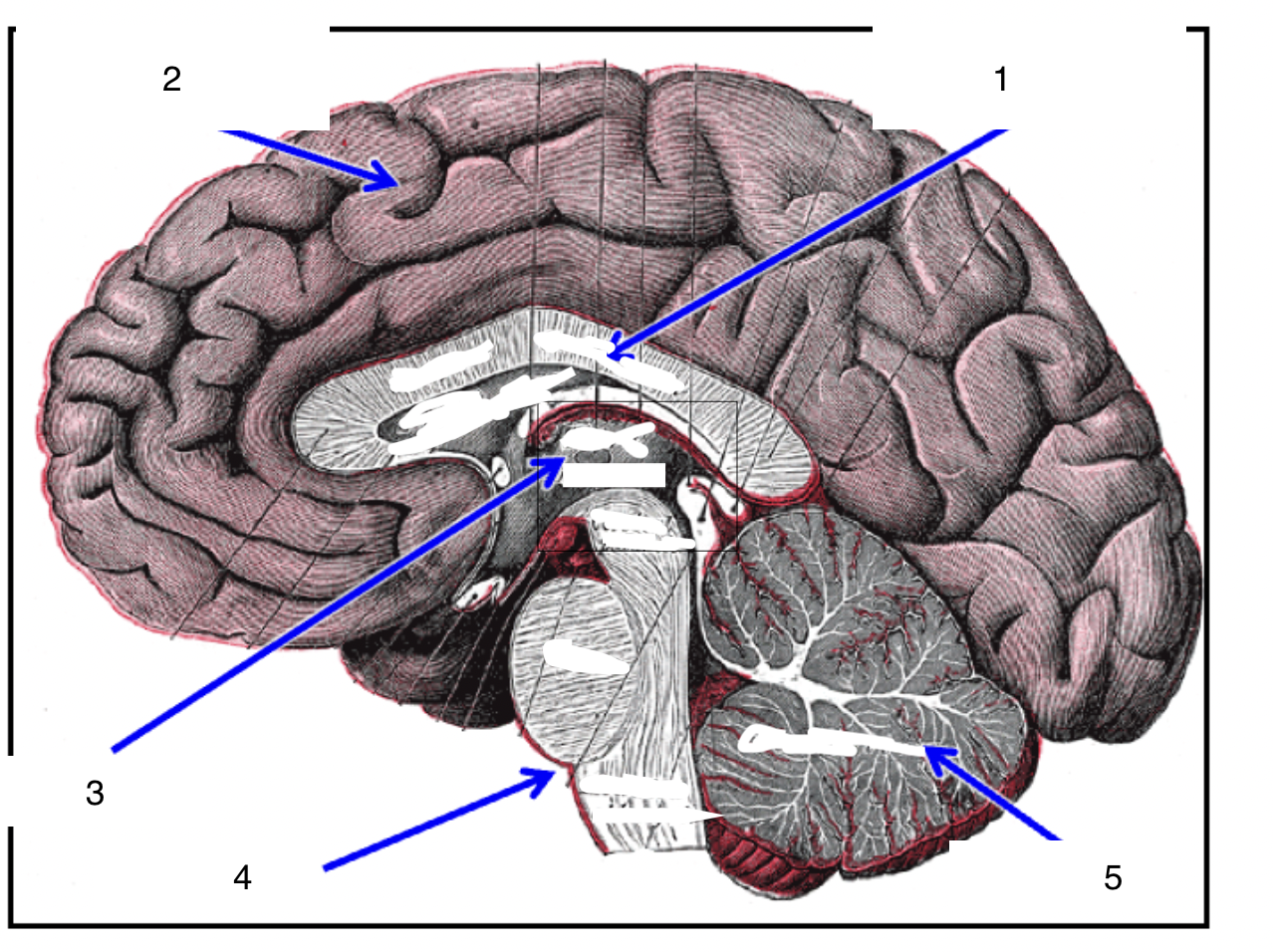
What is 1?
Corpus Callosum
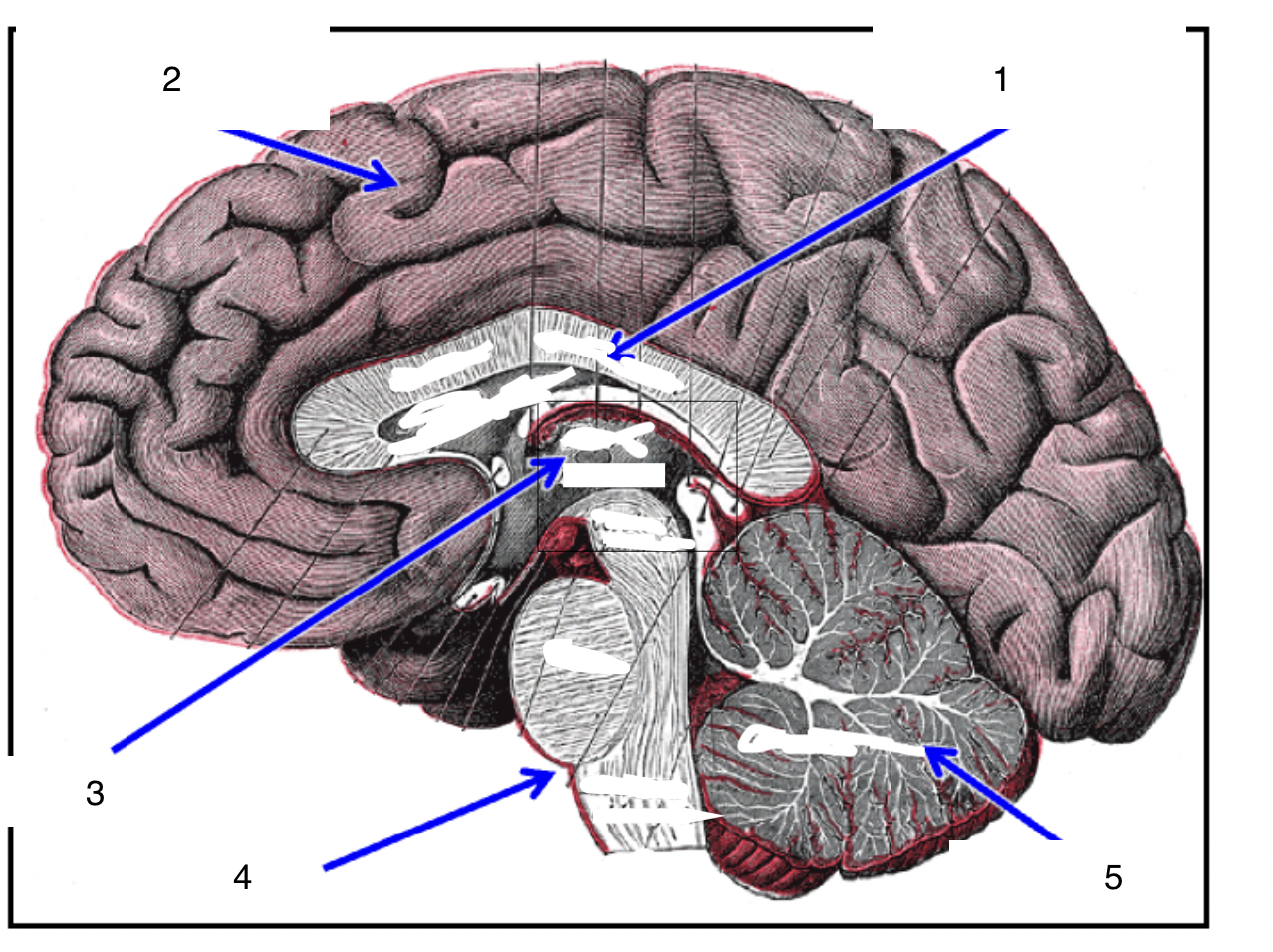
What is 2?
Cerebral cortex
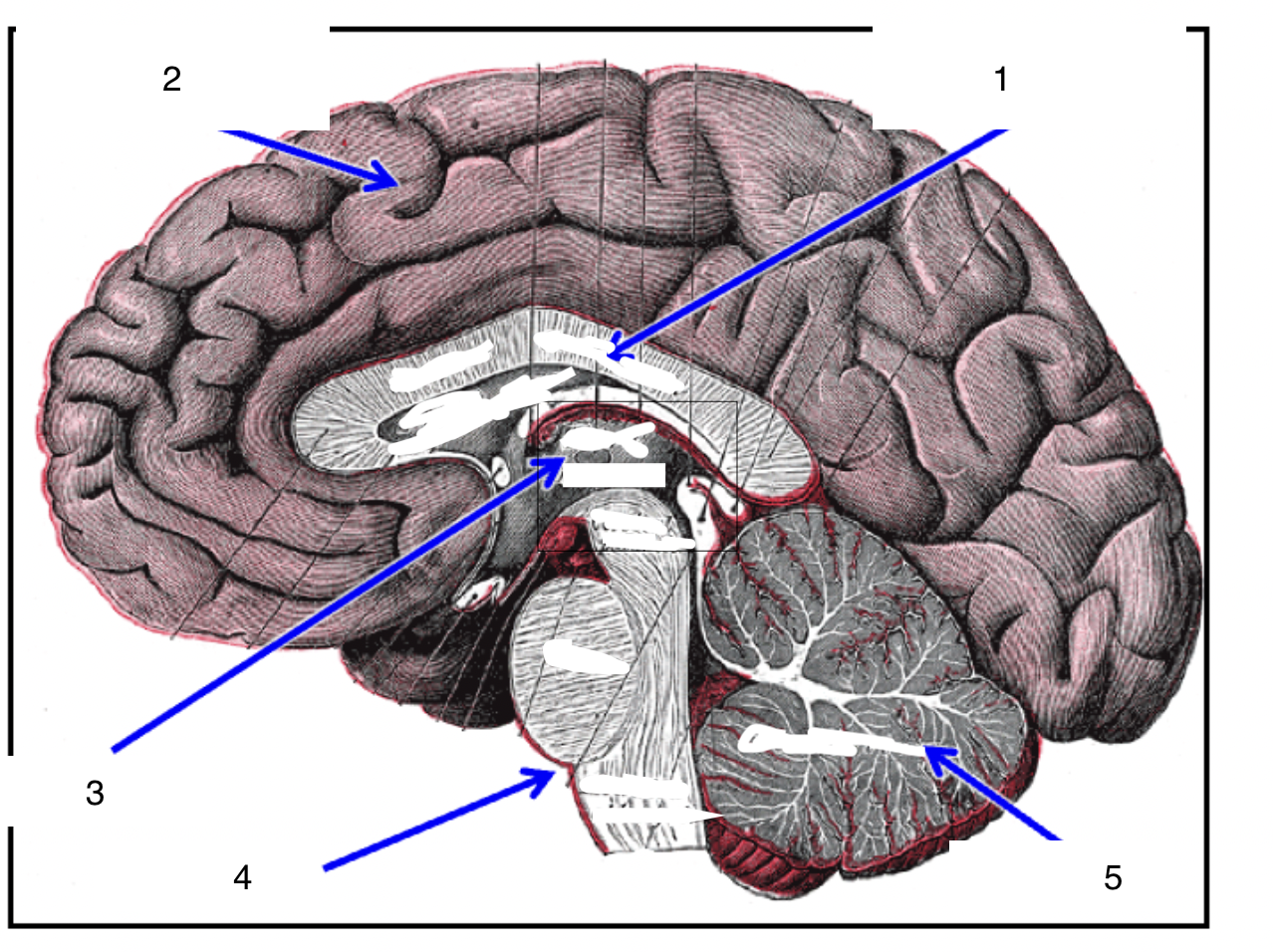
What is 3?
Thalamus
What is 4?
Brainstem
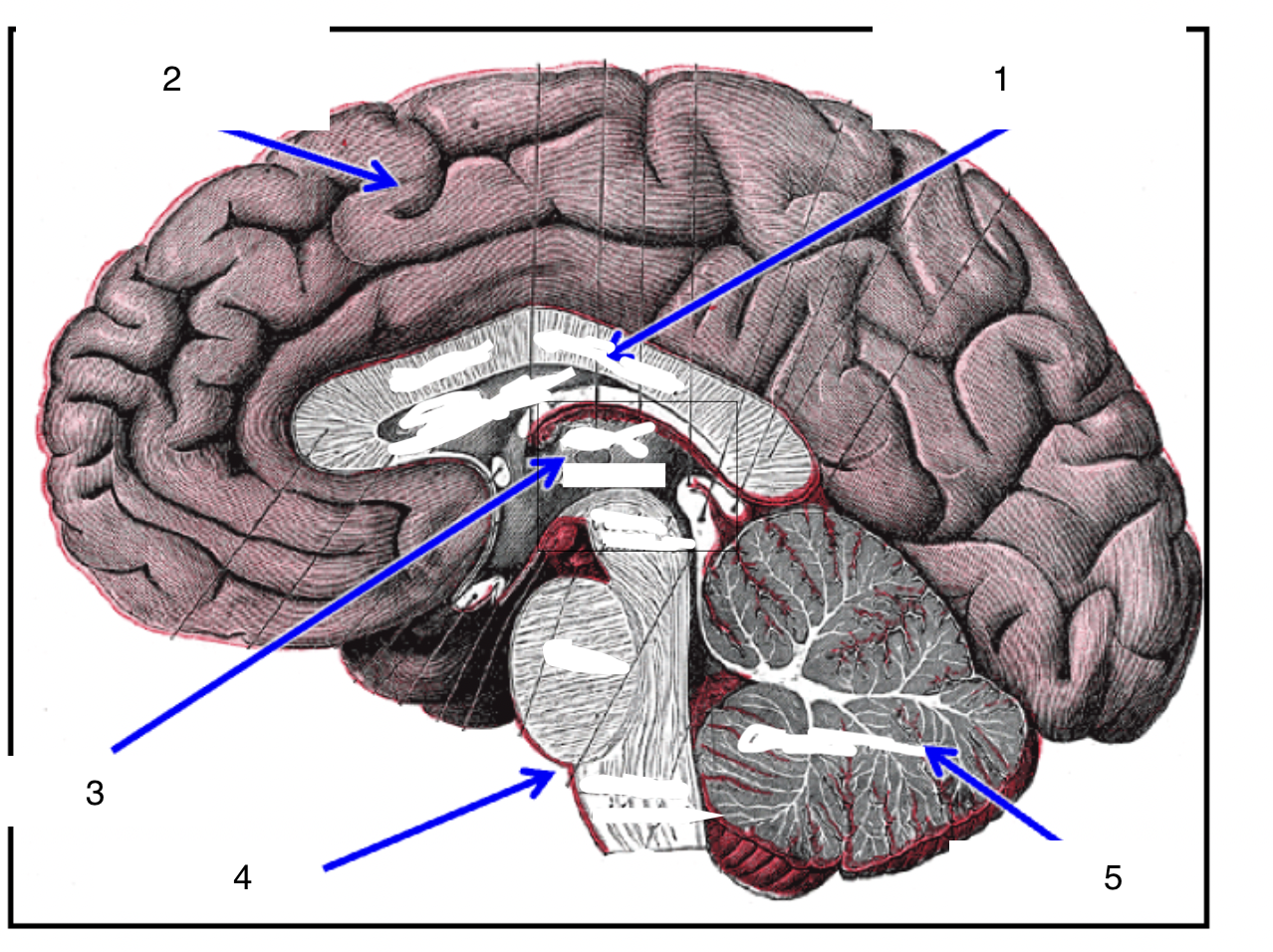
What is 5?
Cerebellum
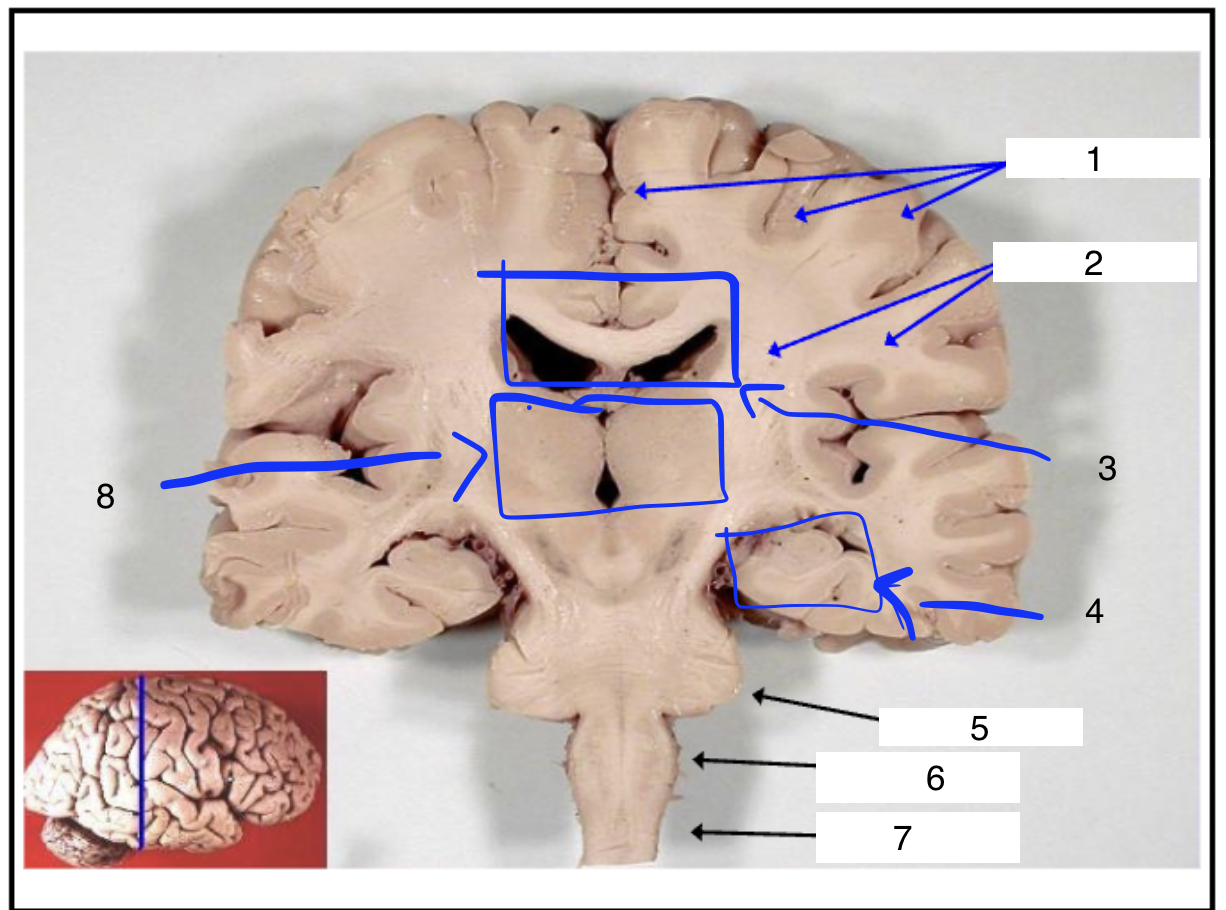
What is 1?
Grey Matter

What is 2?
White Matter
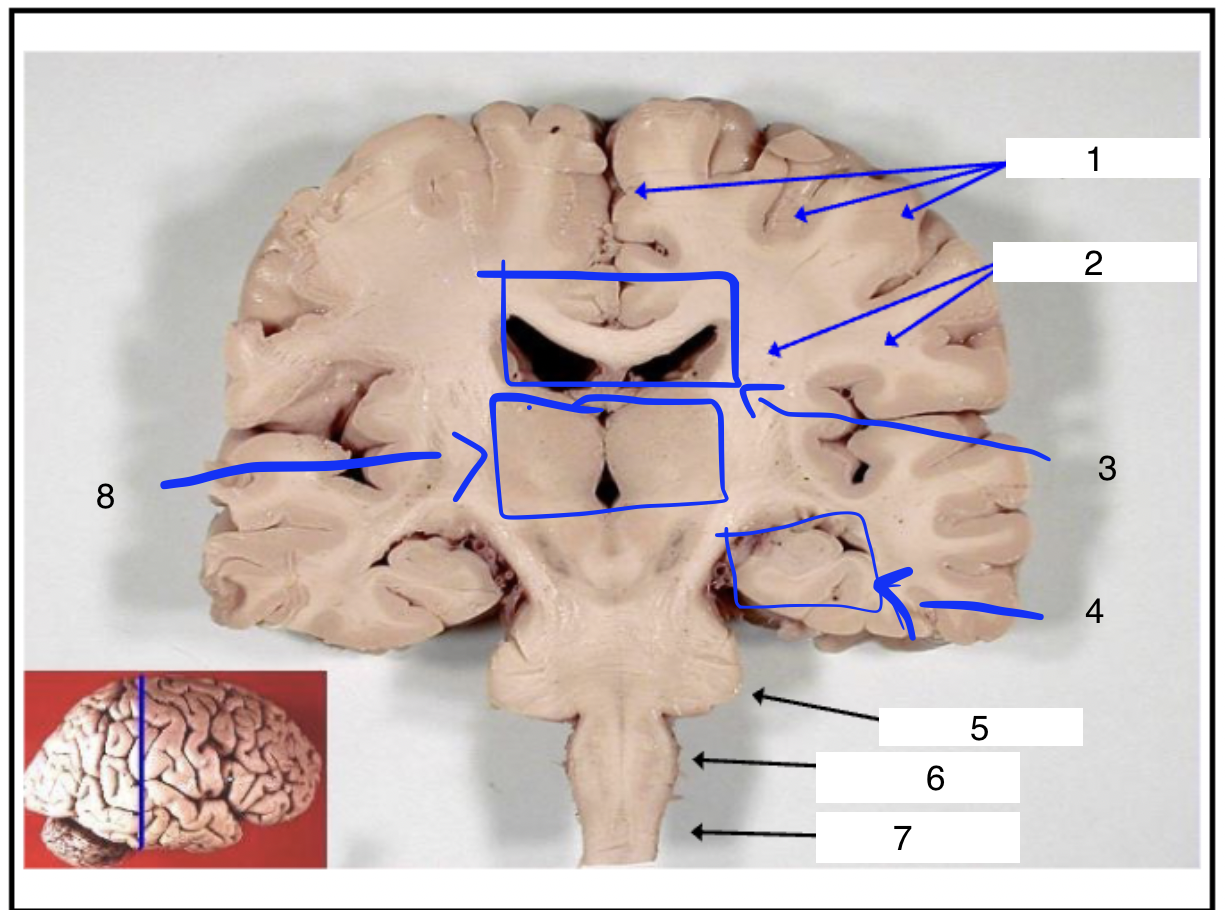
What is 3?
Corpus Callosum

What is 4?
Hippocampus

What is 5?
Cerebellum
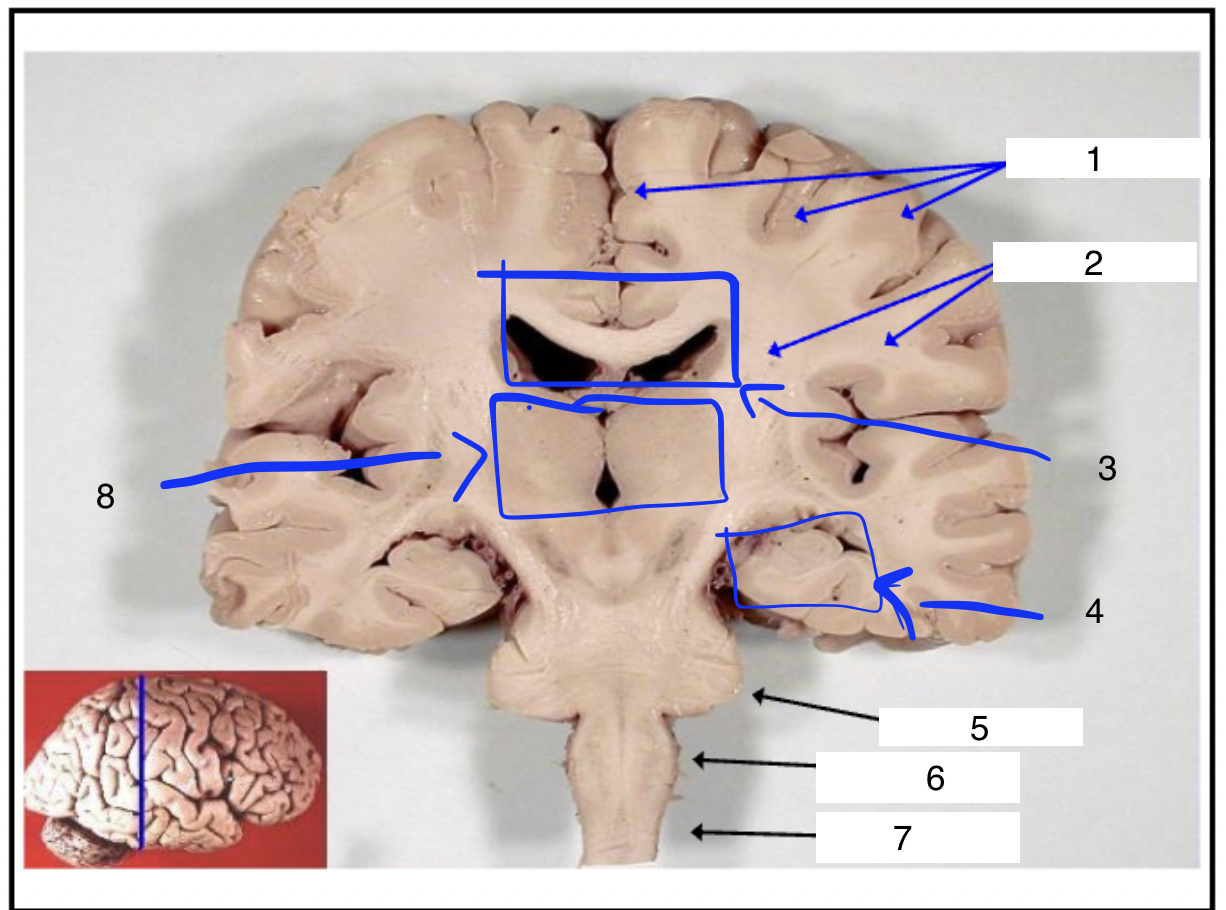
What is 6?
Brainstem
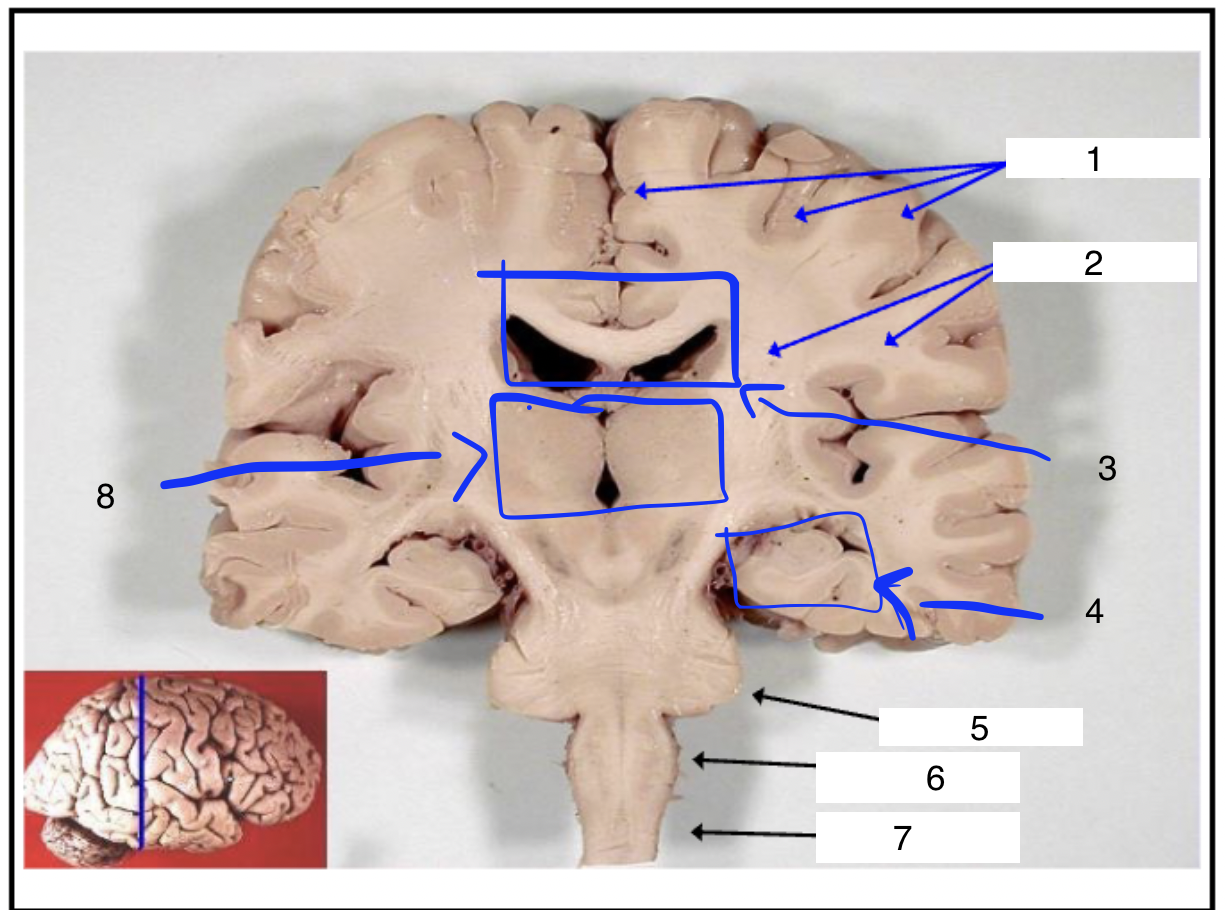
What is 7?
Spinal cord
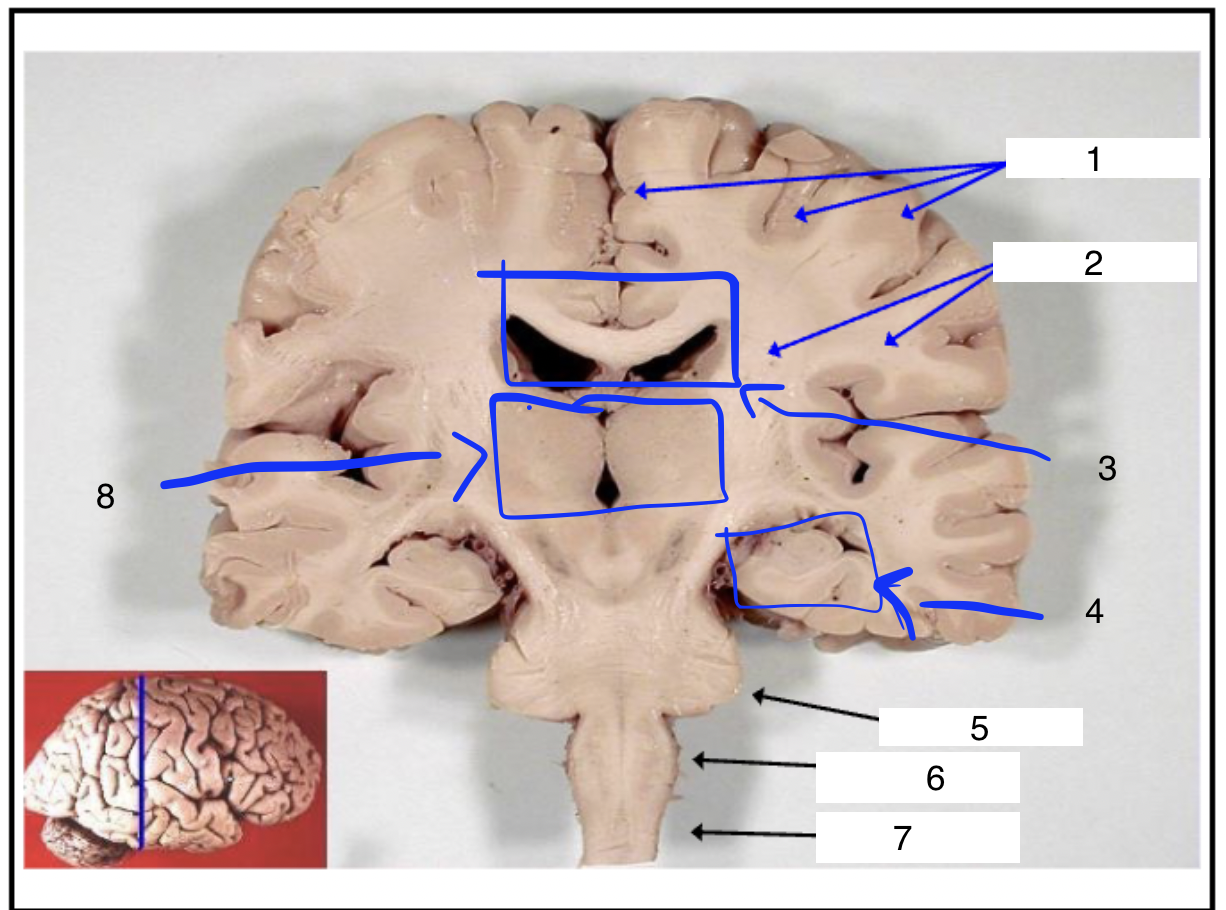
What is 8?
Thalamus
What is each crease of the human brain called?
Sulcus/fissure
What is each visible strip on the surface of the human brain called?
Gyrus
What is the cerebral cortex?
Folded part of the brain that covers the other structures
What is the corpus callosum?
Band of axons that connect the left and right hemispheres together. THey send information from one half of the brain to the other.
What is the Thalamus?
Where sensory signals (except smell) pass through before they are sent to the cerebral cortex
What are the main roles of the cerebellum?
Role in movement, coordination, and conditioning
What part of a neuron does grey matter contain?
Dendrites
What part of a neuron does white matter contain?
Long range axons
What separates the frontal lobe and the parietal lobe?
Central sulcus
What separates the temporal and frontal lobes?
Lateral fissure
What is the frontal lobe?
The lobe in the front of the brain that serves higher functions such as language, thought, memory, and motor function
What is the parietal lobe?
The lobe at the top of the brain that contains mechanisms responsible for sensations caused by stimulation of the skin and also some aspects of visual information
What is the temporal lobe?
The lobe on the side of the brain that contains mechanisms responsible for language, memory, hearing, and vision
What is the occipital lobe?
The lobe at the back of the brain that is devoted primarily to analyzing incoming visual information
What is the motor cortex?
Located at the back of the frontal lobe and controls the ability to make any movement
What is the somatosensory cortex?
Located at the front of the parietal lobe and controls the feeling of touch
What is the cell body?
Center of the neuron, contains the mechanisms that keep the cell alive
What are dendrites?
Structures that branch out from the cell body to receive electrical signals from other neurons
What are axons?
Long extension from cell body that transmit signals to other neurons
What is an action potential?
Propagated electrical potential responsible for transmitting neural information and for communication between neurons
What does not change about an action potential as it travels down the axon?
Shape or height
Where does an action potential travel down?
The axon of a presynaptic neuron
What is released into the synaptic celft?
Neurotransmitters
Where does the neurotransmitter bind to after traveling the synaptic cleft?
Binds with receptor on postsynaptic neuron
What does binding to receptors on postsynaptic neurons cause?
Causes ion channels to open or close
What happens when ions flow into or out of the postsynaptic cell?
It generates a postsynaptic potential
What is an excitatory postsynaptic potential?
Increases the activation of the postsynaptic cell
What is an inhibitory postsynaptic potential?
Decreases the activation of the postsynaptic cell
What are the three major approaches for using brain activity to examine and study cognitive processes?
Measure cognitive process in people/animals with a brain lesion
Stimulate a brain area and measure a cognitive process
Measure neural activity while a cognitive process is engaged
What is spatial resolution?
How closely can we pinpoint in the brain where something is happening
ex. really good spatial resolution can detect the neuron of where something is happening
What is temporal resolution?
Ability to pinpoint when in time neural activity is happening
What are the two causes of lesions?
Naturally occurring and head injuries
What is the problem with lesion method?
Researchers can’t choose where the lesion is in the brain, it is difficult to find patients with lesion in a specific area
How is the lesion problem solved?
Researchers will find patients exhibiting similar symptoms and see what overlap these patients have with the area in the brain there is a lesion in.
What would invasive stimulation look like?
Opening the skull and using electrodes to stimulate the brain while patient is still conscious and can do cognitive tasks
What two discoveries of the brain was found using stimulation technique?
Broca’s area and the map of the body in the motor cortex
What is Broca’s area?
Area in the frontal lobe that is important for producing speech
What is the map of the body in the motor cortex?
Different body areas correspond to different regions of the motor cortex
What are the two non-invasive stimulation techniques?
TMS (transcranial magnetic stimulation) and tDCS (Transcranial direct current stimulation)
What is the TMS technique?
Involves using a really strong magnetic field with a magnetic coil that you hold outside the person’s skull. The magnetic field passes through the skull and causes neurons that are directly under to fire or less likely to fire.
What is the single-unit recording technique?
Use electrodes to record action potential from individual neurons in the brain in an awake, behaving animal.
What are the pros to the single-unit recordings?
It gives us highest possible spatial resolution and temporal resolution
What are the cons to the recording brain activity technique?
It is really invasive and there are limited circumstances for doing this technique
What are the two types of brain imaging?
Structural brain imaging and Functional Brain Imaging
What is one structural brain imaging technique?
MRI
What is an MRI?
MRI scans use the magnetic properties of atoms to het a high-resoltuon picture of brain structure
What is the pro to an MRI?
High spatial resolution
What is the con to an MRI?
It doesn’t show the brain in function