Movement of substances in plants
 Call Kai
 Learn
Learn Practice Test
 Spaced Repetition
 Match
Match Flashcards
 Knowt Play
1/19

There's no tags or description
Looks like no tags are added yet.
Name | Mastery | Learn | Test | Matching | Spaced | Call with Kai | Chat |
|---|
No analytics yet
Send a link to your students to track their progress
20 Terms
What are the different substances transported through plants?
→ Amino Acids
→ Water
→ Mineral ions
→ Sucrose
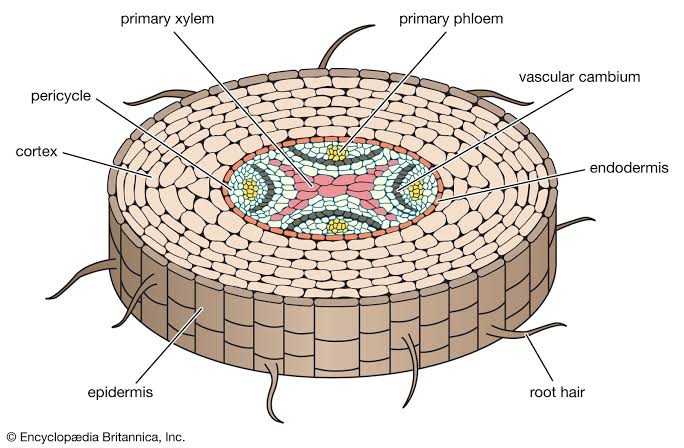
Which tissue carries water and mineral ions through the plant?
The xylem tissue
How is the xylem adapted for its function?
→ No end walls = ensure for efficient water flow
→ No organelles = least resistance of water flow
→ Pits = allows for transport of water between xylem tissue
→ Cell walls are lined with lignin = water proof to prevent water loss and strong to hold against the pressure of water
Draw out where the xylem and pholem are located in the root cell
What path do water molcules take through the plant?
Root → Root hair cell → Cortex → Xylem → Palisade mesophyll
What are teh essential mineral ions required by plants?
1) Magnesium = makes chlorophyll for photosynthesis = a lack of this would cause yellowing in the leaves
2) Nitrates = creates amino acids for protein synthesis = a lack of this would cause stunted growth & dying leaves
Draw out the xylem and pholem in a stem cell
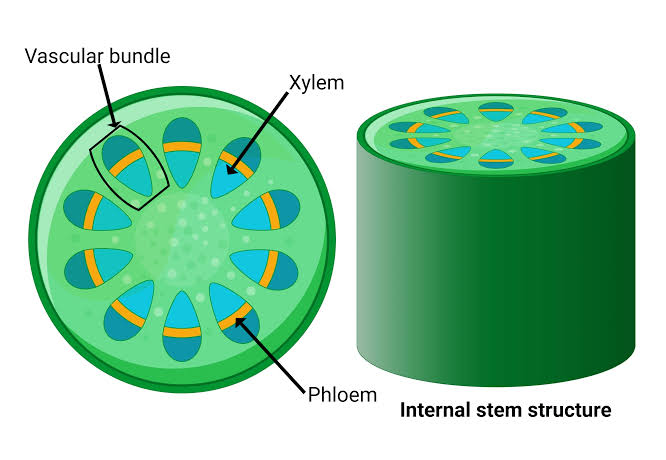
What does the pholem do?
Carries sucrose and amino acids throughout the plant
What is the difference between xylem & pholem
→ Xylems are dead cells stacked end on end
→ Pholems are living cells stacked end on end
What is translocation?
The process of transporting sucrose and amino acids from source to sink through the pholem
Define a ‘source’ and ‘sink’ in a plant
Source = an area of the plant where carbohydrates are made through photosynthesis
Sink = area of plant were carbohydrates are required for respiration
List some common sources & sinks
Sources = Leaf(main), Tuber, seed, fruit
Sinks = Tuber, Seed, Fruit, Flower, Lateral and apial meristem
Why do some sinks become sources?
→ Sometimes leafs may not be present or two young to photosynthesis carbohydrates due to seasonal changes
→ This is when sinks that have stored up excess carbohydrates can feed it to other sinks and become sources
What is transpiration?
The loss of water vapour due from the leaves of a plant due to diffusion of water from spongy mesophyll into air spaces and out of stomata
How do water molecules move through transpiration?
→ All water molecules are attracted together through cohesive forces
→ They rub against the stem of the plant with adhesive forces moving them further up the root and stem
→ the water molecules therefore form a long continous column from root to leave
→ As water molecules diffuse through the stomata of the leaf, their cohesive forces pull another one along continously in a column creating a TRANSPIRATION PULL
What enviromental and physical factors affect the rate of transpiration?
1) Enviromental:
→ Humidity = higher humidity = lower transpiration as the concentration gradient outside and inside leaf is very similar
→ Temperature = high temperature = higher transpiration rates as more water is evaporating maintining a hig concentration gradient of diffusion
→ Wind speed = higher speed = higher transpiration rates due to fast change of water presence with less water vapour staying outside the leaf
→ Light intensity = higher light intensity = higher transpiration due evaporation of water and higher concentration gradient outside leaf and inside
2) Physical:
→ More leaves and bigger SA =.higher transpiration due to more SA for diffusion of water vapour
→ Larger stomata = higher transpiration = larger SA
What happens if too much transpiration occus?
→ Too much turgor pressure will be lost in cell causing the plant to wilt
Does water uptake always equal transpiration rate?
No. Water uptake doesn’t always equal transpiration rate because some water is always lost to photosynthesis and keeping cell turgid.
How can we measure transpiration rate?
1) Celery
→ Placing celery in dyed water for a period of time and cutting up until no more dye is seen in the xylem
2) Potometer
→ See how long it takes for the air bubble to move a certain distance
3) Petroleum jelly
→ Cover leaf SA in pertroleum jelly and measure initial mass
→ Calculate final mass after leaving for a period of time and calculate percentage decrease