Nucleotides 2.1.3
 Call Kai
 Learn
Learn Practice Test
 Spaced Repetition
 Match
Match Flashcards
 Knowt Play
1/28

There's no tags or description
Looks like no tags are added yet.
Name | Mastery | Learn | Test | Matching | Spaced | Call with Kai | Chat |
|---|
No analytics yet
Send a link to your students to track their progress
29 Terms
What is a nucleotide
A monomer of DNA or RNA
What is a Purine
2 carbon ring structure (Adenine and Guanine)
1 carbon ring structure (Cytosine, Uracil and Thymine)
How many H bonds between A and T
2
How many H bonds between C and G
3
Condensation reactions in nucleotides
Forms phosphodiester bonds to create a polymer
What is the polymer of nucleotides called
Called a polynucleotide. A phosphodiester bond is a strong covalent bond that forms between the pentose sugar and phosphate of another nucleotide
ATP Structure
Contains three phosphate ions that play a significant role in energy transfer
Essential for metabolisms
Is an immediate source of energy for biological process
How is ATP made
Made during respiration via a condensation reaction and using the enzyme ATP Synthase
ADP + Pi —> ATP + H2O
ATP is also hydrolysed using Enzyme ATP hydrolase
ATP + H2O —> ADP + Pi
Breaking the bond of one of the phosphate groups releases small amounts of energy
What is phosphorylation
When the inorganic Phosphate made from hydrolysis of ATP binds to a different compound to make them more reactive
What can DNA code for
The sequence of amino acids in the primary structure, This determine the final 3D structure and function of the protein
Polymer forms a double helix with H bonds in between
How DNA structure relate to its function
Stable structure due to sugar phosphate backbones and double helix
2 strands so replication can use both strands
Weak H bonds broken down by helicase enzyme
Large molecule that carries a lot of information
Complementary base pairs means identical copies can be made
DNA Precipitation
1- Homogenise cell with detergent, breaks open cells and cell membranes therefore releasing its contents
2- Filter and remove large debris
3- Add salt to break H bonds between DNA and water
4- Add protease to digest the proteins
5- Add ice cold ethanol to create a precipitate of the DNA (White strand)
Types of RNA
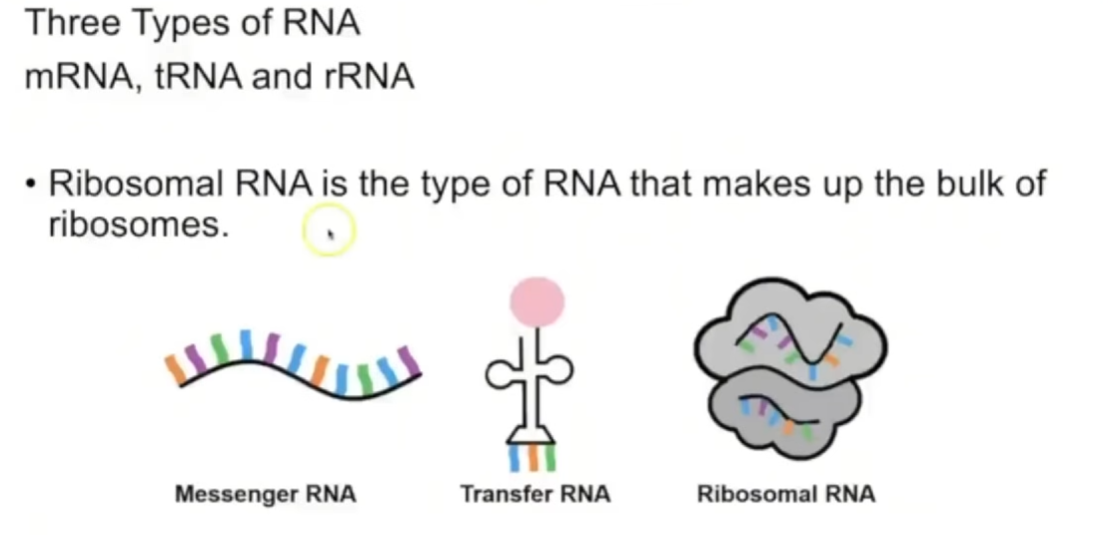
mRNA details
A copy of one gene from DNA
Created in the nucleus carry a copy of the genetic code to the ribosomes in the cytoplasm
mRNA shorter than DNA, short lived, single stranded and every 3 bases in sequence code for one specific amino acid, these 3 bases are called codons
tRNA details (t = transfer RNA)
Found in cytoplasm
Single stranded but folded to create a leaf like shape and is held by H bonds
brings a specific amino acid to the ribosome
determine by the 3 bases on tRNA which is the anticodon and complementary to the 3 bases on the mRNA (codon)
Semi-Conservative DNA Replication
DNA replication is semi-conservative because each new DNA molecule contains:
One original (parental) strand
One newly synthesised strand
This ensures genetic information is passed accurately to daughter cells.
When Does Replication Occur?
Takes place during the S phase of interphase in the cell cycle.
DNA is copied before cell division
DNA Strand Direction
DNA strands have polarity:
5' (five-prime) end
The phosphate group is attached to the 5th carbon of deoxyribose.
3' (three-prime) end
The hydroxyl (-OH) group is attached to the 3rd carbon of deoxyribose.
DNA polymerase can only add nucleotides to the 3' end.
Therefore, new DNA is always synthesised in the 5' → 3' direction.
What is the function of helicase in DNA replication?
Helicase breaks the hydrogen bonds between complementary bases, unwinds the DNA double helix, and separates the two strands
What are single-stranded binding proteins (SSBs)?
Proteins that bind to separated DNA strands and prevent them from rejoining.
What is the role of DNA polymerase?
DNA polymerase adds complementary DNA nucleotides and forms phosphodiester bonds between them.
What is the function of DNA ligase?
DNA ligase joins DNA fragments together by forming phosphodiester bonds in the sugar-phosphate backbone. Joins Okazaki Fragments.
Leading Strand
Synthesised continuously towards the replication fork.
Requires only one RNA primer.
Lagging Strand
Synthesised discontinuously away from the DNA
Produced as short sections called Okazaki fragments.
DNA ligase joins the fragments together.
Stages of DNA replications
.1- Unwinding DNA Helicase. Breaks hydrogen bonds between complementary base pairs. The double helix unwinds and the two strands separate into individual polymers.
2- Template Identification- Both separated strands serve as templates to ensure the genetic code is copied accurately for each new daughter molecule.
3. Complementary Base Pairing- Free-floating DNA nucleotides align opposite their complementary bases on the template strands. Hydrogen bonds reform between the specific base pairs (A-T and C-G).
4. DNA polymerase. Joins adjacent nucleotides together. Catalyst for the formation of phosphodiester bonds to create the new sugar-phosphate backbone.
The genetic code has 3 feature
Degenerate- Amino acid are coded for by more than one triplet of bases
Universal- Same triplet of bases code for same amino in all organisms
Non-Overlapping- Each base in a gene is only part of one triplet of bases that codes for one amino acid. Each codon or triplet read as a discrete unit.
What is Transcription
Where mRNA is created in nucleus
1- H bonds between bases breaks separating the strand
2- One DNA strand acts as a template
3- Free nucleotides align with complementary base pairs
4- In RNA Uracil used instead of thymine this uracil binds to adenine
5- Enzyme RNA Polymerase catalyses the condensation reaction of joining adjacent RNA nucleotide together
6- Phosphodiester bonds forming the sugar phosphate backbone
7- The once copied it leaves the nucleus to find a ribosome in the cytoplasm
What is translation
mRNA from transcription attaches to a ribosome at the start codon
tRNA molecule with complementary anticodon align with mRNA. Ribosome can hold 2 tRNAs at a time.
Amino acids delivered by tRNA joined via a Peptide bond formed between the catalysed byb an enzyme using ATP
Ribosome move along to the next 3 bases and process repeats and continues until a stop codon where ribosome detaches
Polypeptide chain now made and goes to the Golgi body to be modified
What are start and stop codons
Start codon enables the ribosome to attach
End codon causes ribosome to detach