Risk Assessment Objectives
 Call Kai
 Learn
Learn Practice Test
 Spaced Repetition
 Match
Match Flashcards
 Knowt Play
1/291

There's no tags or description
Looks like no tags are added yet.
Name | Mastery | Learn | Test | Matching | Spaced | Call with Kai | Chat |
|---|
No analytics yet
Send a link to your students to track their progress
292 Terms
Risk Assessment Paradigm
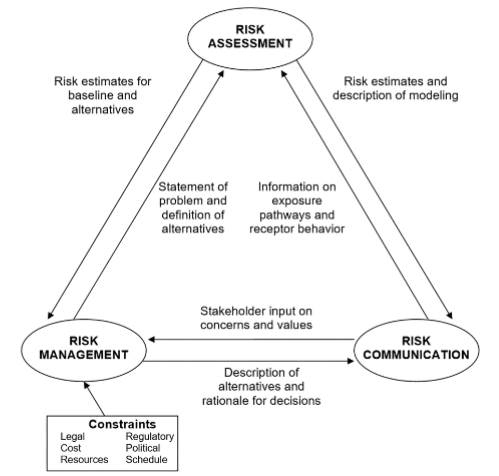
What is risk?
the probability that a substance/situation will produce harm under specified conditions (probability that the event occurs AND consequences of event)
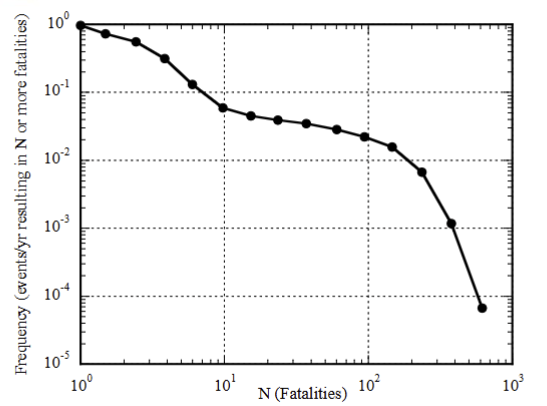
Exceedance probability vs risk
What are three uses/objectives for risk assessment?
ID hazards
Analyze/interpret risk
Determine/implement control measures
OR
meet regulation
meet cleanup criteria
meet the expected risk
Environmental risk assessment
process of making a quantitative estimate of human health risks resulting from release or potential release of contaminants to the environment
Problem statement
ask some type of question to lead to a scientific inquiry and hypothesis, can implicitly or explicitly mandate assumptions/methods
System description
qualitative and quantitative info about physical processes in system (timescale, geo and physical configuration), provides key info for risk calculation component
4 steps of environmental risk assessment calculation procedure with description
Release assessment (S_dot - contaminant emission rate) - ID of contaminants and quantitative estimation of release probabilities and rates
Transport assessment (C) - ID of pathways and estimation of contaminant concentration
Exposure assessment (D) - ID exposed populations and exposure routes and calc of rate/duration of exposure
Consequence assessment (risk) - adverse aesthetic, ecological, and human effects
Transport pathway vs exposure route
how contaminant moves through environment vs how contaminant moves through body
Aleatory uncertainty
related to chance
Epistemic uncertainty
related to knowledge
Assessment endpoint
valuable ecological or system characteristics you want to protect; all the way down to risk → more uncertainty
Measurement endpoint
measurable biological or physical indicators directly linked to those assessment endpoints that tell you if risk is present/changing; case study, stop and compare concentrations/values to literature
Conceptual model
abstraction of various physical, chemical, and biological processes that affect the behavior of the contaminant in the system
Mathematical model
mathematical representation of conceptual model which permits the calculation of assessment measures
Computational model
math model converted to this, usually identical to math model, calc of assessment involves substituting risk parameters into closed-form analytical expressions using rudimentary computational tool like calculator/spreadsheet
Verification
process of assuring that the math model is accurately translated into the computational model
Calibration
adjustment of risk parameters so that predictions of model match observations
Validation
comparison of predictions of computational model to actual field measurements
What are the appropriate units for radiological and chemical contaminant concentrations in air, soil, food, and water?
mass/time, activity/time
Explain the roles of (a) measurement and (b) process knowledge in release assessment and discuss why one is used over the other
measurement = direct from emissions or indirect (calculate based on known exposure); gives more precise info
Process knowledge = knowledge of various processes responsible for contaminant generation and release at site; good for conceptual model formation, can simplify complex processes or work when general info unknown
Use process knowledge to develop conceptual model of contaminant release
5 classes of contaminants with examples
organic compounds - Aldrin
metals - Cadmium
inorganic gases - Chlorine
radionuclides - Cesium-134 and Cesium-137
others - Asbestos
Emission rate
amount of contaminant released per unit time
Specific emission rate
mass emitted per unit volume per time
Given the equation for an actual emission rate calculate total mass released in a time period and max emission rate with time it occurs
Approx for constant emission rate
Sdot_t = Sdot_0
Approx for instantaneous emission rate
Sdot_t = ST * delta_t(t-ta)
Approx for semi-infinite step
Sdot_t = Sdot_0 * h(t-ta)
Approx for finite step
Sdot_t = Sdot_0 [h(t-ta) - h(t-tb)]
Sketches for types of emission rates and approximations of emission rates
Select an appropriate emission rate approx for a given release scenario
What are 2 important considerations when developing emission rate approximation?
total mass released (S_T) and time (Δt)
Calculate contaminant emission rate for a given source using process knowledge and mass balance properties
Fault tree
logic diagram that depicts all possible ways a failure (top event) in a particular system can occur
Event tree
logic diagram that identifies and quantifies possible outcomes of a single initiating event
Difference bt fault and event tree
fault = top down, focus on finding root causes of major event
event = bottom up, predict positive and negative outcomes of some initiating event
For a given system failure condition, construct a simple fault tree
For a given initiating event, construct an event tree
Risk drivers
contaminants and pathways that dominate risk
Contaminant concentration
1) mass per unit volume of medium (m_c/L_medium)
2) mass of contaminant per unit mass of medium (m_c/kg_medium)
Contaminant flux vector
j(r,t); net rate per unit area at which contaminant flows across plane perpendicular to principal direction of flux vector, contaminant flux units are mass/area/time
Advection
transport of a contaminant with the mean flow of the fluid
Dispersion
general term used to describe a variety of processes that cause contaminant movement to deviate from mean flow of fluid, including molecular diffusion, turbulent diffusion, and advective heterogeneities
Contaminant continuity equation
∂C/dt = - ∇•J^A - ∇•J^D
Contaminant transport equation
general equation used for a variety of physical quantities in a flowing fluid, contaminants have to be intimately mixed with fluid through dissolution, entrainment, or suspension, but C contaminants is small enough so fluid flow is not impacted by their presence; first two terms are conservative, other two are not
[time rate of change of C] = [NR of inc in conc due to dispersion] + [NR of inc in conc due to advection] + [generation rate per unit V] - [destruction rate per unit V]
Environmental compartment
useful mathematical construct that is either a distinct component (lake, cow, human body) or distinct subcomponent within a larger component (bottom sediment in a lake, cow’s milk, human liver)
Homogeneous compartment
contaminant concentration does not vary spatially, happens when mixing within compartment is rapid relative to movement into/out of compartment; either advective or non-advective
Partition coefficient
describes contaminant partitioning between two compartments as a ratio between those two concentrations
First-order process
time rate of change of contaminant concentration/mass is proportional to concentration/mass present
Dispersion tail
portion of curve to the right of the peak concentration; occurs bc dispersion and advection are acting in concert before peak arrives and in opposition after it leaves
Describe the three mechanisms that contribute to dispersion
molecular diffusion, turbulent diffusion, and advective heterogeneities
Calculate the new rate of flow of a contaminant across a surface, given the flux vector
S_dot = (integral from z=0 to L) (integral from y = 0 to Y) J(y,z,t)*i_x dydz
Write the mass continuity equation for contaminant concentration
Mass change per time = mass in - mass out + mass generated - mass destroyed
Give the empirical expressions relating flux and concentration
J^A = Cv; J^D = -D∇C where D is dispersion coefficient
Combine the empirical expressions with the mass continuity equation for contaminant concentration and obtain the contaminant transport equation
Give the physical significance of each term in the contaminant transport equation
∂C/dt = change in concentration over time
-∇•j^A(r,t) = contaminant flux due to advection
-∇•j^D(r,t) = contaminant flux due to dispersion
gdot(r,t) = generation rate per unit volume
ddot(r,t) = destruction rate per unit volume
Distinguish between conservative and non-conservative processes in the contaminant transport equation
conservative = -∇•j^A(r,t) -∇•j^D(r,t)
non-conservative = gdot(r,t) - ddot(r,t)
Give units of contaminant transport equation
mass/Vt = A/t * mass/V /A - L/t x mass/V/L + mass/Vt - mass/Vt
Write the general procedure for reducing/simplifying the contaminant transport equation
Reduce/simplify the contaminant transport equation given a particular scenario, including the specific generation term g(x,t)
Describe and apply the homogeneous compartmental models for non-advective first-order removal
dC/dt = -kC → C = C0 exp(-kt)
Describe and apply the homogeneous compartmental models for non-advective constant uptake, first-order removal
Ct = g/k (1-exp(-kt))
Describe and apply the homogeneous compartmental models for non-advective instantaneous partitioning
dC/dt = 0
Describe and apply the homogeneous compartmental models for advective conservative
C = C1 (1-exp(-Qt/V))
Describe and apply the homogeneous compartmental models for advective first-order reactions
advective non conservative first order → C = C1Q/V(k+Q/V) (1-e^-(Q/V+k)t)
Provide physical interpretations of C(r,t)
Simplify the contaminant transport equation
Solve the simplified form of the contaminant transport equation for C(r,t) either analytically, with LaPlace transforms, or both
Transport problems 1D advection semi-infinite step emission rate conservative

Transport problems 1D advection semi-infinite step emission rate first-order reactions

Transport problems 1D advection semi-infinite step emission rate variations
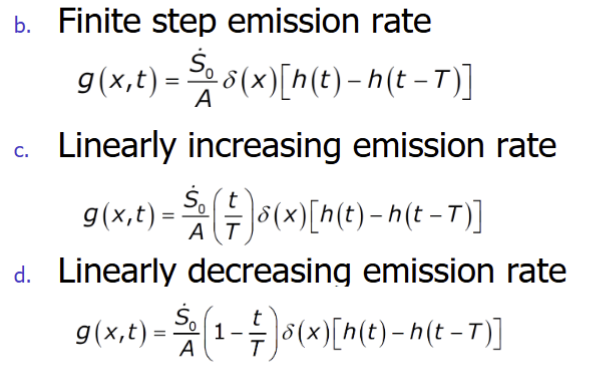
Transport problems 1D advection finite-step emission rate conservative
Transport problems 1D advection finite-step emission rate first-order reactions
Transport problems 1D advection finite-step emission rate variations
Transport problems 1D dispersion point, instantaneous emission rate no advection, conservative
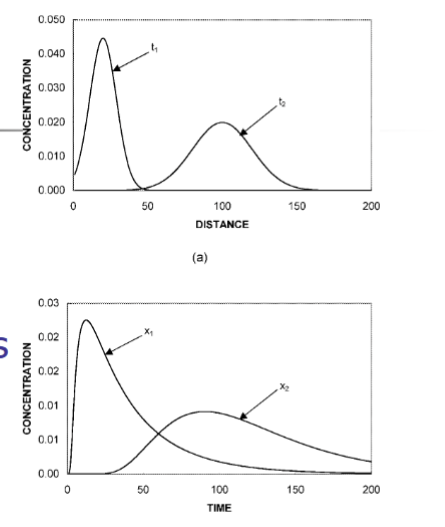
Transport problems 1D dispersion point, instantaneous emission rate advection-dispersion, conservative
Transport problems 1D dispersion point, instantaneous emission rate advection-dispersion, first-order reactions
Transport problems 1D dispersion semi-infinite emission rate conservative
Transport problems 1D dispersion semi-infinite emission rate first-order reactions
Transport problems 3D dispersion
Thermocline
thin layer that separates the upper and lower layers that are stratified, regulates mixing and inhabitant life
Stratification
thermal stratification is when there’s a well-mixed upper layer (epilimnion) and a stable pool of cool water at the bottom (hypolimnion)
What are common sources of contamination for surface water?
discharges from industrial facilities
runoff from contaminated surface soils
seeps from contaminated aquifers
deposition from atmosphere
spills and leaks from ships
What are common pathways through which humans can be exposed to contaminants in surface water?
ingestion of drinking water (most important)
incidental ingestion or skin absorption while swimming or bathing
inhalation of volatized contaminants
consumption of food crops irrigated with contaminated surface water or contaminated from atmospheric deposition
consumption of fish or shellfish
Describe the processes responsible for contaminant transport among the various compartments of surface water
Identify the principal factors that affect contaminant concentration in rivers and streams, lakes, reservoirs, estuaries, and oceans
Quantify the partitioning of a contaminant bt water and suspended sediment using the distribution coefficient
KD = foc*Koc
KD = Cs/Cw
Use the distribution coefficient and suspended solids concentration to evaluate the relative importance of sorption as a process affecting aqueous phase contaminant concentration
Incorporate sorption into simple transport models
Calculate contaminant concentrations in surface water for simple source terms
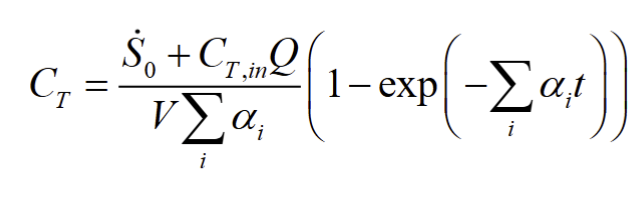
Calculate contaminant concentrations in surface water for geometries like well-mixed lake
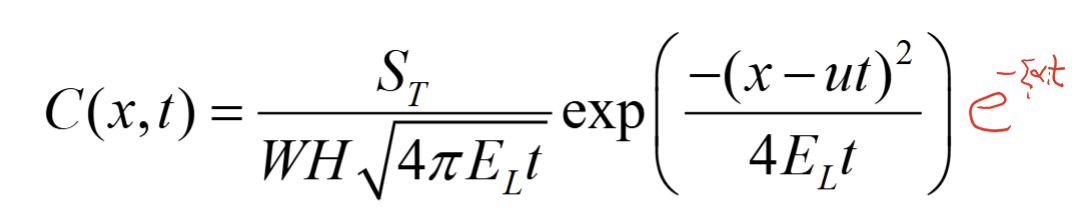
Calculate contaminant concentrations in surface water for geometries like 1D river or stream, instantaneous source (advection/dispersion)
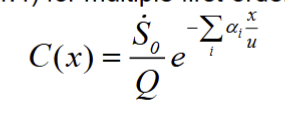
Calculate contaminant concentrations in surface water for geometries like 1D river or stream, constant source (advection only)
Porous media
microscopic spaces bt solid subsurface material
Fractured porous media
macroscopic void spaces in subsurface, transport controlled by velocity, geometry, orientation, rock pores
Fractured non-porous media
macroscopic void spaces in subsurface, transport controlled by pore scale connectivity and Darcy flow
Saturated zone
region below the water table
Vadose (unsaturated) zone
from land surface to the water table
Aquifer
saturated region that can transmit significant quantities of water