Applied CFD Exam 2026
 Call Kai
 Learn
Learn Practice Test
 Spaced Repetition
 Match
Match Flashcards
 Knowt Play
1/144

There's no tags or description
Looks like no tags are added yet.
Name | Mastery | Learn | Test | Matching | Spaced | Call with Kai | Chat |
|---|
No analytics yet
Send a link to your students to track their progress
145 Terms
What are three key advantages that make CFD a valuable tool for engineers?
What factors are essential for ensuring the applicability of a CFD simulation to real-world scenarios?
Why might this applicability not always be guaranteed?
Simplified modelling of individual aspects is required…
Physical Modelling:
- continuum assumption
- Definition of material values like viscosity, surface tension, …
Mathematical Modelling:
- Calculation of conservation equations
Numerical Modelling:
- Truncation of errors
Essential Factors:
- high quality mesh
- accurate physical modelling
- calibration/validation against experimental data
Why not always guaranteed?
- many phenomena —> very complex and interacting spatial and temporal multiscale problems —> cannot be calculated to this day —> requires assumptions, simplifications, which may reduce accuracy and reliability
In 1922, Lewis Fry Richardson conducted the first known flow simulation in an attempt to forecast the weather for Europe, which ultimately failed. Reflecting on this failure, what crucial aspect did Richardson overlook in his calculations?
How did this oversight contribute to the failure of the simulation?
What does the acronym CFD stand for in English?
Outline three fundamental modelling steps that form the basis of every flow simulation
While CFD theoretically allows for the modelling and calculation of various phenomena, what do you perceive as the greatest challenge when simulating the launch of a rocket? Provide an illustrative example.
The ‘Periodic Hill Flow’ serves as a benchmark experiment for simulation tools.
Describe:
a) The experiment itself
b) The specific challenges associated with simulating the flow in this scenario
Name the three consecutive work steps for conducting a CFD simulation (3 pts)
How do fluid and solid differ under shear stress? (2 pts)
The gas flow in the lung capillaries is to be calculated. By which dimensionless number can you determine whether a calculation with the finite volume method is justified? How is it defined?
Which alternative method would you suggest if a finite volume method is not justified? (3 pts)
Which dimensionless number:
a) describes the ratio of inertial to frictional forces in a flow? Name and formula. (2 pts)
b) describes the compressibility of a flow? Name and formula. (2 pts)
c) represents the ratio of inertial (Trägheitskräfte) to surface forces (Oberflächenkräfte)? Name. (1 pt)
d) plays an important role in unsteady flow separation around blunt bodies (stumpfe Körper)? Name. (1 pt)
e) is relevant for describing a thermal boundary layer? Name. (1 pt)
f) represents the ratio of inertial to gravitational forces and is therefore relevant for calculating gravity waves? Name. (1 pt)
Given the total derivative of the quantity 𝝋(𝒙, 𝒕), what is the difference compared to the material derivative?
Why is the material derivative used more often in fluid mechanics? (2 pts)
Given is the material derivative of the quantity 𝝋(𝒙, 𝒕). Mark the local and convective terms. Which term becomes zero in the case of a steady flow? (2 pts)
How many unknowns must you determine when calculating a compressible 3D flow?
Which equations are available for this purpose? (3 pts)
What describes the mass conservation of an incompressible fluid?
Which term of momentum conservation approaches zero in creeping flows (schleichende Strömung) (𝑹𝒆 → 𝟎)? What does this mean for the equation to be solved? (2 pts)
Given the momentum conservation in integral form:

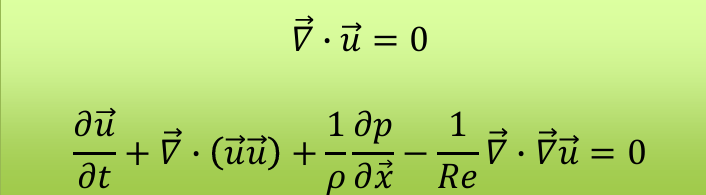
Which term of the Navier-Stokes equations is neglected in deriving the Euler equations? What does this mean for the flow?
Given the momentum conservation in differential and integral form. Name one application for each.
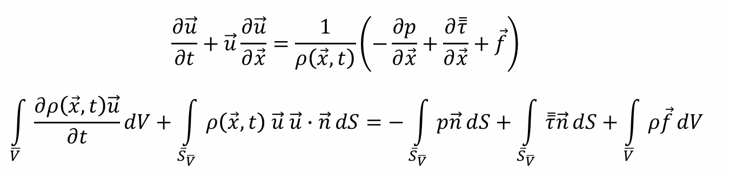
Differential Form: CFD —> how blood flow in arteries, flow around a turbine
Integral Form: engineering applications —> balance on airplane wings
The right-hand side of momentum conservation corresponds to the sum of acting forces. Provide one example each for a point force, surface fore and volume force. (3 pts)
Name three flow mechanically relevant effects that a turbulent boundary layer has compared to a laminar boundary layer. (3 pts)
Give three fundamental properties of turbulent flows. (3 pts)
Explain the term “turbulent energy cascade.” (3 pts)
Provide the basic properties of:
a) Large scales
b) Small scales of a turbulent flow.
Given the kinematic viscosity 𝝂 [𝒎²/𝒔] and the energy dissipation rate 𝜺 [𝒎²/𝒔³]. Determine the Kolmogorov length and Kolmogorov time. (2 pts)
Which length scale describes the size of the smallest vortices in a turbulent flow? (1 pt)
By which method can the largest structures of a turbulent flow be determined? (1 pt)
two-point correlation function R describes a time-averaged correlation between two fluctuations and a spatially distance r
by considiring the distribution of R a integral length measure L can be defined
L describes the distance from which on velocity variations become uncorrelated
What purpose does Gauss’s theorem serve in the finite volume method? (1 pt)
In computational fluid dynamics (CFD), the flow domain is typically divided into subunits where conservation equations are solved. Name the three most important discretization schemes. (3 points)
What is the purpose of grid generation in computational fluid dynamics? (2 pt)
In which regions of the flow is high resolution particularly useful? Explain. (2 Pt)
Explain the term “quadrature” in the context of the finite volume method (why and how?). (2 points)
numerical approximation procedure of surface integrals by summing weight values at specific points through boundary surfaces of control volumes
integral over a surface needs to be approximated —> flux is not constant over a surface
enables numerical evaluation of fluxes
discrete conservation equations are evaluated for every control volume
Explain the term “interpolation” in the context of the finite volume method (why and how?). (2 points)
In the context of grid generation, what is the difference between topology and geometry?
Name three advantages each of structured and unstructured grids. (6 points)
Structured Grids:
- allow grid generation by hand —> optimal result control
- simple topology and quick implementation
- efficient algorithms applicable
Unstructured Grids:
- no global structure
- simple grid refinements by adding points in areas of strong gradients
- complex geometries can be modelled easily
How can grid quality affect the accuracy and convergence of CFD simulations? (2 points)
Which parameter is used to characterize the grid near walls? What must be true for this parameter to resolve turbulent boundary layer flows? (2 points)
What is a connectivity matrix in the context of grid generation? (2 points)
Name the three basic topologies of structured grids. (3 points)
Name three requirements for good grid quality.
What is the concept of “advancing front” in the context of grid generation?
method used primarily in unstructured grids
starting from elements along the edge/boundary, the interior volume is stepwise filled with additional elements
How does the advancing front technique work in unstructured grid generation?
What is the purpose of grid refinement in CFD simulations?
What is the main advantage of structured grids over unstructured grids in terms of numerical diffusion? When is this advantage particularly significant?
Describe the term “triangulation”. What rule is prescribed for Delaunay triangulation and what advantage does it provide for grid quality?
Explain why the computational and memory requirements are higher for an unstructured grid than for a structured grid.
What is a multi-block grid and how does it contribute to efficient grid generation for complex geometries? What is a disadvantage?
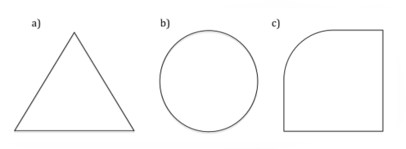
Given the following pipe cross-sections, sketch the blocking for a structured multi-block grid with as uniform quadrilaterals as possible. (3 points)
Turbulence modelling aims to massively reduce the computational cost of Direct Numerical Simulation (DNS) while accurately capturing the effects of turbulence. (4 points)
a) Which scales are particularly suitable for modelling and why?
b) On what mathematical approach is the RANS modelling based?
c) On what mathematical approach is the LES modelling based?
Draw a typical spectrum of the turbulent kinetic energy of a turbulent flow. Make sure to label the axes correctly. (2 points)
Optional: Qualitatively mark the regions resolved in DNS and LES and explain the role of the sub-grid scale model. (2 points)
Optional: How does this spectrum change with increasing Reynolds number? (1 point)
What is the prerequisite for a direct numerical simulation (DNS)? How is turbulence modelled in this case?
With which dimensionless number and which power does the computational cost of a DNS scale?
What do the abbreviations RANS, DNS and LES stand for and what is the difference in their modelling approaches? (6 points)
Which term in the momentum conservation equation leads to the “closure problem” in RANS modelling? How many unknowns does the closure problem involve? (2 points)
Which entries of the Reynolds stress tensor (RST) describe the turbulent kinetic energy (TKE)?
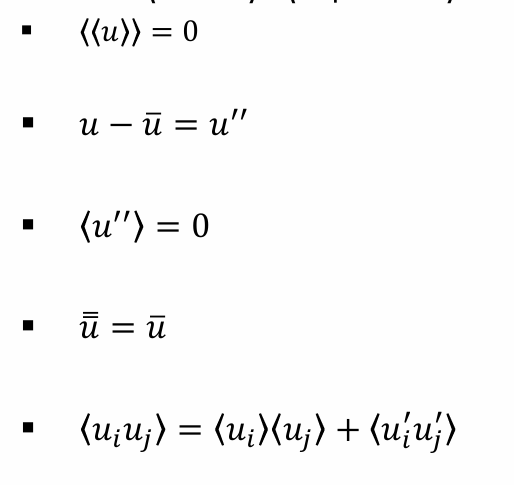
Mark the correct statements with “T” (true) and the incorrect statements with “F” (false): (5 points):

How do the values on the diagonal and off-diagonal of the Reynolds stress tensor behave in the time average in the case of isotropic turbulence?
Into which two categories can the RANS turbulence models covered in the lecture be divided? What is the difference in their modelling approach? Name one advantage and one example for each category. (6 points)
Imagine you are to calculate the mean flow in a swirl combustion chamber. The adjacent image shows the geometry and mean streamlines of such a system. Choose an appropriate RANS turbulence model and justify your choice. (2 points)
RSM model
explicit algebraic Reynolds Stress Model
swirl and curvature are highly anisotropic, where scalar eddy viscosity models can fail
What is the difference between eddy viscosity and kinematic viscosity?
Where do the names zero-equation, one-equation and two-equation model come from? Provide an example for each.
Name one eddy viscosity model, one eddy viscosity transport model and one Reynolds stress model. (3 points)
The most well-known two-equation models are the 𝒌 − 𝝎, 𝒌 − 𝜺 and SST models. Name an application area where each of these models yields good results.
Name a significant disadvantage of the 𝒌 − 𝜺 model and how it can be overcome.
What is the main problem with the use of wall models in CFD simulations?
Kolmogorov and Rotta simplify the dissipation term by assuming isotropy. Why is this assumption justified?
The pressure-strain term is usually divided into a slow term and a rapid term. Describe how both terms work.
Slow Term: drives anisotropic turbulence to be isotropic
Rapid Term: changes the Reynolds-stress-tensor due to external forces that are caused by mean gradients
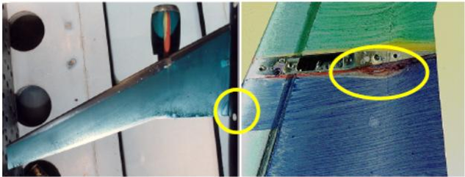
What phenomenon is depicted here? Which turbulence model is suitable for simulating this phenomenon?
In the diagrams below, the dimensionless velocity 𝒖+ is to be plotted against the dimensionless wall distance 𝒚+.
- Plot the experimentally determined profile of a turbulent boundary layer in the first diagram.
- Plot the profile obtained using an 𝜺-based RANS model in the second diagram.
- Plot the profile obtained using an 𝝎-based RANS model in the third diagram.
What is meant by the term backscatter? Describe with one sentence.
In LES, a distinction is made between large-scale (coarse) and small-scale (fine) structures. Briefly describe how they interact with the grid size. (2 points)
Large Scale (coarse structure): captured by the grid until a certain filter —> directly simulated
Small Scales (fine structures): modelled as a subgrid-scale model
as grid resolution increases, more small scales are resolved, reducing the portion that must be modelled
Explain the expression “well resolved LES”
Plot on the diagram below where RANS, DNS and LES are located for a flow with a high Reynolds number and a low Reynolds number.
For a given flow u and a given filter kernel G, how do you obtain the large-scale and small-scale structures of the velocity?
Which of the following statements is correct?
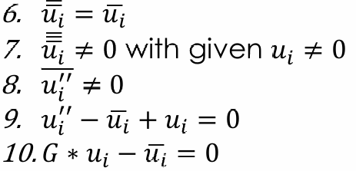
Given the filtered momentum equation. How can the subgrid-scale stress tensor be derived from it?

Given the subgrid-scale stress tensor. Derive the Leonard, cross and Reynolds stress tensors from it.
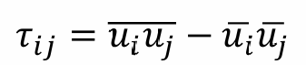
Given the Leonard, cross and Reynolds stress tensors. What physical effects do these tensors describe?
Draw a diagram of the turbulent kinetic energy (TKE) – mark, which part is modelled and which part is simulated with LES/DNS/RANS.
What is the task of a subgrid-scale model?
Describe the similarity between Smagorinskys approach and a class of basic RANS models?
both models rely on the concept of the eddy viscosity to account for the effect of turbulent eddies in the flow
Difference: Smagorinsky uses subgrid scales, RANS uses entie turbulent spectrum
Smagorinsky introduces a constant to calibrate 𝝂SGS. What is the major drawback of this?
Is backscatter possible with the Smagorinsky model? Justify your answer.
What procedure do Germano et al. (1990) propose with their dynamic Smagorinsky model to improve the original Smagorinsky model (1963)?
What is the major advantage of this?
What is the main assumption of the dynamic Smagorinsky model regarding the interaction of scales?
What are the advantages of the dynamic Smagorinsky model over the conventional Smagorinsky model?
self-contained model
no additional emprical assumptions required
no wall dumping required if filter is adjusted accordingly
model is able to “backscatter” —> local and temporary energy flow from small to large scale is possible
What is the biggest disadvantage of the dynamic Smagorinsky model compared to the conventional one?
often leads to instabilities, so that negative values of v_sgs are deleted —> simulation could crash
The task of an LES model is to appropriately model the small-scale tensor 𝝉ij = … that arises from filtering the Navier-Stokes equations.
- How are the quantities ui and uj in the small-scale tensor approximated in Bardina’s Scale Similarity Model (1980)
- What approach do Stolz and Adams pursue with their Approximate Deconvolution Model (1999) to improve the Scale Similarity Model?
- What role does the small-scale viscosity 𝝂SGS play in these two models?
Which mathematical tool can be used to derive the order of a method?
What does the order of a method indicate? Be precise!
What does the midpoint rule state?
What does the trapezoidal rule state?
Upwind Differencing Scheme (UDS): Provide 𝚿e for - U>0 - U<0

Central Differencing Scheme (CDS): Provide 𝚿e for an equidistant grid for - U>0 - U<0

Explain the term numerical viscosity. In methods of which order does it occur?
Given the numerical viscosity for a UDS method, when does this method become unstable? Derive a stability criterion (CFL number).
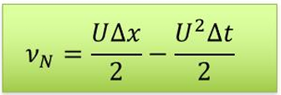
How does numerical viscosity affect the Reynolds number of the simulation?
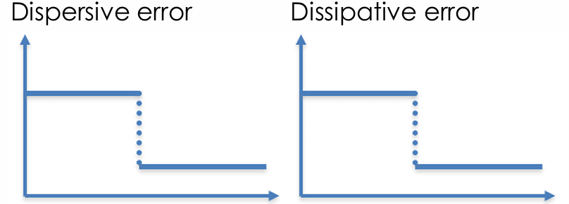
The sketch shows the exact solution 𝒖(𝒙) for a shock wave. Draw a numerical solution with dispersive and dissipative error behaviour. Name a method that exhibits each type of error characteristic.

Given the truncation error E for the friction term in the momentum equation, explain why a uniform grid is better than non-uniform grid.
Briefly explain what the “high-resolution” scheme in ANSYS CFX does. Name one advantage and one disadvantage.