Biology Vocab
 Call Kai
 Learn
Learn Practice Test
 Spaced Repetition
 Match
Match Flashcards
 Knowt Play
1/45

Earn XP
Description and Tags
Revise terms
Name | Mastery | Learn | Test | Matching | Spaced | Call with Kai | Chat |
|---|
No analytics yet
Send a link to your students to track their progress
46 Terms
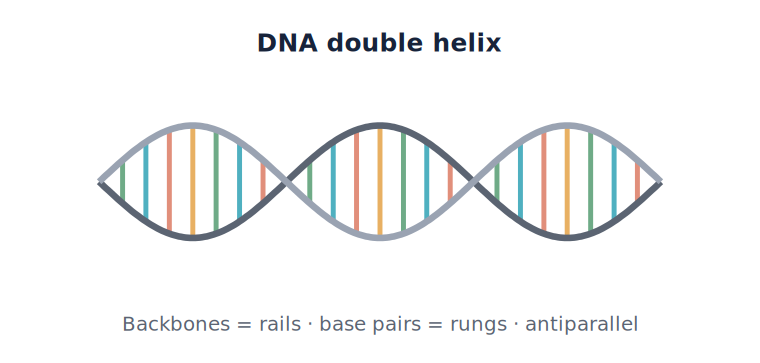
DNA – helical structure
A double helix: two antiparallel strands twisted together. The sugar–phosphate backbones form the outside 'rails'; the paired nitrogenous bases form the inner 'rungs'. The twist protects the bases and makes the molecule compact and stable.
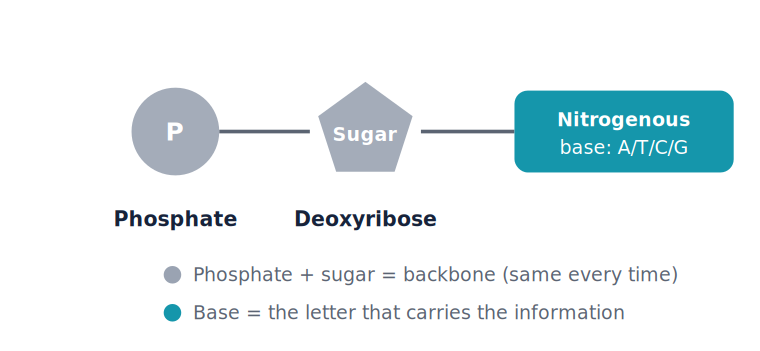
Nucleotide
The repeating unit ('letter') of DNA. Three parts: a phosphate, a deoxyribose sugar, and a nitrogenous base (A, T, C or G). Sugar + phosphate are identical in every nucleotide (the backbone); only the base changes and carries the information.
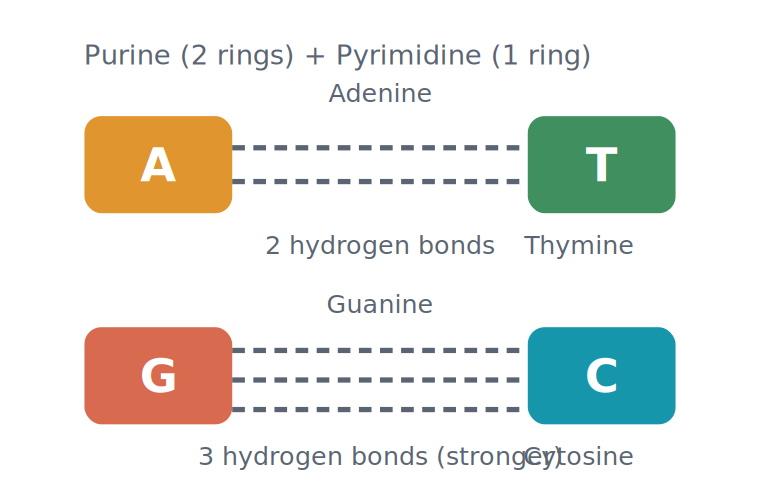
Complementary base pairs
The fixed pairing rule: A pairs with T, G pairs with C. A large purine (A/G) always bonds a small pyrimidine (T/C), keeping the helix an even width. This means each strand is a template for the other – the code is stored twice.
Hydrogen bonds
Weak bonds between paired bases that hold the two strands together. A–T = 2 bonds; G–C = 3 bonds (so G–C is stronger). Individually weak so the strands can 'unzip' for replication/transcription, but strong in number so DNA stays stable.
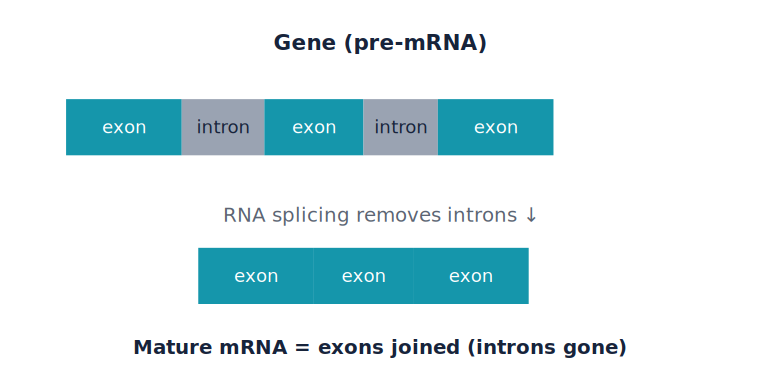
Introns
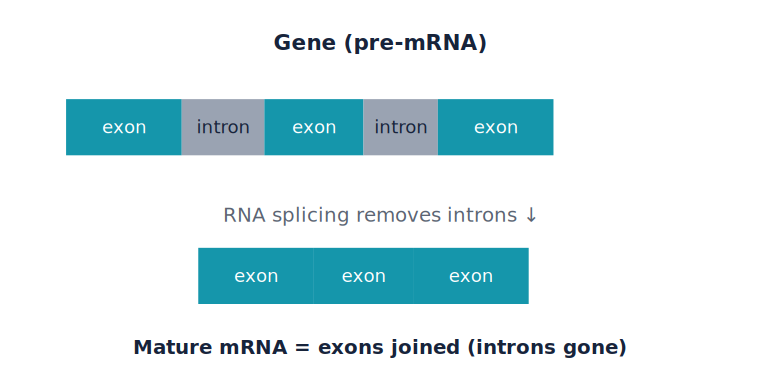
Non-coding sections within a gene. They are transcribed into pre-mRNA but spliced OUT during RNA processing – they don't code for the final protein. Memory hook: Introns = In the bin.
Exons
The coding sections of a gene that are EXpressed. They are kept and joined together during splicing to build the mature mRNA, coding for the amino acid sequence. Memory hook: Exons = Expressed.
Promoter region
A DNA sequence at the start of a gene where RNA polymerase and transcription factors bind. It marks where transcription begins and in which direction – the gene's 'on-ramp' or start switch.
Homologous chromosomes
A matching pair of chromosomes – one from each parent – carrying the same genes at the same loci, but possibly different alleles. They pair up during meiosis I. (Same genes, maybe different versions.)
Sister chromatids
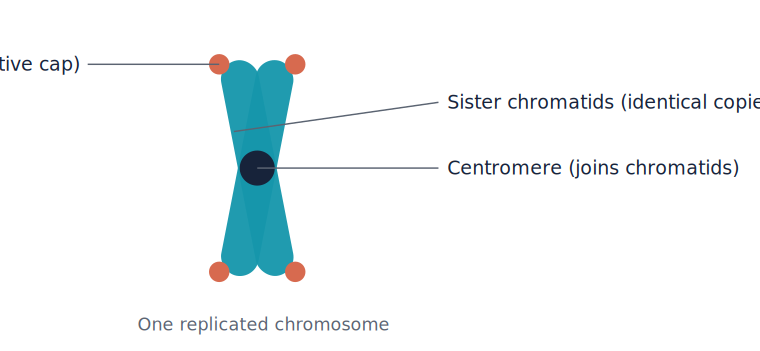
The two identical copies of a chromosome made by DNA replication, joined at the centromere. Genetically identical to each other; separated during mitosis and meiosis II.
Centromeres
The constricted region that joins sister chromatids. It is the attachment point for spindle fibres, which pull the chromatids apart during cell division.
Telomeres
Repetitive, non-coding DNA caps at the ends of linear chromosomes. They protect coding DNA and stop chromosome ends fraying or fusing. They shorten with each replication – linked to cell ageing.
Gene loci
The specific fixed position (address) of a gene on a chromosome. (Locus = singular.) It tells you where a gene sits.
Alleles
Different versions of the same gene, found at the same locus – e.g. a 'brown-eye' allele vs a 'blue-eye' allele. (Same address, different version.)
Histones
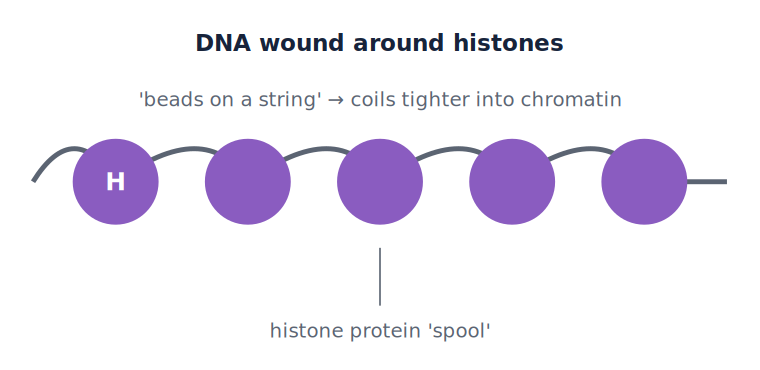
Proteins that DNA wraps around (like thread around a spool) to package and condense it. DNA + histones = chromatin. How tightly DNA is wound also helps control whether genes can be switched on.
Circular chromosomes
A single closed loop of DNA with no free ends. Found in prokaryotes, mitochondria and chloroplasts. No telomeres or centromere needed – compact and efficient.
Mitochondrial DNA (mtDNA)
Small circular DNA inside mitochondria, separate from nuclear DNA. Inherited only from the mother (maternal). Mutates at a steady rate, so it's used to trace ancestry and evolutionary relationships.
Plasmid
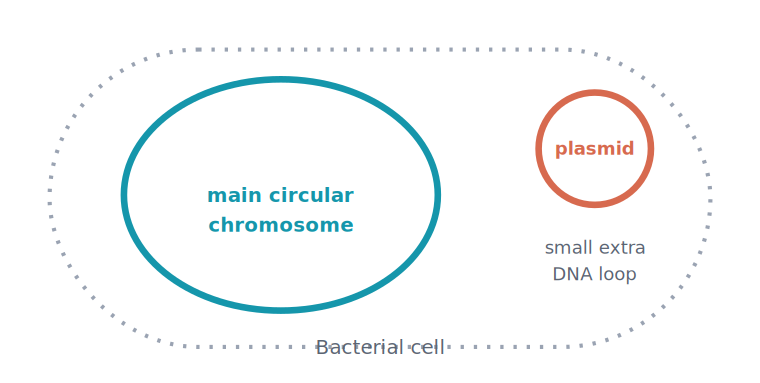
A small, circular piece of DNA separate from the main chromosome, found in bacteria. Replicates independently and often carries extra genes (e.g. antibiotic resistance). A key vector in genetic engineering.
DNA replication
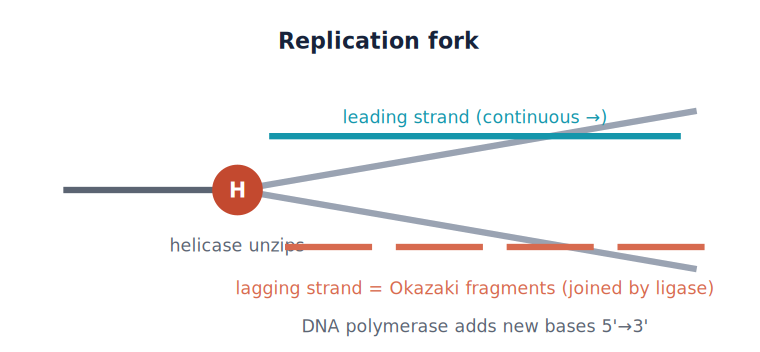
Copying DNA before cell division. It is semi-conservative: the strands unzip and each acts as a template, so every new molecule has one old strand + one new strand.
Helicase
An enzyme that unzips the double helix by breaking the hydrogen bonds between base pairs, creating two template strands (the replication fork).
DNA polymerase
An enzyme that builds the new strand by adding complementary nucleotides to a template. It works only in the 5'→3' direction and proofreads for errors.
Okazaki fragments
Short segments of new DNA made discontinuously on the lagging strand (because polymerase only works 5'→3'). They are later joined into a continuous strand by DNA ligase.
Point mutation
A change in a single base (substitution). The reading frame stays intact. Effect ranges from none (silent), to one amino acid changed (missense), to an early stop codon (nonsense).
Frameshift mutation
An insertion or deletion of bases (not a multiple of 3) that shifts the reading frame. Every codon after the change is misread – usually producing a drastically altered, non-functional protein.
Meiosis
Cell division that produces four genetically unique haploid gametes from one diploid cell. Two divisions halve the chromosome number and generate variation.
Crossing over
In meiosis I, homologous chromosomes swap segments of DNA at the chiasma. This creates new allele combinations (recombination) → variation.
Independent assortment
Homologous pairs line up and separate randomly in meiosis I, so each gamete receives a random mix of maternal and paternal chromosomes. A major source of variation.
Random fertilisation
Any one of millions of genetically unique sperm can fertilise any one of many unique eggs. This multiplies the genetic variation already created in the gametes.
Spermatogenesis
Production of sperm in males: one diploid cell → four functional haploid sperm. Continuous from puberty; cells are small and motile.
Oogenesis
Production of egg cells in females: one diploid cell → one large functional egg (ovum) + polar bodies (discarded). Unequal division concentrates resources in one egg; begins before birth.
Chromosomal abnormalities
Structural errors in chromosomes: Insertion (extra segment added), Deletion (segment lost), Duplication (segment repeated), Inversion (segment reversed), Translocation (segment moves to a non-homologous chromosome).
Aneuploidy
Having an abnormal number of chromosomes (not an exact multiple of the haploid set) – an extra or missing chromosome. Caused by non-disjunction in meiosis. Example: trisomy 21 (Down syndrome).
Karyotype
An organised visual profile of all of an individual's chromosomes, arranged in homologous pairs by size. Used to detect numerical or structural abnormalities (e.g. an extra chromosome 21).
Protein synthesis
Making a protein from a gene's instructions, in two stages: transcription (DNA → mRNA, in the nucleus) and translation (mRNA → amino acid chain, at the ribosome).
Transcription
Copying a gene's DNA into mRNA in the nucleus. RNA polymerase reads the template strand and builds a complementary mRNA copy (using U instead of T).
mRNA (messenger RNA)
A single-stranded RNA copy of a gene that carries the message from the nucleus to the ribosome. It is read in triplets called codons.
RNA processing
Editing pre-mRNA into mature mRNA: splicing removes introns and joins exons; a 5' cap and poly-A tail are added to protect the mRNA and help it leave the nucleus and bind the ribosome.
Gene expression
Using a gene's information to make a functional product (usually a protein), and controlling whether and how much this happens. Regulation lets different cell types express different genes from the same DNA.
Heterochromatin
Tightly packed chromatin. The DNA is coiled and inaccessible, so genes here are switched OFF (not transcribed). Memory hook: hetero = hidden.
Euchromatin
Loosely packed chromatin. The DNA is open and accessible to transcription machinery, so genes here can be switched ON (expressed). Memory hook: eu = expressed.
Transcription factors
Proteins that bind the promoter/regulatory regions of a gene to switch transcription on or off (or tune its rate). They control which genes are expressed in response to signals.
HOX transcription factors
A family of master control genes that regulate body plan and morphology – they direct where structures (limbs, segments) form along the head-to-tail axis. Highly conserved across animals.
Recombinant DNA
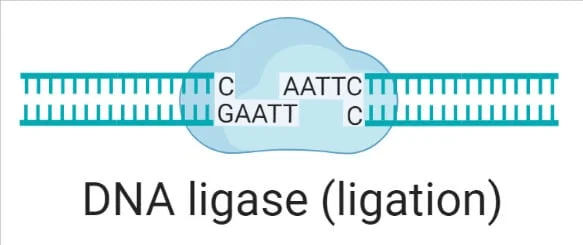
DNA made by combining genetic material from two different sources. Made by cutting DNA with restriction enzymes and joining it (often into a plasmid vector) with DNA ligase.
Restriction enzymes
Enzymes that cut DNA at specific recognition sequences. They can leave 'sticky ends' that let DNA from different sources join. Think: molecular scissors.
DNA ligase
An enzyme that joins DNA fragments by sealing the sugar–phosphate backbone. It bonds sticky ends (recombinant DNA) and joins Okazaki fragments (replication). Think: molecular glue.
PCR (Polymerase Chain Reaction)
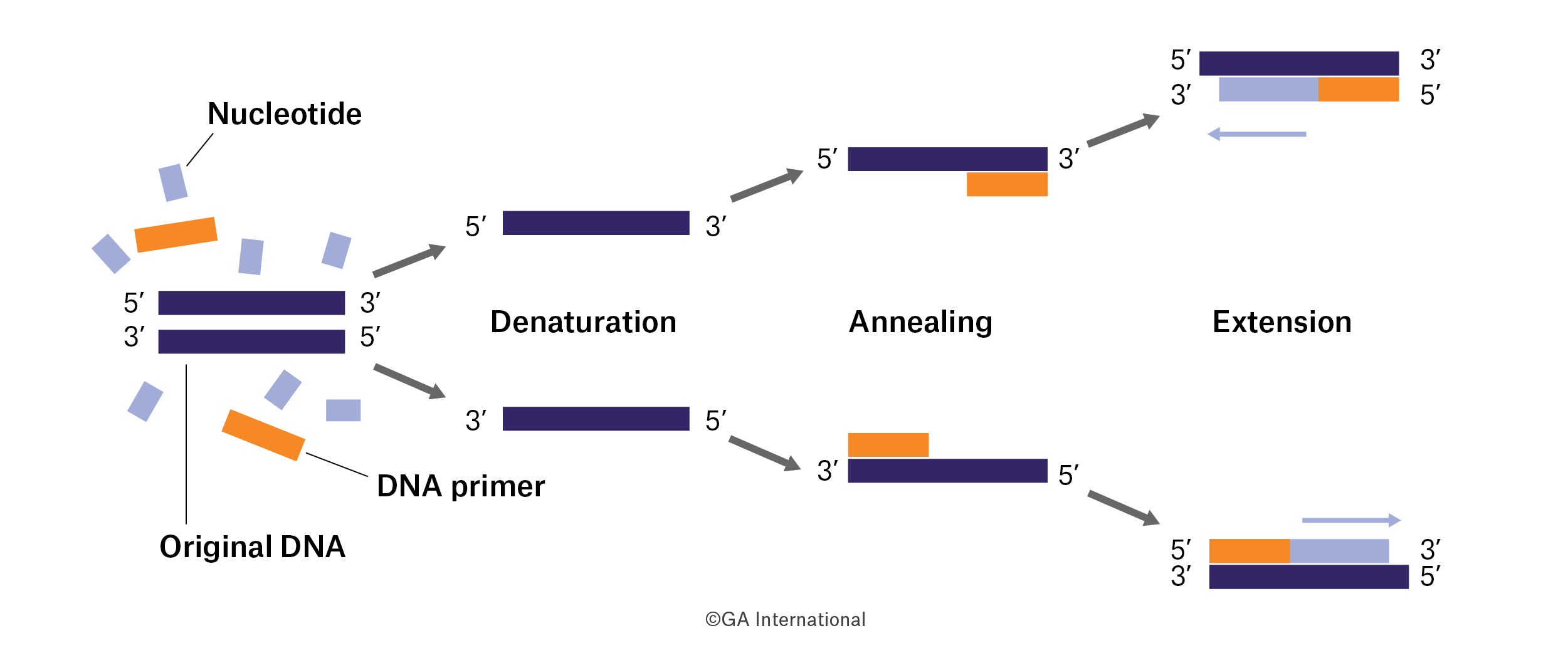
A technique that makes millions of copies of a specific DNA segment. Repeated cycles of heating (denature), cooling (anneal primers) and extending (polymerase) double the DNA each round.
Gel electrophoresis
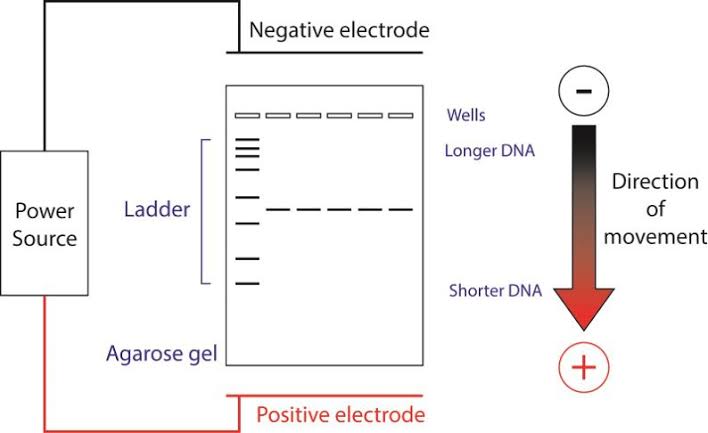
A technique that separates DNA fragments by size using an electric current. DNA is negative, so it moves toward the + end; smaller fragments travel further. The result is a banding pattern used in DNA profiling.