LING: lesson 6 (dialects pt2)
 Call Kai
 Learn
Learn Practice Test
 Spaced Repetition
 Match
Match Flashcards
 Knowt Play
1/20

There's no tags or description
Looks like no tags are added yet.
Name | Mastery | Learn | Test | Matching | Spaced | Call with Kai | Chat |
|---|
No analytics yet
Send a link to your students to track their progress
21 Terms
Southern dialects
many isolated areas in the South due to geographical characteristics
mutually unintelligible dialects and sub-dialects
What are the 6 major Southern dialects?
Wu
Xiang
Gan
Yue/ Cantonese
Hakka/ Kejia
Min
Why is Yue/ Cantonese so interesting?
global migration: most oversees chinese speak cantonese (not putonghua)
own writing system (not standard pinyin or simplified characters
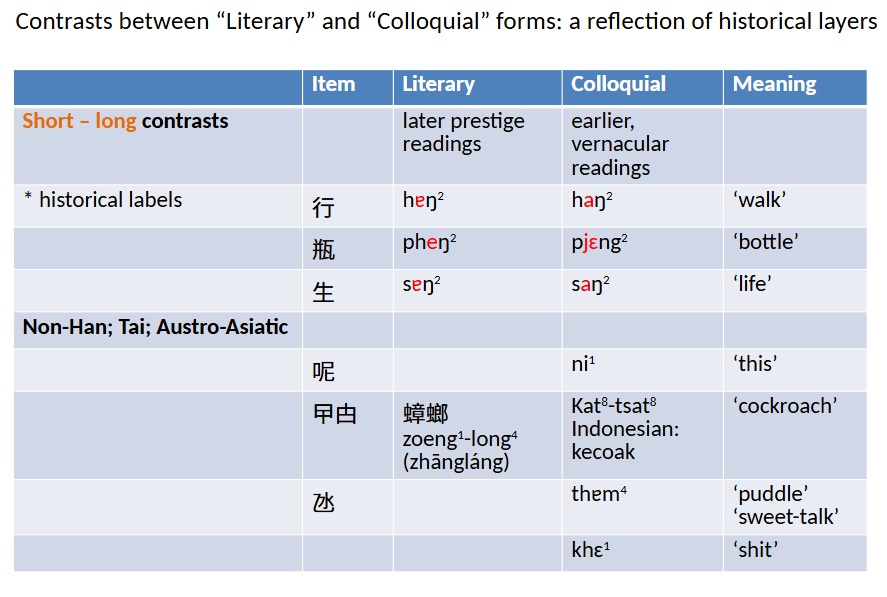
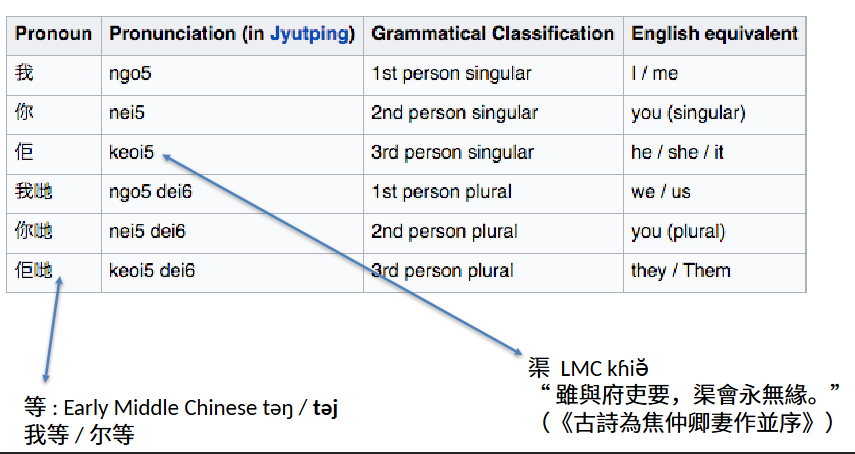
pronounciation is much closer to Tang-dynasty pronounciation
Yue dialect background:
Guangdong, Guangxi, and Hongkong
ca. 80 million speakers
traced back to settlers in the late 3rd century BCE (soldiers dispatched by the First Emperor?)
Guangzhou → Canton → Cantonese
own form of characters (not simplified + newly invented characters)
nearly 90% of American Chinese from Taishan
Why do Yue speakers sometimes refer to themselves as Tangren?
Because the largest migration from N to S happened after the fall of the Tang dynasty (An Lushan)
What does Yue 粤 refer to?
originally: to various ppl of the Yue-kind (Austro-Asiatic/ Tai-Kadai?) occupying areas around the Yangtze and stretching to the Southern coastal region
ancestors of the Tai people?
migration patterns of the Yue:
Qin/ Han: immigration from Central Plain to areas around Yangtze and Southern coastal region
Six Dynasties: further immigrations
Tang: many Chinese flee to the South
What is the connection between Min and Yue?
both have a connection to the Qin-dynasty
→ they have DEEP roots substratum
What are the features of Yue dialect?
mixture of Sinitic and Thai elements
ca. 100 sub-dialects
phonology of Yue:
correlation between tonal features and the aspiration of initial consonants derived from Middle Chinese voiced initials
aspirated voiceless consonants (p, t, k) become 平 and 上 tones
unaspirated become 去 and 入 tones
endings
nasal: -m, -n, -ng
stop: -p, -t, -k
many tones (because of split of the 入声)
other correlations derive from That stratum
ancient Yue probably featured consonant clusters (kl-, gl-, sl-)
same word can be pronounced differently according to colloquial/ literary
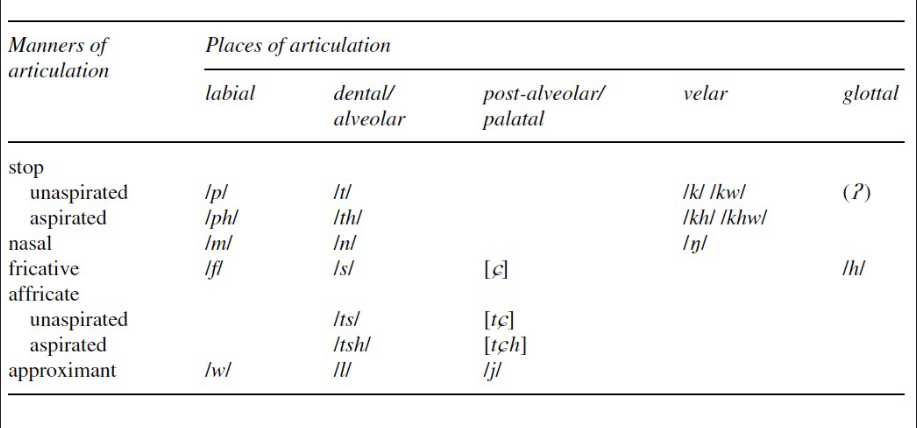
initial consonants of Yue
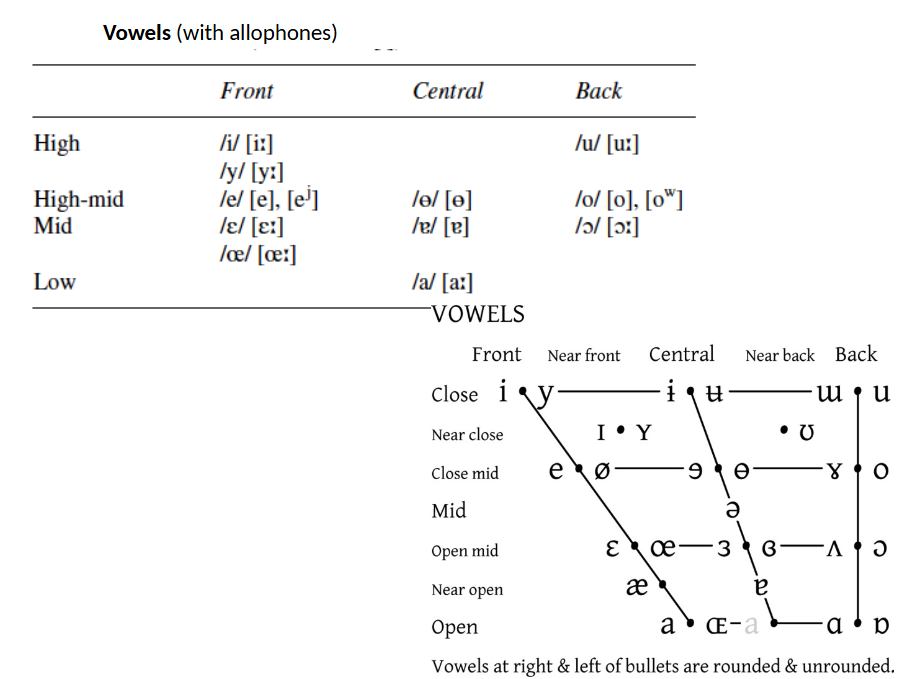
Yue vowels
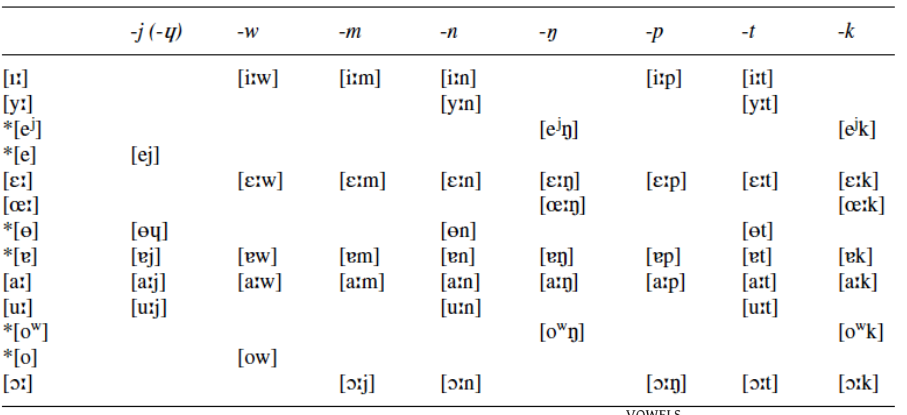
Yue rhymes (vowel + ending consonant)
initials → 763 syllables
tones in Yue
many tones because of:
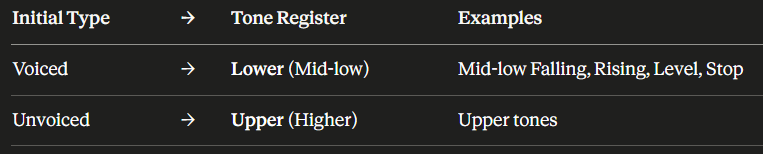
existence of voiced consonants (e.g. b, d, g) and unvoiced (e.g. p, t, k) → voiced became unvoiced later BUT there was still a pitch difference
split of 入声: syllables ending in a stop coda split into upper (unvoiced) and lower (voiced) registers (Mid-low Falling, Mid-low Rising, Mid-low Level, Mid-low Stop)
changed tones: word shifts from Mid-low to High tone to signal familiarity
.
.
syntactic features of Yue in relation to Mandarin Chinese?
most structures have equivalents
BUT Yue has some extra different structures (co-existing in High and Lower register)
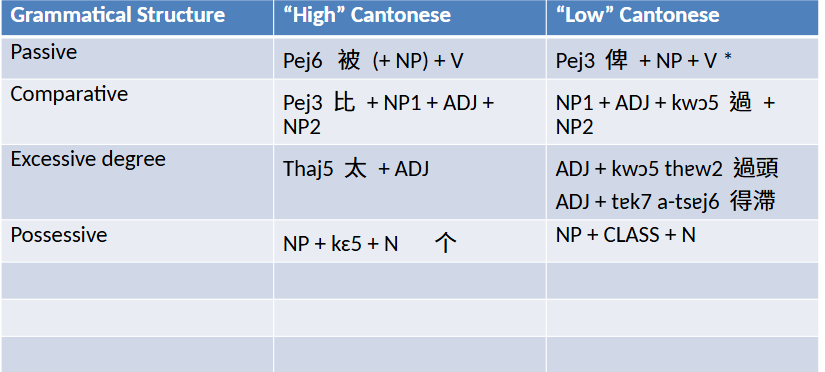
What are some special syntactic features of Yue?
inverted double-object constructions
always an agent in passive constructions
aspect marking
negations
copula
interrogatives
personal pronouns
elaborate aspect marking in Yue:
complex system
perfective can be indicated by a tonal modification
reduplication to indicate: intensity or diminuitive
What are some things that can be marked with an aspect in Yue?
perfective
completive
habitual
progressive
durative
…
Why are the semantics of Yue so compex?
because of the various layers it posseses:
Han Chinese
Archaic Han Chinese
Southern Han Chinese
Loan words (o.a. from English)
“Aboriginal” languages
Native Yue language