DENT2155 - Intestinal Fluid and Electrolyte Transport
 Call Kai
 Learn
Learn Practice Test
 Spaced Repetition
 Match
Match Flashcards
 Knowt Play
1/45

There's no tags or description
Looks like no tags are added yet.
Name | Mastery | Learn | Test | Matching | Spaced | Call with Kai | Chat |
|---|
No analytics yet
Send a link to your students to track their progress
46 Terms
The Gut excretes around ____ mL of Fluid per day.
100 mL
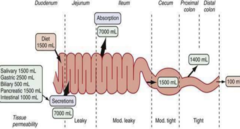
The Gut absorbs around ____ mL of Fluid per day.
8900 mL
Absorbs almost 99% of Fluids
Almost ____ mL of Fluid absorbed by the Gut comes from Endogenous Secretions.
7000
Water moves across the Gut Wall via ____.
Osmosis
Ions like Na+, K+, and Ca2+ are ____ across the Gut Wall.
actively transported
Secretory Cells in the Crypt secrete ____.
Cl-

Villi of Enterocytes absorb ____.
Na+
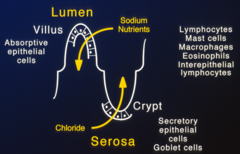
What are the types of Junctions holding Intestinal Cells together?
- Tight Junctions
- Adherens Junctions
- Desmosomes
- Gap Junctions
- Hemidesmosomes
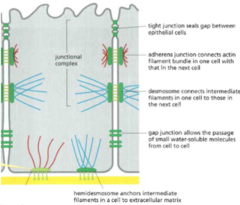
Tight Junctions
Specialized connections between adjacent Cells that create a barrier to control the movement of substances between them

Adherens Junctions
Cell-Cell adhesion structures that connect the Actin Cytoskeleton of neighboring Cells

Desmosomes
Cell-Cell adhesion structures that connect the Microfilament structure of neighboring Cells

Gap Junctions
Specialized Cell-Cell connections that allow direct communication between neighboring Cells by letting small molecules and ions pass from one Cell Cytoplasm to another

Hemidesmosomes
Cell-ECM connection using the Microfilament structure of the Cell

Disruption of Cell Junctions in the Small Intestine leads to ____.
Leaky Gut
The Tissue Permeability of the Jejunum is ____.
Leaky

The Tissue Permeability of the Ileum is ____.
Moderately Leaky

The Tissue Permeability of the Colon is ____.
Tight
What are the 3 Pathways of Water Absorption in the GI Tract?
- Na+ Coupled Absorption
- Na+ and Cl- Absorption (Small intestine and Colon)
- Na+ Absorption (Colon)
Na+ Coupled Absorption
Apical
(1) SGLT1 cotransports Na+ and Glucose into the Enterocyte
Basolateral
(2) GLUT2 pushes Glucose into the Bloodstream
(3) Na+/K+ Pump pushes Na+ out
(4) Cl- follows electrical gradient and travels paracellularly to pair with Na+
(5) Water follows NaCl

Na+ and Cl- Absorption
Apical
(1) Na+/H+ Exchanger pulls Na+ into Enterocyte
(2) Cl-/HCO3- Exchanger pulls Cl- in
Basolateral
(3) Na+/K+ Pump pushes Na+ out
(4) K+/Cl- Cotransporter pushes K+ and Cl- out
(5) Water follows NaCl
Occurs in the Small Intestine and Colon

Na+ Absorption
Apical
(1) ENaC pulls Na+ into Enterocyte
Basolateral
(2) Na+/K+ Pump pushes Na+ out
(3) Cl- follows electrical gradient and travels paracellularly to pair with Na+
(4) Water follows NaCl
Occurs in the Colon

What is the 1 Pathway of Water Secretion in the GI Tract?
Cl- Secretion (Small Intestine and Colon)
Cl- Secretion
Basolateral
(1) Na+/K+ Pump creates a Na+ gradient
(2) Na+/K+/Cl- Cotransporter pulls Na+, K+, and Cl- into the Acinar Cell
Apical
(3) Cl- Channel pushes Cl- into the Pancreatic Lumen
(4) Na+ follows electrical gradient and travels paracellularly to pair with Cl- in the Lumen
(5) Water follows NaCl

Fluid/Electrolyte Balance is disturbed by ____ and ____.
Vomiting/Diarrhea
What can trigger the Vomiting Reflex?
- Stomach Inflammation
- Dizziness
- Intracranial Pressure
- Pain
- Medications
- Pregnancy
- Smell
Be familiar with; Don't Memorize
Chemoreceptor Trigger Zone
Senses the CSF and relays it to the Nucleus tractus solitarius + Vomiting Center
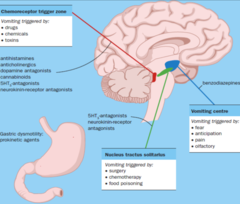
Nucleus tractus solitarius

Brain Stem Vomiting Center

What stimulates the Nucleus tractus solitarius?
- Chemoreceptor Trigger Zone
- Gastric Irritation
- Gag Reflex
- Surgery
What stimulates the Brain Stem Vomiting Center?
- Chemoreceptor Trigger Zone
- Nucleus tractus solitarius
- Cerebellum (via Vertigo/Motion Sickness)
Vomiting Reflex
(1) Hypersalivation
(2) Reverse Peristalsis clears upper content from Small Intestine into Stomach
(3) Glottis closes to prevent Aspiration
(4) Abdominal Wall contracts, increasing intra-Abdominal Pressure
(5) Lower Esophageal Sphincter (LES) and Esophagus relax
(6) Gastric Contents eject
Vomiting leads to loss of what 4 contents?
- H+
- Cl-
- K+
- Fluid
Loss of H+ can lead to ____.
increased pH and Metabolic Alkalosis
Loss of K+ can lead to ____.
Hypokalemia
Loss of Fluid can lead to ____.
RAAS stimulation and loss of even more K+
What can cause Diarrhea?
- Inability to Absorb
- Increased Motility
- Secretory Agents
- Inflammation
Cholera
Acute Intestinal infection caused by ingestion of contaminated water or food
Cholera Mechanism of Vomiting
(1) Cholera releases A + B Toxin
(2) B Toxin binds to Ganglioside GM1
(3) A Toxin travels into the Cytosol and binds Gsa
(4) Gsa stimulates Adenylate Cyclase which increases cAMP
(5) cAMP increases Cl- Secretion

In Secretory Diarrhea, there is an increase in ____ and decrease in ____.
Cl- Secretion/Nutrient Absorption (Na+)
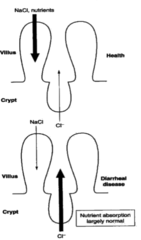
Diarrhea leads to loss of what 2 contents?
- HCO3-
- Fluid
Loss of HCO3- can lead to ____.
decreased pH and Metabolic Acidosis
Loss of Fluid can lead to ____.
RAAS stimulation and loss of K+
Diarrhea leads to an increase in ____.
Cl- Uptake
Secretion in the GI Tract is affected by what 4 factors?
- Hormones/NTs
- Immune System
- Toxins
- Laxatives
Absorption in the GI Tract is affected by what 5 factors?
- NTs
- Mineralocorticoids
- Glucocorticoids
- Somatostatin
- Opiates
Roles of Intestinal Epithelium
- Digestion (Brush Border)
- Absorption
- Protection (Mucus, pH, GALT)
- Secretion
DAPS