Learn: Chapter 3: Federalism (class slides)
 Call Kai
 Learn
Learn Practice Test
 Spaced Repetition
 Match
Match Flashcards
 Knowt Play
1/15

There's no tags or description
Looks like no tags are added yet.
Name | Mastery | Learn | Test | Matching | Spaced | Call with Kai | Chat |
|---|
No analytics yet
Send a link to your students to track their progress
16 Terms
Federalism
The division of power between the national government and state governments.

Supremacy Clause
Article VI provision making the U.S. Constitution and national laws supreme over state laws.
10th Amendment
Reserves powers not delegated to the national government to the states or people.
Enumerated Powers
Powers explicitly granted to the national government by the U.S. Constitution.
Reserved Powers
Areas of public policy over which state governments retain exclusive authority.
McCulloch v. Maryland (1819)
Supreme Court decision establishing federal supremacy and broad implied constitutional powers.
Full Faith and Credit Clause
Article IV requirement that states respect each other's public acts, records, and judicial proceedings.
Laboratories of Democracy
Concept that states can experiment with unique public policies without risking national failure.
Dual Federalism
System where national and state governments operate in distinct, separate spheres ("layer cake").
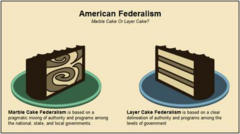
Cooperative Federalism
System where national and state government responsibilities are intertwined ("marble cake").

14th Amendment
Guarantees birthright citizenship, due process, and equal protection under state laws.
Categorical Grants
Federal funds provided to states with strict conditions and specific mandates.
Block Grants
Federal funding given for broad policy areas, allowing states spending flexibility.
Unfunded Mandates
Federal regulations that require state compliance without providing national funding.
Devolution
The process of shifting authority and responsibility from the federal government to states.
U.S. v. Lopez (1995)
Supreme Court ruling that limited federal power under the Commerce Clause.