chapter 5-7 BIO 1111 practice problems
 Call Kai
 Learn
Learn Practice Test
 Spaced Repetition
 Match
Match Flashcards
 Knowt Play
1/90

There's no tags or description
Looks like no tags are added yet.
Name | Mastery | Learn | Test | Matching | Spaced | Call with Kai | Chat |
|---|
No analytics yet
Send a link to your students to track their progress
91 Terms
How many molecules of water are required for the polymerization of a 22 monomer-long cellulose molecule?
21
Which of the following best compares dehydration reactions and hydrolysis?
Dehydration reactions assemble polymers; hydrolysis reactions break polymers apart
The molecular formula of a carbohydrate molecule is C24H42O21. The maximum number of glucose and water molecules that will be consumed by complete hydrolysis of the carbohydrate is ________.
4 molecules of glucose and 3 molecules of water
Which of the following terms does not describe a molecule of glucose?
a disaccharide
The difference between an aldose sugar and a ketose sugar is ________.
the position of the carbonyl group
Maltose is a disaccharide that can easily be digested into glucose molecules. Which type of glycosidic linkage connects glucose molecules in maltose?
α 1–4
An individual experiences abdominal discomfort after consuming a drink containing milk. A loss of function of which enzyme is most likely responsible for the symptoms?
lactase that breaks down the bond between galactose and glucose
Which of the following best describes glycogen?
has alpha 1-6 glyosidic bonds
During a period of fasting, the body initially maintains blood glucose by breaking down its stored carbohydrate reserve. Which macromolecule is primarily used for this purpose?
glycogen
The term insoluble fiber on food packages refers to which of the following molecules?
cellulose
Which of the following statements is correct regarding starch and cellulose?
They are polymers of glucose.
Why can humans digest starch but not cellulose?
Humans have enzymes that can hydrolyze the α-glycosidic linkages of starch but not the β-glycosidic linkages of cellulose

What is the molecule represented by the figure above?
a hexose
An amino acid is to a protein as a glucose molecule is to ________
glycogen
Which of the following statements about lipids is true?
Lipids mix poorly with water.
Which of the following features of cooking oil and gasoline (hydrocarbons) identifies why the molecules are NOT amphipathic?
They do not have a polar or charged region
What is the role of hydrogen in the synthesis of "hardened fats" from vegetable oil?
Hydrogen reduces the number of carbon-carbon double bond.
Which of the following statements describes the interaction of water molecules with phospholipids?
The polar heads interact with water; the nonpolar tails do not.
Which of the following statements correctly describes "saturated fats"?
They contain more hydrogen than unsaturated fats that consist of the same number of carbon atoms.
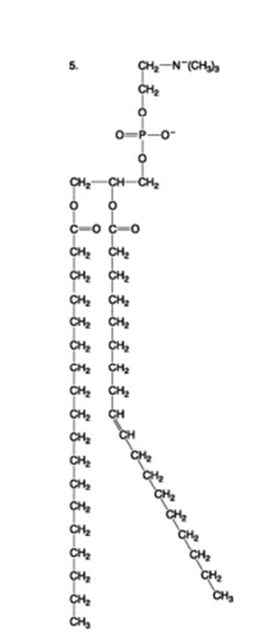
What molecule has both hydrophilic and hydrophobic properties and is found in plasma membranes? what does it look like?
phospholipid
Which molecule is a saturated fatty acid?

A fat (or triacylglycerol) would be formed as a result of a dehydration reaction between ________.
three molecules of 9 and one molecule of 10
How many amino acids and peptide bonds does a tetrapeptide have?
four amino acids and three peptide bonds
Which parts of the amino acids AA1 and AA2 are involved in the formation of a peptide bond?
AA1–AA2
carboxyl group of AA1 and amino group of AA2
Which part of an amino acid gives it its unique identity?
the components of its side chain (R)
Ovalbumin, the egg white protein is denatured in scrambled egg. Which of the following is not affected?
primary structure of ovalbumin
You have just sequenced a new protein isolated from mice and observe that sulfur-containing cysteine residues occur at regular intervals. "This finding is most consistent with which of the following claims about the protein?
Cysteine residues are involved in disulfide bridges that help form tertiary structure.
In sickle-cell disease, as a result of a single amino acid change, the mutant hemoglobin tetramers associate with each other and assemble into large fibers. Based on this information alone, what does the sickle-cell hemoglobin exhibit?
altered primary structure and altered quaternary structure; the secondary and tertiary structures may or may not be altered
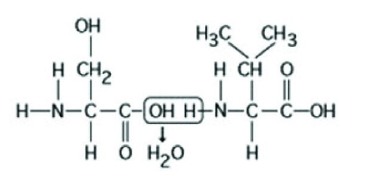
Which of the following chemical reactions is represented in the figure?
results in a peptide bond
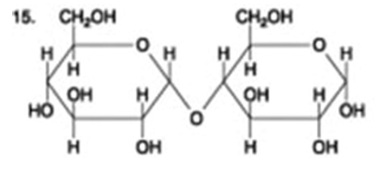
What type of molecule is this?
a disaccharide
Which of the following is the primary function of RNA molecule?
function in the synthesis of proteins
If 14C-labeled uracil is added to the growth medium of cells, what macromolecules will be labeled?
RNA
Which of the following are possible base compositions for double-stranded DNA?
%A %G %C %T %U
5 45 45 5 0
If one strand of a DNA molecule has the sequence of bases 5′-ATTGCA-3′, the mRNA synthesized following the template will be ________.
3′-UAACGU-5
The "flow of genetic information" in molecular biology follows the following path, ________
DNA is transcribed into RNA, which is translated into protein
If homogenized cells are fractionated by differential centrifugation, which of the following organelles will require the greatest centrifugation speed to form a pellet at the bottom of the tube?
ribosomes
Which of the following is the most appropriate technique for observing and measuring the size of ribosomes in a eukaryotic cell?
transmission electron microscopy
Which of the following is the most appropriate technique for observing the three-dimensional structure and organization of microvilli on an intestinal cell?
scanning electron microscopy
Which of the following statements best describes one major difference between prokaryotic cells and eukaryotic cells?
Eukaryotic cells have membrane-bound organelles, while prokaryotic cells do not.
Which of the following pairs of organism groups consist solely of prokaryotic cells?
Bacteria and Archaea
Which of the following structures is common to plant and animal cells?
mitochondrion
Which of the following structures are found in plant, animal, and bacterial cells?
ribosomes
Which of the following areas in bacterial cells best describes where chromosomal DNA is generally localized?
in the nucleoid
Which of the following statements best describes the function of the nuclear pore complex found in eukaryotic cells?
It regulates the movement of proteins and RNAs into and out of the nucleus
Disruption of nuclear pore complexes in a eukaryotic cell will most likely interfere with the transport of which of the following molecules out of the nucleus?
mRNA
Examination of a cell by transmission electron microscopy reveals a high density of ribosomes in the cytoplasm. This observation suggests that the cell is actively producing large amounts of which of the following molecules?
proteins
Which of the following organelles often occupy the majority of the volume of a plant cell?
central vacuole
A cell with a predominance of smooth endoplasmic reticulum is most likely specialized to carry out which of the following processes?
synthesis of large quantities of lipids
Tay-Sachs disease is a human genetic disorder that results in cellular accumulation of very large, complex, undigested lipids. Which of the following organelles is most likely defective in Tay-Sachs disease?
the lysosome
A newly synthesized protein destined for secretion from a eukaryotic cell will generally follow which of the pathways listed below?
rough ER → Golgi → transport vesicle → plasma membrane
Disruption of the function of which of the following organelles would result in a dramatic decrease in ATP synthesis in eukaryotic cells?
mitochondrion
An organelle in a newly discovered cell contains thylakoids, DNA, and ribosomes. These findings suggest that this organelle is most likely similar to which of the following organelles?
chloroplasts
If plant cells are grown on media containing radioactively labeled thymine for one generation, radioactively labeled macromolecules will be detected in which of the following organelles?
in the nucleus, mitochondria, and chloroplasts
While abundant quantities of proteins are produced by free ribosomes in the cytosol, new proteins are also produced by which of the following organelles?
mitochondria
A particular cell contains the following molecules and structures: enzymes, DNA, ribosomes, plasma membrane, and mitochondria. Based on this composition, it could be a cell from which of the following organisms?
nearly any eukaryotic organism
Cyanide binds with at least one protein complex involved in producing ATP. If a cell is exposed to cyanide, most of the bound cyanide is likely to be localized within which of the following organelles?
mitochondria
A young child who suffers from a metabolic disease is always tired and fatigued. Which of the following organelles is most likely malfunctioning in this disease?
mitochondria
Motor proteins provide for molecular motion in cells by interacting with which of the following cellular structures?
components of the cytoskeleton
Which of the following statements best describes some aspect of cytoskeleton structure or function in eukaryotic cells?
Movement of cilia and flagella is the result of motor proteins causing microtubules to move relative to each other
Which of the following structures form cytoplasmic channels that connect adjacent plant cells through the cell walls?
plasmodesmata
The cell walls of bacteria, fungi, and plant cells, and the extracellular matrix of animal cells are all external to the plasma membrane. Which of the following characteristics is common to all of these extracellular structures?
They are constructed of materials that are synthesized in the cytoplasm and then transported out of the cell for assembly
Which of the following statements best explains how the membranes in winter wheat are able to remain fluid in extremely cold temperatures?
The membranes contain an increased proportion of unsaturated phospholipids.
An animal cell that lacks carbohydrates on the external surface of its plasma membrane would likely be impaired in which of the following functions?
cell-cell recognition
Which of the following types of molecules are most likely to lack hydrophilic domains?
cholesterol

Which component in the figure above is hydrophilic?
D

Which component in the figure above represents cholesterol?
E

Which component in the accompanying figure plays a critical role in cell-cell recognition?
B
Which of the following statements best describes how unsaturated fatty acids increase membrane fluidity at lower temperatures?
The double bonds form kinks in the fatty acid tails, preventing adjacent lipids from packing tightly.
Which of the following types of molecules will diffuse through a cell membrane most readily?
small hydrophobic molecules
Which of the following statements best describes a characteristic feature of a carrier protein in a plasma membrane?
It exhibits specificity for a particular type of molecule.
Which of the following molecules would likely diffuse through the lipid bilayer of a plasma membrane most rapidly?
O2
A defect in which of the following molecules would dramatically reduce the rate of diffusion of water across cell membranes?
aquaporins
Which of the following statements best describes a characteristic feature of diffusion?
It is a passive process in which molecules move from a region of higher concentration to a region of lower concentration.
Which of the following cellular processes includes all of the others?
passive transport
When the interior of a cell is in equilibrium with its environment, which of the following statements best describes the relative movement of molecules that can diffuse through the plasma membrane?
There is random movement of molecules into and out of the cell
Which of the following statements best describes a characteristic feature of osmosis?
In osmosis, water moves across a membrane from areas of lower solute concentration to areas of higher solute concentration.
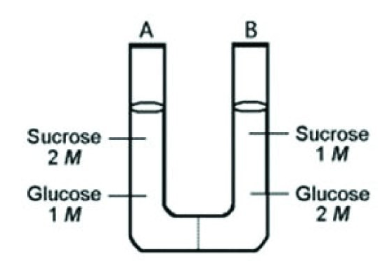
The solutions in the two arms of a U-tube are separated by a membrane that is permeable to water and glucose but not to sucrose. Side A is half-filled with a solution of 2 M sucrose and 1 M glucose. Side B is half-filled with 1 M sucrose and 2 M glucose. Initially, the liquid levels on both sides are equal. Which of the following statements best describes the relationship between the solutions on both sides of the U-tube?
side A is isotonic to side B

The solutions in the two arms of a U-tube are separated by a membrane that is permeable to water and glucose but not to sucrose. Side A is half-filled with a solution of 2 M sucrose and 1 M glucose. Side B is half-filled with 1 M sucrose and 2 M glucose. Initially, the liquid levels on both sides are equal. When the system illustrated above reaches equilibrium, the sugar concentrations on both sides of the U-tube will be ________.
1.5 M sucrose, 1.5 M glucose

Five dialysis bags, constructed of a type of membrane that is permeable to water and impermeable to sucrose, were filled with various concentrations of sucrose and then placed in separate beakers containing an initial concentration of 0.6 M sucrose solution. At 10-minute intervals, the bags were weighed, and the percent change in mass of each bag was graphed.
Which line in the graph represents the bag that contained a solution isotonic to the 0.6 M solution at the beginning of the experiment?
C
What will happen to a red blood cell (RBC), which has an internal ion content of about 0.9%, if it is placed into a beaker of pure water?
The cell will swell because the water in the beaker is hypotonic relative to the cytoplasm of the RBC
Which of the following statements best describes the normal tonicity conditions for typical plant and animal cells in their native environments?
The animal cell is in an isotonic solution, and the plant cell is in a hypotonic solution.
Which of the following results is most likely when a plant cell is submerged in a hypertonic solution?
Plasmolysis will shrink the interior of the cell
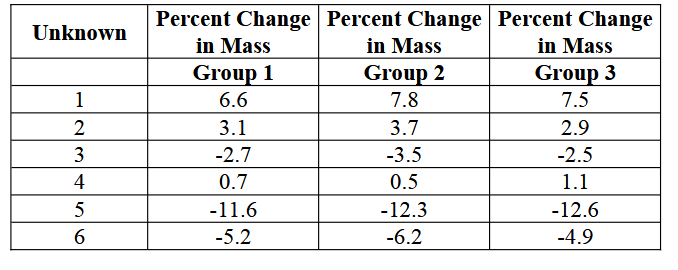
Three lab groups carried out an experiment to identify the concentration of sucrose in six solutions. Each unknown solution (1-6) contained one of the following sucrose concentrations: 0.0 M, 0.2 M, 0.4 M, 0.6 M, 0.8 M, and -1.0 M. Cubes of sweet potato (1 cm3) were soaked for 24 hours in each solution and weighed to determine the change in mass. Each data entry
represents the average of three sample replicates expressed as percent change in mass following a 24-hour soak in the unknown solutions. From the data provided, which unknown solution has a molarity that most closely reflects the molarity of sweet potato cells?
4
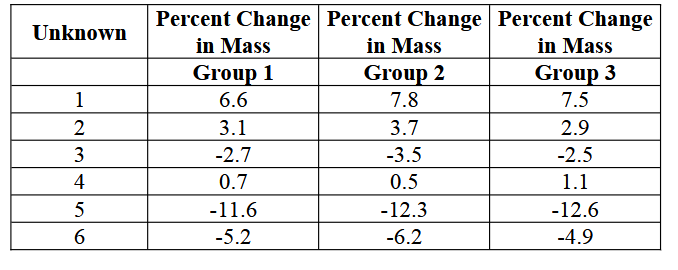
Three lab groups carried out an experiment to identify the concentration of sucrose in six solutions. Each unknown solution (1-6) contained one of the following sucrose concentrations: 0.0 M, 0.2 M, 0.4 M, 0.6 M, 0.8 M, and -1.0 M. Cubes of sweet potato (1 cm3) were soaked for 24 hours in each solution and weighed to determine the change in mass. Each data entry
represents the average of three sample replicates expressed as percent change in mass following a 24-hour soak in the unknown solutions. Which unknown solution contains the highest concentration of sucrose?
5
Which of the following statements best describes characteristic activities of a sodium-potassium pump?
The pump moves three sodium ions out of a cell and two potassium ions into a cell using energy from ATP hydrolysis.
Which of the following statements best explains why the sodium-potassium pump is an electrogenic pump?
It generates voltage across the membrane.
Which of the following membrane activities requires energy from ATP hydrolysis?
movement of Na+ ions from a lower concentration in a mammalian cell to a higher concentration in the extracellular fluid
The voltage across a membrane is called the ________.
membrane potential
The phosphate transport system in bacteria imports phosphate into the cell even when the concentration of phosphate outside the cell is much lower than the cytoplasmic phosphate concentration. Because phosphate import depends on a pH gradient across the membrane, phosphate transport is most likely an example of which of the following transport processes?
cotransport
The force driving simple diffusion is ________, while the energy source for active transport is ________.
a concentration gradient; ATP hydrolysis
Which of the following processes is used by white blood cells when engulfing bacteria?
phagocytosis