Uplands Lecture Exam 1
 Call Kai
 Learn
Learn Practice Test
 Spaced Repetition
 Match
Match Flashcards
 Knowt Play
1/64

There's no tags or description
Looks like no tags are added yet.
Name | Mastery | Learn | Test | Matching | Spaced | Call with Kai | Chat |
|---|
No analytics yet
Send a link to your students to track their progress
65 Terms
Aldo Leopold's decimating and welfare factors
Welfare Factors: food supply, water supply, shelter
Decimating Factors: predators (including humans), starvation (ie competition), disease, and parasites
Habitat definition
an area with the combination of resources (like food, cover, water) and the environmental conditions (temperature, precipitation, presence or absence of predators and competitors) that promotes occupancy by individuals of a given species (or population) and allows those individuals to survive and reproduce
How is habitat measured? Essential elements of a biologically meaningful definition of habitat?
Measured by resources (food, cover, water) and environmental conditions (temp, precip, predators/competitors) that promote occupancy and enable survival and reproduction
Habitat quality
a measure of the capacity of a habitat to support a population
Source/sink
source: environment with all resources needed, population can replace itself;
sink: decreased quality habitat, population cannot replace itself
Habitat selection
process by which an organism chooses one habitat over others
-habitat use vs. habitat availability (comparing use and availability leads to inferences about selection)
-can be exploratory or learned (behavioral) or innate (evolutionary)
Habitat preference
the choice of one habitat over another
- what do animals “like”
- Not very precise, hard to distinguish from selection
Habitat requirement
an attribute necessary for a species/population to survive/reproduce in a given habitat
ex: beavers req. access to water, increasing humidity for salamanders, downed logs for fishers, macaws chew on clay to balance gut
Critical habitat
a habitat necessary for a species/population to survive and/or reproduce in a given area (This is an ecological definition)
- is defined in the Endangered Species Act/has a legal definition
ex: the habitat in which a beaver, salamander, fisher, or macaw lives
Habitat use
occupation of habitat in space and time (no implication of choice)
ex: # of animals found, or time spent
Habitat availability
the area (proportion or acreage) of habitats from which an organism may select
ex: hectares of habitat A, B, and C
habitat selection - regional to microhabitat (Hutto’s hypothetical swallow example)
(ex) violet green swallow choosing habitat at large and small choices
-(continental/regional level) central Mexico or southern Mexico? -> (macrohabitat level) woodlands or grassland? -> (microhabitat level) which tree in specific?
Extrinsic factors of habitat selection
factors exterior to the habitat itself that result in animals selecting/avoiding that habitat (ex: barred owls now selecting doug fir either b/c crossed Canada boreal forest (climate change) or stepping stone across great plains from new trees)
-geographic concentration
-history (e.g. site fidelity, natal philosophy)
Intrinsic factors of habitat selection
those factors which influence an animal’s selection or avoidance of habitat that do exist within a habitat of interest
-cover, food, water, predators, competitors, microclimate, etc
Ultimate factors of habitat selection
those conferring survival or reproductive value on organisms; having adaptive significance for habitat selection
- Why do animals select certain habitats
Ex: natural selection nudges the animals to select “what’s best for them.” (Stabilizing natural selection, Directional natural selection, etc)
Proximate factors of habitat selection
behavioral mechanisms for habitat selection
-How do animals select certain habitats
Ex: Hawk may use prey availability, cover, perches as cues to select habitat; red tailed hawks along highways, not always choosing what’s best for them but may be selecting because proximate benefits to prey
Natural selection should operate to align ____ cues of habitat selection with ___ fitness outcomes of habitat selection?
Natural selection should operate to align proximate cues of habitat selection with ultimate fitness outcomes of habitat selection
(animals should select the best and avoid the worst habitats)
Perceptual trap
Restoration creates high-quality (source) habitats that animals avoid (use proportionately less than their availability)
Ecological trap
Habitat degradation creates poor-quality (sink) habitats that animals select (use proportionately more than their availability)
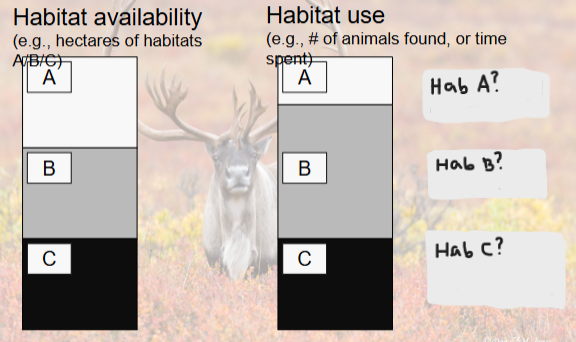
Comparing use vs availability, what can we determine about Habitat A? B? C?
-Avoidance of habitat A
-Selection of habitat B
-Habitat C used in proportion to its availability
Habitat selection template; may be a function of:
genetic encoding, imprinting, learning
Wecker's study of habitat selection in Peromyscus
-white footed mice – naturally select fields
-1/2 field, ½ wood; see how much time spent in X or Y place
-2 genetic stalks lab raised hundreds of generations, lost all innate tendency and individuals collected from the wild
-compare neutral environmentally raised compared to habitat environmental raised in
Graph:
-1 vs 4 show heritability appears to influence selection; early experience in right habitat can enforce selection (reared in certain habitat > later select it)
-2 and 6 show early experience in wrong habitat cannot erase heritability (ex: wood reared select field example of this)

Wien’s model: habitat cues
-heritable preferences, imprinted preferences (ex: long billed curlew breed in inland grassland, come to mudflats in winter; juvenile migrate ahead of adults but still choose this pattern because of genetic/imprinted)
-learned preferences (natal habitat preference induction; habitat that you were raised in influences where disperse to) (barn owls raised in boxes ex – maybe start to see selection of boxes over natural cavities).
Benefits of Conspecific attraction (ultimate and proximate)
Direct group benefits: increased mate choice, decrease predation possibility (ultimate)
Social cues: habitat copying, quality detection (proximate)
Ideal Free Distribution: Rules, Assumptions, and Predictions
Rules:
• Fundamental/inherent habitat quality varies
• Animals choose to maximize fitness (“optimality”)
Assumptions:
• Scramble/exploitation competition only
• Animals have complete knowledge of habitats (ideal)
• Animals are free to choose, free dispersal
• Increasing density is negatively related with fitness
Predictions:
• When habitats are full, fitness of individuals is equal in all habitats
• Habitats with the highest densities have highest fundamental/inherent habitat quality
Ideal Despotic Distribution: Rules, Assumptions, and Predictions
Rules:
• Fundamental/inherent habitat quality varies
• Animals choose to maximize fitness
Assumptions:
• Animals have complete knowledge of habitats (ideal)
• Behaviorally dominant individuals secure resources via interference competition (despotic)
• Increasing density is negatively related with fitness
• Subordinates pay disproportionate costs for competing with despots
Predictions:
• Fitness of individuals is unequal in all habitats; dominant individuals settle in habitats with highest fundamental quality, obtain highest fitness
• Density not necessarily correlated with habitat quality/fitness
interspecific interactions: predation
(between species)
ex: reintroduction of wolves to Yellowstone: after wolves = more veg = less grazing (wolves keep herb mammals moving and not over-grazing particular areas) (heterospecific predation promoted avoidance by elk)
interspecific interactions: competition
(between species)
ex: redwing vs tricolored blackbird: marsh areas before tricolored back vs after (pushed out redwing blackbird) (competition of resources)
ex: orange crowned vs Virginia warbler: orange crowned warbler removal really impacts Virginia warbler choice of maple stem (not really other way around) (heterospecific competition is prompting avoidance)
interspecific interactions: heterospecific attraction
(between species)
ex: black capped vireos
-install call boxes > sites with few got way more
-take call boxes away > still use it; call box 1st attraction (conspecific attraction hypothesis)
interspecific interactions: role of parasites & diseases
(between species)
ex: oocysts from cats in environment > ingested by hyena > parasite affects brain (reduces fear of feline odors) > behavioral change (prediction: less avoidance = approach more closely) > increases level of predation and parasite transmission (Prediction upheld for cubs but not for adult hyenas)
Time lags
• A discrepancy between a change in environmental condition and a change in an animal’s habitat selection response
• Problematic for researchers/managers – current habitat conditions may not be indicative of habitat that was selected (the ghost of habitat selection past…)
-Animals may continue to select a habitat even after it has changed (worsened) OR Animals may continue to avoid a habitat even after it has changed (improved)
Ex: swainson’s hawk – species has strong site-fidelity; presumably historically adaptive (trusts past knowledge that site was good for future selections)
-landscape has changed drastically year to year (evolutionarily novel) to shifting agriculture
-swainson’s hawks now find themselves to be caught in a habitat trap (time lag of not adapting as fast as environment is changing = maladaptive example)
why do we have time lags?
Summary: A delayed response may be adaptive when recent conditions are noisy but past conditions contain reliable information about future fitness

How do we measure habitat quality? - Direct habitat measurements
(assumes we know what attributes are relevant to the animal, and can measure them)
• Quantity of Resources +
• Quality of Resources +
• Ecological Constraints
Measure spatial variation in animals to reveal habitat quality - assumption?
assumes variation in animal attributes reflects variation in habitat quality
Measure spatial variation in animals to reveal habitat quality - demographic measures; Van Horne’s caution
-density/abundance
-reproduction and recruitment
-survival (hardest to measure, done the least)
Van Horne’s caution: density can be a misleading indicator of habitat quality
Ex: Bock and Jones – how often is density not an indicator of habitat quality?
-density was (overall) positively correlated with reproduction (a measure of habitat quality)
-density can be a misleading indicator of habitat quality
-what about habitat selection? – indicator of habitat quality because animal should choose wisely (hab that are best for them)
Measure spatial variation in animals to reveal habitat quality - distribution
(assumes “ideal” scenario in habitat selections)
• Habitat selection or preference
• Frequency or duration of occupation
• Sex, age, or other class ratio
• Sequence of settlement or departure
Measure spatial variation in animals to reveal habitat quality - individual condition
(Condition must be a consequence not a cause of habitat occupancy and must have fitness consequences)
Many, including:
• Body mass
• Parasite loads
• Skeletochronology
• Fluctuating asymmetry
• Stress hormones
• Blood metabolites
• Leucocyte ratios
LRS, and evolutionary underpinnings for habitat selection (sm rodent example)
LRS: Lifetime reproductive success
-ex: small rodent selecting 2 habitats
Habitat A - Lots of food, high predator density, Annual survival probability = 0.6, Annual # offspring (if alive) = 6
Habitat B - Moderate food, low predator density, Annual survival probability = 0.9, Annual #offspring per quarter (if alive) = 2
Expected offspring (short-term):
Habitat A – 6*0.6 = 3.6
Habitat B – 2*0.9 = 1.8
-Habitat A maximizes fitness in the short term
Expected LRS = (offspring per year)*(annual survival)/1 – annual survival
Habitat A – 6*0.6/1-0.6 = 9
Habitat B – 2*0.9/1-0.9 = 18
-Habitat B maximized fitness in the long term
Small rodent example: each rodent each generation chooses randomly (coin flip), what happens over time? Does the population undergo evolution?
No evolution in habitat selection, ~50:50 habitat use
small rodent example: What if some rodents have a heritable tendency to select the habitat with the most food, and other with the fewest predators?
Pop evolves to select B (may take a while)
small rodent example: What if animals don’t select based on any behavioral prioritization at all, but instead young animals inherit the tendency to simply choose reproductive habitats similar to what they were raised in [aka natal habitat preference induction]? What happens over time?
population evolves to select B (those choose A will die off) (B will keep choosing B)
small rodent example: Assume again that habitat decision rules are heritable. What if the safer habitat (B) is best in most years, but sometimes, predators crash and the normally risky habitat (A) confers higher LRS?
Selection for the “worse” habitat could persist in the population, perhaps at a low frequency, because it is occasionally better
What exactly is natural selection acting on?
Heritable variation in decision rules that influence habitat choice.
If individuals have a heritable tendency to:
• select a habitat with higher expected LRS, then
• alleles underlying that tendency will increase in frequency.
Over generations:
the population evolves a bias toward that strategy, the population evolves to select habitat adaptively.
Fitness is:
the expected genetic contribution an individual makes to future generations, relative to others in the population. It…
• Includes lifetime reproduction success
• Includes survival (& reproduction) of offspring
• Is relative
exploitative competition
Indirect interactions among competitors result in all obtaining fewer resources.
interference competition
Direct interactions among competitors result in some securing more resources than others.
How do intra- and interspecific competition differ in their effects on the breadth of habitat a species is likely to use?
Interspecific (between species) competition (for same resources) = decreases (narrows) breadth
-when competing species restricts access to shared resources, other species is forces to retreat to core or primary habitat (contraction in overall range of habitats or resources it utilizes.
Intraspecific (within species) competition (for same resources) = increases (expands) breadth
-driven by density dependence: as density rises -> resource scarcity increases, forcing individuals to diversify their resource usage, search for alternative microhabitats, or expand into secondary environments to survive; widening species niche or habitat breadth.
You are working for a timber company in Maine, and a colleague complains that the state-mandated protections on older forests to preserve habitat for American marten seem unnecessary because field trapping data indicate that more marten inhabit young forest than old forest. Why is knowledge of Fretwell-Lucas distribution models important in understanding why this might occur even if older forests are the most critical habitat for their populations?
-high density does not always mean high quality habitat
-Fretwell-lucas (ideal despotic distribution and ideal free distribution)
-ideal despotic distribution: individuals are not “free” to move anywhere because dominant individuals defend best resources – dominant martens occupy the ideal, high quality regions of old growth forests and push the majority of the population to occupy younger forests
-this could also be seen through the lens of sink/source dynamics – old growth forests act as source populations in which fewer individuals reside but the population is able to replace itself verses the new forests which act as sinks in which high densities led to low survival rates and cannot replace themselves; this creates an ecological trap from these species, but IDD says they cannot escape this trap
-this it is important to continue to protect the habitats that have less martins are they are in actuality the most ideal and by expanding the range to which they exist, maybe more martens can occupy more ideal environments (vs neglecting them and driving all martens into already overpopulated, unideal environments).
Coastal Sage Scrub or Cismontane Chaparral. Your supervisor directs you to approach this question by evaluating the hypothesis that Coastal Sage Scrub is a higher quality habitat for Western Whiptails than is Cismontane Chaparral. Write two predictions of this hypothesis, making sure at least one of them acknowledges Van Horne's cautions concerning measurements of habitat quality.
-van horne’s caution: density does not always equate to habitat quality
Prediction 1 (addresses van horne:)
Western Whiptails inhabiting Coastal Sage Scrub will exhibit significantly higher annual survival rates and greater reproductive output (e.g., larger clutch sizes or higher juvenile recruitment) compared to those in Cismontane Chaparral.
- even if the chaparral shows high lizard counts, the scrub habitat must demonstrate superior long-term survival and reproductive metrics to be considered truly higher quality
Prediction 2:
Adult Western Whiptails in Coastal Sage Scrub will have a higher mean body mass index (BMI) and lower stress-hormone levels during the peak breeding season than adults in Cismontane Chaparral
- Higher quality habitats offer superior thermal regimes and prey availability
Juvenile hyenas infected with a parasite approach the parasite's final host more closely than uninfected juveniles, but adults show little difference. Provide an explanation for the age-specific result that draws on lessons learned from Wecker’s famous experiments with deer mice
-experienced individuals might better assess threats and inhibit risky behavior
-wecker’s deer mice: early experience in wrong habitat cannot erase heritability; perhaps over time experience with this harmful parasite will not completely rule out an individual’s heritable knowledge for survival and will lead to those more vulnerable (cubs) to be more at risk than adults who grew up with infected parents or were infected cubs themselves
-infected cubs will die off and will not become infected adults

ecological reasons for time lag? monitoring suggestions?
-ecological reasons for the time lag could be high site fidelity (keep choosing poor site even when other site has improved), limitations to dispersing (perhaps this species views leaving their site to be more costly than remaining in poor site), perhaps this species relies on social cues to know sites are ideal (more individuals in poor site make it chosen more than newly restored high quality site with no individuals present), perhaps due to the low population index, they will gradually move into the new site as their population increases and pushes more individuals out into new regions in which they find to also be suitable. Species is in line with natural, slow changing world and is thus adapting over time to changes in ecosystem. Even positive changes, when so abruptly, can take a while to see the results and benefits for the species.
-monitoring suggestions: track food availability (see where food goes, assume species will follow), track vegetation response, or for species that migrate, track those early scouts who may be the first to the new area, compare their selection and traits with those who have yet to leave yet. Showing the transition of the resources can allow confidence that the restoration as a success and that the species will respond over time.
A tract of old Douglas-fir retains the same vegetation structure after barred owls colonize it. Spotted owls then disappear because barred owls exclude them. Which statement best applies the lecture's definition of habitat?
A. The tract remains spotted-owl habitat because vegetation alone defines habitat.
B. The tract may have become non-habitat for spotted owls because competitors are part of the conditions permitting occupancy and reproduction.
C. The tract is now a different vegetation type, which automatically makes it non-habitat.
D. The tract remains habitat until managers document a change in temperature or precipitation.
B. The tract may have become non-habitat for spotted owls because competitors are part of the conditions permitting occupancy and reproduction.
Across eight years, mean nest success declines as breeding density increases, but the variation in nest success among territories remains nearly constant. Which interpretation best matches the lecture predictions?
A. The pattern is more consistent with exploitative competition because competitors experience broadly similar reductions in resources.
B. The pattern proves interference competition because mean fitness declines.
C. The pattern proves an ideal despotic distribution because some territories remain occupied.
D. The pattern rules out density dependence because variance does not increase.
A. The pattern is more consistent with exploitative competition because competitors experience broadly similar reductions in resources.
At equilibrium, three habitats contain 60, 30, and 10 breeding animals, yet individuals have the same realized reproductive success in all three habitats. Under IFD assumptions, which inference is strongest?
A. The habitat with 10 animals has the highest fundamental quality.
B. All three habitats have equal fundamental quality because realized fitness is equal.
C. The habitat with 60 animals has the highest fundamental quality.
D. Density cannot provide any information about fundamental quality under IFD.
C. The habitat with 60 animals has the highest fundamental quality.
Dominant individuals monopolize the best denning stands in the forest. Subordinates occupying the same forest suffer steep reproductive costs and many settle on poor denning stands. Which prediction follows from an ideal despotic distribution?
A. Realized fitness should be equal across denning stands after settlement.
B. The densest stands must have the highest intrinsic quality.
C. Dominants in intrinsically good habitat should outperform subordinates, and density may not track habitat quality.
D. All individuals should move freely until per-capita rewards equalize.
C. Dominants in intrinsically good habitat should outperform subordinates, and density may not track habitat quality.
Researchers observe many nonbreeding floaters even though all known territories are occupied. Which experiment most directly tests whether the population is habitat limited?
A. Add food to a random subset of occupied territories and measure nestling mass.
B. Remove territory holders temporarily from randomly selected territories and test whether floaters rapidly occupy the vacancies.
C. Broadcast predator calls in unoccupied habitat and measure vigilance.
D. Compare the genetic diversity of floaters and breeders.
B. Remove territory holders temporarily from randomly selected territories and test whether floaters rapidly occupy the vacancies.
In a reciprocal removal experiment, removing species X causes species Y to expand into high-elevation sites, while removing Y produces no detectable change in X habitat use. What is the strongest inference?
· A. Y competitively excludes X from high-elevation sites.
· B. X alters Y's realized habitat selection, consistent with asymmetric interspecific competition.
· C. Both species prefer low-elevation sites.
· D. The result shows that elevation has no effect on either species.
B. X alters Y's realized habitat selection, consistent with asymmetric interspecific competition.
A telemetry study reports that 70% of locations occur in shrubland. Which missing information is most necessary before concluding that animals select shrubland?
A. The animals' taxonomic family
B. The proportion of shrubland available to the animals
C. Whether shrubland is legally designated as critical habitat
D. The dominant plant species in all adjacent ecoregions
B. The proportion of shrubland available to the animals
As of September 16, 2026, which statement most accurately describes the federal regulatory change discussed in lecture?
A. Congress removed the word 'harm' from the ESA's statutory definition of take.
B. FWS and NMFS rescinded the regulatory definition of 'harm,’ while the ESA's statutory definition of take remains in force.
C. The Supreme Court abolished critical-habitat designations nationwide.
D. The rule makes all habitat modification lawful under provisions of the ESA.
B. FWS and NMFS rescinded the regulatory definition of 'harm,’ while the ESA's statutory definition of take remains in force.
Caribou avoid an otherwise suitable valley because they are geographically concentrated far from it along a traditional migration route. Which classification is most appropriate?
A. Food limitation acting as an intrinsic factor
B. History and geographic concentration acting as extrinsic factors
C. Predation acting as an ultimate factor only
D. Microclimate acting as a proximate factor
B. History and geographic concentration acting as extrinsic factors
A bird settles where vegetation height provides a visual cue of dense insect prey. Insects increase nestling survival. Which pairing is correct?
A. Vegetation height is ultimate; increased nestling survival is proximate.
B. Both are proximate because they occur during one breeding season.
C. Vegetation height is a proximate cue; increased survival is the ultimate benefit.
D. Both are ultimate because natural selection can act on them.
C. Vegetation height is a proximate cue; increased survival is the ultimate benefit.
A ungulate can calf in sparse, moderately dense, or extremely dense marsh vegetation. Calves dropped in sparse vegetation are easily detected by predators, while calves dropped in extremely dense vegetation have difficulty navigating through the vegetation. Calves in moderately dense vegetation have the greatest survival. Which prediction follows if habitat-selection cues become aligned with these fitness outcomes?
A. Directional selection should favor increasingly dense vegetation.
B. Directional selection should favor increasingly sparse vegetation.
C. Stabilizing selection should favor cues associated with moderately dense vegetation.
D. Natural selection should eliminate habitat selection because both extremes reduce fitness
C. Stabilizing selection should favor cues associated with moderately dense vegetation.
Dominant adults settle in one habitat first, while younger individuals occupy it later or settle elsewhere. A manager concludes that the habitat settled first must have the highest quality. Which assumption is required for that conclusion?
A. Individuals have sufficiently accurate information and settlement patterns generally correspond to fitness outcomes.
B. Habitat quality is independent of population density.
C. Young and adult animals have divergent habitat requirements.
D. The first habitat occupied must also contain the greatest number of animals.
A. Individuals have sufficiently accurate information and settlement patterns generally correspond to fitness outcomes.
Managers restore a forest’s hydrology and food resources, producing potential deer population growth greater than replacement. However, animals continue to avoid the forest because it lacks the vegetation structure they historically used as a settlement cue. How should the restored forest be classified?
A. Source
B. Sink
C. Ecological trap
D. Perceptual trap
D. Perceptual trap