Diversity Lecture 4
 Studied by 0 people
 Call Kai
 Learn
Learn Practice Test
 Spaced Repetition
 Match
Match Flashcards
 Knowt Play
1/32

There's no tags or description
Looks like no tags are added yet.
Name | Mastery | Learn | Test | Matching | Spaced | Call with Kai |
|---|
No analytics yet
Send a link to your students to track their progress
33 Terms
Why do we need to know about gender diversity?
You will be a mental health professional for all types of clients
You will meet transgender people even if you do not work in a gender clinic
Transgender and gender diverse population is vulnerable for mental health challenges
Positionality
The social and political context that creates your identity
How your identity influences and biases your perception of and outlook on the world
Terminology: Gender
Socially-constructed roles, behaviors, expressions and identities of girls, women, boys, men and gender diverse people
Terminology: Sex
Biological attributes of humans and animals, including physical features, chromosomes, gene expression, hormones, and anatomy
Terminology: Cisgender vs transgender
Cisgender: Your assigned sex at birth alines with your gender
Transgender: Your assigned sex at birth does not aline with your gender
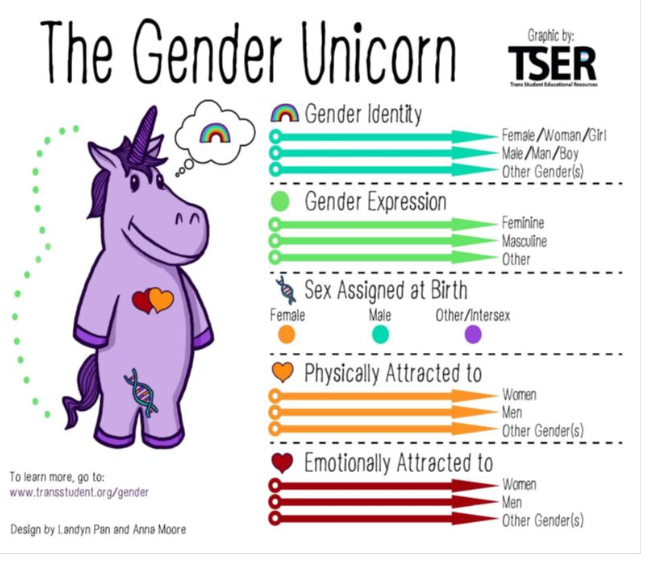
The Gender Unicorn: Differences in:
Gender identity
Gender expression
Sex assigned at birth
Physically attracted to
Emotionally attracted to

How do we explain this increase of Numbers in NL Gender Care?
More awareness and social acceptance
Increased availability of information and representation
Increased accessibility and higher quality of care
Publication of DSM-5 (2013), diagnosis of gender dysphoria now more sensitive for NBGQ gender experience
Change of 'Transgender Law' in 2014
Dutch Gender Care
Mandatory health insurance for every resident of the Netherlands.
Government mandates insurance coverage for necessary gender-affirming treatments
Dedicated, multidisciplinary gender clinics available (e.g., at Amsterdam University Medical Center)
DSM-V Gender Dysphoria
A-criterium
A marked incongruence between one’s experienced/expressed gender and assigned gender, of at least six months duration, as manifested by [at least 2 of 6]
1. Incongruence between experienced gender and sex characteristics
2. Desire to be rid of one’s sex characteristics
3. Desire for the sex characteristics of the other/or alternative gender
4. Desire to be of the other gender/or alternative
5. Desire to be treated as the other/or alternative gender
6. Conviction that one has the typical feelings and reactions of the other/alternative gender
B-criterium: The condition is associated with clinically significant distress or impairment in social, occupational, or other important areas of functioning.
Types of Dysphoria
Social: Discomfort with presenting socially as your birth-gender
Body: Discomfort with your body being of a different gender
Mind: Discomfort with your mind and emotions not lining up with your gender identity
Steps in Dutch Gender Care
Psychologist: Diagnostic phase
Endocrinologist: Hormone treatment (like second puberity for other sex)
Surgeon: Gender affirming surgery
Effects of Gender-Affirming Hormone Therapy: Physical Changes
Transmen (Testosterone therapy):
Menstruation stops
Voice deepens
Facial and body hair growth
Body fat redistributed
Muscle mass and strength increase
Transwomen (Estrogen + anti-androgens):
Breast development
Fewer erections, decreased ejaculation
Less facial/body hair growth
Slower scalp hair loss
More body fat, reduced muscle mass
Effects of Gender-Affirming Hormone Therapy: Mental Health Changes
Feminizing therapy:
↓ Psychological distress and depressive symptoms
↑ Quality of life, emotional balance, expressiveness (weaker evidence)
Masculinizing therapy:
↓ Psychological distress and depressive symptoms
↓ Anxiety and social anxiety symptoms (weaker evidence)
↑ Quality of life, affective dampening, anger expression (weaker evidence)
Psychologist’s Role Before Referring for Medical Treatment
Confirm that:
There is evidence of gender incongruence;
The transgender individual's resilience and support system are sufficient;
The proposed treatment is appropriate and well-suited to the individual;
There are no medical or psychiatric contra-indications;
All additional criteria for treatment are met
Gender Diversity and Mental Health Prevalence
Psychiatric Diagnoses: x 2 Trans individuals have a two fold higher risk of receiving a psychiatric diagnoses as compared to their cisgender counterparts.
Mood Disorders: x 1.5 Transgender individuals are 1.5 more often diagnosed with mood disorders than cisgender individuals.
Anxiety Disorders: x 3.9 Trans individuals are 3.9 times more often diagnosed with anxiety disorders than cisgender individuals
Suicidality: x 13 The prevalence of suicidality is 13 times higher in the transgender population compared to the cisgender population.
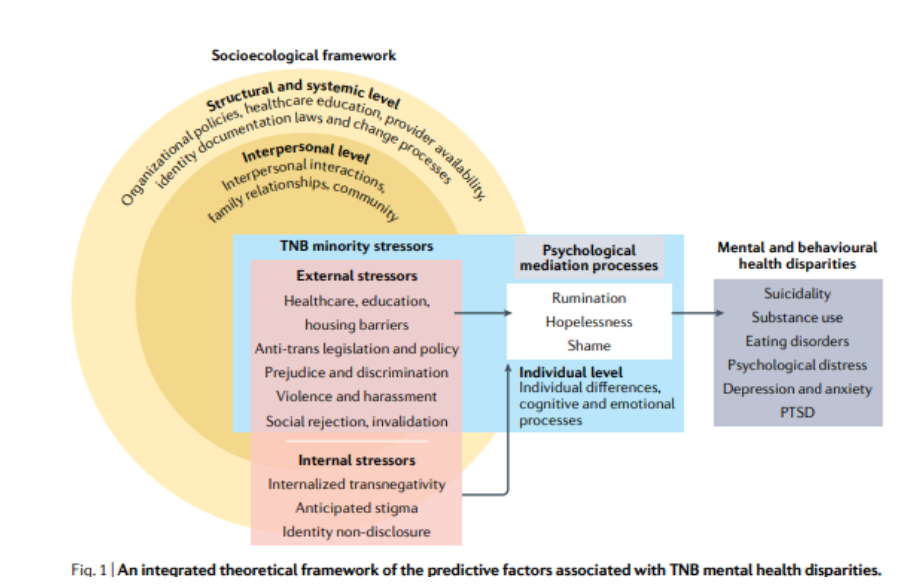
Integrated Framework of TNB (Trans and Non-Binary) Mental Health Disparities
Socioecological Context
Structural/Systemic level: Policies, healthcare access, education, documentation laws.
Interpersonal level: Family, community, and social relationships.
TNB Minority Stressors
External stressors:
Barriers in healthcare, education, housing
Anti-trans legislation and discrimination
Violence, harassment, and social rejection
Internal stressors:
Internalized transnegativity
Anticipated stigma
Identity non-disclosure
Psychological Mediation Processes
Rumination, hopelessness, shame
Cognitive and emotional factors at the individual level
Outcomes: Leads to mental and behavioral health disparities
External Stressors
Discrimination
Rejection
Victimization
Non-affirmation
In 2022, we saw a sharp increase in the number of reported incidents of discrimination against transgender individuals in NL. There have never been so many reports before.

Internal Stressors
Internalized transphobia
Negative expectations
Concealment
Trans Affirmative CBT - Assessment
You could ask:
What are the client's experiences with gender minority stress?
What were client's early messages about LGBTQ+ people?
What are early learning experiences about LGBTQ+ individuals and identities that may contribute to the current problems?
What are the client's underlying beliefs about themselves as LGBTQ+ people?
Does the client have hope for the future?
What stressors currently interfere with the client's ability to cope and/or solve problems?
Therapy Plan in TA-CBT model
Psychoeducation on CBT model and minority stress
Understanding the impact of anti-LGBTQ+ attitudes on behavior and stress
Understanding the influence of thoughts on emotions
Using thoughts to change emotions
Understanding how behavior affects emotions
Work with breaking the pattern of maladaptive thinking and negative emotions
Understanding the impact of minority stress on social attitudes and behavior, relationship building
Developing support networks
Lack of Knowledge on Gender Topic Lead to:
Unnecessary referrals to specialized clinics
Clients feel like they must educate their therapist on gender-related topics
Lack of gender sensitivity, unnuanced approach in language and views
Clinical practice: Gender sensitivity
How can I help foster gender euphoria in my patients?
Update the patient’s gender and pronouns in their medical file.
Make your work environment as inclusive as possible (e.g., by having gender-neutral toilets next to the waiting room).
Display a rainbow-patterned ornament in your workplace or on yourself (e.g., a sticker at the front desk, wearing a rainbow lanyard, etc.).
Adopt gender-inclusive language and practices.
Display your own pronouns on your name badge and in your email signature.
Register yourself in your local database of queer-friendly care providers.
Clinical practice: Exploring gender identity
Differentiate between gender identity, biological sex, presentation and sexual orientation (e.g. using the gender unicorn or genderbread person)
How would you describe your gender identity/sexual orientation?
Explore person's gender awareness and gender identity throughout their lifespan
When did you first become aware of gender – in yourself or others?
Were there key moments, relationships, or experiences that made you reflect deeper on your gender?
Explore person's ideas about gender stereotypes and gender roles
What messages did you learn growing up about boys, girls, or other genders ‘should’ behave?
How do you feel about these traditional gender roles today?
Explore which ideas about gender (roles) they have encountered in their family, culture, school, media etc. And how this has influenced them
How did your family respond when you first shared something about your gender identity?
To what extend do you feel accepted by your family for who you are right now?
Clinical practice: Differential diagnostics
Differentiate between:
Psychological problems that may (partly) result from gender dysphoria
Psychological problems that may have influenced gender dysphoria
Psychological problems that make it difficult to assess gender dysphoria
Study on Missteps in Psychotherapy with Transgender clients
Explored common mistakes therapists make when working with transgender and gender-nonconforming (TGNC) clients.
Method:
Interviews with 45 TGNC adults about psychotherapy experiences.
Used grounded theory to identify themes of therapist errors.
Main Findings: 8 Common Missteps:
Education Burdening: Clients must teach therapists about TGNC issues.
Gender Inflation: Therapist focuses too much on gender.
Gender Narrowing: Binary or limited view of gender.
Gender Avoidance: Avoiding discussion of gender.
Gender Generalizing: Treating all TGNC people as the same.
Gender Repairing: Trying to “fix” transgender identity.
Gender Pathologizing: Seeing TGNC identity as a disorder.
Gatekeeping: Controlling access to medical or gender-affirming care.
Study on Missteps in Psychotherapy with Transgender clients: Conclusion
TGNC clients often face harm from uneducated or biased therapists.
Missteps can undermine trust, cause distress, and reinforce stigma.
Clinical Implications:
Therapists must develop gender sensitivity and cultural competence.
Create a safe, affirming environment for all gender identities.
Recognize and challenge personal biases.
Balance focus on gender with attention to other life issues.
Support clients’ autonomy and gender affirmation without pathologizing.
Study on Barriers to Mental Health Care for Transgender people
Explored what prevents transgender and gender-nonconforming (TGNC) adults from accessing effective mental health care.
Systematic literature review of 8 studies
(6 qualitative, 2 quantitative).Focused on TGNC adults’ experiences with mental health professionals.
Main Findings – 3 Major Barriers:
Personal Concerns:
Fear of being pathologized or stereotyped.
Discomfort with uninformed or biased therapeutic approaches.
Incompetent Professionals:
Therapists often lack knowledge, nuance, or supportive attitudes toward TGNC clients.
Affordability Factors:
High costs, lack of insurance, and financial instability reduce access to care.
Study on Barriers to Mental Health Care for Transgender people: Conclusion
TGNC adults face serious barriers to quality mental health care.
Negative experiences often lead to avoidance of treatment or distrust of professionals.
Clinical Implications:
Urgent need for training in TGNC-affirming therapy.
Services should be affordable, accessible, and non-pathologizing.
Therapists must develop cultural competence, sensitivity, and respect for gender diversity.
Promoting affirming environments improves mental health and encourages help-seeking.
Psychological problems that may (party) result from gender dysphoria
Mood Disorders
Anxiety Disorders (social anxiety, PTSD)
Substance abuse
Risk of suicide
Stress associated with daily life challenges
Psychological problems that may have influenced gender identity/dysphoria
Trauma
Intellectual disability
Autism spectrum
Identity/personality disorders
Psychotic disorders
>>> Detailed assessment and the developmental timeline is important!
Psychological problems that make it difficult to assess gender dysphoria
Intellectual disabilities
Autism spectrum
Acute psychiatric disorders (depression, psychosis, manic episode) that impair judgement and communicative abilities
Difficulties in verbalizing inner experiences
Calling In
What is it? Addressing harmful words or behavior through a private, one-on-one or small group conversation.
When to use it?
You have a relationship or influence with the person
It is safe to do so
The person is open to learning
Goal: Create a compassionate space for understanding, reflection, and behavior change.
Example phrases:
“I’m curious what you meant by that.”
“How might the impact of your words differ from your intention?”
Calling Out
What is it? Addressing harmful words or behavior publicly.
When to use it?
There is urgent harm happening
Safety or power dynamics make private conversation unsafe
Previous attempts to call in have failed
Goal: Stop harm immediately and clearly signal that the behavior is unacceptable.
Example phrases:
“That’s not okay here.”
“I need to push back on that.”
 Note
Note  Flashcards (57)