5. Fixation Disparity - Eye Movements & Binocular Vision Summer 2026
 Call Kai
 Learn
Learn Practice Test
 Spaced Repetition
 Match
Match Flashcards
 Knowt Play
1/74

There's no tags or description
Looks like no tags are added yet.
Name | Mastery | Learn | Test | Matching | Spaced | Call with Kai | Chat |
|---|
No analytics yet
Send a link to your students to track their progress
75 Terms
What is the definition of fixation disparity?
An ocular deviation LESS THAN the size of the diplopia threshold (diplopia threshold = Panum’s area)
Fixation disparity creates a ______ for the point of regard
retinal disparity
Maximum fixation disparity size is when?
when the point of regard is at the edge of Panum's area
When the eyes are under-converged (exo disparity), the target will have (crossed/uncrossed) retinal disparity
crossed retinal disparity
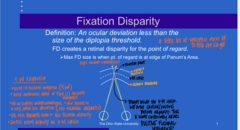
What continually drives positive fusional vergence?
Small amounts of purposeful retinal disparity
What do purposeful errors in fixation disparity provide?
the stimulus to fusional vergence
True or False:
Fixation disparity is the result of "Laziness" or "sloppiness" in the system
False
Amount of fixation disparity is _____ to the amount of fusional vergence
proportional
What does the presence of fixation disparity indicate?
that the patient is utilizing fusional vergence
If the patient has an EXO deviation, they will need (positive/negative) fusional vergence
positive
If the patient has an ESO deviation, they will need (positive/negative) fusional vergence
negative
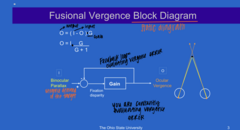
True or False:
There is a feedback loop in the fusional vergence system that is constantly calculating vergence error
true
What is gain?
-a constant of proportionality relating fusional vergence to fixation disparity
-ratio of fusional vergence to fixation disparity
Gain = ??
fusional vergence / fixation disparity
Fusional vergence response is always (more/less) than the stimulus
less
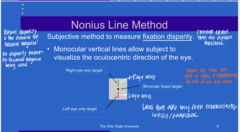
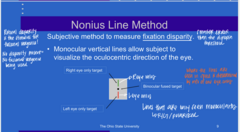
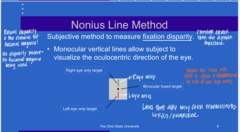
What is the Nonius Line Method?
subjective method to measure fixation disparity
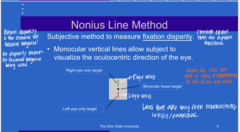
How does the Nonius Line Method work?
Monocular vertical lines allow the subject to visualize the oculocentric direction of the eye
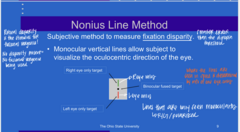
In order for a fixation disparity to be present, it needs to be (larger/smaller) than the diplopia threshold
smaller
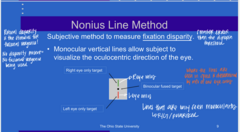
REVIEW: What is the stimulus for fusional vergence?
retinal disparity
REVIEW: If there is no retinal disparity present, is the patient using an fusional vergence?
NO
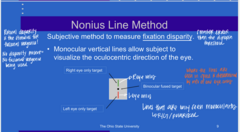
With the Nonius Line Method, the lines are seen in space determined by information of (one eye only/both eyes)
one eye only
What type of equipment is needed for the Nonius Line test?
R/G glasses
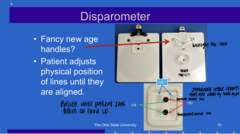
How does the disparometer work?
-Patient will adjust physical position of the lines until they are aligned
-Standard letter charts are seen by both eyes (OU)
-Red line is seen by OD
-Green line is seen by OS
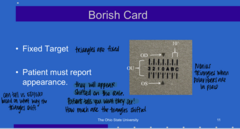
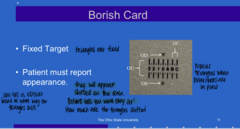
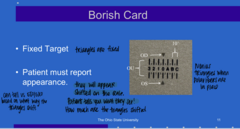
How does the Borish Card work?
-There is a fixed target present (triangles)
-Patient must report the appearance (location) of the triangles relative to the ruler on the card
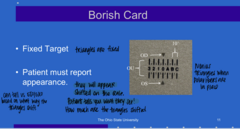
What is the function of the Borish Card?
Can tell us if an EXO/ESO deviation is present based on the way that the triangles are shifted
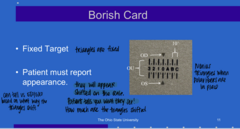
What is the angular separation of the Numbers/letters on the Borish card?
10'
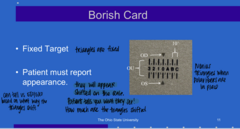
The (OD/OS) will see the triangle above the ruler on the Borish card when polarized glasses are on
OD
The (OD/OS) will see the triangle below the ruler on the Borish card when polarized glasses are on
OS
The (OD/OS) will see the ruler on the Borish card when polarized glasses are on
OU! Both OD and OS see the ruler
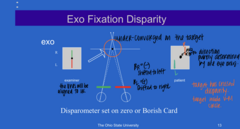
REVIEW: When an EXO fixation disparity is present, the patient is (over/under) converged
under
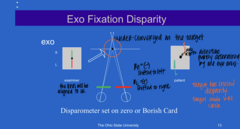
How will a patient with an EXO deviation observe the disparometer?
-Both eyes will see the center target
-Red line (OD) will be to the L of the center target
-Green line (OS) will be to the R of the center target
-Crossed (positive) disparity
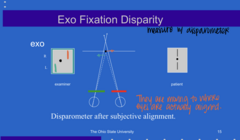
When a patient has an EXO deviation, how will the patient move this target (see pic) in order to get the lines to subjectively align?
-Red line (OD) to the Left
-Left line (OS) to the Right
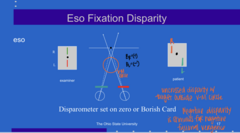
How will a patient with an ESO deviation observe the disparometer?
-Both eyes will see the center target
-Red line (OD) will be to the R of the center target
-Green line (OS) will be to the L of the center target
-Uncrossed (negative) disparity
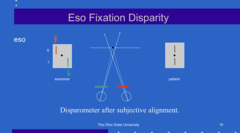
When a patient has an ESO deviation, how will the patient move this target (see pic) in order to get the lines to subjectively align?
-Red line (OD) to the Right
-Left line (OS) to the Left
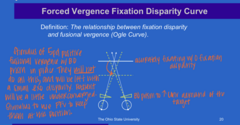
What is the forced vergence fixation disparity curve?
The relationship between fixation disparity and fusional vergence (Ogle Curve)
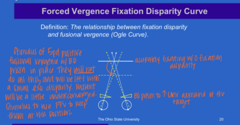
With 5 PD BO Prism is placed in front of a patient in order to stimulate convergence, what will happen?
Fusional vergence WILL NOT converge the entire 5PD BO. Patient will be left with a small EXO deviation relative to the target demand. Patient will be underconverged and this is the stimulus for positive fusional vergence to keep eyes in this position.
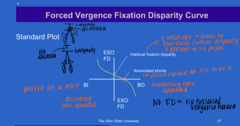
Standard Plot of Forced Vergence Fixation Disparity Curve (Pic)
Standard Plot of Forced Vergence Fixation Disparity Curve (Pic)
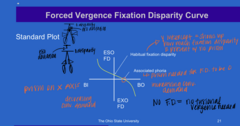
As BI prism increases, the (ESO/EXO) fixation disparity will increase
ESO
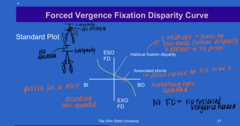
As BO prism increases, the (ESO/EXO) fixation disparity will increase
EXO
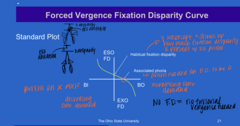
What is the x intercept represent on the Standard Plot of Forced Vergence Fixation Disparity Curve?
Associated phoria
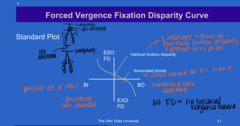
What is the associated phoria?
The prism amount needed for the fixation disparity to be 0
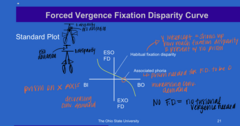
What is the y intercept represent on the Standard Plot of Forced Vergence Fixation Disparity Curve?
Habitual fixation disparity
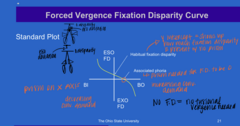
What is the habitual fixation disparity?
How much fixation disparity is present w/ no prism in place
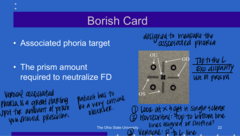
Can the Borish Card be an associated phoria target?
Yes
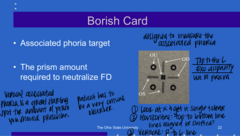
When the Borish Card is used as an associated phoria target, what is it measuring?
the prism amount that is required for the fixation disparity to be neutralized
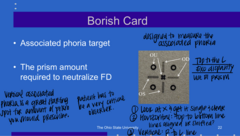
When the Borish Card is used as an associated phoria target, does the patient need to be wearing polarized glasses?
Yes
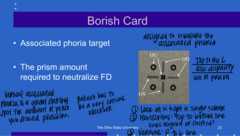
What can BOTH EYES see when the Borish Card is used as an associated phoria target?
-4 circles
-Central x
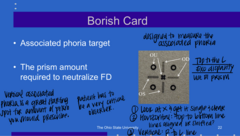
What can OD see when the Borish Card is used as an associated phoria target?
-Top vertical line
-Right horizontal line
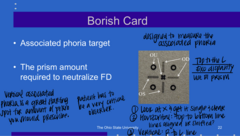
What can OS see when the Borish Card is used as an associated phoria target?
-Bottom vertical line
-Left horizontal line
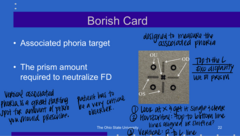
How to perform the Borish Card test to measure associated phoria?
1) Have the patient look at the X in the center of the target and make it single and clear
2) Are the vertical lines (top and bottom) aligned or shifted AT ALL?
3) Are the horizontal lines (right and left) aligned or shifted AT ALL?
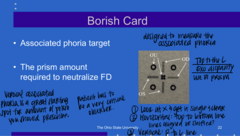
On the Borish card, if the top vertical line looked like it was to the LEFT of the bottom vertical line, what is this disparity?
-crossed disparity
-Exo deviation
**would use BI prism to neutralize the phoria of this patient
What do ASSOCIATED and DISSOCIATED phorias BOTH indicate?
convergence position of the eyes where NO FUSIONAL VERGENCE is needed to fuse the target
What is an associated phoria?
Makes measurement while eyes are associated (fused)
What is a dissociated phoria?
makes measurement while eyes are dissociated (not fused -- one eye covered)
How to dissociate a phoria?
Remove the stimulus to fusional vergence (cover an eye) so that eyes will assume posture where fusional vergence equals 0
How to associate a phoria?
Find the position of the eyes where input to maintain fusional vergence is 0 so fusional vergence must be 0
**putting prisms in front of the patient to make fusional vergence 0
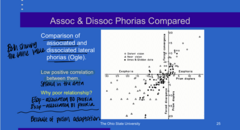
Comparison of Associated and Dissociated Lateral Phorias (Ogle) (Pic)
Comparison of Associated and Dissociated Lateral Phorias (Ogle) (Pic)
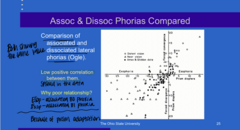
Is there a correlation between the associated and dissociated lateral phorias when compared?
Low positive correlation
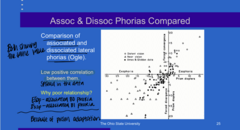
Why is there a POOR RELATIONSHIP between associated and dissociated lateral phorias?
Because of prism adapatation
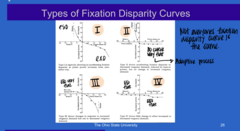
Types of Fixation Disparity Curves (Pic)
Types of Fixation Disparity Curves (Pic)
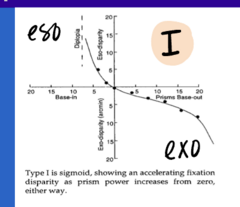
Describe a Type 1 Fixation Disparity Curve
-sigmoid shape
-Accelerating fixation disparity as prism power increases from 0 in the EXO and ESO direction
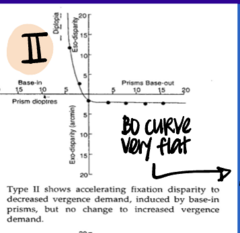
Describe a Type 2 Fixation Disparity Curve
-Accelerating fixation disparity to decreased vergence demand (BI)
-No change to increased vergence demand (BO) = prism adaptation
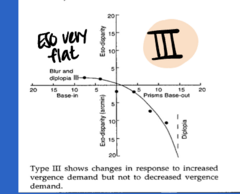
Describe a Type 3 Fixation Disparity Curve
-Accelerating fixation disparity to increased vergence demand (BO)
-No change to decreased vergence demand (BI) = prism adaptation
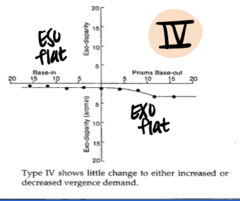
Describe a Type 4 Fixation Disparity Curve
Little change to either increased or decreased vergence demand
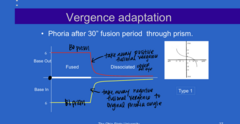
Type 1 Vergence Adaptation Curve (Pic)
**When the stimulus for positive and negative fusional vergence is taken away, the patient will quickly drift back to their normal phoria angle
Type 1 Vergence Adaptation Curve (Pic)
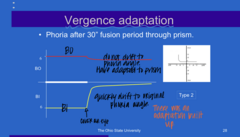
Type 2 Vergence Adaptation Curve (Pic)
**When the stimulus for negative fusional vergence is taken away, the patient will quickly drift back to their normal phoria angle. When the stimulus for positive fusional vergence in taken away, the patient DOES NOT drift to normal phoria angle d/t prism adaptation
Type 2 Vergence Adaptation Curve (Pic)
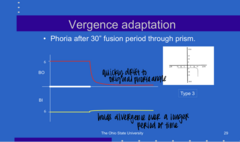
Type 3 Vergence Adaptation Curve (Pic)
**When the stimulus for positive fusional vergence is taken away, the patient will quickly drift back to their normal phoria angle. When the stimulus for negative fusional vergence in taken away, the patient DOES NOT drift to normal phoria angle d/t prism adaptation
Type 3 Vergence Adaptation Curve (Pic)
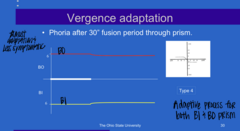
Type 4 Vergence Adaptation Curve (Pic)
**When the stimulus for both positive and negative fusional vergence is taken away, the patient WILL NOT drift back to their original phoria angle d/t prism adaptation
Type 4 Vergence Adaptation Curve (Pic)
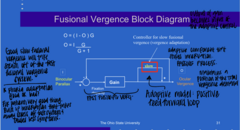
Fusional Vergence Block Diagram (Pic)
Fusional Vergence Block Diagram (Pic)
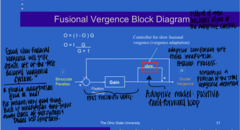
In the Fusional Vergence Block Diagram, the output of the gain (fast fusional vergence) will become what?
The stimulus for the adaptive control (positive feed forward loop)
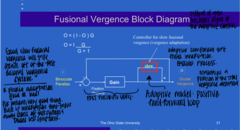
What is the benefit of the adaptive control (positive feed forward loop) on the Fusional Vergence Block Diagram?
The adaptive component stores innervation and is a passive process. It will maintain a portion of the total vergence demand and TAKE STRAIN OFF of the fusional vergence system.
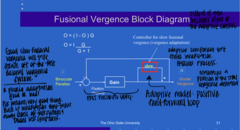
Is phoria adaptation good or bad?
For the patient, it is a very good thing. This built up innervation takes stress away from the fusional vergence system and causes less symptoms.

On the Borish Near Card, what is the magnitude of the deviation?
20' (min of arc)
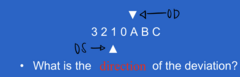
On the Borish Near Card, what is the direction of the deviation?
eso deviation (uncrossed deviation)
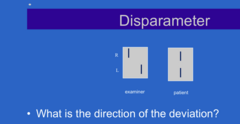
On the Disparometer, what is the direction of the deviation shown?
eso deviation