Meiosis and Mitosis
 Call Kai
 Learn
Learn Practice Test
 Spaced Repetition
 Match
Match Flashcards
 Knowt Play
1/51

There's no tags or description
Looks like no tags are added yet.
Name | Mastery | Learn | Test | Matching | Spaced | Call with Kai | Chat |
|---|
No analytics yet
Send a link to your students to track their progress
52 Terms
Prokaryote
Unicellular, no membrane bound organelles
Prokaryotic DNA does not exist in the highly order and packed arrangement
Made up of eubacteria and archaea
Eukaryote
Both unicellular and multicellular with membrane-bound organelles
Genetic material surrounded in a nuclear enveloped to form a nucleus
DNA is closely associated with histones to form tightly packed chromosomes
Viruses
Neither prokaryotic nor eukaryotic
Outer protein coat surrounding nucleic acid
Prokaryotic Cell Reproduction
Simple division: separation of replicated circular chromosome
Origin of replication
High rate of replication
Eukaryotic Cell Replication
Eukaryotic chromosomes:
Homologous pair
Chromosome structure
The cell cycle
Genetic consequences of the cell cycle
Homologous Pair
Diploid cells carry two sets of genetic information
Haploid cells carry one set of genetic information
Centromere
Attachment point for spindle microtubules
Telomeres
Tips of a linear chromosome
Origins of replication
Where the DNA synthesis begins
The Cell Cycle
Life cycle of the cell
Interphase: an extended period between cell divisions, DNA synthesis, and chromosome replication phase
M phase: mitotic phase
Phase check points: key transition points
Interphase
G1, S, G2
G1: Growth; proteins necessary for cell division synthesized
G1/S checkpoint: regulated decision point
S: DNA synthesis
G2: biochemical preparation for cell division
G2/M checkpoint: only passed if DNA completely replicated and undamaged
M phase
Mitosis: separation of sister chromatids
Cytokinesis: separation of cytoplasm
Mitosis
Prophase
Prometaphase
Metaphase
Anaphase
Telophase
Prophase (Mitosis)
Chromosomes condense
Each chromosome possesses two chromatids.
The mitotic spindle forms.
Prometaphase (Mitosis)
The nuclear membrane disintegrates.
Spindle microtubules attach to chromatids
Metaphase
Chromosomes line up on the metaphase plate
Telophase (Mitosis)
Chromosomes arrive at spindle poles
The nuclear membrane re-forms and the chromosomes relax
Anaphase (Mitosis)
Sister chromatids separate and move toward opposite poles

Prophase Mitosis

Prometaphase Mitosis

Metaphase Mitosis

Anaphase Mitosis

Telophase Mitosis
Genetic Consequences of the Cell Cycle
Producing two cells that are genetically identical to each other and with the cell that gave rise to them
Newly formed cells contain a full complement of chromosomes
Each newly formed cell contains approximately half the cytoplasm and organelle content of the original parental cell
Meiosis
The production of haploid gametes
Fertilization
The fusion of haploid gamates
Genetic variation
Consequences of meiosis
Meiosis
Interphase: DNA synthesis and chromosome replication phase
Meiosis I: separation of homologous chromosome pairs, and reduction of the chromosome number by half
Meiosis II: separation of sister chromatids, also known as equatorial division
Meiosis I
Prophase I
Metaphase I
Anaphase I
Telophase I
Interkinesis
Prophase II
Metaphase II
Anaphase II
Telophase II
Prophase I (Meiosis I)
Synapsis: close pairing of homologous chromosome
Tetrad: closely associated four-sister chromatids of two homologous chromosomes
Crossing over: crossing over of chromosome segments from the sister chromatid of one chromosome to the sister chromatid of the other synapsed chromosome - exchange of genetic information, the first mechanism of generation genetic variation in newly formed gametes
Metaphase I (Meiosis I)
Random alignment of homologous pairs of chromosome along the metaphase plate
Anaphase I (Meiosis I)
Separation of homologous chromosome pairs, and the random distribution of chromosomes into two newly divided cells - second mechanism of generating genetics variation in the newly formed gametes
Homologous chromosomes separate and move toward opposite poles
Telophase I (Meiosis I)
Chromosomes arrive at the spindle poles and the cytoplasm divides
Prophase II (Meiosis II)
The chromosomes recondense
Metaphase II (Meiosis II)
Individual chromosomes line up on the equatorial plate
Anaphase II (Meiosis II)
Sister chromatids separate and move toward opposite poles
Telophase II (Meiosis II)
Chromosomes arrive at the spindle poles and the cytoplasm divides

Middle Prophase I
Chromosomes begin to condense, and the spindle forms
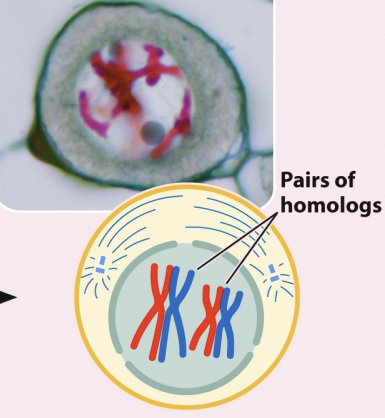
Late Prophase I

Metaphase I
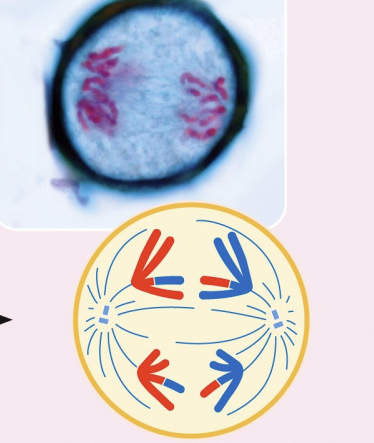
Anaphase I

Telophase I
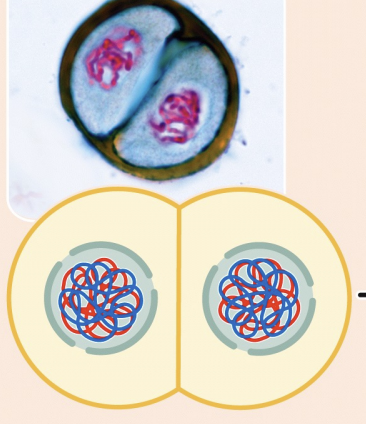
Prophase II
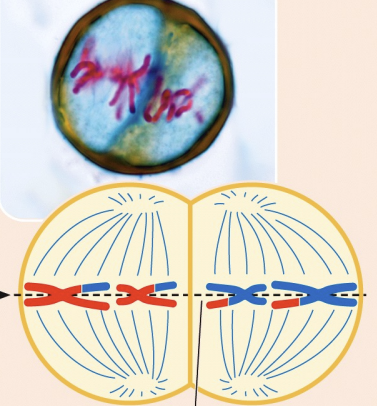
Metaphase II
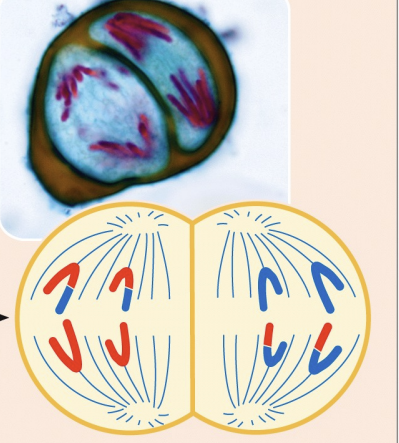
Anaphase II
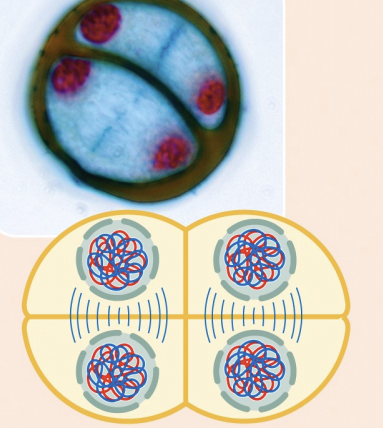
Telophase II

Products of Meiosis
Consequences of Meiosis and Genetic Variation
Four cells are produced from each original cell
Chromosome number in each new cell is reduced by half. The new cells are haploid
Newly formed cells from meiosis are genetically different from one another and from the parental cell
Cohesin
A protein that holds the chromatids together and is key to the behavior of chromosome in mitosis and meiosis
Spermatogensis:
Male gamete production
Oogenesis:
Female gamete production