Chemistry Test 1
0.0(0)
Studied by 2 people Call Kai
 Learn
Learn Practice Test
 Spaced Repetition
 Match
Match Flashcards
 Knowt Play
Card Sorting
1/67

Earn XP
Description and Tags
Last updated 3:12 AM on 1/29/23
Name | Mastery | Learn | Test | Matching | Spaced | Call with Kai | Chat |
|---|
No analytics yet
Send a link to your students to track their progress
68 Terms
1
New cards
Avagadro’s Number
6\.022 \* 10^23 per 1 mole
2
New cards
Chemistry
study of matter and the changes it undergoes.
3
New cards
Science
branch of knowledge gained by the scientific method.
4
New cards
Antoine Lavoisier (18th century)
helped transform chemistry from a science observtion to the science of measurement.
5
New cards
Lavoisier
said matter is elements (cannot be broken down) or compounds (>1 element); helped Dalton for Atomic Theory
6
New cards
Law of Conservation of Mass
during a chemical reaction the total mass remains constant; “Nothing is lost, nothing is created, everything is transformed".”
7
New cards
John Dalton’s Atomic Theory
Atoms combine to form molecules; atoma are not changed in the course of a chemical reaction, they just “change partners”
8
New cards
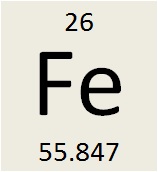
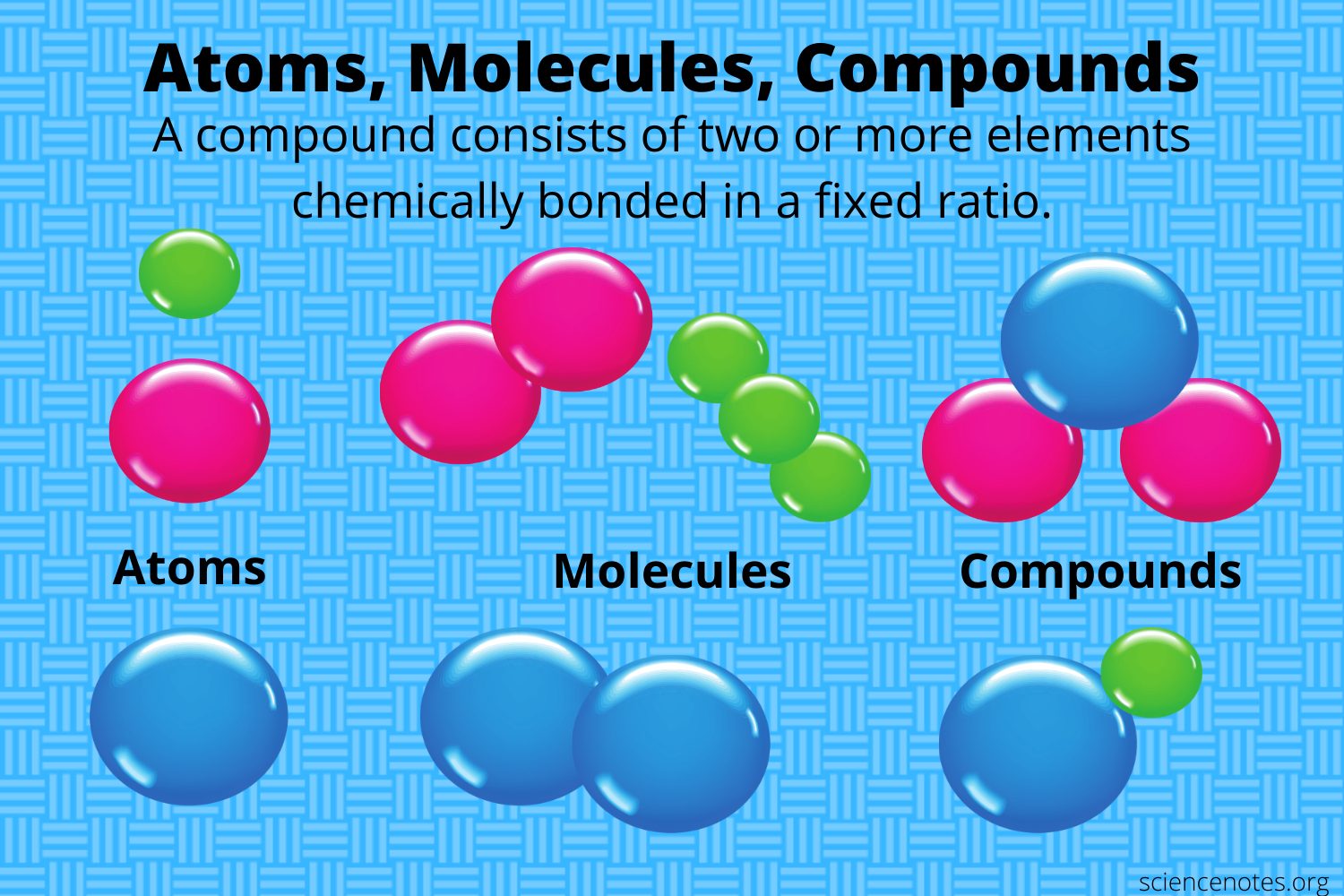
atom
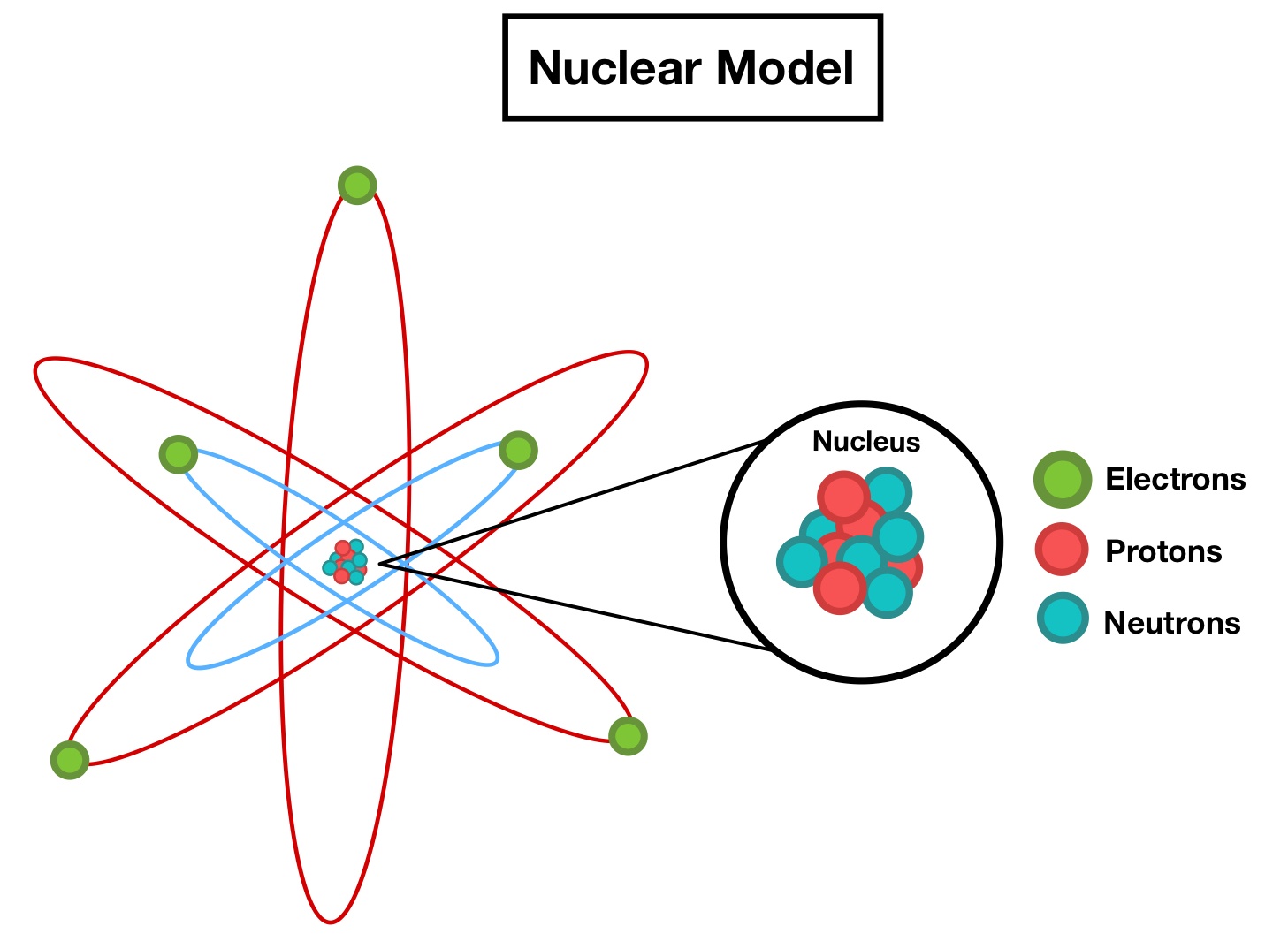
smallest component of an element composed of protons and neutrons surrounded by electrons.
Ex) Na, B, Fe
Ex) Na, B, Fe
9
New cards
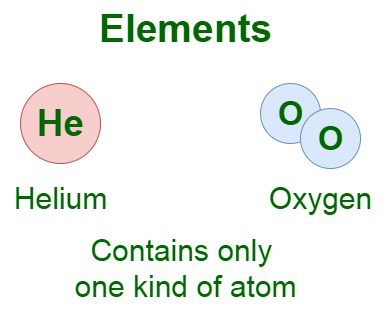
element
an atom or group of atoma of the **same** type.
Ex) Na, C, Fe, P_4, S_8
Ex) Na, C, Fe, P_4, S_8
10
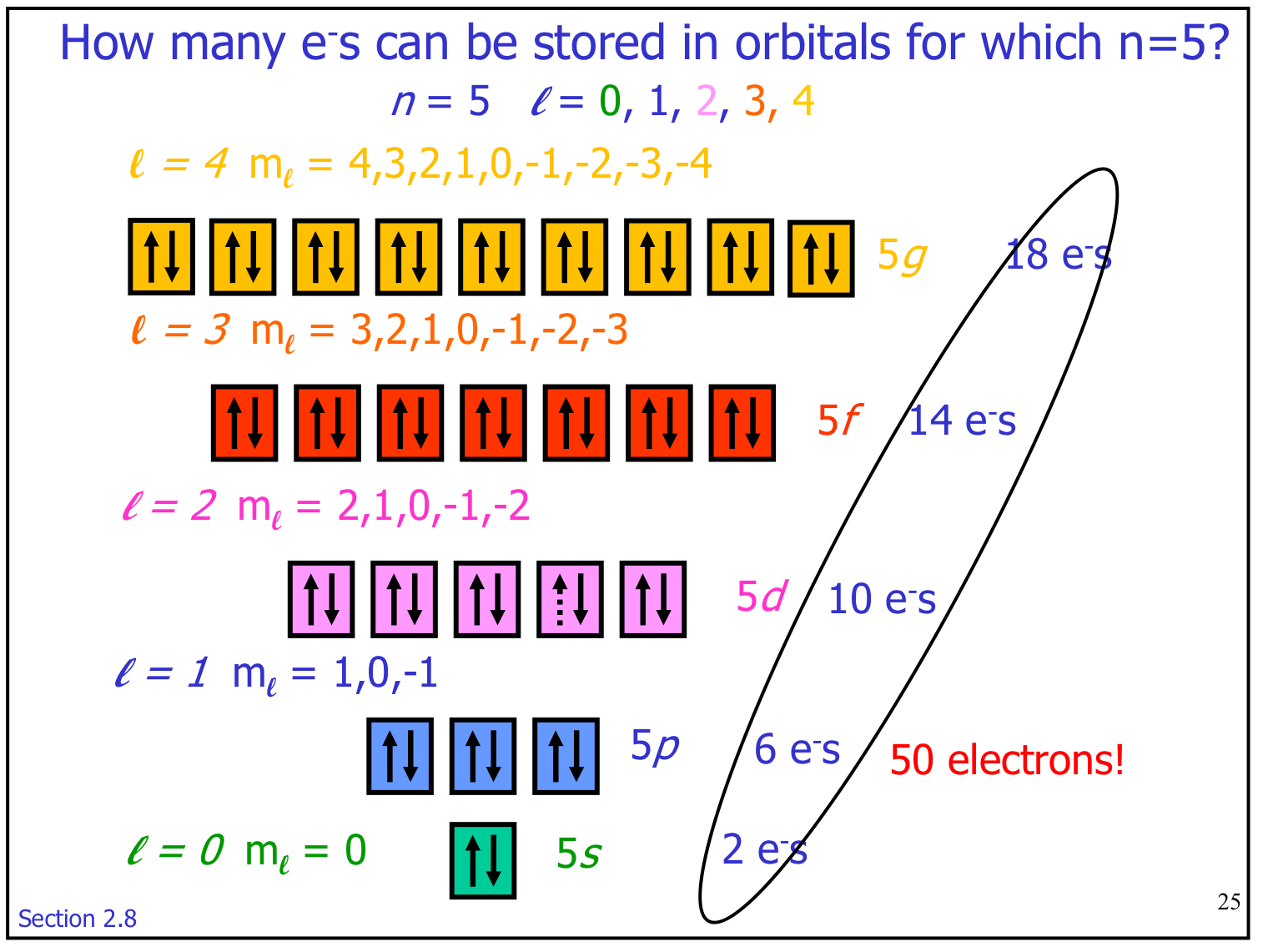
New cards
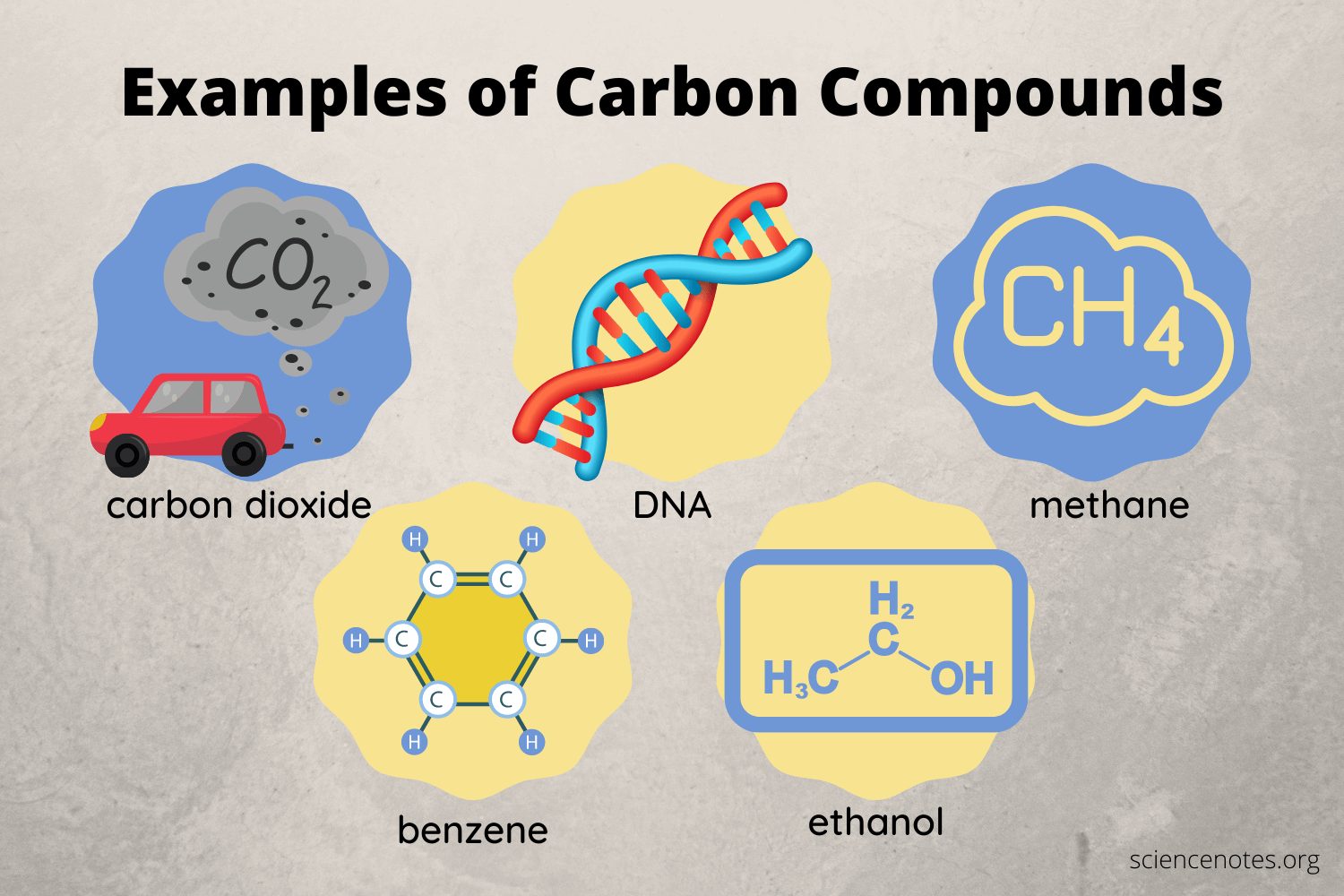
compound
two or more **different** atoms bound together.
Ex) CO_2 , H_2O
Ex) CO_2 , H_2O
11
New cards
molecule
two or more atoms bound together.
Ex) P_4, S_8, CO_2, H_2O
Ex) P_4, S_8, CO_2, H_2O
12
New cards
diatomic molecules
The “gens”
Ex) hydrogen, nitrogen, oxygen, halogens, P_4 & S_8
Ex) hydrogen, nitrogen, oxygen, halogens, P_4 & S_8
13
New cards
two components of the universe
matter and energy
14
New cards
matter
physical objects that take up space, have mass atoms, elements, moleculesm compounds, …”stuff”
15
New cards
energy
the capacity to do work or transfer heat kinetic, potential
16
New cards
potential energy
stored energy, energy of position.
Ex) a truck on a hill; a cheese wheel on a hill; a stretched rubber band (each can be converted to kinetic energy).
Ex) a truck on a hill; a cheese wheel on a hill; a stretched rubber band (each can be converted to kinetic energy).
17
New cards
Nature seeks to
release energy as substances move from higher energy to a lower energy state.
△E < 0
△E < 0
18
New cards
Unfavorable (unlikely)
a floppy rubber band becoming taut. (E final)
19
New cards
Favorable (likely)
a taut rubber band becoming floppy (E initial)
20
New cards
energy change
△E = E (final) - E (initial)
21
New cards
Coulomb’s Law of Force
1800s: Coulumb observed force of charged particles
22
New cards
if charges are f of particles 1 and 2 are both positive or both negative if the force is
positive & repulsive. (from Coulumbs force eqn.)
23
New cards
when one particle is positively charged and the other is negatively charged, the force is
negative & attractive. (from Coulumbs force eqn.)
24
New cards
larger numerator =
large charge
25
New cards
smaller denominator =
closer distance; less shielding (vacuum shields less than water)
26
New cards
particles are more attracted to one another when
they have larger charge and are closer together.
27
New cards
proton
a subatomic particle with a charge of +1 and an atomic mass of 1.
28
New cards
neutron
a subatomic particle with a charge of 0 and an atomic mass of 1.
29
New cards
electron
a subatomic particle with a charge of -1 and an atomic mass of \~0.
30
New cards
atomic number
the number of protons.
31
New cards
atomic mass or mass number
the number of protons and neutrons in an atom.
32
New cards
isotopes
atoms with the same atomic number (protons) but different mass numbers (neutrons different).
33
New cards
cation
a species with more protons than electrons (+).
34
New cards
anion
a species with more electrons than protons (-).
35
New cards
group
elements within the same column sharing similar properties.
36
New cards
period
elements in the same row.
37
New cards
metalloids
elements at border between metals & nonmetals that show properties intermediate between metals and nonmetals.
38
New cards
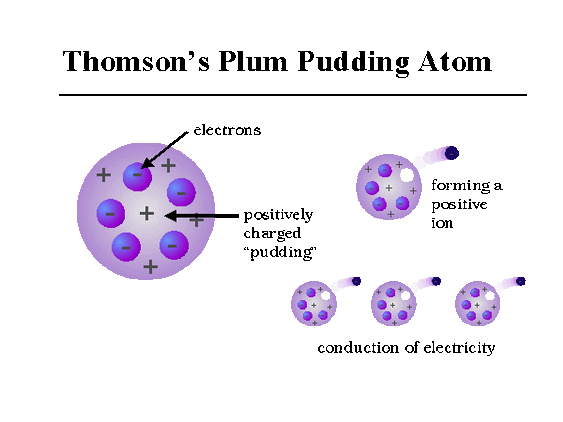
1903: Thompson “Plum/Rasin Pudding”
39
New cards
1911: Rutherford Nuclear Model
40
New cards
Visible light
extends from 400 nm to 700 nm.
41
New cards
Radio Waves
Hertz: wavelengths as long as football fields, used to transmit communication signals.
42
New cards
Microwaves
efficiently absorbed by water, cooking, medical imaging.
43
New cards
Infrared (IR)
Heat: used in commercial night vision equipment.
44
New cards
Visible
seen by human eyes.
45
New cards
Ultraviolet (UV)
High energy: can break chemical bonds.
46
New cards
X-rays
Applied to medical uses; can break chemical bonds.
47
New cards
Gamma rays
Most energetic, will seriously mess you up.
48
New cards
light
is a form of energy called electromagnetic radiation; light exists as a wave.
49
New cards
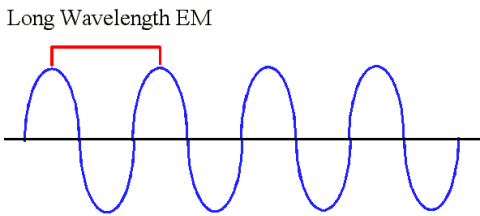
wavelength (lambda)
distance between 2 identical points on a wave
Unit = m
Unit = m

50
New cards
frequency (“nu”)
number of waves that pass ap point in one second.
Units = waves/second , 1/s , Hz , s^-1
Units = waves/second , 1/s , Hz , s^-1

51
New cards
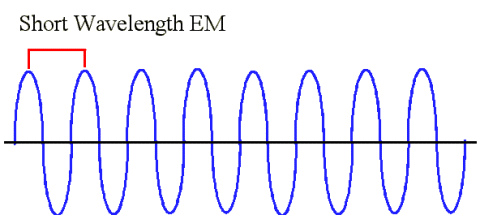
longer wavelength
lower frequency (fewer waves per second)
52
New cards
shorter wavelength
higher frequency (more waves per second)
53
New cards
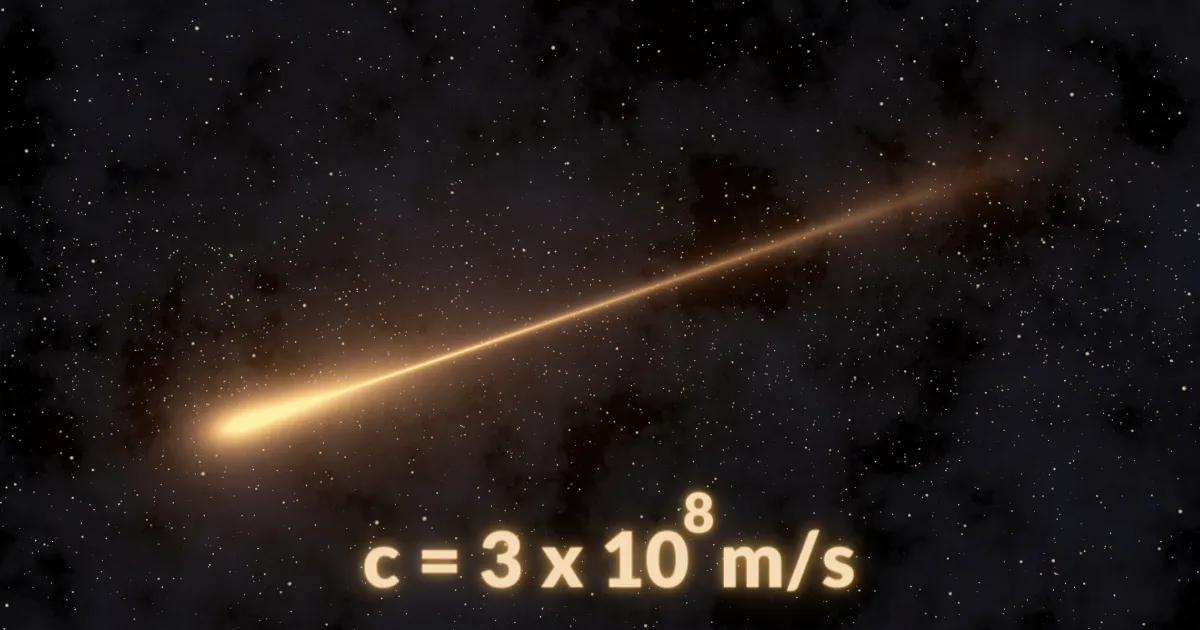
speed of light (c)
3\.0 x10^8 m/s
54
New cards
Photon of light
has energy directly proportional to the frequency of its wave.

55
New cards
Electrons
can orbit the nucleus only at specific **distances** or **energy levels**.
56
New cards
n=1 orbital →
closest to nucleus, lowest in energy.
57
New cards
As **n** increases
distance from nucleus and energy increases.
58
New cards
Energy gaps between orbitals are
**NOT** equally spaced, they move closer together as **n** increases.
59
New cards
Schrödinger equation
in behaving as waves, there are regions where electrons **will be found** regions where they **will NOT be found** (__nodes__).
60
New cards
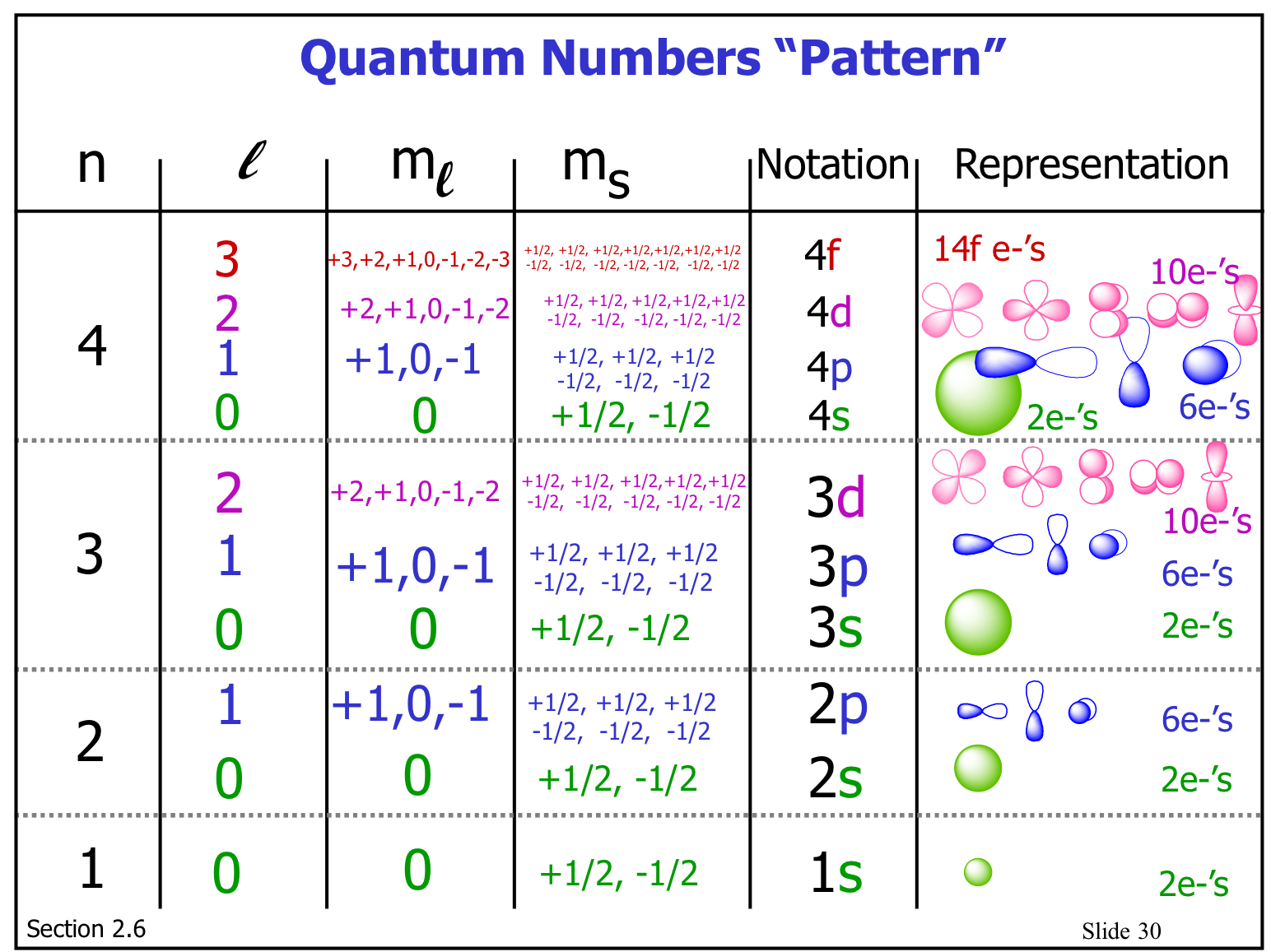
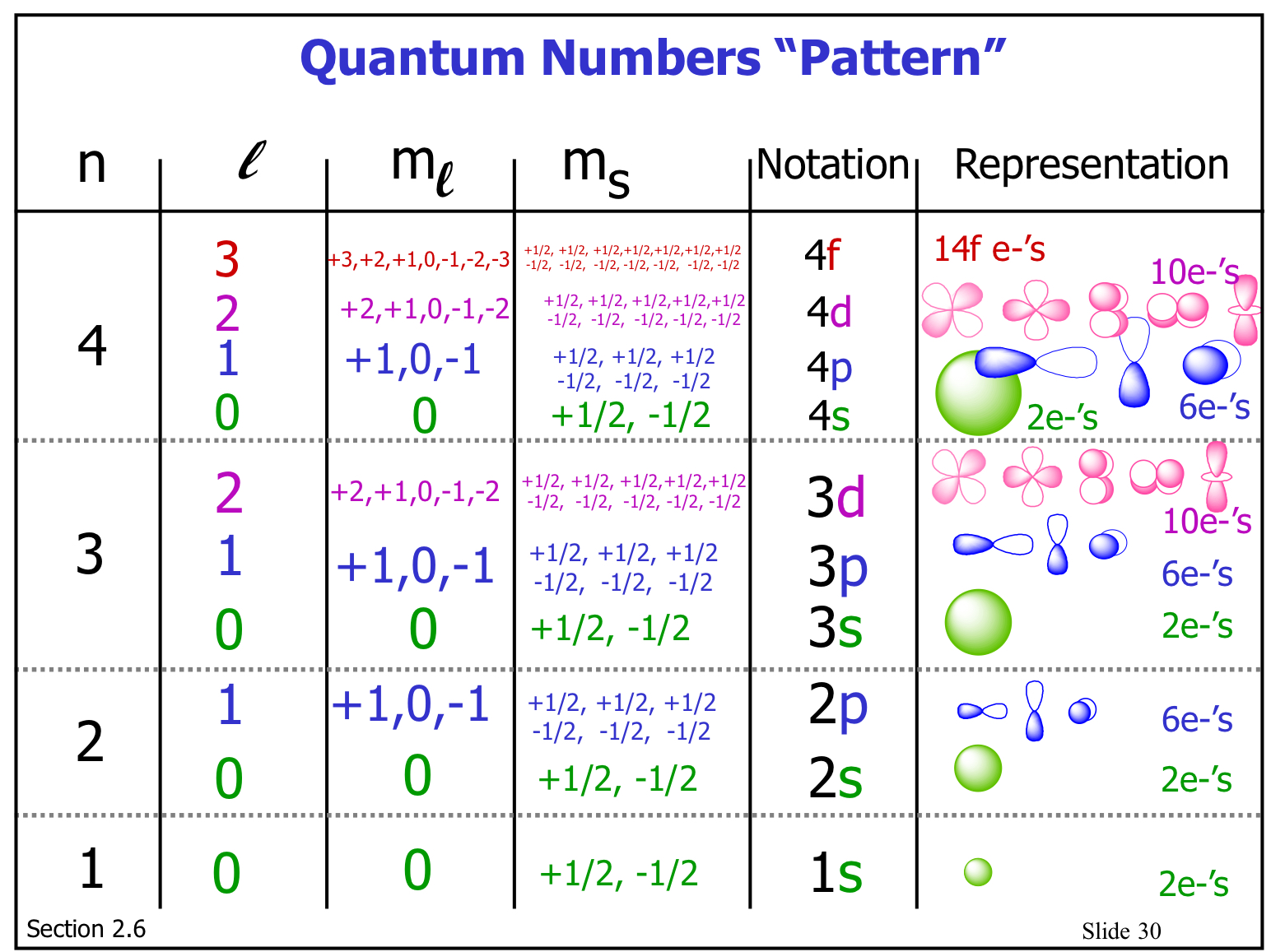
“n” : Principle Quantum Number
designates energy level (or shell); primary indicator of the electrons energy; tells average distance from nucleus; n is always positive.
61
New cards
“l” : Angular Momentum Quantum Number
designates orbital shape; also dictates number angular nodes = l; __secondary__ indicator of electrons energy (sublevel or sub shell); ranges in (n-1, n-2, …, 0) and is also based on letter orbitals.
62
New cards
“m_l” : Magnetic Orbital QN
designates **orientation in space** of the orbitals of the sublevel “l”; indicates the **number** of orbitals ina sublevel; integer values range from “l” to “-l”
63
New cards
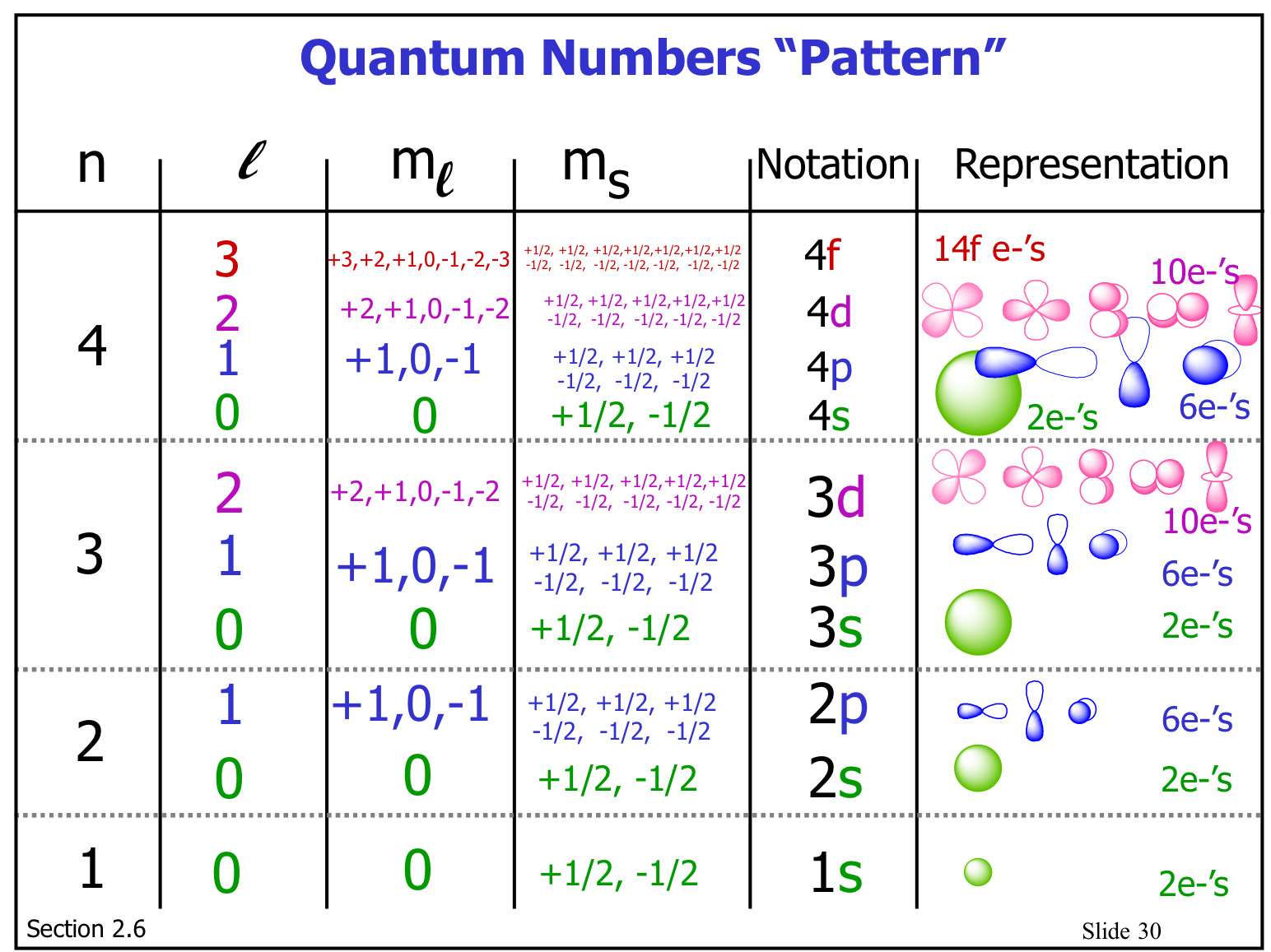
“m_s” : Spin QN
electrons are spheres of negative charge (kind of); when rotate on axes (“spin”), makes magnetic field; depending on rotation the fields can be directionally “up” or “down”; **one orbital** accomodates 2 **electrons** of opposite spin values: +1/2 or -1/2
64
New cards
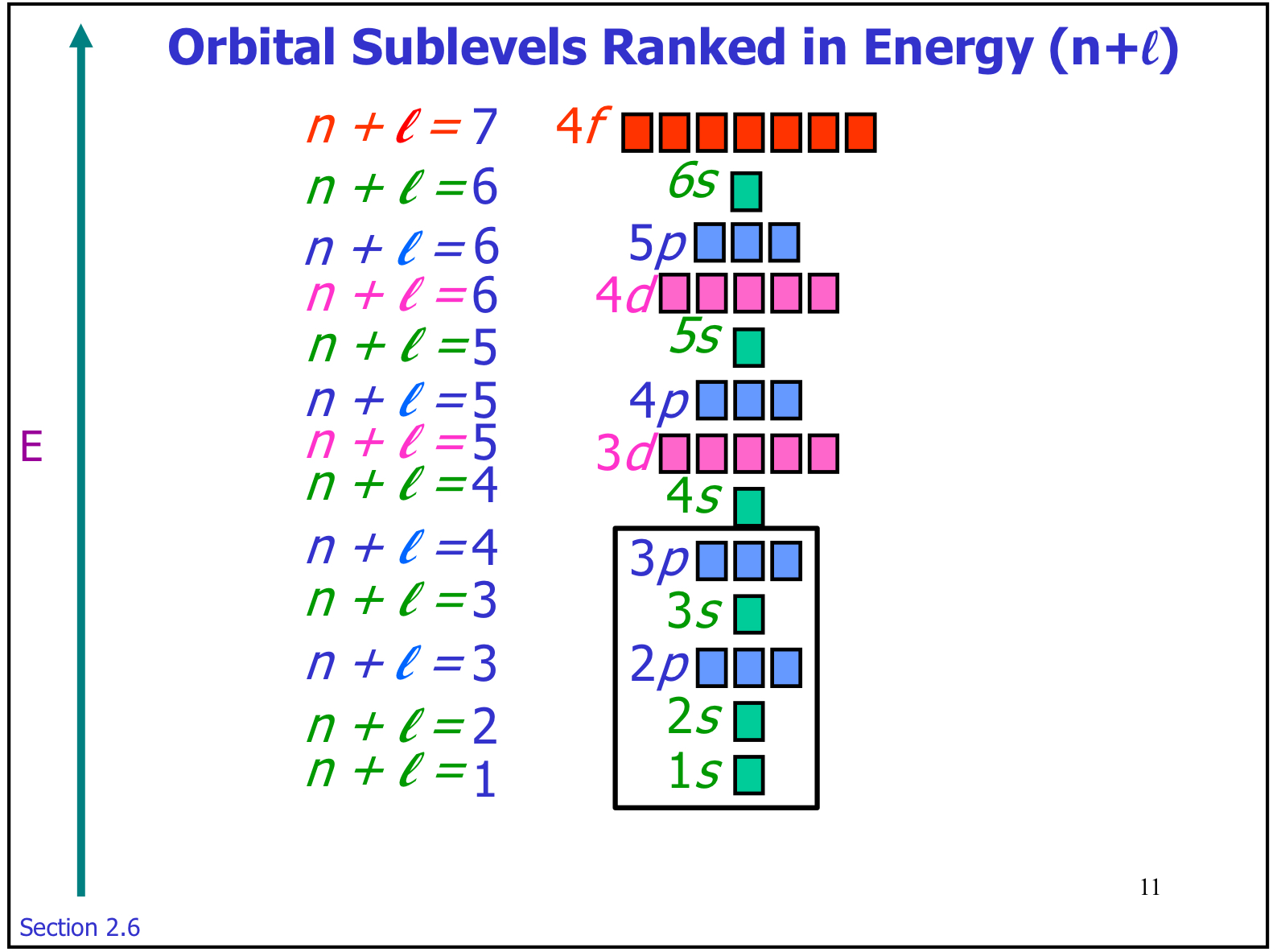
Orbital Sublevels Ranked in Every
(n+l)
(n+l)
65
New cards
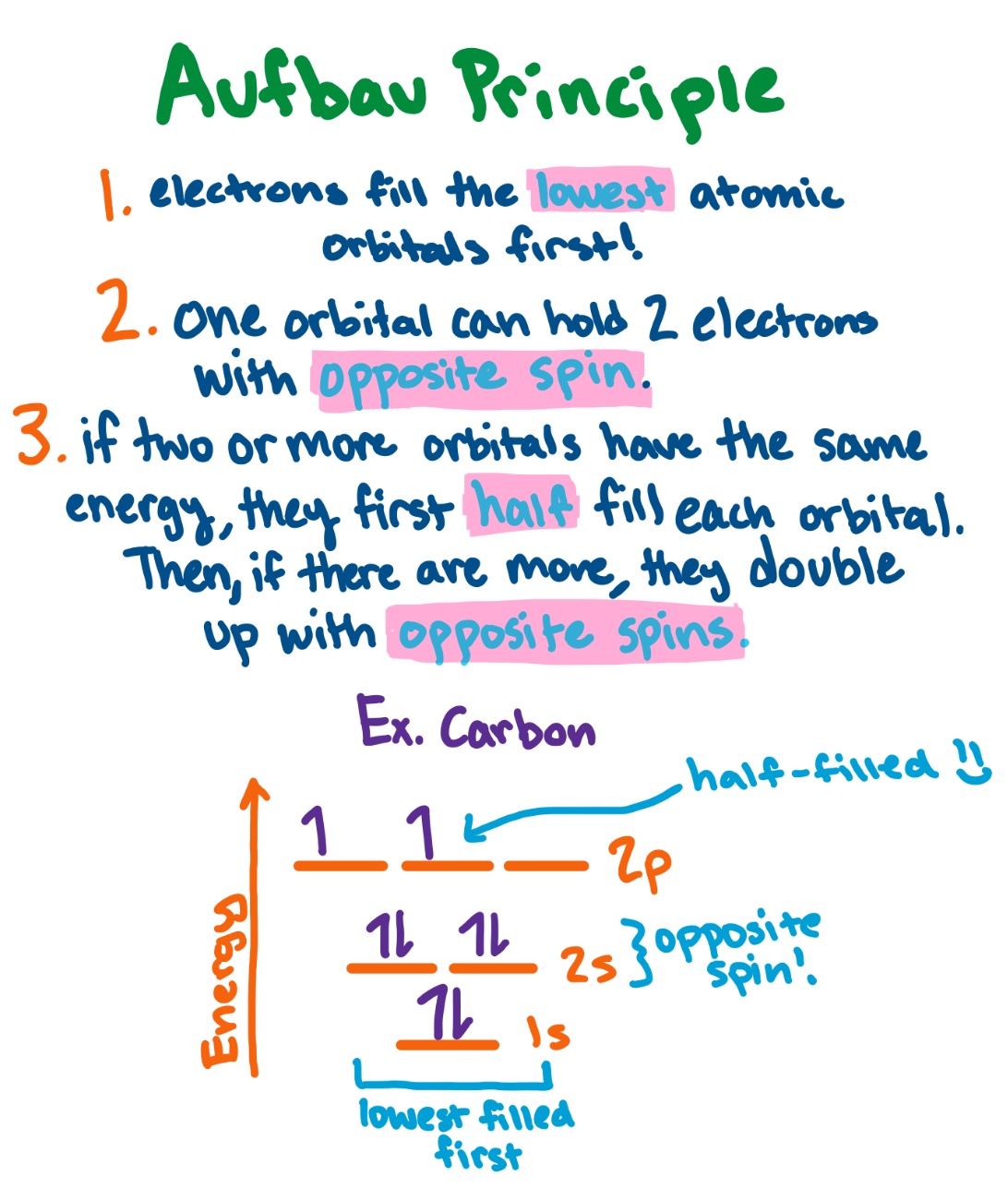
Aufbau (building up) principle
electrons enter first available orbital or lowest (all electrons at the lowest energy); Nature seeks the lowest energy state.
66
New cards
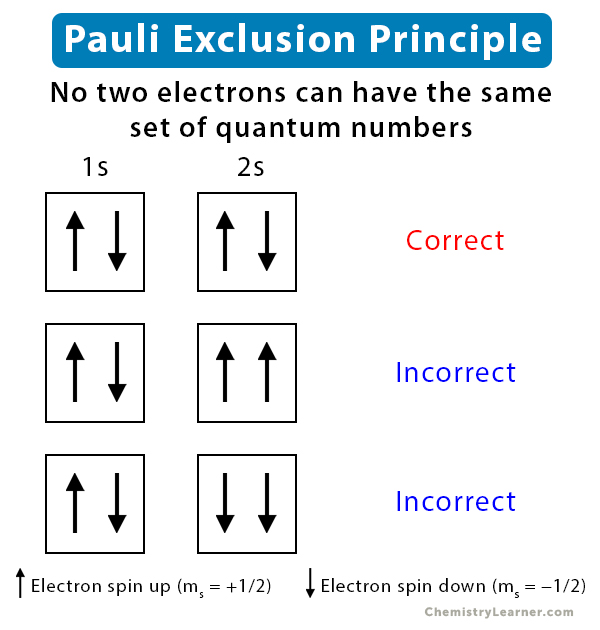
The Pauli Exclusion Principle
No two electrons have the same 4 QN; two objects can’t occupy the same space (electrons in the same sublever spread out as much as possible).
67
New cards
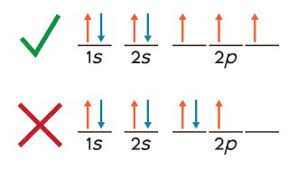
Hund’s Rule
electrons occupy different orbitals in a sublevel with the same spin, rather than pair, until each orbitaal has at least one electron; at the same energy sublevel, electron’s like to spread out and have the same spin, its the lowest energy state, pairing is higher energy (unpaired electrons pointing the same direction).
68
New cards
Finding number of electrons