Lexicology Midterm
 Call Kai
 Learn
Learn Practice Test
 Spaced Repetition
 Match
Match Flashcards
 Knowt Play
1/107

There's no tags or description
Looks like no tags are added yet.
Name | Mastery | Learn | Test | Matching | Spaced | Call with Kai | Chat |
|---|
No analytics yet
Send a link to your students to track their progress
108 Terms
what is lexicology?
branch of linguistics that studies stock of words and their properties

what does lexicology even do?
studies and systematically describes vocab, studies separate words and their morphological and semantic structure + word combinations.
branches associated w/ lexicology
morphology, semantics, phonology, lexicography, psycholonguistics, syntax, historical linguistics
types of lexicology
general, special, synchronic, diachronic, contrastive
general lexicology
general study of words and vocab (not bound to a specific language)
special lexicology
study of vocab and words in a specific language
synchronic lexicology
vocab of a certain language at a certain point in time
diachronic lexicology
how vocab of a langauge changes over time
contrastive lexicology
similarities between vocabs in two diff languages
3 language levels
level of sound (phonetical), grammar (grammatical) and vocabulary (lexical)
how is meaning of words signaled?
through grammatical context (she took a book vs. she took to a life of crime)
how does level of sound influence lexicology?
lengths of vowels, stress placement and pitch. (sheep x ship)

what is stylistics?
study of particular styles and expressive devices in discourse
what is sociolinguistics?
language in relation to social factors (religion, class, ocupation, dialect…)
lexicon synonyms
lexis, word stock, vocabulary, word bank
words in ACTIVE personal lexicon
5000 (we use these frequently)
words in PASSIVE personal lexicon
25000-60000 (depends on occupation, education, reading etc.)
what is a lexeme?
the fundamental unit in a lexicon, a word realized by several morphological words
lexeme example
do = lexeme AND a word, does/did/done/doing = words
what is a sememe?
smallest, indivisible unit of meaning (of the lexeme)
sememe example
move = to move, but also conveys meanings for roll, jump, turn, duck
describe the morphological process
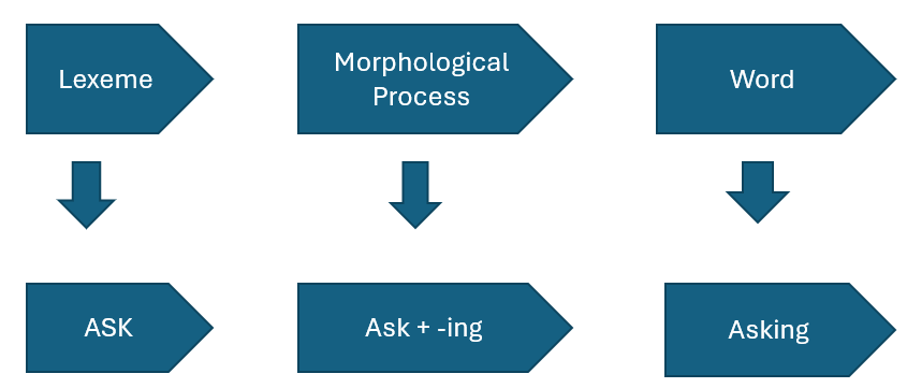
dimensions of lexemes (horss)
historical (development), structural (has a structure), regional (where it’s used), social (who is using the word), occupational (what it means in specific technical or professional contexts) HORSS
loaded lexeme? what even is that?
a lexeme that has a whole lotta connotations (regime = literally a system of doing things, but connotations are an oppressive, undemocratic, illegitimate, or authoritarian ruling group.

what is a word?
a sound or combination of sounds or its repersentation in writing that symbolizes a meaning. (a spoken segment - word - can be used in isolation)
what are three levels of a word?
langue (the invisible rules and system), parole (physical act of speaking or writing), context (circumstances where the word is that helps determine meaning)
what units are words recognized as?
visual (not as auditory)
orthographical words
any sequence of letters separated by spaces in written text (color x colour)
phonological words
a unit of spoken language defined by sound patterns (at all x a tall)
why is segmentation and pausing used?
the words need spaces in between them to be understandable
two types of words
simple (one morpheme: red, give) and complex (more morphemes: blackbird, disembark)
types of word meaning
grammatical vs. lexical
grammatical meaning
divides words into big groups (parts of speech, classes etc.), word order, inflectional suffixes, more abstract than the lexical meaning
lexical meaning
conceptual, associative, stylistic, expressive, collocative
conceptual lexical meaning
the denotative one, what’s in the vocab
associative lexical meaning
the connotations the word suggests or implies (white = pure, clean, cold, neutral vs. red = confident, assertive, aggressive, threatening)
stylistic lexical meaning
meanings when its used in various stylistic strata of lang
expressive stylistic meaning
the emotions the author conveys to the listener/reader
collocative stylistic meaning
a part of the word’s meaning is suggested by the word before and after it in text or speech.
what to know in order to know what the word means? (bruh…)
denotation, connotation, inner structure, collability (the word occurs with other words in context), paradigmatic relation (synonymy + antonymy), taxonomy (classification fo the word), distribution and frequency (how often and in what context the word appears)

semantic fields
an area of meaning (temperature = warm, cold, freezing, hot, boiling)
how do new words happen huh? (fuck me)
word formation, borrowing, change of meaning, change in subsystems

vocab as a system (define it bro)
a set of interconnected phenomena that influence each other
centre vs periphery
centre = stability, the core words everybody knows… peripehery = words limited in frequency (freakbob)

what happpents when umm… subsystems of two languages
red hair (nabarvene chlupy? ewww) x cervene vlasy (proste vlasy)
what the FUCK. is extralinguistic reality?
everything that isn’t langauge… real world things, experiences, events that the words refer to. (no, toyota camry isn’t a bird)
fuck you toyota camry. your bluetooth radio sucks.
what is czech knedlik in english
dumpling, but that umm… really it’s more like a czech nok
why does extralinguistic reality happen?
we OBVIOUSLY don’t have names for things we don’t fucking have here. Mochi is mochi because it’s japanese and we don’t have a czech moči equivalent cuz that’d be piss…
what are content words?
major full lexical words (noun, verb, adjective, adverb)
what are function words?
minor, empty words for grammar purposes (conjunctions, articles, prepositions, determiners, modal verbs, idgaaafffffff)
what extralinguistic bullshit is specific to English?
Tutor, airing cupboard, speaker
lexical density formula (why the fuck is there math)
N / L x 100 (L = all the words in the text, N = the content words)

what are core words?
basic common words used in every language (children, stomach)
what are non-core words?
more specific or less frequent in everyday use (abdomen, offsprings)
what is in core vocabulary?
days otw, months, seasons, numbers, colors, fam members, body parts, common professions
syntagmatic relation
with neighboring words, a collocative relation.
paradigmatic relation
words which can be used in the same position in the sentence, a substitution typa thing.
what paradigmatic relations do we have?
synonymy, antonymy, homonymy, hyper/hyponymy
what syntagmatic relations do we have?
collocations, idioms, phrases
types of synonyms by formality
formal x informal, standard x slang, emotive, borrowing, dialect, results of language change
variants in synonymy
spelling variants (colour x color), pronunciation, morphological, nominal vs. verbal (walk x take a walk), doublets (read x reading), paraphrases (female dog x bitch)
types of synonyms by meaning
absolute (the same shit), close (jump x leap), synonyms differing in intensity, degree and attitude (smash x break), stylistic (father x daddy)

collocations vs synonyms
collocations are habitual pairing of words, synonyms are about shit the same meaning as poop or dung or feces or manure or crap or dookie or excrement or stool or poo
sources of synonyms
borrowing, inter-borrowing, word formation, semantic changes
types of antonyms
gradable, complementary (nongradable), relational (hubby x wife), reverses (come x go, in x out)
antonyms according to word formation structure (RoDeM)
root antonyms (old x new), derivational antonyms (possible x impossible) and mixed antonyms (correct x incorrect x wrong)

what is polysemy bro tell me
words with multiple meanings (big = spacious, tall, adult, important, considerable)

Monosemy
words that have only one meaning WHAAAAAATTTTT??????????? (vowel, phoneme, picosecond)

what is homonymy?
two or more words that have the same spelling or pronunciation but mean sth different (row a boat x a row of ppl)
lexical ambiguity what? who is this?
ONE WORD MORE MEANINGS AGAAAIIINNNN (the student pointed at the mouth and the teached did too…. whose mouth???)
who is False Friends?
photograph x Fotograf (jiny jazyk, jina vec ale zni podobne)
Paronymy is….?
similar spelling or pronunciation but different meaning AGAIN??? bro… (cosmic x cosmetic)

hyponym x hypernym
you know this dude… come the fuck on
Meronymy
only a part of sth (finger x hand)
Holonymy
the thing is wHOLE (wholonymy, dumbass) (hand that has those fingers)
what is incompatibility?
the words in the same category can’t be true at the same time for the same thing (this car is blue x this car is red) (its Sunday x Monday)
Vocabulary growth
new words, word formations, giving a new meaning to an existing word, changing the meaning
why does stuff change meaning?
objective reasons or something FUUUCKKKEEEDD, like wars or cultural or economic shit (or subjective reasons like folk etymology) (or also social reasons cuz we need more fashionable expressions
example of denotation changes
blush (before: to look, now: to get red and shy awwwwwwww!)
pilot (on water before x on airplanes rn)
examples of narrowing meaning
deer (before: animal, today: buck/stag)
hound (dog before, only a certain dog breed rn)
examples of widening meaning
decimate (kill every tenth person → kill fucking everyone ANNIHILATE)


Amelioration (what is this wordddddddddddddd)
improving something GLOW UP TIMEEEE! (making sth more positive or respectable: nice meant foolish and now it means kind and pleasant)
examples of amelioration
nice (foolish x kind), knight (servant boy x noble solider), fascinate (to cast evil curses muhehe x to look aesthetically pleasing)
what is branching?
making shit have new meaning…
head originally meant.. well… the body part.
NOW??? mind, mental ability, a person, life, measure of length, the top part of sth…..

What is figurative language?
expressing facts figuratively (i bombed the test, why the long face?), so idioms i guess idk anymore
What is metaphor?
describing one thing by saying it is another unrelated thing (time is a thief)

types of metaphors
dead metaphor (normalized in everyday speech)
mixed metaphor (two different metaphors intertwined)
conceptual metaphor (expressing one conceptual domain in the concept of another, different one)
what is metonymy?
referring to something by describing it in terms of something else that is closely associated with it.
Patterns of metonymy
container for contained (the kettle is boiling)
possessor for possessed (Where are you parked?)
represented entity for representative (they will announce something later)
whole for part (there are too many mouths to feed)
place for institution (the white house denies the allegations)
what is synecdoche?
part of sth used to refer to the entire thing (not a foot stepped over the line)
what is oxymoron?
combining the contradictory (dark sun)
what is an understatement?
playing down something (tiger woods is an okay golfer)

what is irony?
derisive expression that means the opposite of its literal meaning
what is simile?
comaprison between two diff concepts (as tall as a tower)
what is personification?
describing inanimate objects as if they had human characteristics (the moon watched over me)
what is hyperbole?
exaggerating shit (he spent a BILLION dolla money on dat prada baggg!!)
what is synthesia?
describing a sensation by another sensation’s words (sweet smell, loud color)
what is litotes?
an understatement for rhethorical effect (a not inconsiderable amount of cash)
what is folk etymology?
people create a new meaning from a word they misinterpret. (Woodchuck is an animal that DOESN’T chuck wood… surprise. People just misheard wuchak, which is native american.)
what’s a neologism?
newly coined words, too new or unique to be considered acceptable in daily speech and writing → they gradually get used more and more (citizen journalist, nonliner etc.)