Physics - Chapter 25 - Reflection and Refraction of Light
 Call Kai
 Learn
Learn Practice Test
 Spaced Repetition
 Match
Match Flashcards
 Knowt Play
1/17

There's no tags or description
Looks like no tags are added yet.
Name | Mastery | Learn | Test | Matching | Spaced | Call with Kai | Chat |
|---|
No analytics yet
Send a link to your students to track their progress
18 Terms
Light
a form of energy that travels in waves and allows us to see objects
Dual nature of light`
the idea that light behaves both like a wave and like a particle
Name of Scientists
-Newton
-Huygens
-Young
-Maxwell
-Planck
-Einstein
Ray
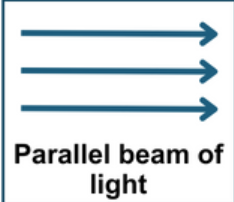
a ray is a straight path of light

Beam
a group of rays traveling together
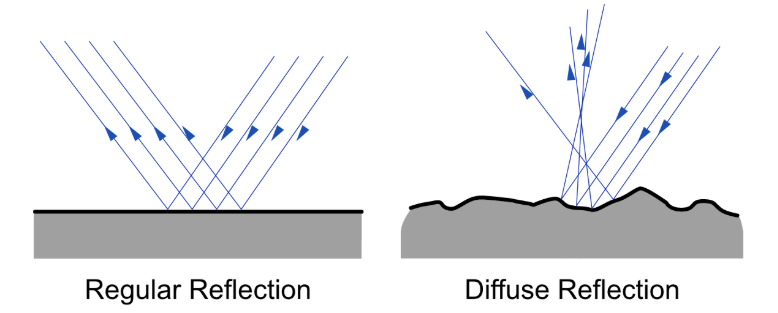
Types of reflection
-regular reflection happens on smooth surfaces
-diffuse reflection happens on rough surfaces
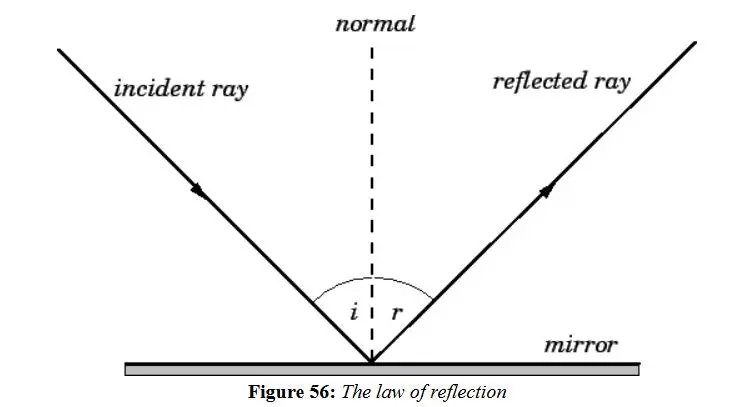
Laws of reflection (same drawing as reflection)
light reflects so the angle of the incidice equals the angle of relfection, and the ray, normal, and surface all lie in the same plane
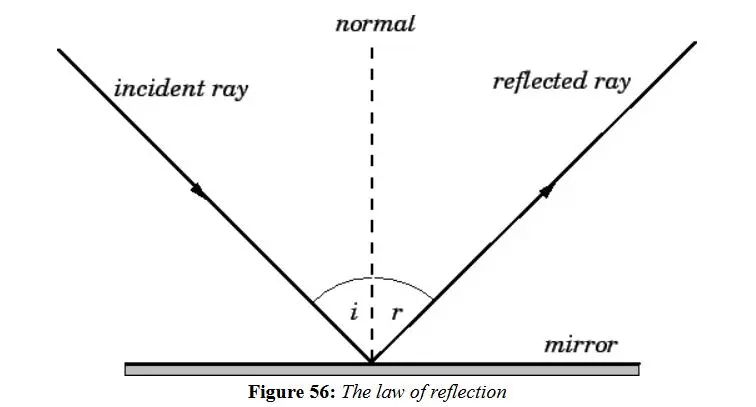
Reflection (same drawing as laws of reflection)
when light bounces off a surface instead of passing through it
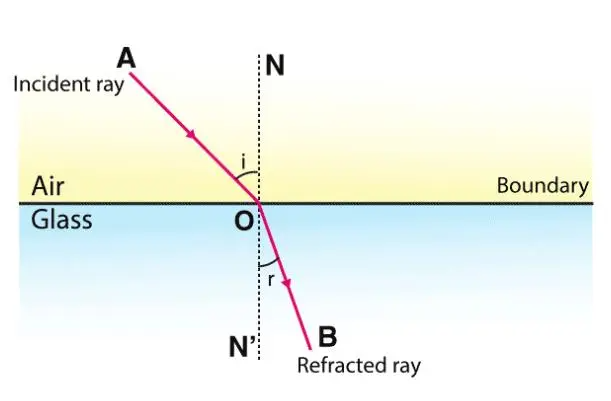
Laws of Refraction (Snell’s Law)
1) the incident ray, refracted ray, and the normal to the interface of 2 media at the point of incidence all lie on the same plane.
2) the ratio of the sine of the angle of incidence to the sine of the angle of refraction is constant (this is also known as Snell’s Law of refraction)
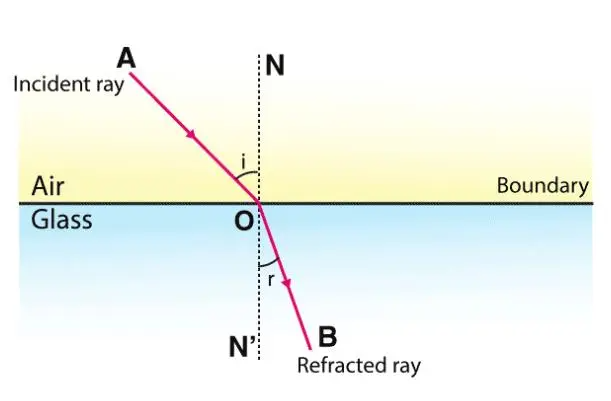
Refraction (Snell’s Law)
the bending of light when it moves from one medium to another
Speed of light
3 ×10⁸ m/s
Characteristics of light
1) light travels in a straight line
2) an electromagnetic wave is light
3) light can also travel through the vacuum
4) light travels without a medium since it is a transverse wave
5) it moves through the vacuum at a speed of 3 ×10⁸ m/s
Principles of light
The seven basic properties of light:
-reflection
-refraction
-diffraction
-interference
-polarization
-dispersion
-scattering, with practical applications: the foundation of rainbows and the mixing of colors in photography.
Dispersion
Occurs because different wavelengths of light have different refractive indices, causing them to refract at different angles through a glass prism. Red light has a lower refractive index and a greater angle of refraction than violet light.

Absorption
Some light energy is absorbed as heat, while unabsorbed wavelengths pass through and appear as the material’s color.
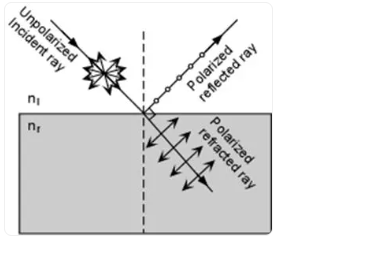
Polarization of light
Plane-polarized light vibrates in one direction perpendicular to its path. There are 2 common ways light becomes polaraized.
Total internal reflection and critical angle
occurs when light hits a boundary above the critical angle, causing complete reflection.

Snell’s Law (Laws of refraction)
When light enters a higher-index medium, it bends towards the normal.
