Psychology Exam 2
 Call Kai
 Learn
Learn Practice Test
 Spaced Repetition
 Match
Match Flashcards
 Knowt Play
1/111

There's no tags or description
Looks like no tags are added yet.
Name | Mastery | Learn | Test | Matching | Spaced | Call with Kai | Chat |
|---|
No analytics yet
Send a link to your students to track their progress
112 Terms
The hind brain
the lower area that initiates basic survival functions and hundles the unconscious stuff
The Limbic system
the emotion area of the brain the source of strong feelings
The cortex
the wrinkly outer area is the wise thinking part of the brain
what are the three basic areas of the brain?
The hind brain, the limbic system, the cortex

What is this called?
the hind brain
what is another name for the hindbrain
Rhombencephalon and “ reptilian brain”

What does the limbic system do
where emotions begin, helps in the formation of memories, and communicates with the hindbrain & the cortex
What are the parts in the Limbic system
Amygdala, hippocampus, hypothalamus, pituitary gland, reticular activating system (ras), ventral tegmental area, nucleus accumbent, thalamus

Amygdala
The emotional alarm system in the brain

Hippocampus
plays a role in learning and memory

Hypothalamus
controls the body’s physical responses like sweating, hunger, fatigue, and energy levels

Pituitary Gland
A squirt bottle of chemicals messages working for the hypothalamus

Reticular activating system (RAS)
filter information that goes into your conscious mind
Ventral tegmental area & Nucleus accumbens
work in the reward system of the brain and use dopamine neurons

Thalamus
helps pass along sensory signals from the cortex
What is the cortex
is the biggest part of the brain and makes up two-thirds of the brains total mass

What are the four parts of the cortex?
The frontal lobe, the parietal lobe, the temporal lobe, the occipital lobe
where is the prefrontal lobe located at
behind the forehead right above the eyes at the front of the brain
Prefrontal cortex
produces your personality, goals, and your values more than any other part of the brain. It also works with the limbic system to help process emotions and is the last part of the brain to mature
Neurotransmitter
chemicals that come out of the synapse at the end of the neurons
Hormones
chemicals that come out of the glands into the blood stream
type of neurotransmitters
Endorphins, oxytocin, serotonin, dopamine, adrenaline, noradrenaline, GABA, acetylcholine, glutamate, cortisol
reaction hormones
Adrenaline(also known as epinephrine), and Cortisol
where are the reaction hormones secreted from
the adrenal glands
Cations
positively charged ions
anions
negatively charged ions
The composition of intracellular and extracellular fluid is similar to salt water, containing:
sodium (Na+), potassium (K+), chloride (Cl-), and anions (A-)
Diffusion
The force on molecules to move from areas of high concentration to areas of low concentration.
Electrostatic pressure
The force on two ions with similar charge to repel each other; the force of two ions with opposite charge to attract to one another.
resting membrane potential
The voltage inside the cell relative to the voltage outside the cell while the cell is a rest (approximately -70 mV).
action potential
A transient all-or-nothing electrical current that is conducted down the axon when the membrane potential reaches the threshold of excitation.
Axon
Part of the neuron that extends off the soma, splitting several times to connect with other neurons; main output of the neuron.
Dendrite
Part of a neuron that extends away from the cell body and is the main input to the neuron.
Excitatory postsynaptic potentials
A depolarizing postsynaptic current that causes the membrane potential to become more positive and move towards the threshold of excitation.
Inhibitory postsynaptic potentials
A hyperpolarizing postsynaptic current that causes the membrane potential to become more negative and move away from the threshold of excitation.
Ion channels
Proteins that span the cell membrane, forming channels that specific ions can flow through between the intracellular and extracellular space.
Ionotropic receptor
Ion channel that opens to allow ions to permeate the cell membrane under specific conditions, such as the presence of a neurotransmitter or a specific membrane potential.
Terminal button
The part of the end of the axon that form synapses with postsynaptic dendrite, axon, or soma.
Threshold of excitation
Specific membrane potential that the neuron must reach to initiate an action potential.
Concrete operations stage
Piagetian stage between ages 7 and 12 when children can think logically about concrete situations but not engage in systematic scientific reasoning.
Conservation problems
Problems pioneered by Piaget in which physical transformation of an object or set of objects changes a perceptually salient dimension but not the quantity that is being asked about.
Formal operations stage
Piagetian stage starting at age 12 years and continuing for the rest of life, in which adolescents may gain the reasoning powers of educated adults.
Object permanence task
The Piagetian task in which infants below about 9 months of age fail to search for an object that is removed from their sight and, if not allowed to search immediately for the object, act as if they do not know that it continues to exist.
Phonemic awareness
Awareness of the component sounds within words.
Piaget’s theory
Theory that development occurs through a sequence of discontinuous stages: the sensorimotor, preoperational, concrete operational, and formal operational stages.
Preoperational reasoning stage
Period within Piagetian theory from age 2 to 7 years, in which children can represent objects through drawing and language but cannot solve logical reasoning problems, such as the conservation problems.
Qualitative changes
Large, fundamental change, as when a caterpillar changes into a butterfly; stage theories such as Piaget’s posit that each stage reflects qualitative change relative to previous stages.
Quantitative changes
Gradual, incremental change, as in the growth of a pine tree’s girth.
Sensorimotor stage
Period within Piagetian theory from birth to age 2 years, during which children come to represent the enduring reality of objects.
Sociocultural theories
Theory founded in large part by Lev Vygotsky that emphasizes how other people and the attitudes, values, and beliefs of the surrounding culture influence children’s development.
Neuron image

what is a neuron
a specialized cell that functions as messengers through the nervous system
Afferent neurons
Sensory messages
Efferent Neurons
motor signals
Interneurons
Carry information between neurons in the brian and neurons in spinal cord
Glial Cells
Specialized supports cells in the brain and spinal cord
what are the glial cells roles?
remove waste, in the spinal cord they are involved with the sensation of pain, help maintain homeostasis
What are the two types of Glial cells
oligodendrocytes and schwann cells
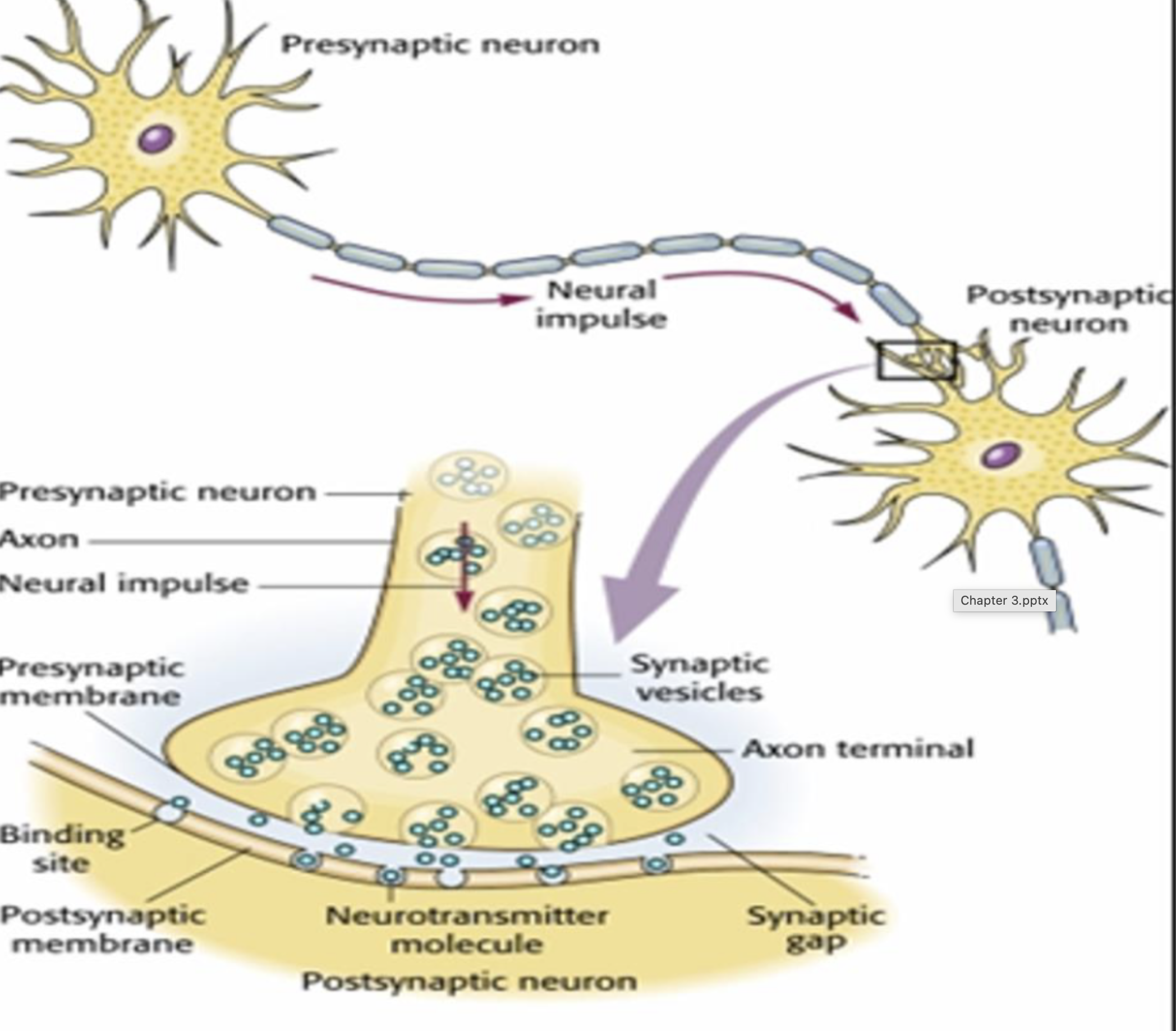
Synapse
junction where the axon terminal of a sending (pre-synaptic) neuron communicates with a receiving (post-synaptic) neuron across the synaptic cleft/gap
synaptic cleft
fluid-filled gaps between
myelin shealth
a white, fatty coating wrapped around most axon that acts as insulation
Neurotransmitter notes
chemicals that can facilitate or inhibit the transmissions of impulses from one neurons to the next
synaptic vesicles
contains with thin membranes that holds neurotransmitter
receptors
“locks” that specific neurotransmitter are the “keys” for
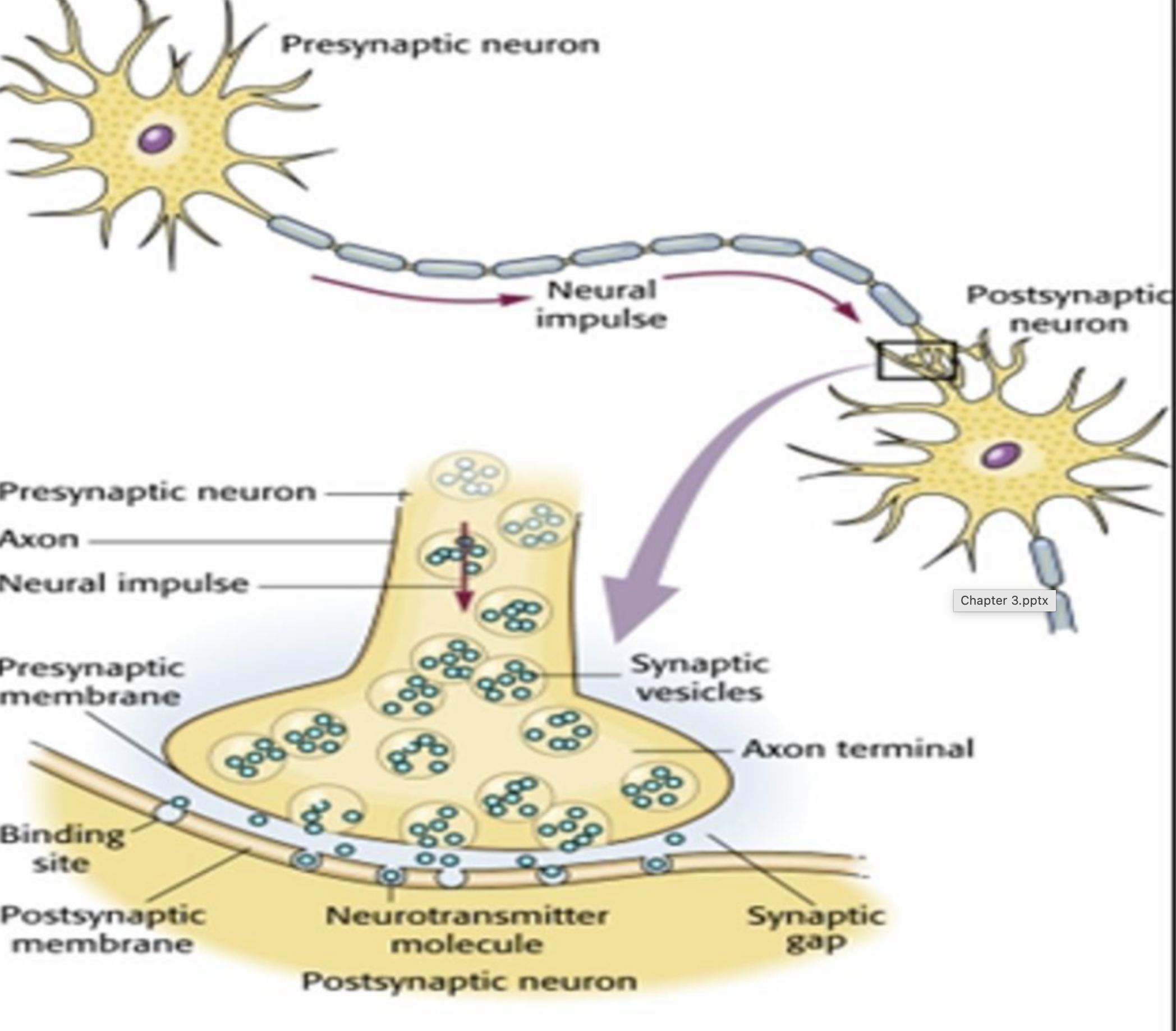
Synaptic gap
Adrenaline
fight or flight neurotransmitter
noradrenaline
concentration neurotransmitter
Dopamine
pleasure neurotransmitter
serotonin
mood neurotransmitter
GABA
calming neurotransmitter
Acetylcholine
learning neurotransmitter
Glutamate
memory
Endorphins
euphoria
the peripheral nervous system
All nerves outside of brain and spinal cord
parts of the The Peripheral nervous system
Somatic Nervous System and Autonomic Nervous System
Somatic Nervous System
all sensory and motor nerves (a part of the peripheral nervous system that controls voluntary muscle movements and processes sensory information
Autonomic Nervous System definition
messenger between CNS and the glands, cardiac muscle and smooth muscles
in the Autonomic Nervous System
Sympathetic Nervous System and Parasympathetic Nervous System
Parasympathetic Nervous System
brings body back to normal the part of your autonomic nervous system that controls your body's ability to relax, slow down, and conserve energy
Sympathetic Nervous System
a part of the autonomic nervous system that controls the body's rapid, involuntary "fight-or-flight" response to danger or stress
The Central Nervous System
The Brain and Spinal Cord
Neuroplasticity
the brain changing how cells are structured or function
(A traumatic experience can “rewire” the brain)
Neurogenesis
when neurons are formed in a developing brain
Somatic
Sensory Pathway – five senses messages (afferent)
Motor Pathway – voluntary movement message (efferent)
Autonomic
Sympathetic – fight or flight
Parasympathetic - rest
Frontal
Prefrontal cortex- executive and personality functioning
Motor Cortex – voluntary body movements
Broca’s Area – directs muscle movements that produce speech sounds
Parietal
Somatosensory Cortex – touch, pressure, temperature, pain and spatial and body awareness
Occipital
Primary Visual Cortex – site where vision registers
Temporal
Primary Audio Cortex – receives sound input
Wernicke’s area – language area for understanding speech and formulating writing and speaking
Left Hemisphere
Controls the right side of the body, coordinates complex movements, and, in most people handles most of the language functions including speaking, writing, reading, and understanding the written and the spoken word
Right Hemisphere
Controls the left side of the body and, in most people, is specialized for visual-spatial perception, the interpretation of nonverbal behavior, and the recognition and expression of emotion
Cerebral Hemispheres
Body movement and feeling
Corpus Callosum
Information transfer
Brain Stem
Life support functions
Jean Piaget
studied cognitive development
Piaget’s Stages of Cognitive Development
Sensorimotor, preoperational, concrete operational, formal operational
Sensorimotor
Birth to 2 yr old
learning through senses and movement
object permanence
preoperational
ages 2 to 7 yr old
language development
learning how to think
concrete operational
ages 7 to 11 yr old
more logic development
thinking is primarily concrete
conservation
Formal operational
Ages 12 and up
even more logic development
new ways thinking