Smith Exam One (CP A-F)
 Call Kai
 Learn
Learn Practice Test
 Spaced Repetition
 Match
Match Flashcards
 Knowt Play
1/64

There's no tags or description
Looks like no tags are added yet.
Name | Mastery | Learn | Test | Matching | Spaced | Call with Kai | Chat |
|---|
No analytics yet
Send a link to your students to track their progress
65 Terms
Pottery
- coarse textured ware made from clay and fired in a kiln
- can be turned on a wheel and can be glazed or unglazed
Amphora
- two handled jar with long neck used for oil or wine
- made to be durable which is why we still have so many today
Geometric
- term for Greek pottery from 8th and 9th century B.C. describing the decorative pattern used
Meander
- decorative pattern consisting of lines turning at right angles
Black-Figure Painting
- Greek pottery from 7th and 6th century B.C.
- black decoration on red ground
- originated in Corinth
Sculpture
- a work of art carried out in three dimensions
Kouros
- term for nude male standing statue in Archaic period
Dipylon Amphora
- 8th century BC
- hounds chasing hares at the bottom, signifies circle of life
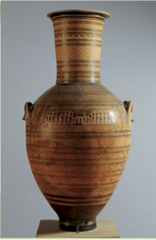
Ajax Prepares to Kill Himself (Amphora)
- 6th century BC
made by Exekias, one of the first people to sign artwork
signed saying "Exekias made me"
- Exekias has 14 surviving vases

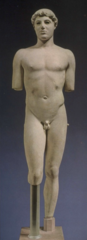
Kouros ("Apollo of Tenea")
- 6th century BC
- appears to have some Egyptian style/inspiration
- not super realistic, looks stiff

Kritios Boy, Statue of an Ephebe
- 5th century BC
- body appears more relaxed, less stiff, and more realistic
Wounded Gaul
- 1st-2nd century AD
- 1st century AD Roman copy of 3rd century BC original

Laocoon Group
- 50 BC
- Trojan priest who wanted to reject the trojan horse gift
- Greek gods sent sea serpent to destroy him and his sons for trying to go against their will

Doric Order
- oldest of ancient architectural orders
- columns sit directly on floor
- columns fluted
- plain capitals

Ionic Order
- base at bottom of columns
- slightly skinnier than doric
- capitals decorated with scrolls (swirls)

Corinthian Order
- base at bottom of columns
- much more detail on capital, multiple layers, with highly decorated leaves

Capital
- the top part of a column
Metope
- carved or painted panel above Doric columns
Fluting
- grooves running up the side of a column
Rotunda
- roofed building with a circular floor plan
- often covered by a dome

Bas-Relief
- a carving that protrudes only moderately/partially from the background plane
Temple of Zeus at Olympia: Herakles, aided by Athena, receives from Atlas the Golden Apples of the Hesperides
- 479-456 BC
- shows Herakles holding up the sky with help of Athena as Atlas gives golden apples

Parthenon
- 447-432 BC
- located in Athens
- Temple for Athena, home for her to dwell in
- Doric order columns

Column Rule for Greek and Roman Architecture
- long side has double the columns of the short side plus one
- ex: short side has 8 columns, long side has 17 columns
Temple of Athena Nike
- 427-424 BC
- built for Athena to celebrate victory in battle
- Ionic order for columns

Agustus of Prima Porta
- 20 BC-15 AD
- subject clothed with military attire
- pose of Roman orator (speaking position)
- can be seen as propaganda for Roman people

Ara Pacis Augustae, The Altar of Augustan Peace
- 13-9 BC
- used to celebrate peace, monument for Agustus bringing peace to land
- sacrifices/offerings left at altar

Ara Pacis Augustae, The Altar of Augustan Peace, Procession of Imperial Family
- 13-9 BC
- used to celebrate peace, monument for Agustus bringing peace to land
- sacrifices/offerings left at altar

Pont Du Gard
- 1st century AD
- located outside of Rome in modern France
- lower-level bridge, higher-level aqueduct
- Roman innovation of arches

Pantheon
- 126 AD
- temple to all Roman gods
- inscription of who built it
- Corinthian order columns

Pantheon Interior
- 126 AD
- temple to all Roman gods
- inscription of who built it
- Corinthian order columns

High Relief
- sculpture which projects almost fully, or at least half of its natural circumference, from its background
Byzantine Art
- associated with Eastern Roman Empire (capital on Constantinople)
- combo of Greek/Roman art and art of near East
- centered on divine rather than earth-bound things
- two dimensional art, gold backgrounds, domes
Sarcophagus of Junius Bassus
- 359 AD
- stone coffin
- made for Junius Bassus, Roman administrator
- Abraham and Isaac depicted
- entry of Christ into Jerusalem depicted
- Christ the law-giver depicted

Christ on his Throne with Angels Mosaic Wall, Sant 'Apollinare Nuovo
- 500 AD
- mosaic inside of basilica, Byzantine style

Hagia Sophia
- located in modern Istanbul (was Constantinople)
- made by Isidorus and Anthemius, first major artist signing since Exekias

Hagia Sophia, Interior
- located in modern Istanbul (was Constantinople)
- made by Isidorus and Anthemius, first major artist signing since Exekias

Articulation
- term referring to the starts and ends of the notes in music, particularly the degree to which each of a succession of notes is separated in performance
Dynamics
- aspect of a material expression concerned with the variation in the volume of sound
Form
- shape or structure of musical work
- for this class focus mainly on repetition of lyrics/music
Mass Ordinary
- texts of Roman Catholic mass that remain constant from day to day
Messe de Nostre Dame: Kyrie
- "the mass of our lady"
- composed by Guillaume de Machaut
- Kyrie, Gloria, Credo, Sanctus, Agnus Dei (songs go together/have cohesion)
Kyrie
- 1360-1365
- four voice parts
- composed by Guillaume de Machaut
- "Kyrie eleison" = "Lord have mercy"
Melisma
- group of notes sung to one syllable of text (rather than one syllable per note)
Romanesque Architecture
- 10th-12th centuries
- first pan-European architectural style since fall of Rome
- stone walls, flat walls, abbeys, cathedrals, rounded Roman arch
Gothic Architecture
- 1120-1400 in central Italy continuing until early 16th century in Northern Europe
- lightness and verticality (extending to heavens, contrast to Romanesque)
Pointed Arches
- two parts of a circle combined to form an arch with a point in the middle that can support more weight than round arches
Ribbed Vaulting
- a network of crossed arches in the ceiling used to support the weight of heavy roofs
Flying Butress
- half of a pointed arch used on exterior to support high stone walls while taking up less space
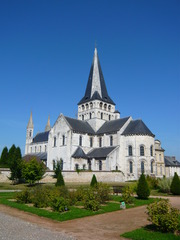
Saint-Georges de Boscherville Abbey
- skinny windows, lots of stone compared to glass, looks "heavy"
- skinny parts of building built high (no large parts built high due to lack of support)
Saint-Georges de Boscherville Abbey: Personification of Death
- carved into the columns as decoration on the inside
- example of bas-relief
- first time seeing large scale stone carvings in roughly 600 years
- appears "cartoonish", not dedicated to realism

Saint-Georges de Boscherville Abbey: Personification of Discipline
- carved into the columns as decoration on the inside
- example of bas-relief
- first time seeing large scale stone carvings in roughly 600 years
- appears "cartoonish", not dedicated to realism

Cathédrale de Chartres
- gothic style
- reaches much higher than Romanesque buildings
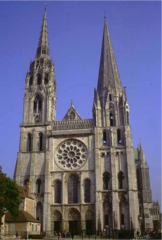
Cathédrale de Chartres, North Rose Window

Cathédrale de Chartres, North Facade
- lots of exterior carving and detail
- contrast to flat stone with Romanesque

Cathédrale de Chartres, Statues
- Isaiah holding a scroll
- Jeremiah holding a shield
- Simeon holding a child
- John the Baptist wearing camel skin and holding lamb
- Peter holding keys
- carvings transfer from bas-relief to high relief
Cimabue
- born before 1251, died in 1302
- from Florence, Italy
- painter and mosaicist
- notably made "Madonna and Child Enthroned"
Giotto di Bondone
- born around 1266, died in 1337
- from Florence, Italy
- potentially a student of Cimabue
- most important Italian painter of 14th century
- notably made "Scrovegni (Arena) Chapel"
Madonna and Child Enthroned
- made by Cimabue
- example of Byzantine art, 2D with a little bit of depth
- hung in a church, very large (roughly 10x7 feet)

Fresco
- a type of wall painting in which pigments are applied to wet plaster
Scrovegni Chapel, Kiss of Judas
- made by Giotto di Bondone
- 1303-1306
- characters are beginning to show emotion/have more expression
- medium of frescoes

Scrovegni Chapel, Crucifixion
- made by Giotto di Bondone
- 1303-1306
- Mary often seen depicted in blue robe
- medium of frescoes

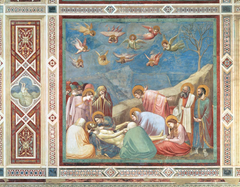
Scrovegni Chapel, Lamentation
- made by Giotto di Bondone
- 1303-1306
- medium of frescoes
Scrovegni Chapel, Resurrection
- made by Giotto di Bondone
- 1303-1306
- medium of frescoes

Naturalism
- representation of objects as they are rather than in a stylized or abstract manner