Ch5- Genetic Linkage and Mapping in Eukaryotes
 Call Kai
 Learn
Learn Practice Test
 Spaced Repetition
 Match
Match Flashcards
 Knowt Play
1/50

There's no tags or description
Looks like no tags are added yet.
Name | Mastery | Learn | Test | Matching | Spaced | Call with Kai | Chat |
|---|
No analytics yet
Send a link to your students to track their progress
51 Terms
BLANK genes do NOT sort independently
Linked
Genes located on the same chromosomes are called?
Syntenic genes
Syntenic genes so close together that their alleles cannot sort independently are called BLANK
Linked genes
BLANK can be quantified to map the positions of genes on chromosomes
Genetic linkage
Alleles of Syntenic genes can be reshuffled when crossing over occurs between Homologs to produce BLANK
Recombinant chromosomes
Homologs that do not reshuffle ales under study are called BLANK or BLANK
Parental chromosomes or non recombinant chromosomes
BLANK plots the positions of genes on chromosomes
Genetic linkage mapping
BLANK of Syntenic genes can occur if they are BLANK on a chromosomes so that recombination occurs very frequently
*Syntenic gene that are closer together will tend to segregate BLANK
Crossing over that prevent linked genes from segregating together occurs during BLANK of meiosis
Independent assortment
Far apart
Together
Prophase I
Linked genes are always BLANK and always located near one another
Genetic linkage leads to the production of significantly BLANK gametes with parental allele combinations than non parental combinations
Syntenic
More
Crossing over is BLANK likely to occur between closely linked genes than between those farther apart on a chromosome
Genetic linkage can be recognized by comparing BLANK of gamete genotypes or BLANK of phenotypes with those expected under independent assortment
If genes are BLANK parental allele combinations with be observed at a BLANK frequency than predicted by chance
Less likely
Observed frequencies, progeny
Linked, higher
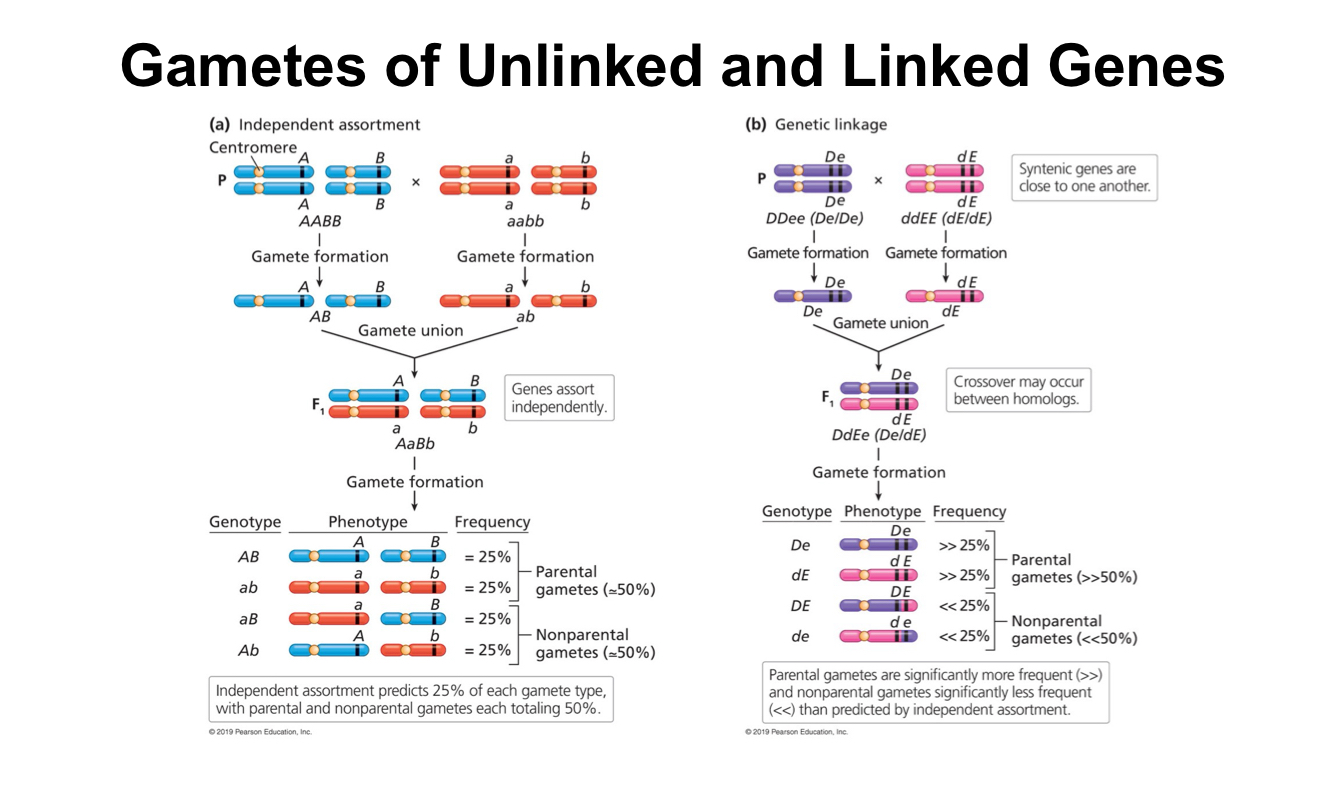
Gametes of unlinked and linked genes
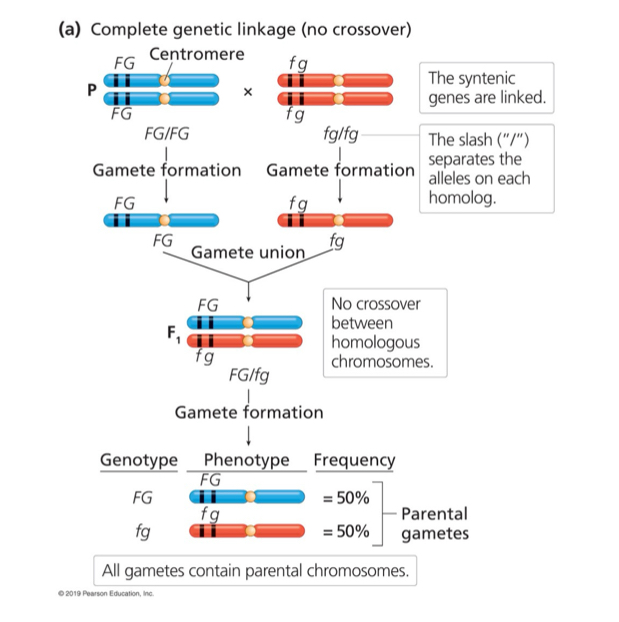
Complete Genetic Linkage is observed when BLANK occurs between linked genes, only BLANK gametes are formed
Some organs is exhibit complete linkage for example: BLANK males have no known crossing over (biological basis unknown)
Crossing over
Parental
Drosophila
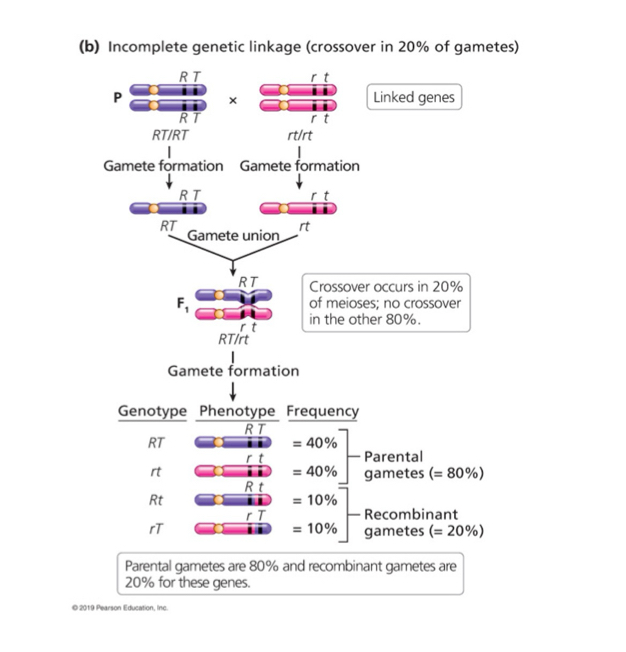
Incomplete Genetic Linkage is BLACK than complete linkage, in this case a BLANK of parental and non parental gametes is produced
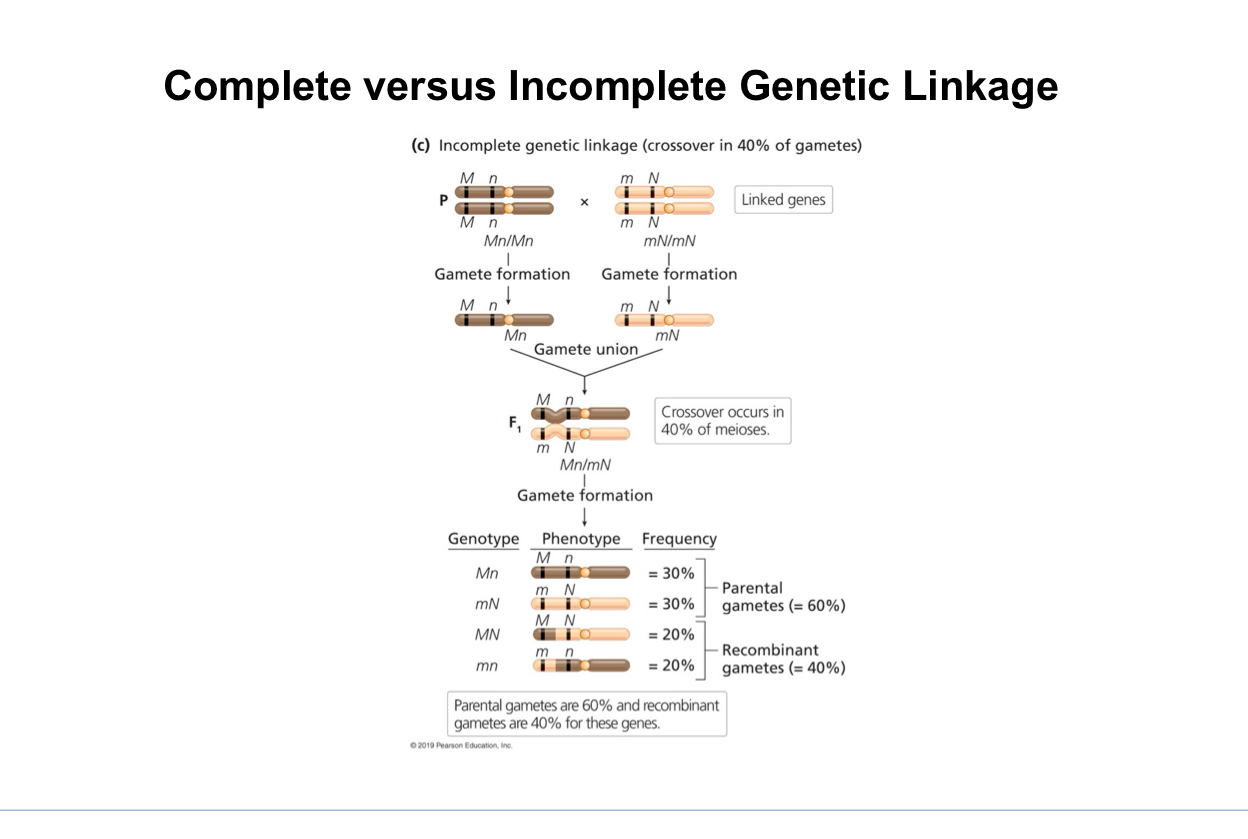
The two parental types are approximately BLANK in frequency as are the two recombinant types
The proportion of parental to recombinant chromosomes or gametes varies between different pairs of genes
Much more common
Mixture
Equal
Complete VS incomplete genetic linkage
Recombination frequency expressed as r is calculated as
Recombination frequency is likely a BLANK of the physical distance between BLANK genes
*crossing over occurs at a higher rate between genes that are BLANK apart
*at a lower rate between genes BLANK together
*linked genes with higher recombination frequencies are BLANK distant from one another than genes with lower frequencies
Reflection, two
*farther apart
*closer together
*more

Detecting Linkage- Test Cross Analysis
Morgan realized that linkage of BLANK in drosophila could be interpreted using a BLANK
in a test cross the BLANK parent contributes only recessive alleles
thus the allies contributed by just the BLANK parent can be examined
Autosomal genes, two-point test-cross analysis
Homozygous recessive
Dihybrid
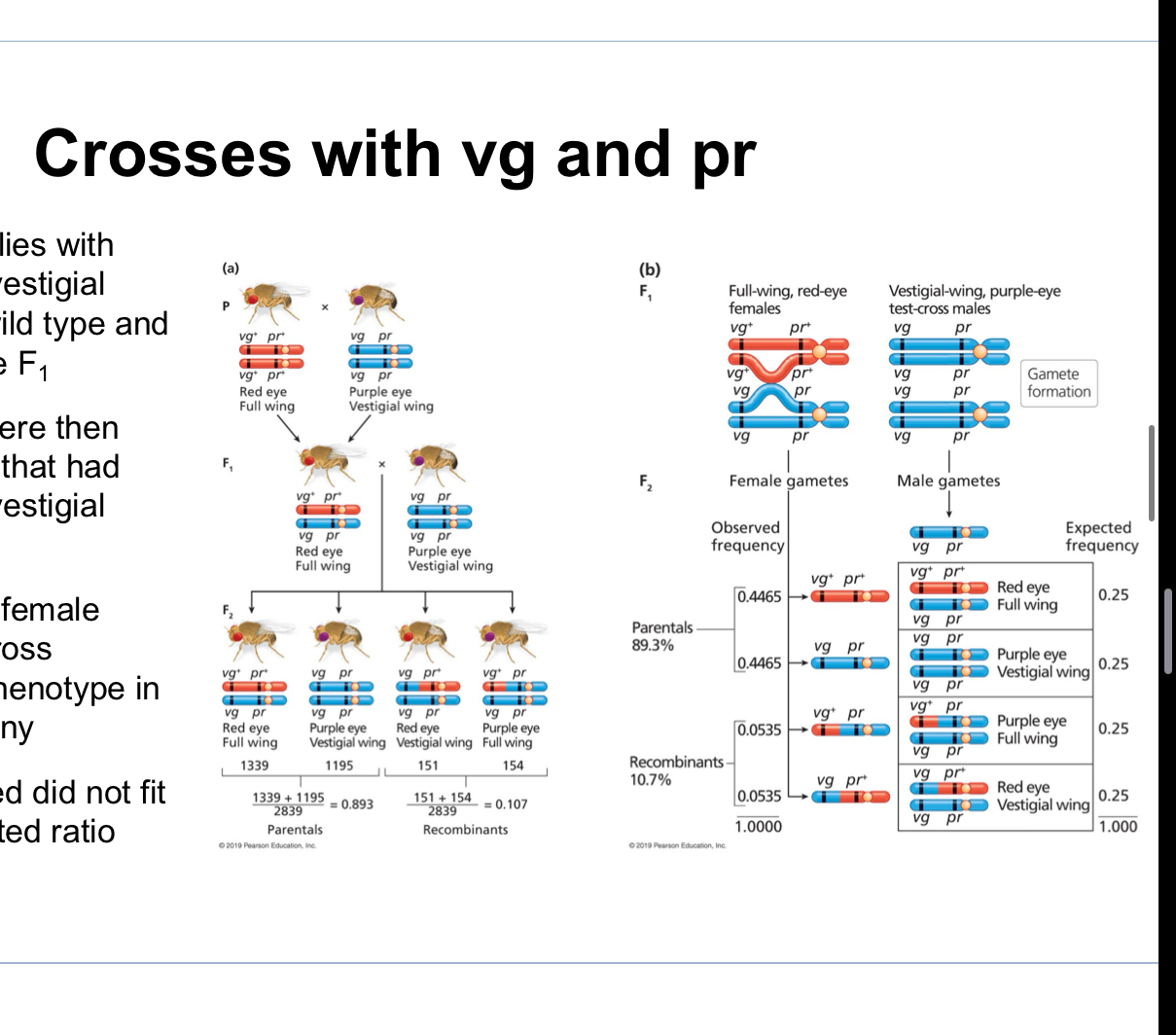
Crosses with vg and pr
Morgan crossed flies with purple eyes and vestigial (short) wings to wild type and obtained BLANK
The F1 females were than crossed to males that had purple eyes and vestigial wings
The alleles in the female gametes in this cross determined the BLANK in each of the progeny
Offspring produced BLANK fit the 1:1:1:1 expected ratio
Wild-type F1
Phenotype
Did not fit
Important Conclusions
BLANK is a physical relationship among BLANK located near one another on a chromosomes
Recombination occurs among linked genes less than BLANK of the time, and greater than BLANK of the gametes contain parental allele combinations
Recombination frequency varies among linked genes in BLANK to the BLANK between them
Genetic Linkage, genes
50%, 50%
Proportion, distance
Cytological Evidence of Recombination
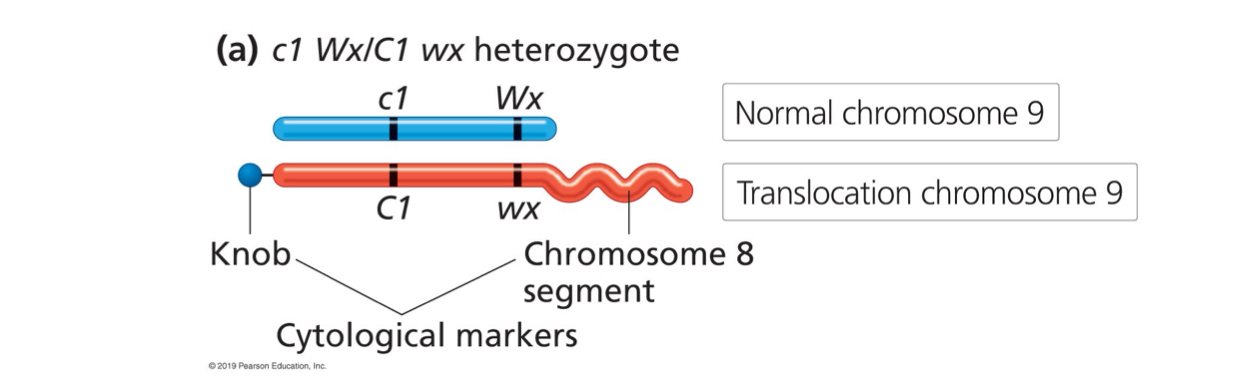
Creighton and McClintock studied recombination between copies of chromosomes 9 in corn using two genes BLANK and BLANK, and two structural differences between the Homologs
*the chromosomes with the cl and Wx alleles was BLANK
*the chromosome with the CL and wx allies had a darkly staining BLANK at one end and a garment of chromosome BLANK at the other end
cl and wx
Normal
Knob
8
Cytological evidence of recombination
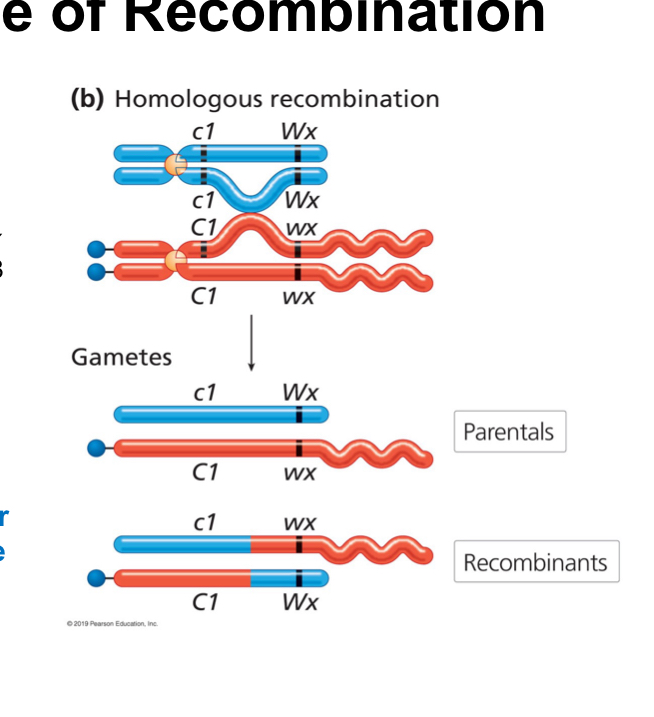
Creighton and McClintock obtained Cytological evidence that recombination between the genes was accompanied by BLANK between the Homologs
*a recombination chromosome with the cl and wx alleles also had the fragment of chromosome BLANK on it
*the recombinant chromosome with the Cl and Wx alleles also had the darkly staining BLANK on it
Creighton and McClintock as as stern studying drosophila, showed that crossover is accomplished by BLANK and BLANK in plants and animals
Physical exchange
8
Knob
Chromosome breakage and rejoining
BLANK was the first to demonstrate that genes are on chromosomes
His student BLANK used the results of several experiments to create a BLANK for the five X-linked genes in drosophila
Morgan
Alfred Sturtevant
Create a genetic map for five
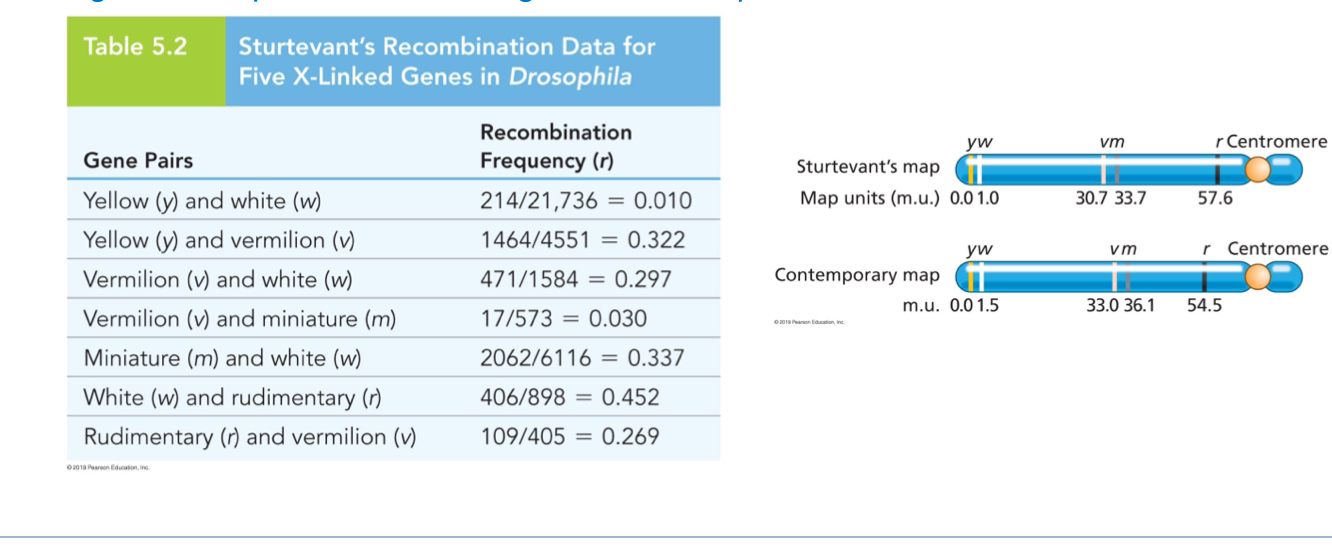
BLANK between two genes can be converted into units of BLANK or BLANK
*this unit is also called a BLANK
*by convention 1% recombination = 1 m.u. Or 1cM
Recombination frequencies
Physical distance, map units (m.u.)
centiMorgan (cM)
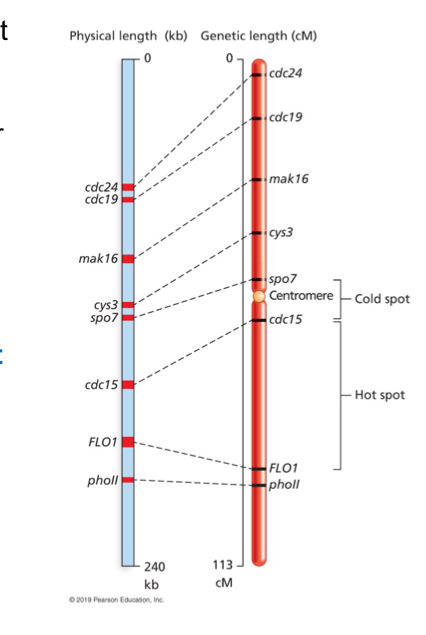
Recombination is dominated by BLANK
detailed assessment of recombination in human, mouse, yeast genomes reveals recombination BLANK or BLANK within each genome
Hotspots
Recombination cold spots
Hotspots and cold spots may lead to placement of genes BLANK or BLANK respectively on the recombination map than on the physical map
Hotspots and cold-spots may be due to the BLANK of DNA in those regions to initiate crossing over (ex cold spots between genes separated by a centromere)
Farther apart or closer together
Feasibility
Recent studies indicate that recombination occurs primarily at specific BLANK
*BLANK research by BLANK indicates that recombination hotspots are distributed unevenly and span relatively short segments of DNA
Similar results in mammalian genomes
Hotspots
*drosophila, Nadia Singh
Mapping of human genes has been more challenging than many other organisms where controlled matings are possible and larger numbers of offspring are produced
In the mid BLANK methods to identify BLANK and improved gene-mapping software facilitated human genome mapping efforts
These polymorphic DNA sequences are called BLANK
Mid-1980s, polymorphic DNA sequences
Genetic markers
The availability of large numbers of DNA markers on each chromosomes led to the identification of BLANK
Linkage groups
Linkage groups are?
Clusters of syntenic genes that are linked to one another
What assigns the linkage group to a nearby chromosomal location?
Linkage between a genetic marker with a known chromosomal location and a member of a linkage group
Different variants of DNA sequence constitute the genetic markers used to study locations of genes
Genetic Markers are typically in BLANK regions of the genome
These markers includes three things?
Noncoding regions
1- variable number tandem repeats (VNTRs)
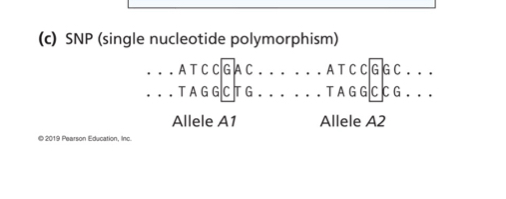
2- single nucleotide polymorphisms (SNPSs)
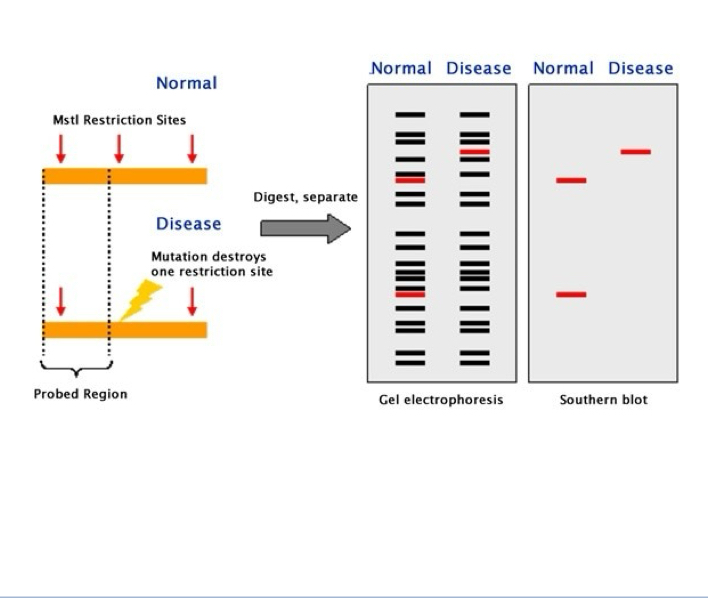
3- restriction fragment length polymorphisms (RFLPs)
BLANK are short DNA sequences (? Bp)
these sequences repeat end-to-end in a chromosomal region
Different chromosomes can carry different repeat numbers of the sequences
Repeat length can varry
VNTRs 3-20 bp
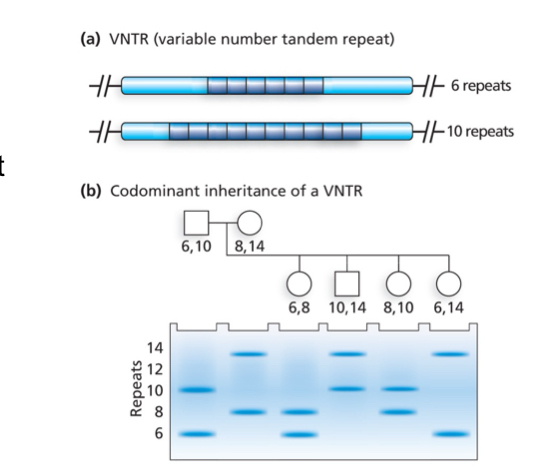
BLANK (? Bp)
more commonly used markers than BLANK
These involve variants with BLANK is substituted by another base pair, typically in a non coding region
There are approx BLANK SNPs in the human genome
SNPs 1 bp
VNTRs
One base pair
3.3 million
BLANK are changes in DNA sequence that are detected using DNA-cutting enzymes called BLANK (BLANK)
RRLPs
Restriction endonucleases (restriction enzymes)
Restriction enzymes recognizes and BLANK specific sequences of DNA
Pieces of DNA resulting from restriction enzyme cutting are called BLANK
Cut
Restriction fragments
The specific array of SNPs in a small region on a single chromosome is called a BLANK
These SNPs are BLANK variants and will tend to be BLANK during meiosis
Haplotypes may differ between the members of chromosomes pair- maternal and paternal chromosomes may have different haplotypes in a single individual
Haplotype
Closely linked, passed on together
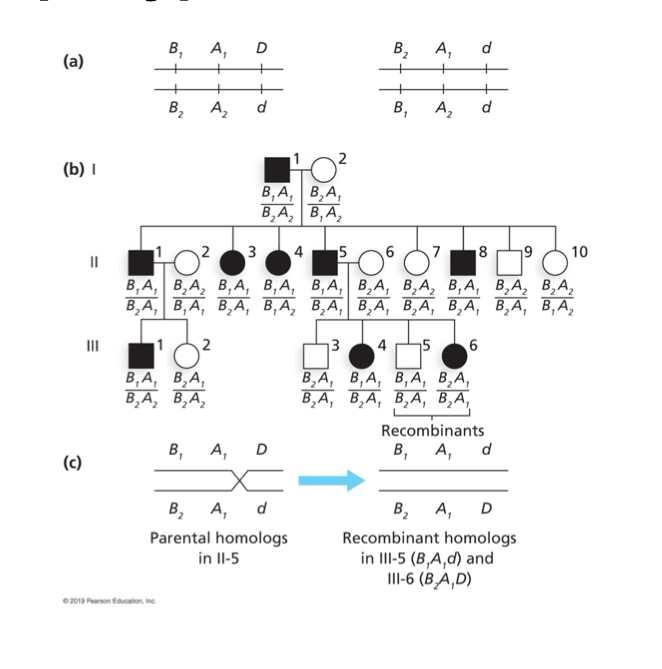
A first obstacle to mapping human genes is the difficulty of determine BLANK
Allelic phase
Define allelic phase
*when a disease causing allele is seen to segregate along with a known genetic marker BLANK can be determined
The arrangement of alleles of linked genes on parental chromosomes
Allelic phase
A statistical method allows geneticists to calculate the overall probability of genetic linkage between genes or trait and a marker
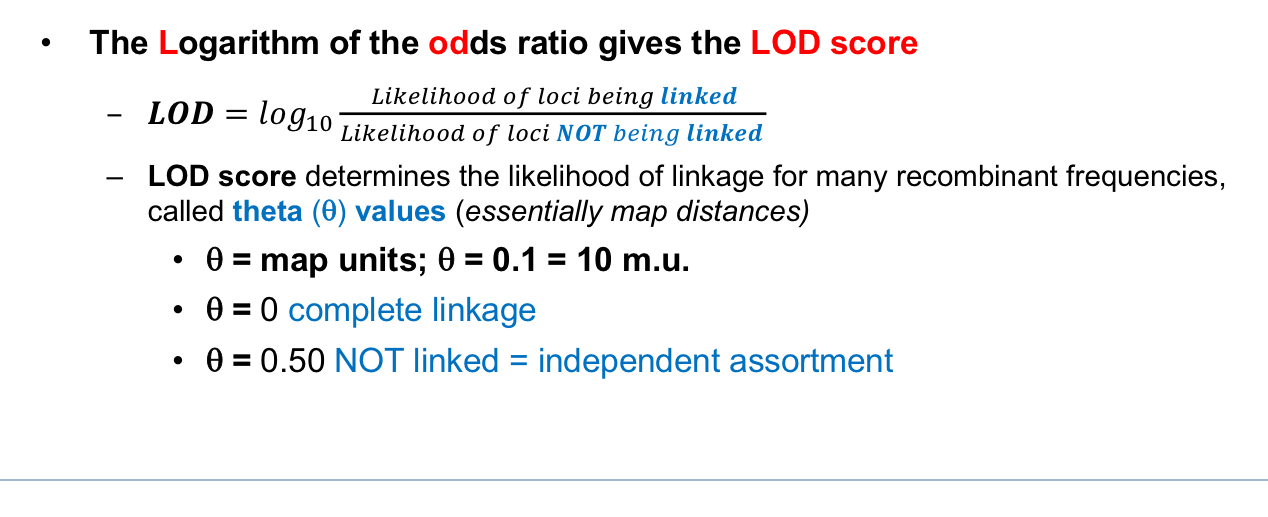
Compares the likelihood of obtaining the genotypes and phenotypes observed in the pedigree BLANK two genes are linked BLANK the likelihood if they are unlinked
The BLANK gives the BLANK score
If, verses
Logarithm of the odds ratio gives the LOD score
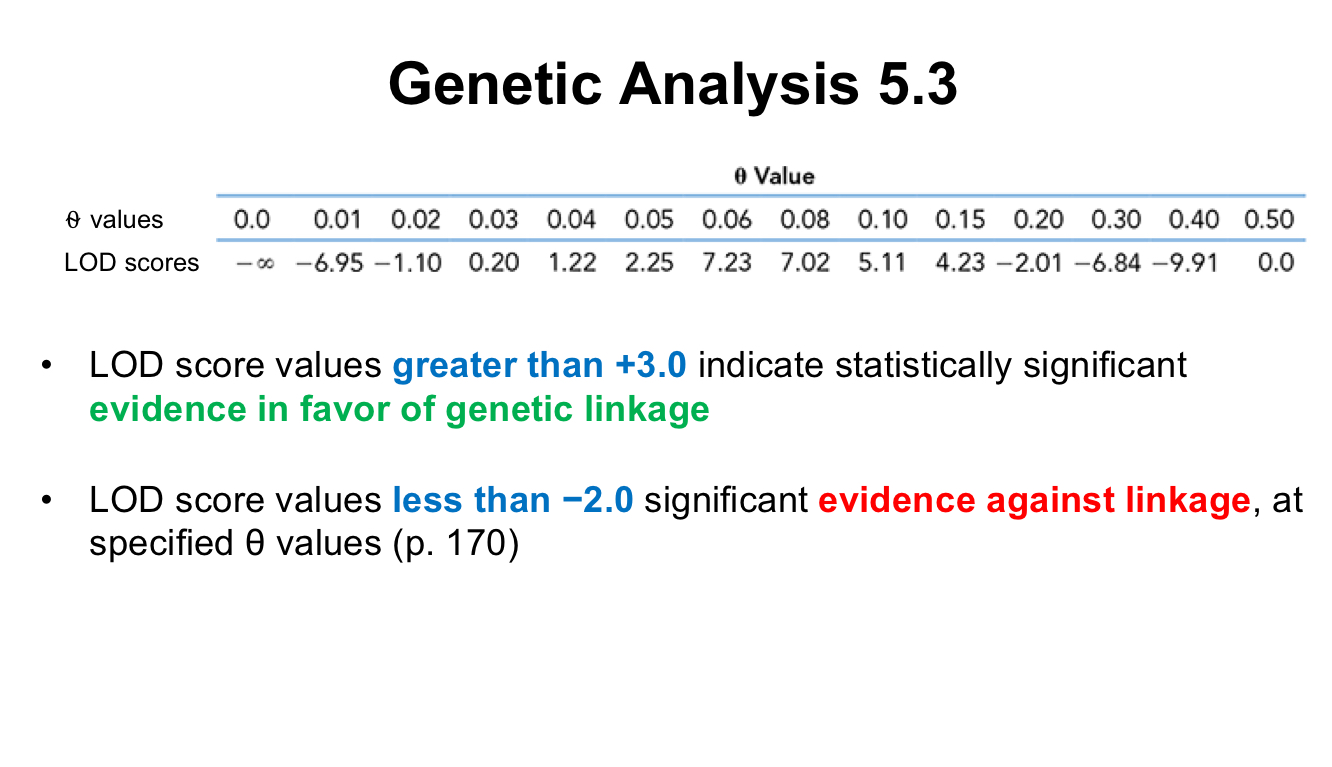
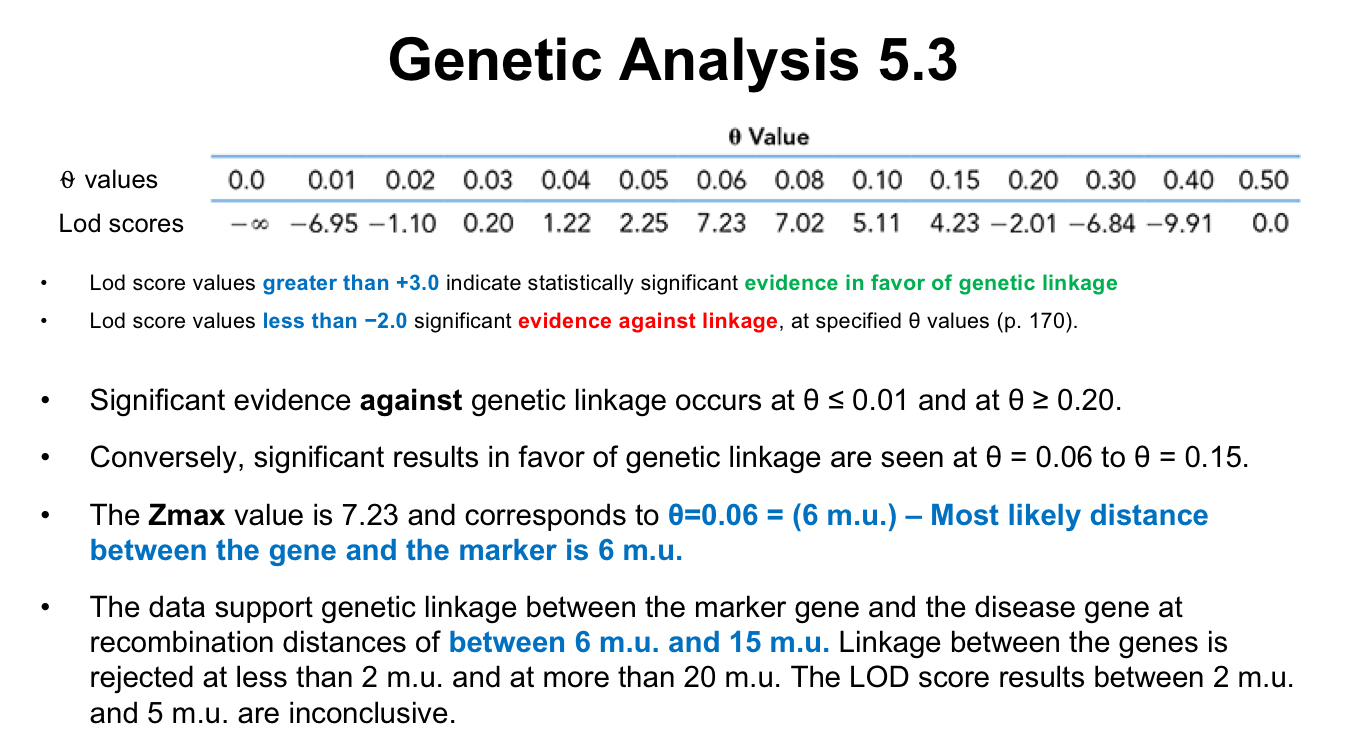
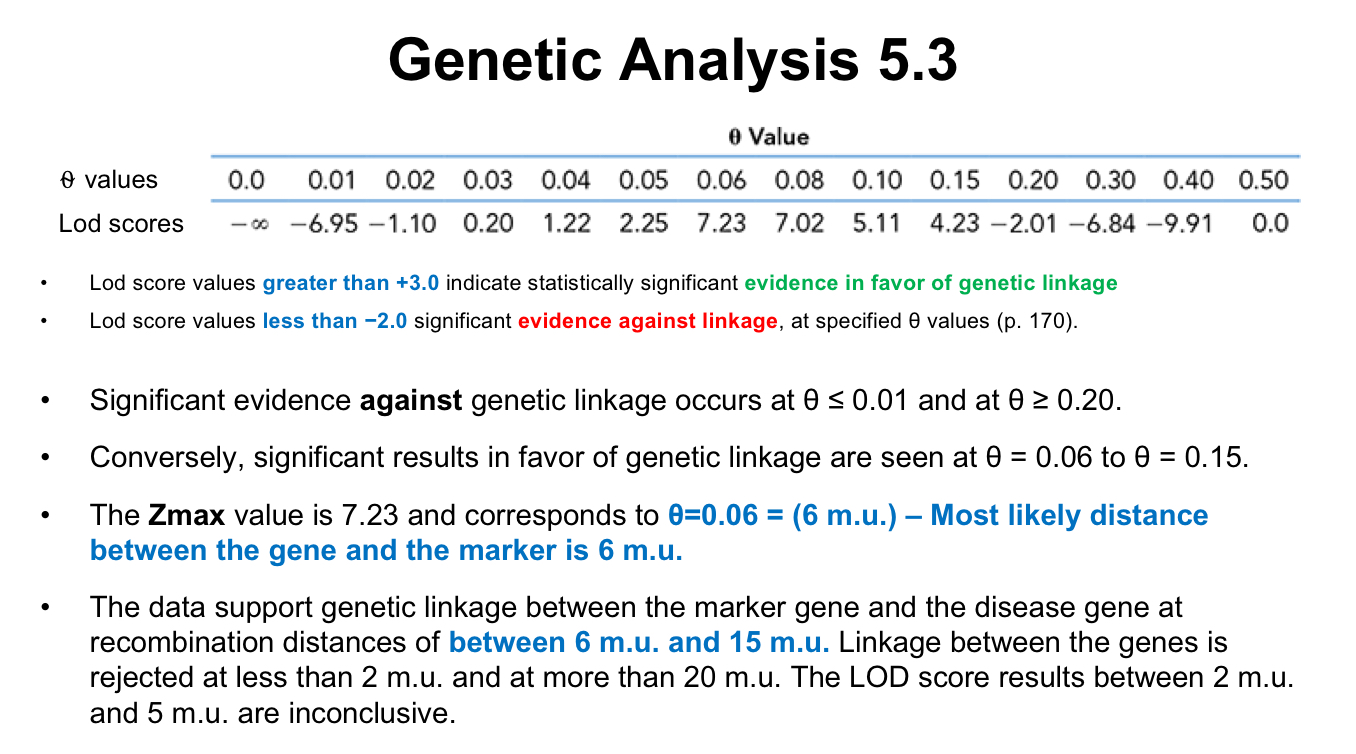
Interpreting LOD scores
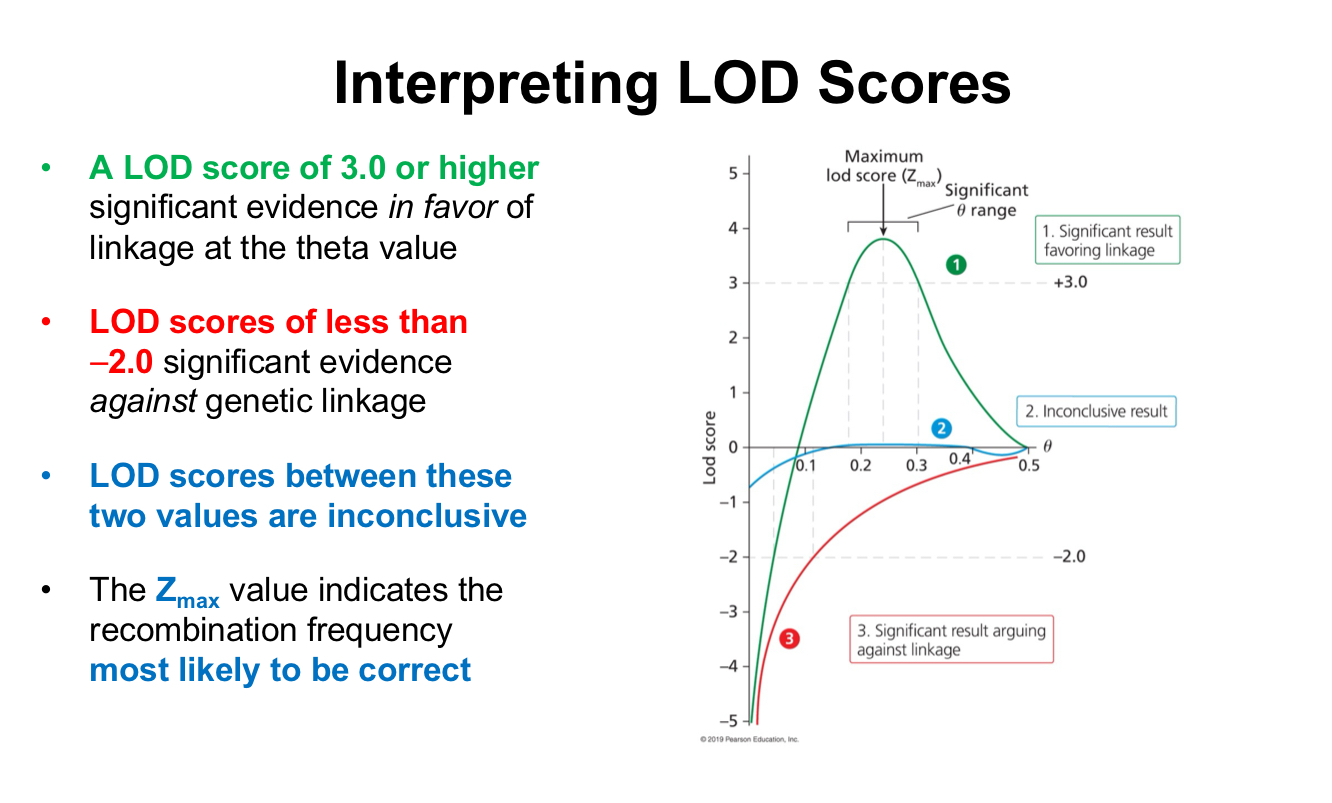
A LOD of BLANK or higher significant evidence in favor of linkage at the theta values
A LOD score of less than BLANK significant evidence against genetic linkage
LOD scores between these two values are BLANK
The BLANK values indicated the recombination frequency most likely to be correct
3.0
-2.0
Inconclusive
Z max
Problem
Problem
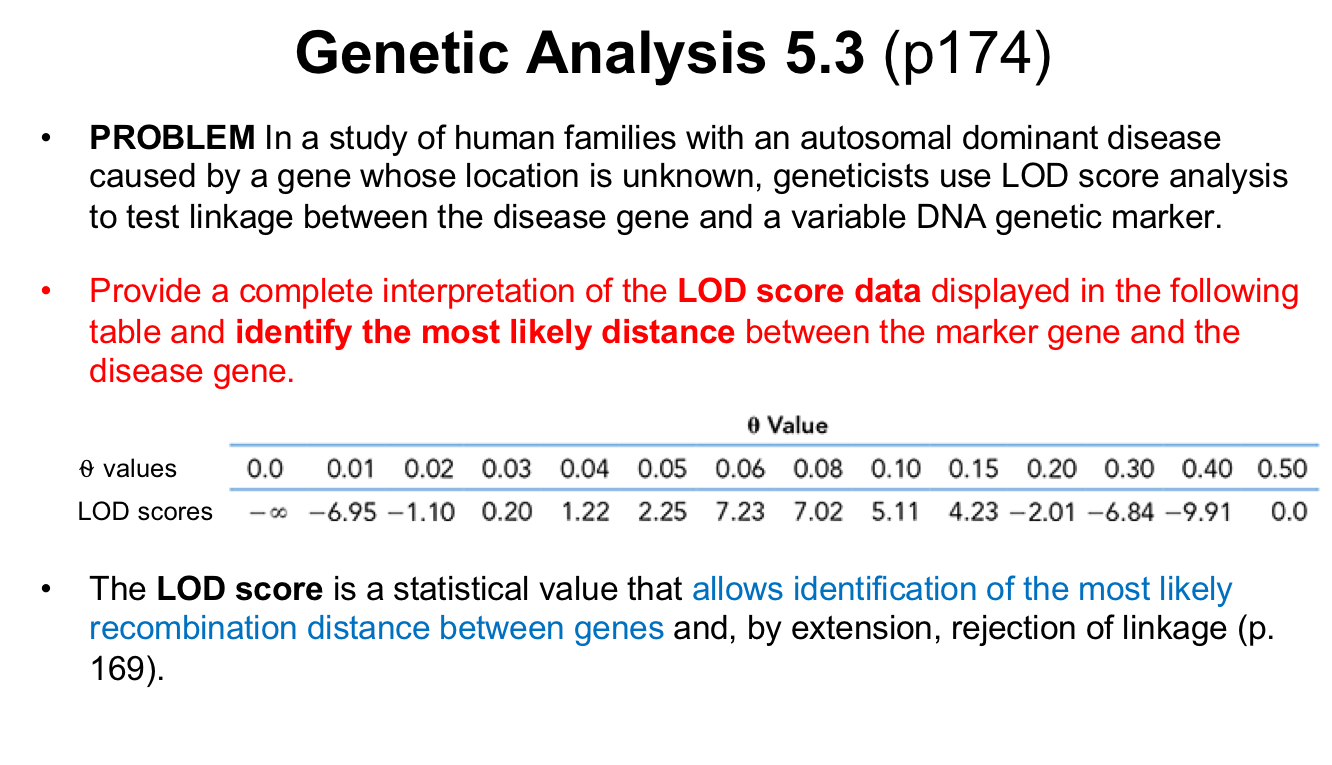
Problem
The genetic mapping approach involves a series of linked markers along a chromosomes to form a genetic map of the chromosome (one step at a time) - contrast to BLANK
GWAS
BLANK detects and locates genes that influences traits BLANK of multiple genes
*the influential genes may be BLANK throughout the genome
*identifies where in the genome the BLANK influencing a single trait are located
Genome-wide association studies (GWAS)
As a group
Genes
GWAS looks for BLANK between traits and groups of alleles in BLANK
*BLANK are the typical genetic markers for GWAS due to their frequent distribution in most Genomes
*GWAS uses closely linked BLANK in haplotype groups with known chromsome locations
Associations, populations
SNPs
GWAS Results are represented in the BLANK
Manhattan plot
A Manhattan plot indicates?
The locations of genes contributing to the development of traits and conditions
The BLANK the green bar on the plot the stronger the association between a potential contributing genes and a chromosomal location
Higher
BLANK distribution of alleles for linked genes (or linked gene and marker)
When frequencies of haplotypes in a population deviate significantly from what is expected it is called BLANK
Reflects the BLANK relationship between alleles of closely linked genes
Means the gene we are studying is closely associate to the BLANK
Can only be separated by BLANK which are random and infrequent
Nonrandom
Linkage disequilibrium
Non-random
SNP haplotype
cross overs
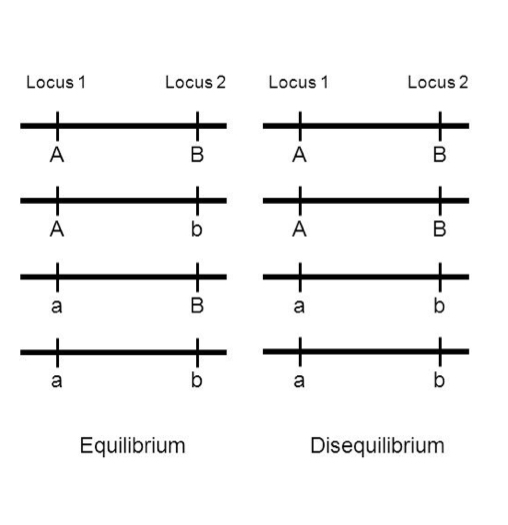
If linkage disequilibrium is found in a SNP haplotype then what?
Activities associated with identifies genes are then identified to determine if their action may contribute to the condition
For example: the BLANK gene was suggested to be associate with BLANk based on GWAS results (more recently named BLANK gene)
Further study indicated that BLANK variant alleles associated with CD increased inflammatory response of intestinal tissue therapy contributing to CD development
All genes located in the chromosomes region must be identified
CARD15, Crohn’s Disease (CD), NOD2 gene
CARD15 gene