Oral Surgery Instruments
 Call Kai
 Learn
Learn Practice Test
 Spaced Repetition
 Match
Match Flashcards
 Knowt Play
1/4

There's no tags or description
Looks like no tags are added yet.
Name | Mastery | Learn | Test | Matching | Spaced | Call with Kai | Chat |
|---|
No analytics yet
Send a link to your students to track their progress
5 Terms
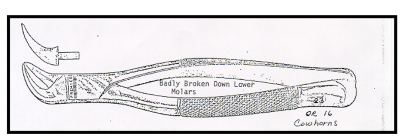
Lower Molar Forceps
Used for: Badly broken lower (mandibular) molars.
Description: Heavy, curved beaks with pointed tips that fit into the furcation (between the roots) of lower molars.
Purpose: Grips the remaining tooth structure or roots securely so the dentist can loosen and remove broken lower molars.
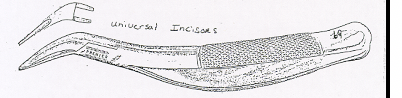
Upper Incisor forceps
Used for: Upper incisors (front teeth).
Description: Long, narrow, straight beaks designed to fit the single root of an upper incisor.
Purpose: Grasps upper front teeth for extraction while minimizing damage to the surrounding tissues
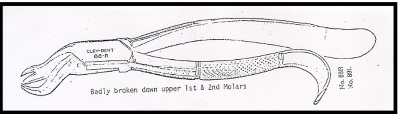
Cow Horn Forceps
Used for: Badly broken upper first and second molars (as labeled in the image).
Description: Beaks resemble the horns of a cow and are designed to engage the tooth/root area.
Purpose: Provides a strong grip on broken molars, allowing the dentist to elevate and remove the tooth or remaining roots.
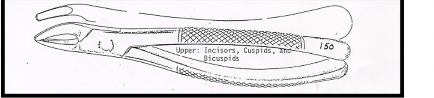
#150 Upper Universal Forceps
Used for: Upper incisors, cuspids (canines), and bicuspids (premolars).
Description: Universal upper forceps with smooth, symmetrical beaks.
Purpose: Used for routine extraction of most upper anterior teeth and premolars.
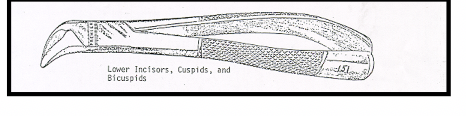
#151 Lower Universal forceps
Used for: Lower incisors, cuspids (canines), and bicuspids (premolars).
Description: Similar to the #150 but angled to fit the lower arch.
Purpose: Used for routine extraction of lower anterior teeth and premolars.