ME 216 Exam 1
 Call Kai
 Learn
Learn Practice Test
 Spaced Repetition
 Match
Match Flashcards
 Knowt Play
1/84

Earn XP
Description and Tags
University of Alabama ME 216 Shaon Talukdar
Name | Mastery | Learn | Test | Matching | Spaced | Call with Kai | Chat |
|---|
No analytics yet
Send a link to your students to track their progress
85 Terms
What are thermal-fluid sciences?
the physical sciences that deal with energy and the transfer, transport, and conversion of energy
System
whatever we want to study
Surroundings
everything external to the system
Boundary
distinguishes system from its surroundings
Therme
heat
Dynamis
power
Microscopic Approach
aims to characterize by statistical means the average behavior of the particles making up a system and use this info to describe the overall behavior of the system
Macroscopic Approach
describes system behavior in terms of the gross effects of the particles making up the system, specifically, effects that can be measured by instruments such as pressure gages and thermometers
Heat
form of energy that can be transferred from one system to another as a result of temp difference
Heat Transfer
deals with the determination of the rates of such energy transfers and variation of temp
Why are units important?
dimensional homogeneity
Closed System
always contains the same matter
Can anything transfer across the boundary of a closed system?
energy transfer is permitted, however mass cannot transfer
Open System
a given region of space through which mass flows
Can anything transfer across the boundary of an open system?
mass and energy can cross the boundary
State
the condition of a system as described by its properties
Process
a transformation from one state to another
Equilibrium
a state of balance
Thermal Equilibrium
if the temp is the same throughout the entire system
Mechanical Equilibrium
if there is no change in pressure at any point of the system with time
Phase Equilibrium
if a system involves two phases and when the mass of each phase reaches an equilibrium level and stays there
Chemical Equilibrium
if the chemical composition of a system does not change with time, that is, no chemical reactions occur
The State Postulate
the state of a simple compressible system is completely specified by two independent, intensive properties
Simple Compressible System
if a system involves no electrical, magnetic, gravitational, motion, and surface tension effects
Extensive Property
depends on the size or extent of a system
ex. mass, volume, energy
How do you find the value of an extensive property for an overall system?
sum of its values for the parts into which the system is divided
Intensive Property
independent of the size or extent of a system
ex. pressure, temperature
Are intensive properties additive like extensive properties?
no
Density
mass/volume
Specific Volume
1/density
intensive property
Absolute Pressure
pressure with respect to the zero pressure of a complete vacuum
MUST be used in thermo relations
What is a change in energy of a system composed of?
kinetic energy
potential energy
internal energy
Sensible Energy
the portion of the internal energy of a system associated with the kinetic energies of the molecules
Latent Energy
the internal energy associated with the phase of a system
Chemical Energy
the internal energy associated with the atomic bonds in a molecule
Nuclear Energy
the tremendous amount of energy associated with the strong bonds within the nucleus of the atom itself
What are the two forms of energy interactions associated with a closed system?
heat transfer
work
What’s the difference between heat transfer and work?
an energy interaction is heat transfer if its driving force is a temp difference; otherwise it’s work
What are energy transfers by heat induced by?
a temperature difference between the system and its surroundings
What direction does net energy transfer by heat occur in?
decreasing temperature
Adiabatic
if a system undergoes a process involving no heat transfer with its surroundings
Heat transfer into a system is…
positive
Conduction
the transfer of energy from the more energetic particles of a substance to the adjacent less energetic ones as a result of interaction between particles
Convection
the transfer of energy between a solid surface and the adjacent fluid that is in motion; combined effects of conduction and fluid motion
Radiation
the transfer of energy due to the emission of electromagnetic waves (photons)
Work
energy from a force acting through a distance
Work done by a system is…
positive
Heat and work are both ____ functions
path
Heat and work NOT states, they’re…
processes
Systems possess energy, but not…
heat or work
First Law of Thermodynamics
energy cannot be created or destroyed, it can only change forms
Efficiency Equation
desired output/required input
Heating Value of the Fuel
the amount of heat released when a unit amount of fuel at room temp is completely burned and the combustion products are colled to the room temp
Lower Heating Value (LHV)
when the water in the combustion gases is a vapor
Higher Heating Value (HHV)
when the water in the combustion gases is completely condensed and thus the heat of vaporization is also recovered
Generator
a device that converts mechanical energy to electrical energy
Phase
a quantity of matter that is homogeneous throughout in both chemical composition and physical structure
Pure Substance
a substance that has a fixed chemical composition throughout
What’s a mixture of several things but still considered a pure substance?
air
Compressed Liquid
a substance that is not about to vaporize
where temp is lower than the saturation temp corresponding to the pressure at the state
Saturated Liquid
a liquid that is about to vaporize
temp increases considerably while the specific volume increases slightly
Saturated Liquid-Vapor Mixture
the state at which the liquid and vapor phases coexist in equilibrium
Saturated Vapor
a vapor that is about to condense
Superheated Vapor
a vapor that isn’t about to condense (that isn’t a saturated vapor)
P-V-T Surface Single-Phase Regions
solid
liquid
vapor
P-V-T Two-Phase Regions
liquid-vapor
solid-vapor
solid-liquid
P-V-T Vapor Dome
dome-shaped region composed of the two-phase liquid-vapor states
Saturation State
a state at which a phase changes, begins, or ends
P-V-T Saturated Liquid and Saturated Vapor Lines
lines bordering the vapor dome
Saturation Temperature
the temperature at which change takes place at a given pressure
Phase Diagram
projections of the P-V-T surface onto the pressure-temp plane
Saturation Pressure
designates the pressure at which a phase change takes place at a given temp
When are pressure and temperature not independent? (P-V-T)
two-phase regions
P-V Diagram
projection of the P-V-T surface onto the pressure-specific volume plane
T-V Diagram
projection of the P-V-T surface onto the temperature-specific volume plane
Quality (x)
for a two-phase liquid-vapor mixture, the ratio of the mass of vapor present to the total mass of the mixture
ranges 0 to 1
What’s the quality of a saturated liquid?
x = 0
What’s the quality of a saturated vapor?
x = 1
Property Diagrams for Phase-Change Processes
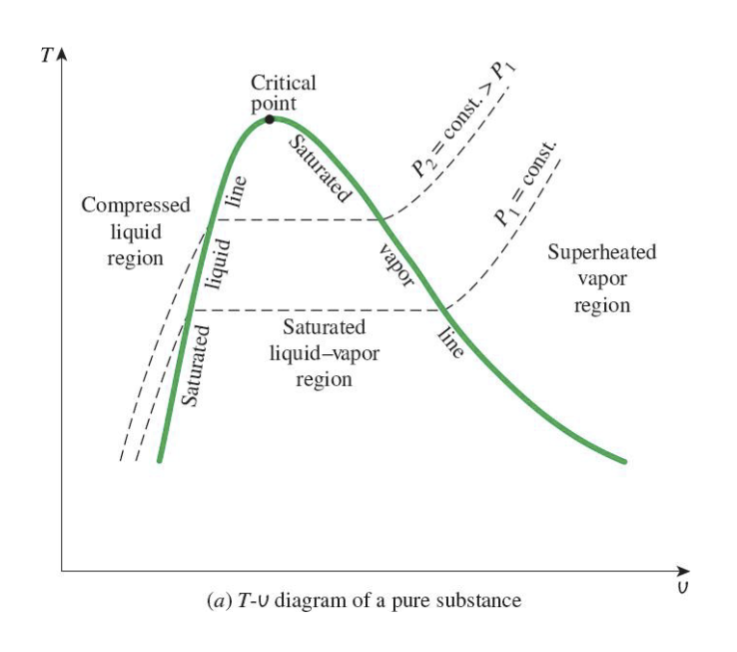
How can you find the specific volume of a two-phase liquid-vapor mixture?
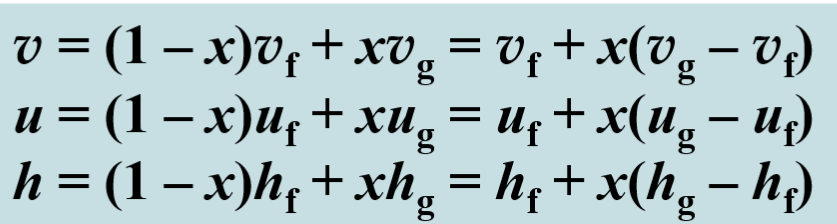
use the saturation tables and quality, x
Equations Used to Fix the State in a Two-Phase Liquid-Vapor Region
When is linear interpolation used?
when a state does not fall exactly on the grid of values provided by property tables
Closed System Energy Balance
the change in the amount of energy contained within a closed system during some time interval equals net amount of energy transferred in and out across the system boundary by heat and work during the time interval
Thermodynamic Cycle
a sequence of processes that begins and ends at the same state
ex. power cycles, refrigeration cycles, heat pump cycles
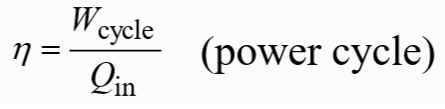
How is the performance of a system undergoing a power cycle evaluated?
thermal efficiency