Chem Part 2
 Call Kai
 Learn
Learn Practice Test
 Spaced Repetition
 Match
Match Flashcards
 Knowt Play
1/63

There's no tags or description
Looks like no tags are added yet.
Name | Mastery | Learn | Test | Matching | Spaced | Call with Kai | Chat |
|---|
No analytics yet
Send a link to your students to track their progress
64 Terms
Intermolecular Bonding
-Refers to bond between molecule and neighboring molecules
-Normally weaker than Intramolecular
Polarity
-Measure of unequal sharing of electrons as result of different electronegativities
Partial Changes in Polarity
-Uneven distribution results in atoms having partial changes
-More electronegativity = stronger pull to electrons
Polarity of diatomic molecules
-Symmetrical molecules are non-polar
-Asymmetrical molecules are polar
VESPR Shapes (memorise shapes)
-Tetrahedral
-Trigonal Pyramidal
-Bent
-Linear
-Trigonal Planar
Percipitation Reactions
-A reaction between two soluble ionic substances that forms a solid product
-The solid product is called a precipitate
Solubility
Is the maximum amount of solute that will be dissolved in a known quantity of a solvent at a given temperature
Molarity
- Measure for concentration in terms of number of moles in substance per litre
Non-polar Polyatomic molecules
-Covalent Bonds are non-polar if molecule is symmetrical
-Pull of electrons are equal in opposite directions the dipoles cancel each other out
-Even distribution of electrical charge
Polar Polyatomic molecules
-In asymmetrical molecules the individual dipoles of the covalent bonds do not cancel each other out making in not dipole
-Uneven distribution of electrical charge
Soulability
-Maximum amount of a solute that can be dissolved in a given quantity of a solvent at a certain temperature
Dissociation
-The process of separating positive and negative ions from a solid ionic compound to form hydrated ions when an ionic compound dissolves in water
Soluble table
In book
Kinetic Molecular Theory
-Gas particles are in constant, random motion
-Have very little attraction to one another
-Space between particles is large
Pressure
-Increases when there is an increase in number of collisions because the gas particles have more kinetic energy hence they move rapidly
Temperature
-As temp of a closed system increases, average energy of the system also increases
-Unit for temp is Kelvin (K) degrees + 273K = K
Volume
-The volume the gas occupies is always constant = Fixed volume
-Volume is not constant = Variable volume
Gas Laws in Book
-Gay-Lussac's Law
-Charles Law
-Boyle's Law
Aqueous solutions and molarity
A mixture of solute dissolved in water
Concentration
A measure of number of particles in a specified volume of soloution
Concentrated Soloution
A solution containing many particles per unit volume of soloution
Dilute Soloution
Soloution containing few particles per unit volume of soloution
Saturation
Unsaturated: A soloution that can dislove more soloute
Saturated: A soloution in which no more soloute can disolve
Supersaturated: soloution that has been heated to disolve more soloute, but on cooling after a disturbance crystals of the solvent are produced
What is behavior of gas affected by?
-Pressure
-Temp
-Volume
Standard Temp and Pressure
Standard Temp = 273K
Standard Pressure = 100kPa
Gas Law
P x V = n x R x T
p = pressure in kPa
V = volume in L
n = mdes
T = Temp in K
R = Universal constant 8.313k Mol
Precipitation Reactions
-Reaction between 2 soluble ionic substances that forms a solid product
Structure of an Atom
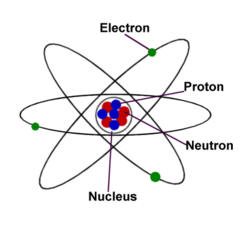
Charges of Particles
Neutron - Neutral
Electron - Negative
Proton - Positive
Periodic Table Groups
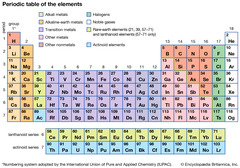
Electron Configuration
Practice
What is atomic mass number with decimal?
Total number of protons + average number or neutrons
Properties of Metal Elements
-Good conductors of heat and electricity
-Shiny
-Ductile
-Can be pounded to thin (malleable)
Properties of non-metal elements
-Poor conductors of heat and electricity
-Not ductile or malleable
-Brittle and break easy
-Dull
-Most are gases
Ionic Bonding
Practice
A positive and negative bond
A metal and non-metal bonding
Metal gives and electron to non-metal
Covalent
2 negatives bonding
A non-metal and non-metal bonding
Non-metals share electrons
Usually gases or liquids
Don't conduct electricty
Factors that affect reaction rate
-Concentration of moles - lower concertation- slower
-Pressure - Lower pressure - further away
-Surface area and catalysts - If surface area increases -more area to react
-Temperature - Colder is slower- Can't move as quick
Required of chemical reaction
-Particles need to collide
-Activation energy
-Connect oreintation
Balancing Reactions
Practice
Numerals for covalent
1-Mono, 2-Di, 3-Tri, 4-Tetra, 5-Penta, 6-Hextra, 7-Hepta, 8-Octa, 9-Nona, 10-Deca
Metallic Character
-Elements become less metallic as you move across the periodic table
Atomic Radius
-The distance from the nucleus of an atom to the outermost electron shell
-Becomes smaller as you go across and upwards as there are more positive electrons which means more shells creating a bigger shape
Ionisation Energy
-Energy required to remove an electron from gaseous atom
-Increases as you go up and across because more shells as you go down meaning more spread out and can take it easier
Electronegativity
-A measure of an atoms ability to attract electrons in a chemical bond
-Increases as you go up and across because more shells as you go down meaning more spread out and can take it easier
Ionic Radius
-Radius of an ion
-When it becomes positive or negative it looses size
Diatomic Molecules
Ex. H2, N2, O2, F2, Cl2, Br2, I2\
-All non-metallic gases (except noble) will form covalent bonds with themselves to be a diatomic
-Never single
Practice Electron Dot Diagram vs Lewis Structure
Naming Covalent Compounds
Step 1: Name first non-metal as an element
Step 2: Name 2nd non-metal as ide at the end
Step 3: Put the numeral in front of both numbers mono doesn't go in front of first
How to find electrons and neutrons
Neutrons = mn - an
Electrons + protons = an
exothermic reaction
releases energy (heat)
negative
lower product energy
endothermic reaction
absorbs energy
positive
higher product energy
Acid
Chemical compound that donates an hydrogen atom
Base
Chemical compound that accepts an hydrogen atom
Arrehenius Model
-Acids can produce high concentration of hydrogen ions in aq solution
-Acids increase concentration of hydrogen ions in water while bases increase hydroxide ions
Concentration of acids + bases
Diluted soloution will contain less soloute than same volume of concentrated solution
pH scale
6.9 and below = acid
7 = neutral
7.1 and above = basic
Hydrogen ions in pH
Low pH values have high concentration of hydrogen ions
Chromatography
Technique that can be used for qualitive or quanative analysis, as it identifies both components in mixture and how much
The two phases of Chromotography
Mobile: Solvent moves through stationary phase
Stationary: A substance that stays still
RF Value
Distance travelled by substance / distance travelled by solvent
Intermolecular Forces
-Attraction between molecules not bonds
-Three types - Dispersion, Dipole-Dipole and Hydrogen Bonding
Dispersion Forces
-Occur between covalent polar and non-polar
-Contain valance electrons that constantly move therefore are weak as only create dipole-dipole bond for short time period
Dipole-dipole Forces
-Attractions between oppositely charged regions of polar molecules
Hydrogen Bonding
-specific dipole-dipole bond where a positive hydrogen atom bonded to a F, O or N
-Strongest out of all bonds