TCP Week 3 (Special Populations in Pediatrics)
 Call Kai
 Learn
Learn Practice Test
 Spaced Repetition
 Match
Match Flashcards
 Knowt Play
1/100

There's no tags or description
Looks like no tags are added yet.
Name | Mastery | Learn | Test | Matching | Spaced | Call with Kai | Chat |
|---|
No analytics yet
Send a link to your students to track their progress
101 Terms
pathway of fetal heart circulation
Placenta exchanges CO2 and urea from baby via 2 umbilical arteries in exchange for O2, glucose, and other nutrients
VERY well oxygenated blood from placenta → 1 large umbilical vein → splits
• >50% enters IVC through the ductus venosus (bypasses liver)
•
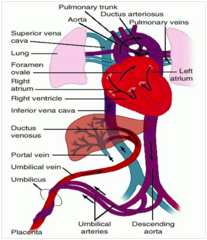
after birth and the first breath, what happens to the CV system (3 changes)?
Expansion, Opening, Closing:
Expansion of Lungs: Lungs now function due to decrease in pulm vasculature resistance
Open: Systemic vasculature resistance increases closing off placental circulation
Closure: foramen ovale (in 1-3 mon) and ductus arteriosus in days!!
central cyanosis after birth
(bluish lips and eyelids) is NORMAL
if cyanosis after birth extends beyond mucous membranes besides lips and eyelids, this is
ABNORMAL and PATHOLOGIC
Monitor for:
- Respiratory: tachypnea, flaring, retractions, wheezing
- Vascular: pallor, lethargy, poor pulses/capillary refill
- Failure to thrive in longer term
- Vital signs: BP and HR
Think heart failure and shock!
what are the normal heart murmurs?
- stills
- pulmonary flow/ejection murmur
still murmur (age group, sound, where it is best heard, and cause)
Age group: 2-7 y/o, school age, seen in adults
Listen for: "washing machine", "musical twang", early to mid systolic, short, Grade 1-2 intensity
Best Heard: LLSB, supine, fever/exercise/stress
Cause: Debatable and largely unknown: aortic murmur, issues MV cord
pulmonary flow/ejection murmur (age group, sound, where it is best heard, and cause)
Age group: 8-14 y/o, school age and adolescents, 0.6-0.8 per 1000
Listen for: "blowing" "harsh", mid systolic
Best Heard: LUSB II ICS, supine, fever/exercise/stress
Cause: Rapid blood flow across the normal functioning pulmonary valve, normal
picture of the normal vitals by age
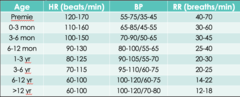
BP:
Premie
0-3m
3-6m
6-12m
1-3y
3-6y
6-12y
>12y
Premie: 55-75/35-45
0-3m: 65-85/45-55
3-6m: 70-90/50-65
6-12m: 80-100/55-65
1-3y: 90-105/55-70
3-6y: 95-110/60-75
6-12y: 100-120/60-75
>12y: 100-120/70-80
HR:
Premie
0-3m
3-6m
6-12m
1-3y
3-6y
6-12y
>12y
Premie: 120-170
0-3m: 110-160
3-6m: 100-150
6-12m: 90-130
1-3y: 80-125
3-6y: 70-115
6y+: 60-100
RR:
Premie
0-3m
3-6m
6-12m
1-3y
3-6y
6-12y
>12y
Premie: 40-70
0-3m: 30-60
3-6m: 30-45
6-12m: 25-40
1-3y: 20-30
3-6y: 20-25
6-12y: 14-22
>12y: 12-18
overview of congenital heart disease
up to 90% of peds cardiology is CHD
1% of births in US, lead cause of death in 1st yr of life (excluding prematurity)
In first 6 months, VSD + PDA MC cause of HF, which manifests w/ FTT
causes of congenital heart disease (prenatal)
- maternal rubella
- DM insulin dependence
- alcoholism
- advanced maternal age
causes of congenital heart disease (environmental)
- high altitude
- h/o radiation
causes of congenital heart disease (drugs)
- lithium
- phenytoin
- warfarin
causes of congenital heart disease (genetic)
- Trisomy 13 + 18 + 21
- Turner
what are the two general categories of congenital heart disease?
Acyanotic: (L→R shunt), increase pulm blood flow
Cyanotic: (R→L shunt), decrease pulm blood flow
VSD (incidence)
Second most common heart defect (behind bicuspid aortic valve), most common CHD for children; more male infants
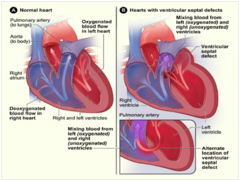
VSD (pathophysiology)
size + pulm vasc resistance pressure = shunt direction
small defect: L → R shunt (L side less pressure)
large and complicated: R→ L shunt (Eisenmenger sdr)
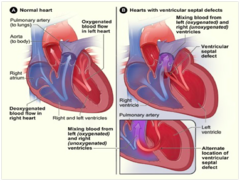
VSD (symptoms)
Size dependent:
- FFT
- SOB
- clubbing
VSD (sound and location)
sound: loud holosystolic murmur
location: 3rd-4th ICS along LSD
VSD (eval and Tx)
Eval: ECHO
Tx:
small: majority spontaneously close during first 2 years of life (acyonotic, small)
large: surgical repair and HF medication (cyanotic, large)
ASD (incidence)
3nd most common, 10-15% of CHD; 2:1 female to male
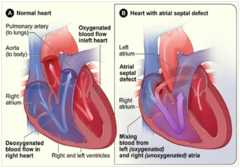
ASD (pathophys)
L → R shunt, failure of septal tissue forming
Larger than PFO, often a large cause for thrombus to cross over
ASD (symptoms)
generally asx (esp bc typically acyonotic), but size dependent
ASD (sound and location)
Sound: systolic ejection crescendo-decrescendo, widely split S2
Location: LUSB/pulmonic area
ASD (eval and Tx)
Eval:
- Echo (mainstay)
- CXR w/ cardiomegaly
- ECG w/ incomplete RBB and RVH
Tx:
- spontaneous closure 90% (esp if
list the acyanotic (L->R) murmurs
- VSD (if small)
- ASD
- PDA
patent ductus arteriosus (PDA) (incidence)
More common in prematurity, 3-8 per 10,000 live births, more female and AA, maternal rubella, genetic conditions
*normal anatomical ft for a fetus, should go away though
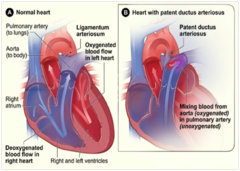
patent ductus arteriosus (PDA) (pathophys)
L → R shunt between aorta and PA
patent ductus arteriosus (PDA) (symptoms)
generally asymptomatic, but again size dependent, can cause FTT and endocarditis
patent ductus arteriosus (PDA) (sound and location)
sound: machinery-like murmur
location: 2nd IC space/LUSB
bounding peripheral pulses and wide pulse pressure
patent ductus arteriosus (PDA) (eval and tx)
Eval:
- Echo
- ECG w/ LVH
- CXR w/ cardiomegaly
Tx:
indomethacin: for closure
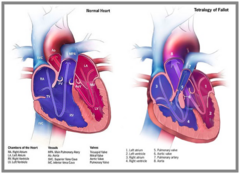
Tetralogy of Fallot (incidence)
Most common cyanotic CHD; without repair: mortality 50% in 3 years, 90% in 20 years
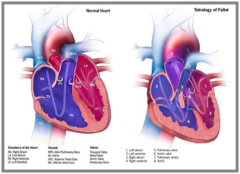
Tetralogy of Fallot (pathophys)
R → L shunt
• VSD
• right ventricle outflow obstruction/pulmonary stenosis
• aortic override that straddles the VSD
• right ventricular hypertrophy
blood "mixing"
Tetralogy of Fallot (symptoms)
- cyanotic
- DOE
- hyercyanotic spells called "tet spells"
- squatting helps increase systemic resistance → decreasing venous return to the heart → more O2 blood available to the body
Tetralogy of Fallot (sound and location)
- harsh holosystolic murmur at LSB
- loud single S2
Tetralogy of Fallot (eval and Tx)
Eval:
- Echo (mainstay)
- ECG w/ RVH
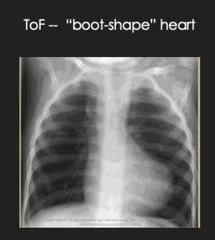
- CXR w/ boot-shape heart
Tx:
PGE1 (prostaglandins): to keep PDA since pulmonary stenosis is severe
surgery
transportation of great arteries (ToGA) (incidence)
Much more common in boys 4:1
transportation of great arteries (ToGA) (pathophys)
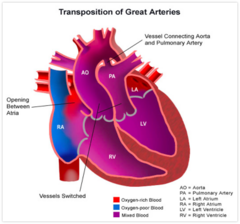
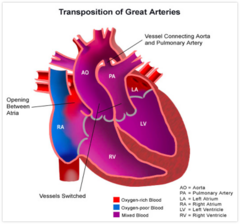
R → L shunt & cyanotic, early and progressive, parallel circuits of unoxygenated blood
- Aorta arises from the RV
- PA arises from LV
- Better prognosis with an ASD or VSD to allow blood mixing.
transportation of great arteries (ToGA) (symptoms)
progressive cyanosis
transportation of great arteries (ToGA) (sound and location)
- NO MURMUR unless comorbid VSD
- loud single S2 due to aortic valve closer to chest wall than the pulmonic
transportation of great arteries (ToGA) (eval and Tx)
Eval:
Echo
CXR triad:
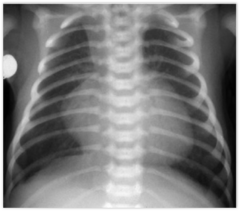
- "egg on string" (in image)
- increase pulm vasc congestion
- cardiomegaly
Tx:
PGE1(prostaglandins): to allow PDA, which allows for mixture of systemic and pulmonary blood
Surgery
TORCH
Toxoplasmosis
Other (syphilis, varicella-zoster, parvovirus B19)
Rubella
Cytomegalovirus (CMV)
Herpes infections
All can cause congenital infections and produce thromobocytopenia, thrombotic thrombocytopenia purpura (TTP) or blueberry muffin rash
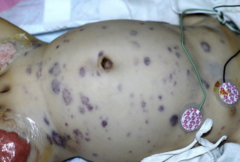
congenital toxoplasmosis (incidence)
transmitted by:
- cat litter
- pork
- lamb
worse if mom is infected later in preg
congenital toxoplasmosis (pathophys)
- toxoplasma gondii (protozoan)
- opportunistic
congenital toxoplasmosis (s/sx and PE)
- TTP
- heptosplenomegaly
- hearing loss
- cognitive deficits
- chorioentinitis and encephalitis
- fever
- seizure
congenital toxoplasmosis (eval)
Labs:
- PCR from amnio
- IgG and IgM
Imaging:
adult: head CT with ring enhancing lesions
kids: intracranial calcifications for kids on US
congenital toxoplasmosis (Tx)
sulfadiazine + pyrimethamine + leucovorin (all x 1yr): to prevent bone marrow suppression and reduce nephro tox
sometimes w/ prednisone
congenital rubella (incidence)
first 3 months of pregnancy, almost eradicated in US
congenital rubella (pathophys)
togavirus, from respiratory droplet, teratogenic
congenital rubella (S/S and PE)
- TTP
- sensorineural deafness
- cognitive deficits
- cataracts
- heart defects (PDA, pulmonary stenosis, coarc of aorta)
congenital rubella (eval)
- + IgM and + IgG
- PCR or viral culture
- CBC may show low platelets
congenital rubella (Tx)
- No official cure
- ? Immune globulin therapy
- if severe an indication for abortion
congenital CMV (HHV5) (incidence)
present in most people (70%) but problematic if congenital, most common congenital infectious cause of hearing loss and cognitive deficits
congenital CMV (HHV5) (pathophys)
HHV 5, opportunistic
congenital CMV (HHV5) (S/S and PE)
- TTP
- hepatosplenomegaly
- mental and motor delays
- retinitis causing hemorrhages w/ soft exudates (pizza pie fundoscopic exam, scrambled eggs/ketchup)
- pneumonia
- hepatitis
congenital CMV (HHV5) (eval)
Labs:
CBC and serologies, liver function studies, creatinine, PCR
Diagnostics:
- CXR
- Tissue biopsy showing Owl's eye (epithelial cells w/ enlarged nuclei)
- CT head for newborns for calcifications, microcephaly, or enlarged ventricles
- Fetal blood sampling and US monitoring
congenital CMV (HHV5) (Tx)
Ganciclovir IV
OR
Valganciclovir PO
specialist referral
congenital HSV (incidence)
30-50% of newborn of mothers with primary genital herpes develop HSV disease, 3/10,000 babies
congenital HSV (pathophys)
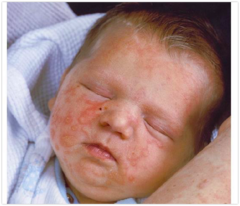
Herpes simplex 1 and 2, maternal genital or oral
congenital HSV (S/S and PE)
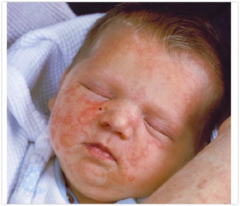
- Clustered vesicles present only in 35% infected newborns
- encephalitis
- can disseminate and look like sepsis
- seizures
- sx not seen til end of 1st or 2nd week of life
congenital HSV (eval)
- PCR and serologies
- Tzank smear
congenital HSV (Tx)
- encephalitis: acyclovir IV
- valacyclovir
- famciclovir
length of tx depends on severity
congenital syphilis (incidence)
fluctuating since the early 2000s, but now on the rise again
congenital syphilis (pathophys)
Treponema pallidum (spirochete)
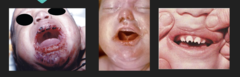
congenital syphilis (S/S and PE)
- Stillbirth and death
- Maculopapular palmar/plantar rash
Early from 0-2 y/o:
- hepatosplenomegaly
- bone abnormalities
- "snuffles" (rhinitis)
- severe anemia
Late findings:
- saddle nose
- high palate arch
- Hutchinson teeth
Typical TORCH syndrome of deafness, rash, HSM, meningitis and neuro issues, fever
congenital syphilis (eval)
Labs:
- darkfield microscopy
- VDRL/RPR
- CSF
Imaging:
long bone XR: osteochondritis
congenital syphilis (Tx)
- Penicillin G IV or IM x 10 days
- One dose if baby < 1 month
congenital HIV (incidence)
Steadily decreasing, now
congenital HIV (pathophys)
HIV 1 & 2, also by breastfeeding or poor maternal control
congenital HIV (S/S and PE)
- Asymptomatic at birth
- Eventual typical symptoms like FTT, recurrent infections
congenital HIV (eval)
- nucleic assay PCR and viral load
- antibody test not as reliable due to maternal antibodies in blood for >18mon to 2 y/o
congenital HIV (Tx)
- ART for 4-6 weeks after delivery, w/ testing frequently during the 1st year at least 1mon and 4mon
- new guidelines published, PCP prophylaxis
juvenile rheumatoid arthritis (JRA) (incidence)
Most common arthritis in children, 1/1000 children, 2:1 female to male
juvenile rheumatoid arthritis (JRA) (pathophys)
autoimmune, HLA type DR8, DR4, and DP3
what are the three types of juvenile rheumatoid arthritis (JRA)? what defines each?
Pauciarticular (oligo-):
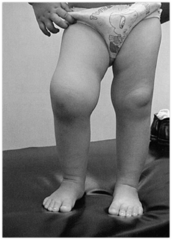
juvenile rheumatoid arthritis (JRA) (S/S and PE)
if pain >6 weeks
- swelling
- intermittent fever w/ truncal and proximal rash
- morning stiffness
- fatigue
- limp
- uveitis in 10% especially w/ + ANA
- nodules jts or organs
juvenile rheumatoid arthritis (JRA) (eval)
(+) RF in polyarticular
(+) ANA oligo
- CBC mild anemia
- elevated ESR and CRP
- Lyme titer
- X-ray and US of joints considering age
- eye exams
juvenile rheumatoid arthritis (JRA) (PHARM Tx)
1st Line:
- NSAIDs
OR
- corticosteroids short term, steroid injections
2nd Line:
DMARDs:
- Methotrexate
- sulfasalazine
- hydroxychloroquine
Biologic disease modifying anti-rheumatic agents (bDMARD):
- TNF-alpha like adalimumab (Humira) and Etanercept (Enbrel)
- IL-I antagonists like anakinra
juvenile rheumatoid arthritis (JRA) (NON PHARM Tx)
- PT and OT
- Swimming, cycling, weight-based training
corticosteroid side effects
C = cataracts
U = ulcers
S = striae
H = HTN
I = infectious
N = necrosis of bone (avascular)
G = growth retardation
O = osteoporosis
I = increased ICP (pseudotumor cerebri)
D = DM
M = myopathy
A = adipose tissue hypertrophy (buffalo hump)
P = pancreatitis
congenital hydrocephalus (incidence)
1-3/1000 children, more males
congenital hydrocephalus (pathophysiology)
blockages of ventricular system:
- aqueductal stenosis tumor
- cyst
imbalance of CSF production
reduced reabsorption:
- meningitis, hemorrhages, blocking arachnoid villi
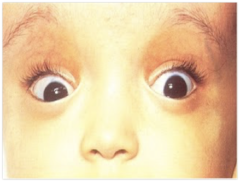
congenital hydrocephalus (S/S and PE)
- sunsetting eyes
- enlarged head
- lethargy/crying/vomiting
- thin scalp skin and prominent veins
- poor head/neck control
congenital hydrocephalus (eval and tx)
Eval:
- US and CT
- Regular head circumference measurements
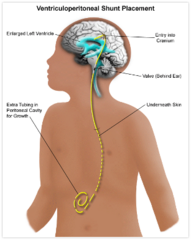
Tx: Shunt
cerebral palsy (CP) (epi)
Incidence: 3/1000 children, about 500,000 children in US
cerebral palsy (patho)
Nonprogressive motor disorder from damage to the brain, symptoms correspond to where drain damage occurs
•Prenatal toxins, radiation, DM, nutritional deficiencies
•Prematurity
•Perinatal anoxia, trauma, infections
cerebral palsy (symptoms and PE)
delayed motor
language and social skills
vision/hearing impairments
seizures
intellectual disabilities
spastic or hypotonic symptoms
FTT
cerebral palsy (eval)
Brain MRI, abnornal in up 80%
cerebral palsy (tx)
Baclofen pump
botulism toxin
PT/OT/speech
antiparkinsonian agents medications
selective dorsal rhizotomy
GI and ortho surgeries
CP: POSTER
P = posturing/ abnormal extensor thrusting
O = oropharynx problems, swallow issues, grimace, tongue thrusts
S = strabismus
T = tone hyper- or hypo-
E = evolutional - persistence of primitive reflexes
R = reflexes - increased DTRs
4 out 6 = Diagnose CP
Trisomy 18 (Edwards Syndrome) (patho)
3 copies of Chromosome 18 due to nondisjunction
Trisomy 18 (Edwards Syndrome) (sx and PE)
most die before birth or during 1st year of life, small, abnormally shaped head
a small jaw and mouth
clenched fists with overlapping fingers
Trisomy 18 (Edwards Syndrome) (heart defects)
VSD, PDA, PFO
Trisomy 18 (Edwards Syndrome) (eval)
Genetic testing
Trisomy 18 (Edwards Syndrome) (tx)
palliative care, surgery
Trisomy 13 (patau syndrome) (pathophys)
3 copies of Chromosome 13 due to nondisjunction
Trisomy 13 (patau syndrome) (S/S and PE)
- most die before birth or during 1st year of life
- poor brain and spinal cord development
- microphthalmia
- cleft lip and palate
- hypotonia
- intellectual disability
- microcephaly
- polydactyly
Trisomy 13 (patau syndrome) (heart defects)
- VSD
- ASD
- PDA